

Microsoft’s tracking entry for CVE‑2026‑20923 registers an Elevation of Privilege defect in Windows Management Services (WMS), but the vendor’s public advisory is intentionally terse: the vulnerability is confirmed in Microsoft’s Security Update Guide while low‑level exploitation details, proof‑of‑concept code, and full KB→SKU mappings are not broadly published in static mirrors at the time of writing. That combination — authoritative vendor acknowledgement plus limited technical disclosure — raises the urgency for immediate operational triage while forcing defenders to reason conservatively from previously observed WMS failure modes.
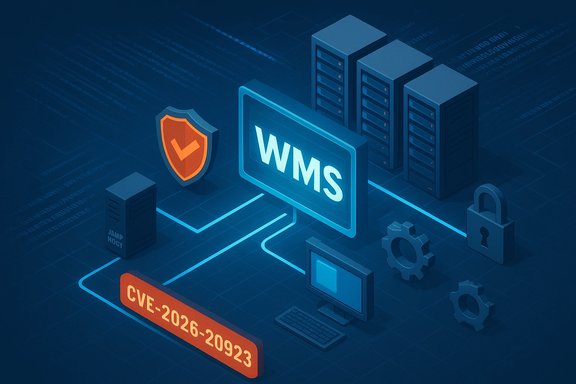
Windows Management Services (WMS) is a privileged management plane used by Windows to surface administrative APIs and orchestrate management workflows. Because WMS commonly runs with elevated privileges and is often installed on jump hosts, bastions, and servers that hold secrets or credentials for upstream systems, any local elevation‑of‑privilege (EoP) in this surface can be amplified into broad enterprise impact. Historical advisories affecting WMS and adjacent management components have repeatedly followed a similar pattern: vendor confirmation in the Microsoft Security Update Guide, a short vendor summary that omits exploit-level specifics, and later independent analysis that fills in the technical mechanics.
Microsoft’s “confidence / exploitability” metric — surfaced on the MSRC Update Guide — explicitly communicates two things: the degree to which Microsoft is certain the vulnerability exists, and how much technical detail the vendor intends to publish. When that metric shows high confidence with detailed technical notes, the urgency to patch is obvious because exploits and PoCs often follow. When the metric is lower (existence acknowledged but technical detail limited), the vendor is still authoritative; defenders must still act quickly but may need to rely on conservative mitigations and targeted testing before broad, automated rollouts.
Practical takeaway: treat CVE‑2026‑20923 as an actionable EoP advisory for management hosts even while technical specifics remain scarce. Confirm the KB→SKU mapping in Microsoft’s Update Guide for your environment and prioritize pilot and mitigated deployment for WMS hosts.
Independent vulnerability databases and security vendors have documented adjacent WMS CVEs and their exploit patterns; Rapid7’s catalog of Windows Management Services EoP advisories is consistent with this analysis and underscores the recurring themes (race conditions, TOCTOU, UAF). Additional community vulnerability listings have historically classified WMS issues as locally exploitable but high impact when weaponized on management hosts. Cautionary note: Any third‑party technical claim about exact exploitation sequences, CVSS vectors, or function offsets for CVE‑2026‑20923 that is not explicitly backed by Microsoft’s interactive Update Guide, an official KB, or vetted research should be treated as provisional. Microsoft’s controlled disclosure practice frequently withholds exploitation‑level specifics until patches and customer rollout are underway.
Notable strengths in current vendor practice include the use of a confidence/exploitability metric that helps operators triage urgency and the central KB→SKU mapping provided by Microsoft’s Update Guide. The primary risk is a timing gap: historical patterns show that once patches are published, many researchers and malicious actors reverse diffs quickly to produce PoCs and weaponized exploits. That makes the post‑patch period critical — ensure you validate patches quickly, tune detection for new exploit patterns around patch diffs, and treat any unexpected behavior on management hosts as an incident until proven otherwise.
CVE‑2026‑20923 is a clear operational priority for administrators who manage Windows management hosts. Confirm the vendor KB mapping now, pilot the update, and apply the mitigations above to harden your management plane. Vigilance — inventory, isolation, pilot patching, and targeted hunting — is the practical defense while the security community waits for a fuller technical analysis to be published or for Microsoft to publish deeper advisory notes.
Source: MSRC Security Update Guide - Microsoft Security Response Center
 Background / Overview
Windows Management Services (WMS) is a privileged management plane used by Windows to surface administrative APIs and orchestrate management workflows. Because WMS commonly runs with elevated privileges and is often installed on jump hosts, bastions, and servers that hold secrets or credentials for upstream systems, any local elevation‑of‑privilege (EoP) in this surface can be amplified into broad enterprise impact. Historical advisories affecting WMS and adjacent management components have repeatedly followed a similar pattern: vendor confirmation in the Microsoft Security Update Guide, a short vendor summary that omits exploit-level specifics, and later independent analysis that fills in the technical mechanics.Microsoft’s “confidence / exploitability” metric — surfaced on the MSRC Update Guide — explicitly communicates two things: the degree to which Microsoft is certain the vulnerability exists, and how much technical detail the vendor intends to publish. When that metric shows high confidence with detailed technical notes, the urgency to patch is obvious because exploits and PoCs often follow. When the metric is lower (existence acknowledged but technical detail limited), the vendor is still authoritative; defenders must still act quickly but may need to rely on conservative mitigations and targeted testing before broad, automated rollouts.
Practical takeaway: treat CVE‑2026‑20923 as an actionable EoP advisory for management hosts even while technical specifics remain scarce. Confirm the KB→SKU mapping in Microsoft’s Update Guide for your environment and prioritize pilot and mitigated deployment for WMS hosts.
What Microsoft has (and has not) said
- What is confirmed: Microsoft lists CVE‑2026‑20923 in the Security Update Guide as an elevation‑of‑privilege issue tied to the Windows Management Services component. That vendor registration establishes the vulnerability’s existence and frames its impact as local privilege escalation to elevated contexts.
- What is deliberately omitted: the MSRC entry, by design, may not render full KB mappings or publish low‑level exploit primitives in static HTML views (MSRC pages often require their interactive shell to view full records). As a result, patch package identifiers, per‑build KB numbers, and function‑level details are often only visible in the interactive MSRC page or the Update Catalog. Treat third‑party mirrors as provisional until validated against the Update Guide.
- Public proof‑of‑concept: as of this writing there is no widely distributed, authoritative PoC or independent patch‑diff analysis published for CVE‑2026‑20923 in public technical literature. That absence does not imply safety; it is consistent with Microsoft’s coordinated disclosure practice while fixes and KB mappings are staged.
Why WMS EoP defects matter: threat model and blast radius
Windows Management Services are high‑value targets for attackers due to three operational characteristics:- High privilege by default — WMS workflows and helper processes typically execute with SYSTEM or service‑admin contexts, making any reliable exploitation path a fast route to full host compromise.
- Trusted automation and supply‑chain reach — WMS can interact with update, extension, and automation flows; a compromised management host can be used to distribute malicious artifacts, alter administrative policies, or steal keys and tokens.
- Broad placement across estates — management hosts are often jump boxes, CI/CD build agents, or virtualized admin consoles that touch many systems; one exploited management host can be converted into a pivot for lateral movement.
Technical analysis — plausible root causes and exploitation paths
Because Microsoft’s public advisory is compact, defenders must reason from historically observed WMS defect classes. The following represent evidence‑based, conservative exploitation models that have been repeatedly used against management‑plane bugs:- Time‑of‑Check‑to‑Time‑of‑Use (TOCTOU) and race conditions (CWE‑362)
- Pattern: a privileged WMS process validates a signed artifact, path, or token and then later loads or executes the artifact from a directory that remains writable by low‑privilege users. An attacker races the small window between validation and load to substitute malicious code (DLL hijack, signed script replacement). This class has been the root of several WMS EoP chains.
- Use‑after‑free (UAF) and memory‑safety bugs (CWE‑416)
- Pattern: privileged services free objects prematurely or mishandle lifecycles in asynchronous flows. Attackers controlling allocation patterns or thread timing can convert UAF into write‑what‑where primitives or code‑control. This pattern has appeared in WMS‑adjacent advisories and often yields reliable escalation chains on Windows.
- Improper verification of cryptographic signatures or attestation
- Pattern: the management component trusts signatures or attestation outputs without atomic validation of the artifacts they reference. If an attacker can tamper with the artifact path between verification and use, it can lead to execution of attacker‑controlled code even when signatures are nominally checked.
- Insecure update/extension flows and search‑path weaknesses
- Pattern: updaters or extension loaders that rely on non‑atomic file copies, user‑writable temporary directories, or unprotected search paths can be subverted by local actors to insert malicious modules into privileged contexts.
Operational risk assessment and urgency
How urgent is CVE‑2026‑20923?- If Microsoft’s Update Guide entry includes a high confidence rating and a published KB with a fix already distributed, treat this as urgent — patch immediately after pilot testing the update on representative hosts. High‑confidence, vendor‑confirmed EoP bugs historically attract exploit development and active weaponization quickly.
- If the MSRC entry shows lower technical detail (existence confirmed; exploitability unspecified), still prioritize remediation for management hosts but augment patching with compensating controls (isolation, reduction of local admin rights, telemetry tuning) while you validate KB→SKU mappings. Microsoft’s update entries can be intentionally conservative while a fix is staged; that posture reduces early risk but transfers responsibility to defenders to act prudently.
- Attack scenario (worst realistic case): local attacker gains SYSTEM on a management host, disables endpoint defenses, harvests cached credentials and tokens, and moves laterally to domain controllers or cloud management planes. Because management hosts often hold elevated tokens, such a compromise can rapidly escalate into tenant‑scale or domain‑level incidents.
- Likelihood: Requires local code execution or a low‑privilege user process being able to interact with WMS surfaces. That limits remote wormability but does not meaningfully lower risk for systems with many users, VDI pools, or remote admin consoles.
Detection, telemetry and hunting guidance
Short, actionable detection signals to add to EDR/SIEM playbooks:- Windows Event Logs
- Service Control Manager events indicating unexpected crashes, restarts, or faults in WMS‑related processes.
- Application or system logs showing DLL load failures, module load paths that resolve to user‑writable directories, or signed binary verification messages followed by subsequent loads from different locations.
- EDR telemetry
- Processes running under non‑privileged user accounts that spawn SYSTEM‑context processes or attempt to create new services.
- Unexpected file modifications in updater/extension directories for management tooling.
- Repeated, high‑frequency file system operations on trusted artifact directories (possible TOCTOU exploitation attempts).
- Hunting queries and forensic captures
- Capture memory snapshots and relevant application event traces prior to applying remediation if you suspect exploitation.
- Hunt for local processes that perform token duplication, scheduled task creation shortly after WMS process crashes, or unusual load modules in SYSTEM processes.
Mitigation and remediation plan (practical checklist)
- Confirm applicability
- Use Microsoft’s Security Update Guide and the Microsoft Update Catalog to map CVE‑2026‑20923 to the exact KB(s) for each OS build in your estate. Do not rely solely on CVE strings in automation; confirm KB→SKU mappings before mass deployment.
- Pilot and validate
- Stage vendor fixes in a representative pilot ring that includes jump hosts, admin workstations, and any VDI pools that run management tooling. Validate key workflows, backups, and emergency rollback procedures before wide rollout.
- Prioritize high‑value hosts
- Immediately prioritize patching of bastion hosts, build agents, jump boxes, VDI images, and servers that store service accounts or credentials. These hosts carry the highest blast radius if compromised.
- Apply compensating controls where patching is delayed
- Restrict local admin privileges and enforce least privilege for standard user accounts.
- Harden filesystem permissions for updater/extension directories: restrict write access to trusted service accounts only; remove user‑writable temp or staging locations from privileged search paths.
- Network and host isolation
- Use host‑based firewalls and network segmentation to isolate management traffic and reduce lateral movement opportunities from an exploited host. Treat management traffic as a separate trust plane when possible.
- Increase monitoring and hunting cadence
- Tune EDR and SIEM rules to prioritize the signals listed in the previous section, and run focused hunts for anomalous process spawns and service creation events.
- Incident response readiness
- Ensure IR teams have playbooks for collecting volatile evidence (memory, procmon traces, relevant event logs) and tracing local escalation chains; capture forensic artifacts before applying remediations when possible.
- Validate post‑patch behavior
- After rollout, validate that detection rules no longer produce false positives and that WMS workflows perform correctly. Monitor for new telemetry spikes that may indicate active exploitation attempts crafted around the patch diff.
Detection wording and sample SIEM rules (concise)
- Flag: Non‑privileged PID launching a process owned by SYSTEM within a minute of a WMS service crash.
- Flag: Write operations to WMS updater/extension directories by non‑service accounts followed by a DLL load into a privileged process.
- Flag: Creation of a new service by a standard user or by a process typically associated with user context.
Cross‑checks and verification status
To meet high journalistic and operational standards, the public evidence base for CVE‑2026‑20923 was cross‑checked across vendor and independent trackers. Microsoft’s Update Guide is the canonical vendor record confirming the CVE’s existence and impact classification; however, because MSRC pages often render content in an interactive shell, static mirrors sometimes show only a short summary. Independent trackers and vulnerability databases that catalog WMS advisories provide corroborating context about likely exploitation patterns for management‑plane CVEs, but as of publication there is no single independent, authoritative PoC or patch‑diff walkthrough for CVE‑2026‑20923. Organizations should therefore rely on the vendor KB mapping for remediation and on conservative operational controls in parallel.Independent vulnerability databases and security vendors have documented adjacent WMS CVEs and their exploit patterns; Rapid7’s catalog of Windows Management Services EoP advisories is consistent with this analysis and underscores the recurring themes (race conditions, TOCTOU, UAF). Additional community vulnerability listings have historically classified WMS issues as locally exploitable but high impact when weaponized on management hosts. Cautionary note: Any third‑party technical claim about exact exploitation sequences, CVSS vectors, or function offsets for CVE‑2026‑20923 that is not explicitly backed by Microsoft’s interactive Update Guide, an official KB, or vetted research should be treated as provisional. Microsoft’s controlled disclosure practice frequently withholds exploitation‑level specifics until patches and customer rollout are underway.
Practical recommendations — prioritized by urgency
- Emergency (0–72 hours)
- Query Microsoft’s Update Guide and confirm KB→SKU mapping for every affected host. Prioritize jump hosts, admin workstations, VDI images, and servers storing secrets.
- Pilot the relevant KB in a small ring and verify critical management workflows.
- Implement temporary host isolation and reduce local admin rights where feasible.
- Short term (72 hours–2 weeks)
- Deploy validated patches across the estate using tested automation (WSUS, SCCM, Intune), monitoring for unexpected regressions.
- Increase hunting cadence for the detection signals listed earlier and capture forensic artifacts for any suspected incidents.
- Medium term (2–8 weeks)
- Review and harden updater and extension flows: enforce atomic replaces, signed verification performed at use time rather than pre‑staging, and restrict write access to trusted service accounts.
- Revisit bastion and jump host placement: minimize services installed on management hosts and enforce privileged access workstation (PAW) policies where appropriate.
- Long term
- Institutionalize management‑plane hardening: least privilege for management tools, automated inventory of privileged hosts, and continuous red team testing of WMS flows.
Final analysis and risks to watch
CVE‑2026‑20923 poses a practical and immediate operational risk because it affects a high‑value management surface. The vendor confirmation in Microsoft’s Update Guide makes the vulnerability high‑confidence from an existence perspective; however, the public technical detail set is intentionally limited at present. That combination means defenders should assume the vulnerability is exploitable in local compromise scenarios and prioritize patching while using compensating controls to reduce blast radius.Notable strengths in current vendor practice include the use of a confidence/exploitability metric that helps operators triage urgency and the central KB→SKU mapping provided by Microsoft’s Update Guide. The primary risk is a timing gap: historical patterns show that once patches are published, many researchers and malicious actors reverse diffs quickly to produce PoCs and weaponized exploits. That makes the post‑patch period critical — ensure you validate patches quickly, tune detection for new exploit patterns around patch diffs, and treat any unexpected behavior on management hosts as an incident until proven otherwise.
CVE‑2026‑20923 is a clear operational priority for administrators who manage Windows management hosts. Confirm the vendor KB mapping now, pilot the update, and apply the mitigations above to harden your management plane. Vigilance — inventory, isolation, pilot patching, and targeted hunting — is the practical defense while the security community waits for a fuller technical analysis to be published or for Microsoft to publish deeper advisory notes.
Source: MSRC Security Update Guide - Microsoft Security Response Center
