

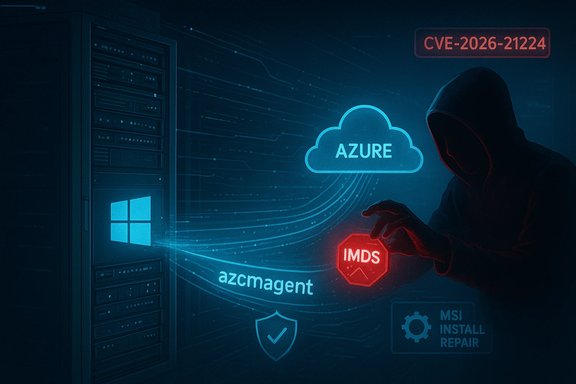
A high‑confidence elevation‑of‑privilege vulnerability has been recorded in the Azure Connected Machine (azcmagent) / Azure Arc agent ecosystem under CVE‑2026‑21224, touching an agent component that bridges on‑host systems with the Azure management plane — a class of flaws that can convert a local, low‑privilege foothold into SYSTEM/root control on a host and, crucially, enable abuse of machine‑assigned managed identities and extension management to access tenant resources.
Azure Connected Machine Agent (commonly referred to as azcmagent or Azure Connected Machine / Azure Arc agent) installs on Windows and Linux servers to provide identity, configuration, extension management and telemetry linking on‑prem and hybrid assets to Azure. These agents expose privileged local endpoints and run privileged services to perform management tasks, which makes any local elevation‑of‑privilege (EoP) vulnerability disproportionately dangerous in hybrid environments.
Microsoft’s Security Update Guide (MSRC) is the canonical record for CVE→KB→package mappings; Microsoft also publishes a confidence metric with cloud‑adjacent advisories to indicate whether technical details are fully verified, corroborated, or tentative — a useful signal for defenders deciding how urgently to act. Operational playbooks published by community and industry analysts repeatedly emphasize validating MSRC KB mappings and fixed package builds rather than relying solely on CVE strings.
Caveat: the specific exploit primitive (for example exact IOCTLs, function offsets, or patch diffs) is not publicly confirmed in the materials available for this briefing and should be treated as unverified until independent technical write‑ups or vendor patch diffs appear.
Source: MSRC Security Update Guide - Microsoft Security Response Center
 Background
Azure Connected Machine Agent (commonly referred to as azcmagent or Azure Connected Machine / Azure Arc agent) installs on Windows and Linux servers to provide identity, configuration, extension management and telemetry linking on‑prem and hybrid assets to Azure. These agents expose privileged local endpoints and run privileged services to perform management tasks, which makes any local elevation‑of‑privilege (EoP) vulnerability disproportionately dangerous in hybrid environments.Microsoft’s Security Update Guide (MSRC) is the canonical record for CVE→KB→package mappings; Microsoft also publishes a confidence metric with cloud‑adjacent advisories to indicate whether technical details are fully verified, corroborated, or tentative — a useful signal for defenders deciding how urgently to act. Operational playbooks published by community and industry analysts repeatedly emphasize validating MSRC KB mappings and fixed package builds rather than relying solely on CVE strings.
What CVE‑2026‑21224 means (summary)
- Vulnerability class: Elevation of Privilege (local). Public vendor messaging and community analysis place this squarely in the EoP category typical of agent/management‑plane bugs.
- Attack vector: Local (authenticated) or processes running with low privileges on the host; exploitation typically requires some form of local code execution or the ability to run a non‑privileged process.
- Potential impact: SYSTEM/root on the host, with management‑plane amplification such as requesting machine‑assigned tokens (via IMDS/HIMDS), installing or hijacking extensions, and calling Azure APIs to read or modify tenant resources. Blast radius includes bastions, CI/CD runners, build agents, and any host with a machine‑assigned identity.
- Exploit maturity: Unknown in the public record available to this report. Microsoft’s MSRC guidance often refrains from disclosing low‑level exploit details until patches are widely available, and community trackers show that PoCs sometimes appear after disclosure. Treat the vulnerability as operationally urgent even if a public PoC is not yet available.
Why azcmagent EoP vulnerabilities are uniquely dangerous
Azure management agents are not ordinary userland utilities. They occupy a privileged bridge between local hosts and cloud control planes. That combination creates several high‑risk primitives:- Local services that run as SYSTEM/root but accept configuration or telemetry inputs.
- Local metadata endpoints (HIMDS/IMDS) that provide machine‑assigned tokens to local processes, which attackers can misuse if they gain SYSTEM privileges.
- Installer and MSI repair flows that run in elevated contexts and, if unsanitized, can enable command injection during upgrade/repair operations.
Technical analysis (what defenders can reasonably infer)
Public vendor advisories for agent/extension vulnerabilities in recent years show recurring root‑cause patterns that are relevant when analyzing CVE‑2026‑21224:- Improper access control (CWE‑284): privileged APIs exposed to non‑privileged callers.
- Unsafe input parsing / deserialization (CWE‑502/CWE‑20): telemetry or config data processed without sufficient validation.
- Installer/repair argument chaining: MSI repair flows or elevated installers that accept unsanitized parameters leading to command injection.
- Race conditions / memory safety defects: timing or heap‑corruption issues that are harder to weaponize but serious when present.
Caveat: the specific exploit primitive (for example exact IOCTLs, function offsets, or patch diffs) is not publicly confirmed in the materials available for this briefing and should be treated as unverified until independent technical write‑ups or vendor patch diffs appear.
Attack scenarios and operational consequences
The most realistic, high‑priority exploitation chains worth defending against are:- Local foothold → EoP → SYSTEM: an attacker with a low‑privileged process (compromised user, malicious installer, build runner) triggers the EoP to obtain SYSTEM/root on the host.
- SYSTEM → HIMDS/managed identity misuse: with SYSTEM, the attacker calls local metadata endpoints to request machine‑assigned tokens and uses those to call ARM APIs (read storage, access Key Vault, modify RBAC).
- SYSTEM → Extension hijack/persistence: the attacker installs or replaces an agent extension to persist and to attempt lateral movement across Arc‑managed hosts.
Verification, confidence, and the MSRC “confidence” metric
Microsoft’s Security Update Guide entry and the vendor confidence metric are important for operational decision‑making:- A high‑confidence vendor entry (vendor‑confirmed with mapped KB/package) means defenders can act on specific build numbers and KBs with strong assurance.
- A medium or low confidence entry (community reports, partial corroboration, or CVE reservation) raises the need for hunting, containment, and inventory until a canonical KB→package mapping is published.
Immediate operational playbook (0–72 hours)
The following prioritized checklist converts urgency into action for security and ops teams.- Inventory — locate every host running azcmagent/AMA/related Azure agents.
- Use Azure Resource Graph to enumerate Arc‑connected machines and extract agentVersion fields. Example conceptual query pattern: resources | where type =~ 'microsoft.hybridcompute/machines' | extend agentVersion = properties.agentVersion | project name, agentVersion.
- Confirm vendor advisory — open Microsoft’s Security Update Guide entry for CVE‑2026‑21224 and extract the KB mapping and fixed package version(s). Do not proceed to mass patching without KB→package validation.
- Prioritize high‑risk hosts for immediate patching:
- Bastions, jump hosts, build/CI runners, systems with machine‑assigned identities, and domain controllers or highly privileged consoles.
- Apply compensating controls while patching is staged:
- Restrict access to local metadata endpoints (HIMDS/IMDS) via host firewall rules or network segmentation.
- Limit who can run MSI repair or installers; apply strict UAC and remove unnecessary local admin rights.
- Apply application allow‑listing (WDAC/AppLocker) for agent binaries.
- Detection and hunting — deploy behavioral detections:
- Alert for non‑standard processes querying IMDS/HIMDS or requesting managed identity tokens.
- Hunt for unexpected extension installs, MSI repair invocations, and agent binary spawning unusual child processes.
- For suspected compromise — isolate, collect forensics, rotate keys:
- Isolate affected hosts to prevent lateral and cloud abuse. Collect azcmagent logs, HIMDS request records, system event logs, EDR telemetry, and memory images where feasible. Rotate machine identities and keys if token theft is suspected.
Detection recipes and practical SIEM/EDR rules
Focus on behavior because exploit signatures are often missing or brittle. Example detection hypotheses include:- Processes other than known agent/service names querying local metadata endpoints or requesting tokens.
- Unexpected MSI repair operations invoked outside normal maintenance windows, or MSI calls with unusual arguments.
- Agent binaries spawning child processes that are unusual (command shells, PowerShell with encoded commands, tools that modify services).
- Sudden Azure Activity log events: unexpected role assignments or RBAC edits following local host activity. Correlate tenant‑side logs with host telemetry.
Patching and validation (recommended sequence)
- Stage: Identify test hosts that repr oduce production roles and install vendor‑published fixes there first. Validate agent versions and application behavior.
- Rollout: Use staged deployment via WSUS/SCCM/Intune or your enterprise patch pipeline. Prioritize critical host groups first.
- Validate: After patching, perform two independent checks — local agentVersion on hosts and centralized inventory (Azure Resource Graph or endpoint management). Don’t rely on a single verification method.
- Post‑patch hunting: Monitor for residual signs of exploitation (unexpected scheduled tasks, new services created near the time of patching, or lingering unusual processes).
Long‑term hardening and governance (1–12 weeks)
- Enforce least privilege for installer/repair operations and restrict who can perform local upgrades.
- Move management plane traffic to private link or private endpoints where possible and restrict outbound access to management APIs.
- Centralize azcmagent/HIMDS telemetry with longer retention to aid retrospective forensics.
- Harden CI/CD and build runners: isolate jobs, enforce signed artifacts, and prevent arbitrary execution of elevated installers within shared runners.
Risk assessment and prioritization — what to patch first
Rank hosts by their ability to amplify compromise:- Bastions, jump boxes, admin consoles and privileged management hosts.
- Hosts with machine‑assigned managed identities or access to Key Vaults, storage accounts, or other sensitive resources.
- Shared CI/CD runners, build agents, and multi‑tenant hosts where non‑trusted workloads can execute.
- Arc‑enabled hosts showing older azcmagent builds per inventory queries.
What remains unverified and cautionary notes
- Public, actionable exploit details (PoC) for CVE‑2026‑21224 were not present in the materials available during this analysis. Absence of PoC does not imply low risk; historically these EoP classes are weaponized rapidly once technical details are public. Mark any claim of in‑the‑wild exploitation as provisional until vendor incident reports or multiple independent forensic confirmations appear.
- CVE fragmentation across community feeds is a known operational hazard: multiple CVE labels and fragmented advisory feeds have previously led teams to patch the wrong package. Always map to Microsoft’s MSRC advisory and the KB/package mapping before mass deployment.
Conclusion
CVE‑2026‑21224 reinforces a hard lesson: vulnerabilities in management agents carry outsized risk because they straddle both host and cloud control planes. Treat this advisory as high priority. The defensive imperative is simple and measurable:- Inventory every azcmagent/AMA host now.
- Confirm the vendor’s KB↔package mapping in Microsoft’s Security Update Guide before mass patching.
- Prioritize bastions, hosts with machine identities and shared runners for immediate remediation.
- Apply compensating controls and deploy behavioral detections while rolling out validated fixes.
Source: MSRC Security Update Guide - Microsoft Security Response Center
