

Microsoft’s security database lists CVE-2026-21234 as an elevation‑of‑privilege issue tied to the Windows Connected Devices Platform Service (CDPSvc), and the entry highlights the vendor’s report confidence metric — a signal security teams must parse carefully when prioritizing remediation and hunting for post‑compromise activity.
The Windows Connected Devices Platform Service (service name: CDPSvc) is a system service used across modern Windows client and server builds to broker device interactions: Nearby Sharing, device pairing, companion device scenarios and other proximity or device‑to‑device flows. Because CDPSvc frequently runs with elevated privileges on many Windows SKUs, memory‑safety defects or synchronization errors inside that service have repeatedly been attractive targets for attackers seeking local privilege escalation (LPE) to NT AUTHORITY\SYSTEM.
In recent years the Connected Devices Platform has been the subject of several vulnerability advisories describing memory corruption and race conditions that can be leveraged for escalation. Those earlier advisories — including multiple use‑after‑free and heap‑overflow reports across 2024–2026 — establish a clear pattern: CDPSvc is a high‑value post‑compromise target for attackers with local code execution or the ability to run unprivileged processes on a host.
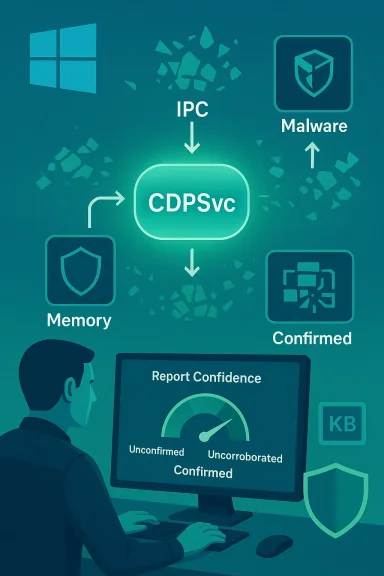
Microsoft’s entry for CVE‑2026‑21234 includes a paragraph on the vendor’s report confidence / exploitability confidence metric: “This metric measures the degree of confidence in the existence of the vulnerability and the credibility of the known technical details… The urgency of a vulnerability is higher when a vulnerability is known to exist with certainty.” That language is critical because the way a vulnerability is categorized (unconfirmed, corroborated, confirmed) should directly affect how quickly organizations escalate patching and incident response.
Common confidence levels used in industry guidance include:
Source: MSRC Security Update Guide - Microsoft Security Response Center
 Background / Overview
The Windows Connected Devices Platform Service (service name: CDPSvc) is a system service used across modern Windows client and server builds to broker device interactions: Nearby Sharing, device pairing, companion device scenarios and other proximity or device‑to‑device flows. Because CDPSvc frequently runs with elevated privileges on many Windows SKUs, memory‑safety defects or synchronization errors inside that service have repeatedly been attractive targets for attackers seeking local privilege escalation (LPE) to NT AUTHORITY\SYSTEM.In recent years the Connected Devices Platform has been the subject of several vulnerability advisories describing memory corruption and race conditions that can be leveraged for escalation. Those earlier advisories — including multiple use‑after‑free and heap‑overflow reports across 2024–2026 — establish a clear pattern: CDPSvc is a high‑value post‑compromise target for attackers with local code execution or the ability to run unprivileged processes on a host.
Microsoft’s entry for CVE‑2026‑21234 includes a paragraph on the vendor’s report confidence / exploitability confidence metric: “This metric measures the degree of confidence in the existence of the vulnerability and the credibility of the known technical details… The urgency of a vulnerability is higher when a vulnerability is known to exist with certainty.” That language is critical because the way a vulnerability is categorized (unconfirmed, corroborated, confirmed) should directly affect how quickly organizations escalate patching and incident response.
Why CDPSvc vulnerabilities matter
- Runs with elevated privileges. CDPSvc routinely interacts with privileged components and often executes in contexts where memory‑safety faults can be escalated to SYSTEM.
- Broad presence across SKUs. The service appears on many Windows client and server builds, which increases blast radius when vulnerabilities exist.
- Complex IPC surface. CDPSvc mediates between user‑mode callers, drivers, and other platform services; asynchronous callbacks and IPC add concurrency and timing complexity that often underpins exploitable race conditions and use‑after‑free defects.
- History of memory issues. Public trackers and vendor advisories over the past two years document multiple CDPSvc flaws (use‑after‑free, heap overflows and race conditions), demonstrating both recurring engineering risk and attractive exploitability once an attacker gains a local foothold.
The vendor’s “report confidence” metric — what it means for defenders
Microsoft and other vulnerability tracking frameworks use a confidence metric to indicate how strongly the evidence supports the vulnerability claim. In plain terms, the metric answers this question: do we know this bug exists, and do we trust the technical details that describe how it can be exploited?Common confidence levels used in industry guidance include:
- Unconfirmed / Unknown: Initial or single reports with little corroborating technical detail. Reproducing the bug may be difficult or impossible with currently available information.
- Uncorroborated / Reasonable: Multiple reports or research that suggests a root cause, but missing some confirmatory details or vendor acknowledgment.
- Confirmed: Vendor acknowledgement, detailed technical write‑ups, or a working proof‑of‑concept that demonstrably reproduces the issue.
- When the confidence metric is confirmed, you should treat the vulnerability as actionable: validate affected assets, apply vendor updates immediately, and hunt for exploitation.
- When the confidence metric is uncorroborated or unknown, treat the vulnerability as potential — increase monitoring and detection capabilities, but prioritize confirmed issues for immediate emergency change windows.
- Attackers can weaponize confirmed LPE bugs quickly after public disclosure; the faster a vulnerability graduates from “uncorroborated” to “confirmed,” the higher its exploitation urgency.
What we can and cannot verify about CVE‑2026‑21234
- What we can verify with high confidence:
- CDPSvc is a recurring target for memory‑safety vulnerabilities. Independent trackers and prior CVEs show multiple use‑after‑free and heap‑overflow issues in this component across 2024–2026.
- Historically, Microsoft has remediated CDPSvc issues through cumulative security updates and KBs that map to specific Windows builds. Administrators must match build numbers to the correct KB.
- The vendor’s report confidence / exploitability descriptors are part of standard vulnerability scoring and reflect the degree to which a vulnerability claim is corroborated.
- What we could not independently corroborate at the time of writing:
- Detailed technical root cause, exploitability steps, proof‑of‑concept code or a public exploit specific to CVE‑2026‑21234. The MSRC page referenced lists the CVE and includes the report confidence language but, as of this article, public aggregator indexes and common CVE mirrors had sparse or inconsistent entries for the exact CVE number.
- Precise CVSS vector values or an authoritative mapping of affected builds to specific KBs for CVE‑2026‑21234 without consulting the Microsoft Security Update Guide and the Microsoft Update Catalog directly.
Technical context: typical exploitation primitives in CDPSvc
Although we lack a public proof‑of‑concept tied to CVE‑2026‑21234 specifically, the exploit techniques we describe below are the same primitives seen in prior, confirmed CDPSvc advisories and are therefore relevant to defenders assessing risk.Common root causes observed in CDPSvc advisories
- Use‑after‑free (UAF): A pointer to freed memory is accessed later, enabling an attacker who controls heap layout to replace freed blocks and redirect control flow.
- Heap‑based buffer overflow: Overwriting adjacent heap metadata or function pointers to control execution.
- Race/synchronization issues: Concurrent access to shared structures without correct locking, exploitable via timing techniques.
- Improper input validation: Leading to malformed IPC objects or unexpected jumps in code paths.
How UAF or heap overflow in an elevated service yields SYSTEM
- An attacker with local code execution or the ability to place data into an IPC channel triggers a vulnerable path in CDPSvc that frees memory while a callback or pointer remains reachable.
- The attacker «grooms» the heap: allocates controlled objects or data structures that get placed at the memory location of the freed block.
- When the service later dereferences the stale pointer, it operates on attacker‑controlled data — allowing overwrite of function pointers, vtables, or token structures.
- The attacker manipulates kernel or process token data (or redirects execution to spawn a SYSTEM shell) to escalate privileges to NT AUTHORITY\SYSTEM.
Operational risk: who should worry first?
Prioritization should follow two axes: the presence of the vulnerable component and the criticality of the host’s role.- High‑priority targets:
- Domain controllers, network infrastructure servers, and hosts that manage remote endpoints. An LPE on these systems can enable broad lateral movement.
- Servers running exposed management interfaces that allow local code execution or file write access. If an attacker can place files or execute code as a low‑privileged user on such hosts, the LPE becomes an immediate path to full compromise.
- High‑value workstations (administrators, developers, build servers). Attackers often escalate on admin workstations to steal credentials or signing keys.
- Medium‑priority:
- Standard user workstations in sensitive business units.
- Application servers that are not externally exposed but host business‑critical processes.
- Low‑priority (but not ignorable):
- Systems where CDPSvc is present but the host is air‑gapped or strictly controlled. Patching and monitoring are still recommended.
Detection and hunting recommendations
Given the class of potential bug (memory corruption in an elevated service), detection should focus on behavioral and forensic signals rather than signature‑only checks.- Endpoint detection and response (EDR) rules to deploy:
- Alert on unexpected CDPSvc crashes or repeated faults in the Connected Devices Platform Service process.
- Monitor and alert on CDPSvc spawning command shells or child processes it ordinarily does not launch.
- Watch for anomalous DLL loads into CDPSvc or suspicious module names and paths.
- Detect attempts to call APIs commonly used for token manipulation and impersonation (for instance, suspicious use of NtSetInformationToken in userland tooling).
- Log‑based signals:
- System event logs that record process crashes, access violations, or Application Error events tied to CDPSvc.
- Windows Defender/AV telemetry indicating exploit mitigation triggers (for example, CFG or DEP violations).
- Unusual network activity immediately following a CDPSvc crash (attackers sometimes use a crash to trigger fallback code paths that call out).
- Hunt steps:
- Query EDR telemetry for recent CDPSvc faults or abnormal process trees.
- Search for local accounts or scheduled tasks created shortly after CDPSvc anomalies.
- Collect memory images of suspicious hosts for kernel and user‑mode analysis if you suspect active exploitation.
- Compare current DLL and process hashes against known good baselines for CDPSvc to spot tampering.
- Forensics checklist if you suspect compromise:
- Preserve a full memory image and system drive snapshot.
- Export relevant Windows event logs and EDR artifacts.
- Look for indicators of persistence that are common follow‑ups to privilege escalation (new services, scheduled tasks, registry Run keys).
- Validate credentials and account changes — assume the attacker may have obtained privileged tokens.
Recommended mitigations — immediate and medium term
- Patch first, validate second.
- If Microsoft has published a KB that addresses CVE‑2026‑21234 for your build, deploy it as a high priority. Confirm the build/KBS mapping before mass deployment.
- If a vendor fix is not yet available or you cannot deploy instantly:
- Tighten local access controls. Prevent untrusted users from running executables on sensitive hosts.
- Use application control (AppLocker or Windows Defender Application Control) to restrict execution of unapproved binaries.
- Harden privilege boundaries on endpoints and reduce the number of local administrator accounts.
- Temporarily restrict CDPSvc usage where possible:
- If your environment does not use Nearby Sharing, device pairing or companion device features on certain hosts (for example, servers), consider disabling or restricting CDPSvc. Caveat: disabling system services can have downstream effects — test before broad rollout.
- Increase monitoring and EDR sensitivity:
- Tune EDR detection to surface anomalous CDPSvc behavior and escalate alerts to security operations.
- Network segmentation:
- Separate critical infrastructure from endpoints where lateral movement would cause elevated risk.
- Incident readiness:
- Prepare containment playbooks, memory imaging resources and external forensic support contacts in case of confirmed exploitation.
Practical remediation checklist for IT teams
- Inventory: Identify hosts with the Connected Devices Platform Service and map Windows build numbers.
- Verify: Check Microsoft’s Security Update Guide and the Update Catalog for explicit KBs that remediate the CVE for each build.
- Prioritize: Schedule emergency patch windows for domain controllers, management servers and admin workstations.
- Patch: Apply vendor updates and verify installations; do not rely solely on Windows Update unless your update pipeline is visible and auditable.
- Validate: After patching, validate that the vulnerable code paths are no longer reachable by testing on non‑production hosts where possible.
- Monitor: Enable EDR rule sets and log collection recommended above; perform post‑patch hunting for residual suspicious activity.
- Document: Record decisions, affected assets, deployment steps and incident response readiness notes for auditors and future lessons learned.
Disclosure and responsible reporting: why the confidence metric matters for public communication
Security teams and vendors must balance transparency and operational risk when publishing vulnerability details. The report‑confidence metric helps avoid premature alarm by communicating whether a vulnerability is fully validated or still under investigation. From a defender’s perspective:- Treat confirmed advisories as immediate action items.
- Treat uncorroborated advisories as triggers to harden detection, inventory and incident readiness — but avoid emergency change processes unless evidence indicates active exploitation.
- Always rely on vendor KB mappings to determine patch applicability — third‑party CVE aggregators sometimes show incomplete or inconsistent build mappings.
Final analysis — strengths and open risks
- Strengths (in Microsoft’s approach and vendor ecosystem):
- Modern vulnerability pages now include report‑confidence/exploitability language that helps defenders prioritize, which is a valuable operational signal when triaging.
- Microsoft’s cumulative update model centralizes fixes for many SKUs and, when KB mappings are accurate, enables efficient remediation.
- Community tracking and vendor advisories for related CDPSvc issues demonstrate transparency and a steady cadence of fixes.
- Risks and gaps:
- Fragmentation in CVE entries for the Connected Devices Platform (multiple related CVEs across 2024–2026) has occasionally made it hard to map a single CVE to the correct KB for a particular build. This remains a practical problem for patch orchestration.
- If a CVE’s public presence is limited (no POC, sparse indexing across feeds), defenders may underestimate urgency until the issue is confirmed and weaponized.
- Memory‑corruption bugs in privileged services are inherently dangerous because attackers can reliably target them as the final privilege escalation step once local code execution is available.
Conclusion — what defenders should do right now
- Treat the MSRC entry for CVE‑2026‑21234 as an actionable intelligence item: check your inventory for CDPSvc presence and match Windows build numbers to vendor KBs.
- If Microsoft has published a remediation for your build, schedule and deploy it as a priority, starting with domain controllers, admin workstations and servers accessible to multiple users.
- If a remediation is not yet available or the entry’s confidence level is “under investigation,” immediately step up EDR detection for CDPSvc anomalies and harden execution policies to make exploitation more difficult.
- Use the vendor’s report confidence as an operational triage signal: confirm → patch quickly; uncorroborated → hunt and monitor aggressively while awaiting vendor confirmation.
- Finally, assume that memory corruption in elevated services is a likely eventual target: reduce unnecessary local privileges, strengthen application control, and maintain a tested incident response path that includes memory capture and forensic analysis.
Source: MSRC Security Update Guide - Microsoft Security Response Center
