

Microsoft has assigned CVE-2026-21522 to a newly disclosed elevation-of-privilege flaw affecting Azure Container Instances (ACI) Confidential Containers, warning that an attacker with access inside a confidential guest could potentially escalate privileges and interact with host-level resources. Microsoft’s advisory currently provides a short technical summary and a report-confidence explanation rather than a full exploit write-up or proof-of-concept, leaving critical implementation details undisclosed while urging customers to apply vendor guidance as patches and mitigations become available. (msrc.microsoft.com)
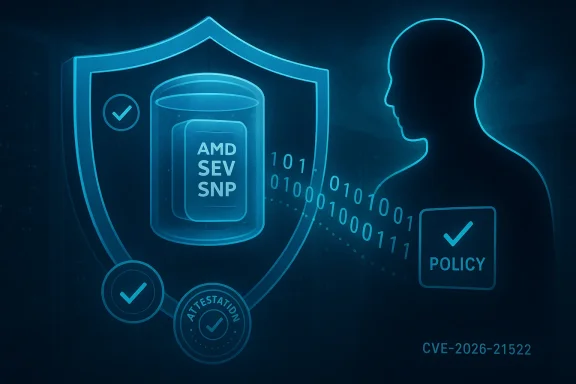
Confidential computing for containers aims to combine container convenience with hardware-backed isolation: memory, CPU state, and attestation are protected by a Trusted Execution Environment (TEE) — most commonly AMD SEV-SNP in Microsoft’s Confidential Containers on ACI — so that even a compromised host OS or hypervisor should not be able to read or tamper with a workload’s secrets. Microsoft’s Confidential Containers stack on ACI integrates a TEE-backed guest runtime with attestation, policy enforcement, and a constrained control plane to provide per-container confidentiality and integrity guarantees.
That architecture is powerful, but complex. Over recent years, multiple issues in cloud container runtimes and integrations — particularly where host-agent interfaces, file mounts, or management sockets cross the trust boundary — have produced privilege-elevation bugs. Examples in the Azure ecosystem and research literature show the kinds of integration mistakes that can convert a promising TEE design into an exploitable attack surface. Microsoft’s new CVE-2026-21522 sits inside that wider context: it is a reminder that a hardware root of trust does not automatically eliminate attack vectors that arise from orchestration and integration logic.
This limited public disclosure pattern is increasingly common for cloud provider advisories: vendors publish CVE identifiers and impacted products quickly, then follow with deeper technical notes and patches once they can coordinate mitigations, issue fixes, and notify affected customers. Microsoft’s report confidence language—explaining whether something is observed, corroborated by research, or vendor-confirmed—helps operators understand how immediate and actionable the threat is even when technical details remain sparse. (msrc.microsoft.com)
What to watch for in the coming days:
Source: MSRC Security Update Guide - Microsoft Security Response Center
 Background
Confidential computing for containers aims to combine container convenience with hardware-backed isolation: memory, CPU state, and attestation are protected by a Trusted Execution Environment (TEE) — most commonly AMD SEV-SNP in Microsoft’s Confidential Containers on ACI — so that even a compromised host OS or hypervisor should not be able to read or tamper with a workload’s secrets. Microsoft’s Confidential Containers stack on ACI integrates a TEE-backed guest runtime with attestation, policy enforcement, and a constrained control plane to provide per-container confidentiality and integrity guarantees. That architecture is powerful, but complex. Over recent years, multiple issues in cloud container runtimes and integrations — particularly where host-agent interfaces, file mounts, or management sockets cross the trust boundary — have produced privilege-elevation bugs. Examples in the Azure ecosystem and research literature show the kinds of integration mistakes that can convert a promising TEE design into an exploitable attack surface. Microsoft’s new CVE-2026-21522 sits inside that wider context: it is a reminder that a hardware root of trust does not automatically eliminate attack vectors that arise from orchestration and integration logic.
What Microsoft published (the official summary)
Microsoft’s Update Guide entry for CVE-2026-21522 is terse: the entry names the vulnerability as an Elevation of Privilege issue in Azure Container Instances Confidential Containers, and includes the vendor’s standard vulnerability-impact and confidence text (the “metric” that explains how certain they are about the vulnerability’s existence and root cause). The advisory emphasizes that the level of public technical detail is limited and that the confidence metric reflects how thoroughly the issue has been characterized. At the time of writing, Microsoft’s public page contains the official CVE listing and basic impact description, but not a full technical analysis or exploit code. (msrc.microsoft.com)This limited public disclosure pattern is increasingly common for cloud provider advisories: vendors publish CVE identifiers and impacted products quickly, then follow with deeper technical notes and patches once they can coordinate mitigations, issue fixes, and notify affected customers. Microsoft’s report confidence language—explaining whether something is observed, corroborated by research, or vendor-confirmed—helps operators understand how immediate and actionable the threat is even when technical details remain sparse. (msrc.microsoft.com)
Why this matters: attack surface and impact
Confidential containers seek to protect highly sensitive workloads — cryptographic operations, private ML models, multi-party computation workloads, or any process handling regulated data — by isolating computation inside a guest whose memory and execution state are protected from the host. When that isolation is undermined by an elevation-of-privilege bug, the consequences are severe:- Host compromise from inside an allegedly isolated guest: If an attacker can break the guest-to-host boundary, they can access host-level secrets (kubelet config, cloud credentials), tamper with neighbor workloads, or create persistent footholds. This is the canonical danger of container escape combined with cloud credentials.
- Severe downstream risks to multi-tenant environments: ACI supports multi-tenancy; a compromised node or host-side service can endanger other tenants if isolation boundaries fail, especially where orchestration services share privileged agents on the host. Historical cloud container CVEs show that a single integration mistake (e.g., an exposed management socket or improperly sanitized mount) is often enough to jump from container-level compromise to host-level control.
- Supply-chain and attestation erosion: Confidential containers rely on attestation and enforcement policies. Attackers who can bypass policy checks or modify attestation enforcement may be able to load malicious workloads that appear legitimate to remote verifiers, eroding trust in the attestation model itself. Academic analyses of TEE-in-container designs show that trust boundary misconfigurations frequently undermine otherwise-solid cryptographic protections.
What we know — and what we don’t
Microsoft’s published entry confirms the CVE assignment and provides a confidence rubric; however, it does not publish a step-by-step root cause or exploitation sequence in the public advisory at the moment. That means:- Known: CVE-2026-21522 exists, it is classified as an elevation-of-privilege issue in ACI Confidential Containers, and Microsoft has assigned the CVE and published a short advisory. (msrc.microsoft.com)
- Unknown / not yet public: the exact vulnerable component (for example, whether the flaw is in the ACI attestation flow, the container runtime, a host-side agent, or particular device handling), a CVSS base score or exploitability score in the public advisory, and whether any proof-of-concept code exists in the wild. Microsoft’s confidence metric language suggests that technical specifics are still being carefully managed. (msrc.microsoft.com)
How similar vulnerabilities have been exploited in the past
To assess realistic threat models for CVE-2026-21522, we can draw lessons from past Confidential Containers and container runtime CVEs:- Exposed management sockets, improperly restricted device nodes, or misrouted mount operations have allowed containerized processes to access host resources and escalate privileges. Several AKS Confidential Containers issues disclosed in 2024–2025 exploited these integration edges, where the container runtime and node agent expose functionality intended for trusted orchestration but not hardened for arbitrary guest access.
- In older Azure ACI disclosures, vulnerabilities arose from cloud-service integration patterns rather than from hardware TEEs themselves: misconfigurations in host agents or shared services created avenues for cross-tenant access. Microsoft’s coordinated-disclosure posts have repeatedly emphasized rotating credentials and minimizing privileged credential exposure as immediate mitigations when host-side issues are patched.
- Academic analyses of TEE container designs repeatedly show that expanding the trusted computing base (TCB) with orchestration logic or sidecars increases attack surface. Research calls out that keeping the TEE’s attack surface minimal and keeping orchestration logic outside the TEE reduces the likelihood of host-to-guest/guest-to-host escalation. These academic findings align with a practical security posture: focus on narrowing the TCB, rigorous interface hardening, and deliberate policy for host-guest interactions.
Immediate mitigations and recommended steps for operators
If you run Confidential Containers on ACI — particularly for sensitive workloads — take the following prioritized actions immediately. These steps are defensive best practice drawn from Microsoft guidance on ACI/Confidential Containers, historical incident response patterns, and secure-container hardening recommendations.- Confirm exposure and inventory:
- Identify all ACI Confidential Container deployments and the workloads running within them.
- Enumerate secrets, credentials, and host-integrated mounts associated with those workloads.
- Apply vendor updates:
- Watch Microsoft’s security update channels for a patch or configuration guidance for CVE-2026-21522 and apply fixes as they are released.
- If automatic updates are available for the control plane or ACI nodes, enable them after validating in a staging environment where possible. (msrc.microsoft.com)
- Rotate and minimize privileged credentials:
- Rotate any long-lived cloud credentials (service principals, managed identities) that are referenced by or accessible to ACI groups that run confidential workloads.
- Replace secret volumes with short-lived, ephemeral tokens where possible and follow least-privilege principles. Microsoft has recommended rotating privileged credentials after earlier container service disclosures; the same practice is sound here.
- Harden host–guest interfaces:
- Disable or restrict exec/attach features and any privileged device mounts unless explicitly required. If possible, limit access to management sockets and host services via policy.
- Monitor aggressively:
- Increase logging and telemetry for Confidential Container groups, including attestation failures, unusual mount or device access attempts, and sudden changes in container policy enrollments.
- Treat anomalous attestation or policy events as high-priority incidents; they can indicate an attempted bypass.
- Consider workload migration:
- If you run exceptionally sensitive processes and cannot immediately validate the patch state or mitigations, plan for temporary migration to alternate confidential compute options (e.g., Confidential VMs, application enclaves) until ACI Confidential Container patches are verified. Microsoft’s AKS documentation explicitly advises migration options when Confidential Containers are limited or in preview sunset scenarios.
Deeper analysis: probable causes and systemic lessons
Because Microsoft’s public advisory is intentionally limited, any technical diagnosis must be probabilistic. But combining Microsoft’s architecture documentation, prior CVE patterns, and academic analyses of TEE container designs yields a defensible set of likely root causes and systemic lessons.Probable cause vectors
- Host-side agent or management interface misconfiguration: Past container escapes and AKS/ACI CVEs were often triggered by management sockets or host agents that trusted guest input. If an ACI host agent exposed an interface for image measurement, policy management, or attestation that did not enforce strict privileges or input validation, a crafted guest could leverage it to escape.
- Improper mount and device-node handling: Container runtimes that inadvertently allow device nodes or host filesystems to be accessible from within a secure guest create a direct channel to the host. Historical incidents show that symbolic-link and mount-timing attacks are practical in these scenarios.
- Policy enforcement bypass: Confidential Containers rely on enforcement policies (cryptographically bound to measured images). If policy generation or verification is flawed, an attacker could present a recreation that appears valid to verification services. Academic work on reducing the TCB argues the policy path is a recurrent weakness if not minimal and strictly validated.
Systemic lessons
- TEEs reduce a class of threats but do not obviate secure engineering discipline at integration points. Every interface between host and guest becomes a potential escalation vector.
- Minimizing the trusted computing base (TCB) is not just an academic ideal: it directly reduces opportunities for orthogonal system components (like orchestration agents, sidecars, or monitoring agents) to be co-opted into an exploit chain.
- Rapid CVE assignment with limited technical detail is valuable for operations because it allows patch windows and mitigation planning; but vendors must follow quickly with root-cause analysis and reproducible patches to avoid long windows of uncertainty.
Risk calculus: how worried should organizations be?
Risk depends on your workload, threat model, and operational posture:- High-risk: organizations running multi-tenant, high-value workloads in ACI Confidential Containers (private keys, model IP, regulated data) should treat CVE-2026-21522 as urgent and act immediately on mitigations and credential rotations. The cost of potential host compromise is very high in these contexts.
- Moderate risk: teams using Confidential Containers for convenience or lower-sensitivity apps should still harden interfaces and validate vendor updates, but may tolerate brief defensive windows while patches are validated.
- Low risk: workloads that do not rely on ACI Confidential Containers or that reside in well-isolated single-tenant environments are less immediately impacted, though they should remain aware of upstream patches and long-term supply-chain effects.
What vendors and cloud operators should do differently
CVE-2026-21522 is not just a one-off bug — it is a data point in a recurring pattern where orchestration complexity undermines hardware guarantees. Vendors and cloud operators can take several systemic steps:- Release comprehensive, timely post-patch technical write-ups that explain root cause without enabling trivial weaponization. Transparency helps operators validate fixes and harden adjacent services.
- Harden host API surfaces by default: require mutual TLS and cryptographic authentication for management sockets; adopt explicit access control lists; and run host agents with least privilege.
- Provide safer out-of-the-box defaults for Confidential Containers: disable exec/attach to guests, do not mount host device nodes unless requested, and avoid persistent host-side credentials for container-managed operations.
- Encourage customers to use ephemeral, short-lived secrets and to adopt attestation-driven access control where attestation results are actively checked before any sensitive operation.
Final thoughts and what to watch next
CVE-2026-21522 is a sober reminder that hardware-based confidentiality is necessary but not sufficient; integration, orchestration, and policy enforcement are the frequent sites of failure. Microsoft’s advisory and its confidence metric are useful initial signals, but defenders need more: reproducible mitigations, timeline for patches, and clear guidance on what was wrong and how it was fixed.What to watch for in the coming days:
- Microsoft’s follow-up advisory that provides patch identifiers, CVSS scoring, and a clear remediation timeline. Apply those patches immediately and validate in staging before rolling them out in production. (msrc.microsoft.com)
- Independent researcher write-ups and proof-of-concept disclosures (if any). Treat public PoCs as high-risk indicators and prioritize patching if exploitation appears feasible.
- Cloud-native tooling updates (container runtimes, attestation services, operator images) and documentation updates that clarify recommended hardening settings for confidential workloads.
Executive summary (quick checklist)
- CVE-2026-21522 affects Azure Container Instances Confidential Containers and is classified as an elevation-of-privilege vulnerability by Microsoft. (msrc.microsoft.com)
- Microsoft’s advisory currently emphasizes a report-confidence metric and does not publish full exploit details in the initial entry. Treat technical specifics as provisional until vendor or trusted researcher disclosure. (msrc.microsoft.com)
- Historical patterns and academic analyses indicate the likely risk vectors are host–guest integration points: management sockets, mounts, device nodes, and policy-enforcement paths. Harden those interfaces immediately.
- Immediate defensive steps: inventory ACI confidential workloads, rotate privileged credentials, restrict host-facing interfaces, increase monitoring, and apply Microsoft patches as soon as they’re available.
- Longer-term: cloud vendors should minimize trusted computing bases, publish timely technical remediation details, and default to conservative, hardened configurations for confidential container features.
Source: MSRC Security Update Guide - Microsoft Security Response Center
