

The Linux kernel received a small but consequential bugfix in the Ceph client library (libceph) that corrects a missing error return in the authentication completion path — a change tracked as CVE‑2026‑22992 that, if left unpatched, can leave higher layers confused about authentication state and in some configurations produce a kernel NULL‑pointer dereference during session setup.
Ceph’s kernel client (libceph) implements the client‑side protocol for talking to Ceph monitors (mons) and object storage daemons (OSDs). That protocol includes an authentication handshake: a client asks a monitor to authenticate it, a reply is processed, and session establishment continues using the msgr2 transport when authentication succeeds. A subtle logic flaw in one of the completion callbacks (the function mon_handle_auth_done) caused an error observed during the auth reply handling to be propagated internally via finish_auth() but not returned by mon_handle_auth_done(). The result is an inconsistent state: higher layers learn that something went wrong during authentication while msgr2 still attempts to continue session establishment in the background. In secure mode this mismatch can produce a WARN in the crypto setup path and later lead to a NULL pointer dereference in prepare_auth_signature(). This defect is cataloged as CVE‑2026‑22992.
I also checked the collection of uploaded forum files and actid not contain an upstream advisory or the kernel commit itself, so I relied on canonical security trackers and the upstream commit/tag information to assemble the technical picture.
Why is that important?
Note: public exploit code or proof‑of‑concepts were not available at the time of these advisories; trackers report low EPSS/exploit likelihood. That said, an attacker able to trigger the exact authentication failure sequence inside a target environment could cause client process crashes.
Source: MSRC Security Update Guide - Microsoft Security Response Center
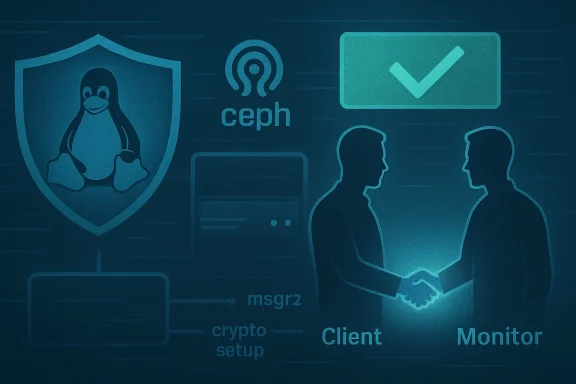 Background / Overview
Ceph’s kernel client (libceph) implements the client‑side protocol for talking to Ceph monitors (mons) and object storage daemons (OSDs). That protocol includes an authentication handshake: a client asks a monitor to authenticate it, a reply is processed, and session establishment continues using the msgr2 transport when authentication succeeds. A subtle logic flaw in one of the completion callbacks (the function mon_handle_auth_done) caused an error observed during the auth reply handling to be propagated internally via finish_auth() but not returned by mon_handle_auth_done(). The result is an inconsistent state: higher layers learn that something went wrong during authentication while msgr2 still attempts to continue session establishment in the background. In secure mode this mismatch can produce a WARN in the crypto setup path and later lead to a NULL pointer dereference in prepare_auth_signature(). This defect is cataloged as CVE‑2026‑22992.I also checked the collection of uploaded forum files and actid not contain an upstream advisory or the kernel commit itself, so I relied on canonical security trackers and the upstream commit/tag information to assemble the technical picture.
Why this matters: one missing return, outsized impact
On its face the flaw is a typical error‑handling omission: a handler (ceph_auth_handle_reply_done) can produce an error that finish_auth() propagates internally, but mon_handle_auth_done() failed to return that error to its caller. That single missing return value creates a mismatch in the state machine that coordinates authentication and session establishment.Why is that important?
- Authentication and session setup are multi‑stage operations where state consistency matters. If a lower layer discovers an error but higher layers think authentication succeeded, subsequent code can run with invalid assumptions.
- In this case, when the kernel is built or configured for secure sessions, the background attempt by msgr2 to continue can enter crypto setup code paths that expect valid, non‑NULL data. The kernel code then may log WARN messages and — in the worst case — dereference a NULL pointer, causing a kernel oops/panic and an availability failure.
Technical anatomy: what the patch fixes
The call flow (simplified)
- Client sends authentication request to a Ceph monitor.
- Monitor replies; reply processing culminates in ceph_auth_handle_reply_done().
- finish_auth() is invoked to finalize the auth transaction and propagate any handler error.
- mon_handle_auth_done() is called as the mon authentication completion callback.
- If mon_handle_auth_done() does not return the handler error, the caller (higher layer) believes authentication succeeded; yet finish_auth() recorded an error.
- msgr2 proceeds to session establishment while the higher layers believe auth failed — or vice‑versa — causing conflicting assumptions. This mismatch can drive the code into crypto setup (setup_crypto()) and, under certain conditions, a NULL dereference in prepare_auth_signature().
The failure mode
- Short term: inconsistent state leads to background session establishment attempts while userland or higher kernel layers believe authentication failed. The net effect is confusing log noise and potentially redundant retries.
- In secure mode: attempting to set up cryptography without validated auth data can raise a WARN in setup_crypto(); if subsequent code attempts to use an expected pointer that was never initialized (or was cleared on error), prepare_auth_signature() may dereference NULL.
- Impact: availability loss (kernel oops/panic) on affected hosts. Several security trackers classify the impact as availability‑focused (no confidentiality/integrity loss), and the CVSS vector reported by vendor trackers places the attack vector as local with an availability impact.
Sources, confirmation and cross‑checks
To build this analysis I cross‑checked:- The NVD / MITRE record which summarizes the vulnerability description and flags the key function names and the NULL‑dereference risk.
- The upstream kernel commit lists and the Ceph‑for‑kernel merge tags where the change is recorded — this is the authoritative source for the actual code modification that returns the handler error. The change appears in the kernel trees and was included in the stable fixset.
- Distribution advisories and trackers (Debian, SUSE, Red Hat references) that have cataloged the CVE and mapped it to distro kernels and upcoming fixes. These confirm that vendor maintainers are aware and are preparing or shipping patches.
- OSV and several vulnerability databases that mirror the NVD description and list the CVE metadata and timestamps. These sources corroborate publish/modified dates and the lack of a public exploit.
Affected components and likely exposure
This CVE affects the kernel libceph component — i.e., the in‑kernel Ceph client. In practice, affected systems include:- Linux hosts acting as Ceph clients (RADOS, RBD, CephFS mounts) running kernels that include the vulnerable libceph revision.
- Systems where Ceph authentication is enabled (secure mode). Non‑secure or anonymous configurations are less likely to trigger the crypto code paths described in the advisory.
Note: public exploit code or proof‑of‑concepts were not available at the time of these advisories; trackers report low EPSS/exploit likelihood. That said, an attacker able to trigger the exact authentication failure sequence inside a target environment could cause client process crashes.
Detecting the problem in your environment
The vulnerability manifests in a narrow set of behaviors — look for these signs in logs and monitoring:- Kernel messages or ceph client logs with WARNs tied to crypto setup or failed attempts to prepare signatures during authentication.
- Ceph client diagnostic logs that show an authentication transaction failing in one place while msgr2 shows session connection attempts continuing in the background.
- Symptoms on clients: sudden Ceph client daemon crashes, kernel oopses, or services using RBD/CEPHFS reporting I/O errors or disconnects shortly after auth attempts.
- Search your syslog/journal for Ceph monclient messages around authentication, and for WARN lines that mention crypto setup. The NVD description specifically calls out setup_crypto() WARNs and prepare_auth_signature() as the code paths that can see a NULL dereference; those function names are good search targets.
- Grep Ceph logs for authentication failure patterns and concurrent msgr2 session attempts.
- Scan kernel logs (dmesg/journal) for WARNs or oops entries near Ceph auth events.
- If you operate Ceph clients at scale, run a log correlation query to find clients that observed auth failures but then attempted session establishment within seconds — that event pair suggests the inconsistent behavior this CVE addresses.
Mitigation and remediation guidance
The definitive remediation is to apply the patched kernel that includes the upstream fix (the commit that ensures mon_handle_auth_done() returns the handler error). Because libceph is in‑kernel, remediation paths are:- Install vendor kernel updates that include the upstream stable fix. Watch your distribution security tracker (Debian, Ubuntu, Red Hat, SUSE, etc.) for release notes and kernel package versions that contain the patch.
- If you cannot immediately update kernels, consider short‑term operational mitigations:
- Reduce exposure of Ceph client authentication paths to untrusted networks. The attack/trigger here is in the client‑to‑monitor auth exchange, so restricting which hosts may contact monitors reduces risk.
- Where possible, move critical Ceph clients to patched nodes or reduce the number of unpatched Ceph clients performing authentication until a patch window is available.
- Monitor closely and enable alerting for the log signatures described above (WARNs in setup_crypto, unexpected NULL deref oopses) so you can detect and roll back or isolate affected hosts quickly.
- For cloud or managed environments, coordinate with your provider / distribution vendor to schedule kernel updates during maintenance windows; the fix must be in the kernel image (kernel package) used by client hosts.
Deployment checklist for administrators
- Inventory all hosts that mount Ceph FS, use RBD, or otherwise act as Ceph clients.
- Identify kernel versions running on those hosts and compare them to vendor advisories for CVE‑2026‑22992.
- Schedule kernel updates for Ceph clients to versions that include the stable patch (or vendor backport).
- Test updates in a staging environment, especially for systems with custom kernel modules or strict uptime requirements.
- Deploy updated kernels in rolling fashion, watching for any regression or interaction with Ceph client daemons.
- Post‑update, validate that the previous logs (WARNs/oops) no longer appear and that client session establishment behaves consistently.
- Boot a single host into the previous kernel and verify service restoration.
- Revert any configuration changes made for the patch window.
- Coordinate with vendor support for a backport or alternative resolution if regressions persist.
Risk assessment and operational impact
- Likelihood of exploitation: Low to moderate. There were no public PoCs at publication time, and exploit frameworks did not list active exploits. However, an attacker within a network that can influence Ceph authentication exchanges or a misconfigured client in a multitenant environment could trigger the behavior. Trackers show low EPSS scores but stable CVE publication and vendor mapping.
- Impact if exploited: Moderate (availability). The vulnerability primarily causes crashes or oopses on Ceph client hosts (NULL dereference), affecting availability of services that depend on those mounts; it does not appear to permit arbitrary code execution or data disclosure in the publicly documented descriptions. Several vendor CVSS assessments place the impact in the availability domain.
- Attack vector: local or network‑adjacent in the sense of the auth exchange — an attacker needs to be able to trigger the auth reply failure or influence the monitor/client auth handshake in a way that exercises the code path. This is not a simple unauthenticated remote code execution bug.
Developer and maintainer notes (for kernel and Ceph maintainers)
- The fix is corrective and minimal: return the handler error from mon_handle_auth_done() so the caller observes the same state finish_auth() propagated.
- The broader lesson: state machines that coordinate asynchronous handlers must propagate errors consistently across all callback/return paths. Missing returns are a common root cause for state mismatches and can lead to subtle races between protocol layers.
- For downstream packagers: maintainers should verify the specific stable commit(s) backported into their kernels and ensure that packaging notes reflect the CVE and the kernel version that carries the fix. Multiple stable commit IDs have been referenced in vendor bugzilla/tracker entries; ensure you pick the correct backport for your kernel branch.
Practical recommendations (summary)
- If you run Ceph clients on Linux hosts: prioritize applying vendor kernel updates that include the libceph fix for CVE‑2026‑22992.
- Until patched: restrict which systems may reach Ceph monitors, monitor Ceph and kernel logs for WARNs and unexpected oopses tied to authentication/crypto setup, and isolate any host that repeatedly exhibits auth‑related crashes.
- Test kernel updates in staging: Ceph interactions can be sensitive to kernel changes; validate mounts and RBD operations before rolling updates into production.
- Keep an eye on vendor advisories: distributions publish the exact package versions that include the upstream fix. Use those package IDs when scheduling updates.
Conclusion
CVE‑2026‑22992 is a clear example of how a small error‑handling omission inside a kernel protocol implementation can create inconsistent state between layers and lead to an availability impact in real deployments. The technical fix is straightforward — return the handler error from mon_handle_auth_done() — and upstream kernel maintainers have merged the change into stable trees. Operators should treat this as a kernel patching priority for Ceph client hosts: monitor your environment for the characteristic log patterns, schedule kernel updates from your distribution vendor, and apply standard staging and rollback safeguards before mass deployment. The vulnerability is not an immediate, high‑confidence remote code execution threat, but it does create real availability risk in production Ceph deployments if left unpatched.Source: MSRC Security Update Guide - Microsoft Security Response Center
