

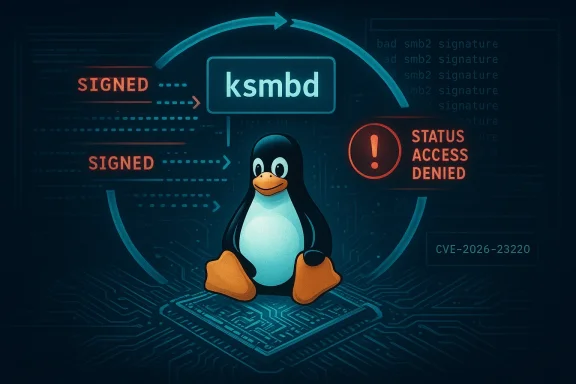
A subtle pointer-reset bug in the Linux kernel's in‑kernel SMB server, ksmbd, has been assigned CVE‑2026‑23220 and fixed upstream; left unpatched the defect can cause the server to loop indefinitely while repeatedly reprocessing the same failed request, flooding logs and driving CPU usage to high levels.
Background
ksmbd is the Linux kernel’s in‑kernel implementation of the SMB/CIFS server protocol. It was developed to provide a high‑performance server path inside the kernel, reducing context switches and improving throughput compared with userspace SMB servers in certain workloads. Over the last several kernel releases the ksmbd area has received frequent fixes that strengthen robustness, close races, and tighten input validation — a pattern that continued into early 2026 with the fix for CVE‑2026‑23220.This particular defect is not a memory corruption or privilege‑escalation bug. Instead, it is a logic/state‑management flaw that appears only along a narrow error path: when the kernel receives a signed SMB2 request and the signature check fails, code that prepares an SMB2 error response resets an offset used to follow chained commands in the same SMB request buffer. By zeroing that offset the server loses the pointer to the next command header; the processing loop then incorrectly believes the failing packet is still the current chained message and reattempts handling it in perpetuity. The result is a denial‑of‑service‑style availability problem for the kernel SMB server: repeated error messages and wasted CPU cycles. The NVD advisory summarizes this behavior and the root cause.
What happened — a concise technical narrative
- A signed SMB2 request arrives at ksmbd and is delivered to __process_request() for validation and handling.
- The code path calls check_sign_req() to verify the SMB2 signature when the message carries the SIGNED flag and the command is one of the types that should be signed.
- If the signature check fails, __process_request() calls set_smb2_rsp_status(work, STATUS_ACCESS_DENIED) to prepare an error response.
- set_smb2_rsp_status() intentionally resets several per‑work fields — among them work->next_smb2_rcv_hdr_off — to zero as part of assembling a fresh error reply buffer.
- Resetting next_smb2_rcv_hdr_off discards the offset that pointed to the next command header when the original packet contained a chain of SMB2 commands.
- Because the chain pointer is lost, subsequent calls to is_chained_smb2_message() see the same header at the same location and, if the header’s NextCommand field is non‑zero, report that a chained message exists.
- The server’s main processing loop therefore tries to continue handling (or re‑handle) the same failed request repeatedly rather than advancing to the real next command — producing an infinite loop.
Why this is practically important
This is not a remote code‑execution or arbitrary memory‑corruption flaw, but practical operational risk still exists:- The behavior can produce an endless stream of kernel log entries such as “bad smb2 signature” and other diagnostic messages, which rapidly fill logs and obfuscate other important events.
- The loop consumes CPU on the host; on heavily loaded file‑server nodes this can substantially affect I/O throughput and overall service availability.
- Because ksmbd runs in kernel context, recovery frequently requires restarting the host or unloading kernel code paths — neither trivial in production environments that host user data or compute workloads.
- The bug triggers only in specific conditions (signed messages that fail verification and are part of a chained SMB2 buffer), but those conditions are not exotic: misconfigured clients, deliberate malformed traffic, or even buggy signature generation could all trigger the path.
The upstream fix — what changed in the code
The root of the problem was the combination of two behaviors:- set_smb2_rsp_status() aggressively zeroed offsets and reset IO vector indices to prepare a clean error response buffer.
- The surrounding control flow assumed it was safe to request continued processing (SERVER_HANDLER_CONTINUE) after invoking set_smb2_rsp_status(), implicitly trusting the offset state.
In practice the patch does not alter how valid signed requests are handled; it only affects the continuation behavior when a signature check returns an error and the response‑preparation function resets work state that would otherwise be used to continue. That makes this fix low risk to functionality while high payoff for stability.
Attack surface and threat model
- Attack type: local or remote denial‑of‑service (DoS) against the ksmbd service on the host. An attacker that can send SMB2 traffic to a host running ksmbd can attempt to send malformed or incorrectly signed chained requests to try to trigger the condition.
- Exploitability: moderate in the sense that an attacker needs to reach the ksmbd service and craft packets that fail signature checks while using chaining; that is easier in misconfigured networks or when an attacker can impersonate an SMB client on the same network segment.
- Privilege impact: DoS/availability. The bug does not appear to provide a path to code execution or privilege escalation; it is a logic loop causing resource consumption. NVD and upstream discussions do not list memory‑safety or RCE concerns for this CVE.
Who’s affected
- Any distribution or device that ships the Linux kernel with ksmbd enabled (either built‑in or as a module) and that has not applied the upstream fixes is potentially affected.
- Many mainstream distributions that expose ksmbd functionality have historically backported or packaged ksmbd fixes into stable kernels; check your vendor’s kernel advisory for the specific CVE mapping and kernel/patch level that includes this fix. Enterprise trackers such as Red Hat Bugzilla show distribution triage and backport plans.
- Environments that expose SMB services directly (for example, storage appliances, NAS devices, or virtual machines offering file shares) should consider the presence of ksmbd in the deployed kernel and whether it is used in the data path.
Detection and indicators
Because the bug manifests as repeated handling of the same failed request, a number of practical signs can help detect attempted or actual triggering:- Kernel logs flooded with repeated messages indicating signature failures — messages such as bad smb2 signature or repeated error codes tied to smb2 signature checks.
- Elevated CPU usage localized to the ksmbd thread(s) or kernel context when file‑server traffic is present.
- Sudden reduction in SMB throughput or timeouts for legitimate clients while the kernel spins on the loop.
- Repeated patterns in connection logs where the same client or series of chained requests correlate with the timing of log spam and CPU spikes.
Mitigation and remediation
- Patch: The primary remediation is to install kernel updates that include the upstream fix for CVE‑2026‑23220. Upstream commits and stable‑tree patches have already been posted, and distribution vendors commonly publish backports; apply the appropriate kernel update or vendor patch as soon as practicable.
- Workarounds: If patching immediately is impossible, consider the following mitigations:
- Disable ksmbd entirely if it is not being used. If neither kernel nor userspace components require in‑kernel SMB, unloading or blacklisting the ksmbd module reduces exposure.
- Restrict network exposure to SMB services. Use firewall rules, host‑based access controls, and network segmentation to limit which hosts can send SMB traffic to the machine.
- Apply IDS/IPS signatures that detect repeated failed signature checks or suspicious chained SMB2 messages; while signature coverage may be imperfect, it can raise alerts for anomalous behaviour.
- Monitoring: Increase logging and set up alerts for the symptoms described in the Detection section. Early detection reduces mean time to repair and prevents log saturation from masking other incidents.
- Incident response: If you see persistent kernel spin and log flooding tied to ksmbd, prepare for a kernel restart as the reliable remedy to break the loop; in production clusters consider live migration or service failover first where possible. Document the event and collect packet captures and logs for forensic review before rebooting if legal or operational constraints require preservation of evidence.
Assessing the fix: strengths and potential risks
Strengths
- The upstream fix is minimal and surgical: changing the handler return value to abort the loop avoids reprocessing invalidated buffers and has minimal potential for functional regressions. That makes it an ideal emergency fix with low risk for downstream regressions.
- The change targets a specific error path and does not alter normal processing semantics for valid signed requests.
- The patch is present in stable trees and has been discussed on the standard upstream mailing lists and stable review threads, making vendor backporting straightforward for distributions.
Potential risks / caveats
- While the fix prevents the infinite loop, it also terminates processing of the particular work item; if a legitimate but transient signing error occurs, that chained command will be aborted. In practice this is appropriate — a failed signature indicates a malformed or unauthenticated packet — but operators expecting different failure semantics should be aware of the change.
- Any kernel fix, even small ones, risks exposing latent bugs in adjacent code paths. Distributions should test backports, especially on appliances or specialized builds where ksmbd behavior is part of the storage or virtualization data plane. The ksmbd area has historically received many targeted fixes; operators with strict availability SLAs must validate the new kernel in staging before wide deployment.
- The broader risk is operational: administrators who do not monitor kernel logs or who expose SMB services broadly may miss attack attempts that exploit such logic defects to cause outages. Patching alone reduces risk but is not a substitute for proper service exposure controls and monitoring.
Practical guidance for administrators
- Prioritize patching: treat CVE‑2026‑23220 as a moderate‑priority availability bug for any host running ksmbd in production. Confirm vendor notices and apply the kernel updates that include the upstream commit.
- Inventory: identify which hosts have ksmbd loaded or built in, which containers or VMs rely on kernels that may include ksmbd, and whether any NAS or appliance images use that kernel. Vendor attestations can be helpful but are product‑scoped; do not assume a vendor attestation for one product implies other artifacts are safe without explicit confirmation.
- Staging: test updated kernels in a staging environment that exercises the SMB code path, especially chained request scenarios and client signature handling.
- Network hygiene: reduce SMB exposure through ACLs and firewalling. Prefer allowing SMB only from known clients or internal subnets and deny SMB over public networks entirely.
- Logging and alerting: add rules to detect repeated signature failures or excessive kernel log churn related to ksmbd. Automation can reduce the time to detect and remediate an incident initiated by this bug.
- For appliance vendors: coordinate with distribution suppliers to ensure backports are applied to long‑term support kernels and publish clear guidance to customers about patch timing and any required service restarts.
Broader context — ksmbd’s maturity and ongoing hardening
ksmbd has matured rapidly as an in‑kernel server offering performance advantages, but kernel‑space protocol implementations have unique risk profiles: a misbehaving packet handler affects core system availability. Over the past several years a steady stream of ksmbd fixes has addressed races, reference counting issues, input validation, and now logical pointer/reset mistakes. The pace and nature of these fixes reflect both active maintenance and the structural complexity of supporting a network protocol inside the kernel. Community mailing lists and stable‑tree patches show regular backports and vendor engagement to keep production kernels safe. Administrators should view ksmbd as a maintained component but one that benefits from cautious exposure and prompt patching.Conclusion
CVE‑2026‑23220 is a clear example of how small state changes in an error path can produce outsized operational problems in kernel code. The vulnerability is not a privilege‑escalation or memory‑corruption flaw, but its capacity to produce infinite loops, log flooding, and CPU exhaustion in a kernel file‑server makes it a meaningful availability risk for systems that run ksmbd. The upstream patch is targeted and low risk, and distributions have the necessary stable commits and mail‑thread context to backport the change; the immediate operational answer is simple and decisive: identify affected hosts, apply the kernel update that includes the fix, and harden exposure and monitoring for SMB services in the meantime.Source: MSRC Security Update Guide - Microsoft Security Response Center
