

Using the uploaded CVE text plus kernel and Microsoft advisory context, I’m drafting the article as a publish-ready feature with no citations or links in the body per your output contract.
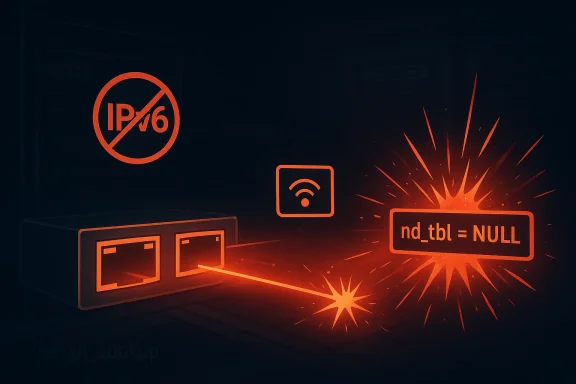
A newly disclosed Linux kernel flaw, tracked as CVE-2026-23381, exposes a sharp edge in bridge networking when IPv6 is disabled at boot but bridge neighbor suppression remains enabled. In practical terms, the bug can trigger a kernel NULL pointer dereference if an ICMPv6 Neighbor Discovery packet reaches the bridge, causing a crash path inside
The vulnerability sits in one of the least glamorous but most important layers of Linux networking: the bridge subsystem. Bridges are often used in virtualized environments, container hosts, lab networks, and appliances where packet forwarding behavior matters just as much as throughput. When bridge features such as neighbor suppression are enabled, the kernel attempts to filter or manage certain IPv6 Neighbor Discovery behaviors to reduce unnecessary flooding and improve efficiency.
The problem begins when a system is booted with
The record for CVE-2026-23381 is still being enriched, so the public data set remains sparse on scoring and impact classification. But the kernel-side description is detailed enough to show the mechanics of the flaw, and the fix is already clear: replace the unconditional
This is also a useful reminder that Linux kernel CVEs often arise from configuration-dependent logic bugs, not just from classic memory corruption. The kernel may be highly modular, but the modules still have to agree on who owns initialization, who checks feature availability, and who refuses to touch data structures that were never created. When that contract is broken, the result is often a crash rather than an exploit—but crashes in kernel space are still serious, especially on servers and appliances that need to stay online.
IPv6 Neighbor Discovery is one of those areas where the kernel does a lot of work behind the scenes. It resolves neighboring nodes, manages reachability, and helps maintain link-layer mappings. When a bridge is configured to suppress certain neighbor traffic, the kernel tries to avoid broadcasting unnecessary discovery chatter across ports. That can be a useful optimization, but it also means the bridge code becomes dependent on the state of IPv6 internals.
The vulnerability described in CVE-2026-23381 appears in a very specific sequence. If the system is booted with
That makes this bug a good example of why kernel code cannot rely on broad compile-time assumptions when runtime state matters. The distinction between “IPv6 support is built into the kernel” and “IPv6 is actually enabled and initialized at runtime” is not cosmetic. It is the difference between a safe branch and a dereference into the void.
The stable-tree fix was straightforward enough that it was backported through multiple branches, which is usually a sign the upstream maintainers considered it small, contained, and low-risk to apply. But small fixes can mask larger architectural lessons. The real issue is not just one missing check; it is the broader tension between feature disabling and code paths that remain partially active.
The failure chain is very specific. The packet arrives, the bridge layer invokes
The change in the fix replaces the use of
The replacement of
This fix also avoids turning the bridge code into a patchwork of one-off null guards. Instead, it restores the intended relationship between IPv6 activation and neighbor suppression logic. In security terms, that is preferable because it reduces the chance of future code drift creating a second bug at a nearby call site.
Another subtle benefit is maintenance clarity. Future developers reading the code will be less likely to believe that suppression logic is safe under all configurations. The guard now signals an architectural truth: if IPv6 is disabled, NS/NA suppression should not participate in packet handling at all.
Enterprises often disable IPv6 for reasons that are not purely technical. Some do it to reduce configuration complexity, some to match older compliance baselines, and others because an internal application stack was never tested against dual-stack behavior. That makes this CVE especially relevant: the more an organization treats IPv6 as “off,” the more likely it is to underestimate IPv6-related logic still present in the kernel.
On the other hand, this vulnerability is also a reminder that disabling IPv6 does not automatically eliminate IPv6 code paths. Kernel subsystems may still contain callbacks or packet classifiers that expect IPv6-related structures to exist. That gap between perceived and actual exposure is where configuration-based vulnerabilities thrive.
Consumer devices are also more likely to be configured through vendor defaults rather than deliberate admin choices. That means a feature combination like “IPv6 off, neighbor suppression on” can exist simply because a product team used a tuned baseline that was never stress-tested under every traffic condition. In embedded environments, default behavior is security policy whether anyone intended it to be or not.
The Linux kernel team has long treated many bugfixes as CVE-worthy because the security boundary is so broad. The kernel’s own CVE documentation notes that almost any bug can be relevant to system security depending on context, and that applicability is up to the user’s deployment. That philosophy fits this case well: the vulnerability is highly configuration-dependent, but configuration dependence does not make it unimportant.
This is especially true in networking, where code paths often serve both performance and compatibility goals. A feature like neighbor suppression may be perfectly sensible when IPv6 is live, but that does not mean the same logic should remain armed when IPv6 is disabled. The bug exists because that boundary was too soft.
That creates a familiar challenge for operators: patch visibility can be fragmented. A distribution may consider the issue fixed in one kernel stream while a different appliance vendor ships an older branch with the same networking behavior. The CVE itself gives you a common identifier, but not a universal remediation package.
This is why CVE coordination in the Linux world can feel both precise and messy at once. The CVE points to one vulnerability, but the actual remediation may land through multiple trees, vendor branches, and release trains. That is normal for a project of this scale, though it can complicate operational compliance.
The wider ecosystem has increasingly emphasized hardening, telemetry, and safe defaults. Bugs like this one reinforce the argument that protocol-disable knobs must be handled with exceptional care. If a feature is disabled, code paths that depend on it should become inert, not merely unlikely. That principle matters across the industry, whether the product is a general-purpose Linux distribution or a tightly controlled embedded appliance.
What matters now is whether operators use this bug as a one-off patch item or as a trigger for broader network-stack review. Systems that disable IPv6 should be examined for other assumptions about neighbor tables, suppression logic, and packet handlers that may still presume IPv6 state exists. That kind of review pays off because kernel bugs rarely arrive alone.
Source: NVD / Linux Kernel Security Update Guide - Microsoft Security Response Center
A newly disclosed Linux kernel flaw, tracked as CVE-2026-23381, exposes a sharp edge in bridge networking when IPv6 is disabled at boot but bridge neighbor suppression remains enabled. In practical terms, the bug can trigger a kernel NULL pointer dereference if an ICMPv6 Neighbor Discovery packet reaches the bridge, causing a crash path inside
neigh_lookup() through br_do_suppress_nd(). The fix is small, but the lesson is bigger: kernel configuration choices that look like simple feature toggles can still leave surprising attack surface behind.
 Overview
The vulnerability sits in one of the least glamorous but most important layers of Linux networking: the bridge subsystem. Bridges are often used in virtualized environments, container hosts, lab networks, and appliances where packet forwarding behavior matters just as much as throughput. When bridge features such as neighbor suppression are enabled, the kernel attempts to filter or manage certain IPv6 Neighbor Discovery behaviors to reduce unnecessary flooding and improve efficiency.The problem begins when a system is booted with
ipv6.disable=1. In that mode, the IPv6 stack is not fully initialized, which means the kernel’s nd_tbl structure never gets populated through the usual initialization path. If the bridge code later assumes IPv6 state exists and dereferences ipv6_stub->nd_tbl, it can end up passing a NULL pointer into neigh_lookup(). That is not a subtle failure: it is a direct crash path in interrupt context, exactly the kind of bug administrators dread because it can take down a machine with little warning.The record for CVE-2026-23381 is still being enriched, so the public data set remains sparse on scoring and impact classification. But the kernel-side description is detailed enough to show the mechanics of the flaw, and the fix is already clear: replace the unconditional
IS_ENABLED(IPV6) style assumption with ipv6_mod_enabled() in the callers. That effectively disables NS/NA suppression when IPv6 is disabled, which is the correct behavior for a feature that depends on the IPv6 stack being alive in the first place.This is also a useful reminder that Linux kernel CVEs often arise from configuration-dependent logic bugs, not just from classic memory corruption. The kernel may be highly modular, but the modules still have to agree on who owns initialization, who checks feature availability, and who refuses to touch data structures that were never created. When that contract is broken, the result is often a crash rather than an exploit—but crashes in kernel space are still serious, especially on servers and appliances that need to stay online.
Background
The Linux bridge code is widely used because it provides a flexible way to connect interfaces at Layer 2. In cloud and virtualization setups, it is often the glue between guest VMs, containers, and physical NICs. Bridge features accumulate over time, and so do the number of assumptions inside them, especially around IPv6 handling, neighbor tables, and suppression logic.IPv6 Neighbor Discovery is one of those areas where the kernel does a lot of work behind the scenes. It resolves neighboring nodes, manages reachability, and helps maintain link-layer mappings. When a bridge is configured to suppress certain neighbor traffic, the kernel tries to avoid broadcasting unnecessary discovery chatter across ports. That can be a useful optimization, but it also means the bridge code becomes dependent on the state of IPv6 internals.
The vulnerability described in CVE-2026-23381 appears in a very specific sequence. If the system is booted with
ipv6.disable=1, inet6_init() exits before ndisc_init() can populate nd_tbl. Later, if neighbor suppression is enabled and an ICMPv6 Neighbor Discovery packet arrives, the bridge code reaches for ipv6_stub->nd_tbl and finds nothing there. The failure then happens when neigh_lookup() is handed a pointer that should never have been null in the first place.That makes this bug a good example of why kernel code cannot rely on broad compile-time assumptions when runtime state matters. The distinction between “IPv6 support is built into the kernel” and “IPv6 is actually enabled and initialized at runtime” is not cosmetic. It is the difference between a safe branch and a dereference into the void.
The stable-tree fix was straightforward enough that it was backported through multiple branches, which is usually a sign the upstream maintainers considered it small, contained, and low-risk to apply. But small fixes can mask larger architectural lessons. The real issue is not just one missing check; it is the broader tension between feature disabling and code paths that remain partially active.
Why bridge code is exposed
The bridge subsystem does not live in isolation. It sits in the packet path and sees traffic that often arrives before higher-level policy can intervene. That makes bugs in its fast path especially relevant on systems that process a lot of traffic or use virtualization heavily. A NULL pointer dereference in this area can easily become a denial-of-service event even if no data is leaked or overwritten.- Bridges operate close to the ingress path.
- Neighbor suppression changes packet handling behavior.
- IPv6-disabled systems can still encounter code that assumes IPv6 state exists.
- Kernel crashes in softirq or IRQ context are especially disruptive.
What Exactly Broke
At the center of the bug is thend_tbl pointer, which should represent IPv6 neighbor discovery table state. Under normal conditions, the kernel sets that up during IPv6 initialization. Under the ipv6.disable=1 boot parameter, that setup never finishes, leaving the bridge code with a pointer that is effectively uninitialized by omission.The failure chain is very specific. The packet arrives, the bridge layer invokes
br_do_suppress_nd(), and that function attempts to consult neighbor discovery state to decide whether suppression logic applies. But because the IPv6 subsystem is disabled, the nd_tbl reference is null, and the call to neigh_lookup() ends up dereferencing invalid memory. The reported crash log shows the fault happening in a networking receive path rather than in a user-triggered ioctl or sysfs call.The crash path in plain English
The trace matters because it shows how quickly a packet can become a kernel panic. An ICMPv6 Neighbor Discovery packet reaches the bridge, the bridge attempts to process it, and then the kernel hits a NULL pointer dereference inneigh_lookup(). That is enough to interrupt normal packet handling and potentially destabilize the host.- IPv6 is disabled at boot with
ipv6.disable=1. ndisc_init()never initializes the neighbor discovery table.- Neighbor suppression remains enabled on the bridge.
- An ICMPv6 ND packet arrives.
br_do_suppress_nd()dereferencesipv6_stub->nd_tbl.neigh_lookup()receives a null table pointer and crashes.
The change in the fix replaces the use of
IS_ENABLED(IPV6) with ipv6_mod_enabled() in the relevant callers. That sounds small, but it changes the decision from a compile-time or build-time assumption to a check that better reflects the actual runtime availability of the IPv6 module. In other words, the kernel is being told to ask, “Is IPv6 really available right now?” instead of assuming the answer from configuration.Why NULL dereferences still matter
Kernel NULL dereferences are often dismissed as “just crashes,” but that undersells the operational pain. On a single-user laptop, a crash is annoying. On a virtualization host, a gateway, or a network appliance, it can be a service interruption affecting many workloads at once. The more central the system is to traffic flow, the more serious a crash becomes.- A crash in softirq context can be hard to recover cleanly from.
- Network-facing bugs can be reachable without local login.
- Infrastructure hosts may process the triggering traffic routinely.
- Reboots or failovers can introduce cascading downtime.
Fix Strategy and Code-Level Significance
The kernel fix is elegantly minimal, which is often what you want in low-level networking code. Rather than trying to retrofit a complex null-check deep in the packet-processing chain, the patch ensures that the suppression logic only runs when IPv6 is actually enabled. That prevents the bridge from wandering into a state it should never have assumed was valid.The replacement of
IS_ENABLED(IPV6) with ipv6_mod_enabled() is especially important because it reflects the distinction between build-time capability and runtime readiness. Linux frequently compiles in support for features that might later be disabled by boot parameters, module loading decisions, or distribution defaults. If a code path only checks the former, it can make unsafe assumptions about tables, callbacks, or protocol state.Why runtime checks are better here
Runtime feature detection is not just a style preference. In kernel code, it is often the only reliable way to avoid referencing objects that may never have been initialized. That becomes critical when subsystems are conditionally active but still reachable from common networking paths.This fix also avoids turning the bridge code into a patchwork of one-off null guards. Instead, it restores the intended relationship between IPv6 activation and neighbor suppression logic. In security terms, that is preferable because it reduces the chance of future code drift creating a second bug at a nearby call site.
Another subtle benefit is maintenance clarity. Future developers reading the code will be less likely to believe that suppression logic is safe under all configurations. The guard now signals an architectural truth: if IPv6 is disabled, NS/NA suppression should not participate in packet handling at all.
What the patch really changes
The patch does more than prevent one crash. It narrows the legal operating modes of the bridge code so that invalid combinations are rejected by design. That is a better long-term posture than sprinkling local null checks that treat the symptom but not the assumption failure.- It aligns bridge behavior with IPv6 runtime state.
- It disables neighbor suppression when IPv6 is unavailable.
- It avoids dereferencing an uninitialized neighbor table.
- It reduces future maintenance risk around similar assumptions.
Impact on Enterprises and Virtualized Hosts
The most exposed systems are likely to be servers where bridge networking is part of the day-to-day architecture. Virtualization hosts, container nodes, and edge appliances frequently use bridge devices because they simplify network segmentation and traffic forwarding. If those machines also useipv6.disable=1 for policy or legacy compatibility reasons, the vulnerable condition becomes more plausible.Enterprises often disable IPv6 for reasons that are not purely technical. Some do it to reduce configuration complexity, some to match older compliance baselines, and others because an internal application stack was never tested against dual-stack behavior. That makes this CVE especially relevant: the more an organization treats IPv6 as “off,” the more likely it is to underestimate IPv6-related logic still present in the kernel.
Virtualization changes the stakes
In virtualized environments, the bridge is rarely an optional nicety. It is usually a core datapath component. A crash there can bring down multiple guests, interfere with east-west traffic, and complicate failover orchestration. If the host reboots under load, the operational blast radius can grow quickly.On the other hand, this vulnerability is also a reminder that disabling IPv6 does not automatically eliminate IPv6 code paths. Kernel subsystems may still contain callbacks or packet classifiers that expect IPv6-related structures to exist. That gap between perceived and actual exposure is where configuration-based vulnerabilities thrive.
Enterprise exposure patterns
- Linux virtualization hosts using bridge devices.
- Container platforms with bridged networking.
- Edge gateways that suppress neighbor discovery traffic.
- Appliances shipped with IPv6 disabled by default.
- Mixed environments where legacy assumptions still influence kernel tuning.
Why This Matters for Consumer and Embedded Devices
Although the headline impact is likely strongest in server and infrastructure environments, the bug should not be ignored by consumer-facing systems that use Linux under the hood. Many routers, gateways, and embedded network appliances rely on kernel bridge features or similar forwarding logic. If those devices boot with IPv6 disabled while still handling discovery traffic in a bridged configuration, they may inherit the same failure mode.Consumer devices are also more likely to be configured through vendor defaults rather than deliberate admin choices. That means a feature combination like “IPv6 off, neighbor suppression on” can exist simply because a product team used a tuned baseline that was never stress-tested under every traffic condition. In embedded environments, default behavior is security policy whether anyone intended it to be or not.
Embedded complexity is the hidden risk
The kernel bug is a reminder that embedded vendors often ship long-lived images with a mixture of upstream and downstream changes. That increases the chance that one subsystem believes another is present when, in practice, it is not. A bug like CVE-2026-23381 can therefore sit quietly until a particular traffic pattern arrives.- Consumer routers may use bridge-like forwarding paths.
- IoT gateways often prioritize feature reduction, including IPv6 disabling.
- Embedded vendors may not test rare ND suppression paths thoroughly.
- A simple packet can still trigger a full kernel crash.
Security and Reliability Lessons from the Patch
One reason this CVE stands out is that it blurs the line between a security flaw and a reliability defect. The vulnerability produces a NULL pointer dereference, which is often categorized as a crash issue first and a security issue second. But in kernel space, even a “mere crash” can be weaponized as a denial-of-service condition, and that is enough to justify serious attention.The Linux kernel team has long treated many bugfixes as CVE-worthy because the security boundary is so broad. The kernel’s own CVE documentation notes that almost any bug can be relevant to system security depending on context, and that applicability is up to the user’s deployment. That philosophy fits this case well: the vulnerability is highly configuration-dependent, but configuration dependence does not make it unimportant.
Lessons for maintainers
The patch reinforces a few durable engineering rules. First, a subsystem should never assume that another feature is initialized just because the kernel was compiled with support for it. Second, packet-processing paths should prefer explicit runtime checks over indirect assumptions. Third, feature disablement needs to be tested as a first-class mode, not an afterthought.This is especially true in networking, where code paths often serve both performance and compatibility goals. A feature like neighbor suppression may be perfectly sensible when IPv6 is live, but that does not mean the same logic should remain armed when IPv6 is disabled. The bug exists because that boundary was too soft.
What developers should take away
- Test disabled-feature boot modes, not just enabled ones.
- Treat protocol modules and initialization state separately.
- Avoid letting packet paths assume that tables exist.
- Prefer design-level guards over scattered local fixes.
- Document the dependency between suppression logic and IPv6 readiness.
Compatibility, Backports, and the Stable Tree
Because this issue was resolved in the kernel and then propagated through stable branches, administrators should expect downstream vendors to package it according to their own release cycles. That means the same root bug may appear under different advisory labels, package versions, or distribution backport references. In the Linux ecosystem, the fix path is often not a single upstream commit but a sequence of vendor-integrated updates.That creates a familiar challenge for operators: patch visibility can be fragmented. A distribution may consider the issue fixed in one kernel stream while a different appliance vendor ships an older branch with the same networking behavior. The CVE itself gives you a common identifier, but not a universal remediation package.
Backports are not all identical
Backported fixes often preserve the essence of the upstream change while adapting to older code. That is good for stability, but it also means the exact patch text may vary. Administrators should therefore care less about whether a particular commit hash matches and more about whether their shipped kernel includes the corrected runtime gating around neighbor suppression.This is why CVE coordination in the Linux world can feel both precise and messy at once. The CVE points to one vulnerability, but the actual remediation may land through multiple trees, vendor branches, and release trains. That is normal for a project of this scale, though it can complicate operational compliance.
Practical patching guidance
- Identify whether the system uses bridge networking.
- Check whether IPv6 is disabled with boot parameters.
- Determine whether neighbor suppression is enabled.
- Verify the kernel branch includes the runtime guard fix.
- Reboot only after confirming the patched kernel is active.
Broader Competitive and Ecosystem Implications
For Linux distributors, appliance vendors, and cloud platform teams, this CVE is another example of how deep networking logic can become a support burden if not audited carefully. The cost is not just security response time. It is also the reputational cost of a crash in a subsystem customers assume is mature and battle-tested.The wider ecosystem has increasingly emphasized hardening, telemetry, and safe defaults. Bugs like this one reinforce the argument that protocol-disable knobs must be handled with exceptional care. If a feature is disabled, code paths that depend on it should become inert, not merely unlikely. That principle matters across the industry, whether the product is a general-purpose Linux distribution or a tightly controlled embedded appliance.
What competitors should notice
Vendors competing in cloud, networking, and edge infrastructure will want to avoid the impression that their stacks are brittle under configuration changes. The market is not just judging whether a vulnerability exists; it is judging how quickly a vendor can explain the root cause, ship the fix, and demonstrate that the defect is not symptomatic of a broader quality gap. That is especially true for organizations selling hardened systems or managed Linux services.- Clear advisories reduce operational anxiety.
- Fast backports improve trust in vendor maintenance.
- Good default configurations reduce future exposure.
- Rigorous disable-feature testing becomes a selling point.
- Transparent remediation improves enterprise confidence.
Strengths and Opportunities
The upside of this incident is that it was found, understood, and fixed in a way that is relatively easy to reason about. The patch is narrow, the failure mode is clear, and the operational remediation is straightforward. That makes it a good candidate for fast adoption in downstream kernels and vendor builds.- Simple root cause: the bug is easy to explain and verify.
- Targeted fix: the runtime guard is low-risk.
- Clear exposure model: IPv6 disabled plus neighbor suppression enabled.
- Strong maintenance value: the patch improves long-term code clarity.
- Good backport candidate: minimal behavioral change beyond the fix.
- Useful audit trigger: organizations can scan for the risky configuration combination.
- Improved architectural discipline: the change reinforces correct dependency handling.
Risks and Concerns
The main concern is that the bug exists in a code path many administrators would not think to test under IPv6-disabled conditions. That makes it easy for the issue to linger in production, especially on systems where the network stack has been tuned over time and no one has revalidated the assumptions behind those tunings. It also raises the possibility of similar configuration-dependent defects elsewhere in the kernel.- Configuration blind spots can leave dormant bugs active.
- Network-facing crash paths can produce high-impact downtime.
- Embedded defaults may hide the issue from end users.
- Vendor backport lag can delay effective mitigation.
- Partial feature disablement creates misleading security assumptions.
- Operational complexity makes root-cause analysis harder during outages.
- Adjacent code paths may share the same architectural flaw.
Looking Ahead
The most likely next step is broad downstream adoption of the fix across enterprise kernels, distribution builds, and appliance images. Administrators should expect the issue to show up in vendor advisories once packaging catches up, and they should treat the vulnerable configuration pair as a practical audit item even before every affected release is named. The good news is that the remediation path is narrow enough to apply quickly once identified.What matters now is whether operators use this bug as a one-off patch item or as a trigger for broader network-stack review. Systems that disable IPv6 should be examined for other assumptions about neighbor tables, suppression logic, and packet handlers that may still presume IPv6 state exists. That kind of review pays off because kernel bugs rarely arrive alone.
- Confirm whether the affected kernel is in use.
- Check for
ipv6.disable=1at boot. - Review bridge configurations for neighbor suppression.
- Apply the vendor kernel update that includes the fix.
- Re-test networking after patching to confirm expected behavior.
- Audit adjacent packet paths for similar runtime assumptions.
Source: NVD / Linux Kernel Security Update Guide - Microsoft Security Response Center
