

A newly reported vulnerability labeled CVE-2026-23943—described in some circles as a pre-auth SSH denial-of-service via an unbounded zlib inflate—has triggered concern across operations and security teams, but public authoritative details remain sparse. As of March 17, 2026, the vendor page that was referenced for this CVE returns no usable advisory and mainstream vulnerability repositories do not yet expose a full, corroborated technical write-up. That combination—an alarming summary coupled with an absence of verified vendor guidance—means administrators must act cautiously but promptly: treat the report as a credible indicator of risk, leverage proven mitigations that defend against zlib/SSH inflate issues, and monitor for authoritative patches and advisories from upstream vendors and distribution maintainers.
Compression in SSH has a long and complicated history. The SSH protocol supports optional compression of the encrypted payload using the widely deployed zlib library. Implementations historically offered two models:
What makes the current situation unusual is the mismatch between the terse—or missing—vendor advisory and the technical severity implied by the short description. When an advisory page is unavailable or blank, organizations must rely on established best practices for zlib/SSH hardening rather than waiting for an exact patch window. This article walks through the technical mechanics of the risk, practical mitigations you can apply now, detection guidance, and a risk-based patching plan for mixed environments.
Take these concrete steps now:
Source: MSRC Security Update Guide - Microsoft Security Response Center
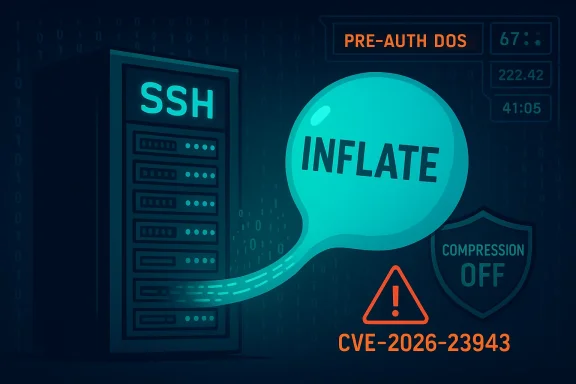 Background / Overview
Compression in SSH has a long and complicated history. The SSH protocol supports optional compression of the encrypted payload using the widely deployed zlib library. Implementations historically offered two models:- Pre-auth compression (the legacy "zlib" method) — compression begins before the user authenticates, immediately after key exchange.
- Delayed compression (the "zlib@openssh.com" extension) — compression is negotiated but not activated until after successful user authentication.
What makes the current situation unusual is the mismatch between the terse—or missing—vendor advisory and the technical severity implied by the short description. When an advisory page is unavailable or blank, organizations must rely on established best practices for zlib/SSH hardening rather than waiting for an exact patch window. This article walks through the technical mechanics of the risk, practical mitigations you can apply now, detection guidance, and a risk-based patching plan for mixed environments.
Why unbounded inflate matters: the technical mechanics
How inflate can be weaponized
At runtime, zlib’s inflate routine expands compressed data into memory. If an attacker can provide compressed data that claims to expand into a very large or malformed buffer, and the surrounding program does not validate limits or handle inflate errors correctly, several failure modes are possible:- Resource exhaustion: inflate reports or attempts to allocate huge amounts of memory to hold expanded data, causing the process to consume excessive RAM and swap and possibly the host to OOM-kill critical processes.
- Crash (DoS): malformed compressed streams trigger error paths in inflate that the embedding program does not handle, causing aborts, segmentation faults, or other fatal errors.
- Heap/stack corruption: past zlib bugs and improper caller handling have led to out-of-bounds reads/writes and double-free conditions that produce crashes and, in rare cases, possible code-execution primitives.
- Amplification via pre-auth input: because compression can be negotiated and used prior to authentication in some setups, an unauthenticated remote attacker can feed malicious compressed packets to the SSH server repeatedly—massively lowering the bar for remote exploitation.
Why SSH makes this worse
SSH daemons often run privileged code paths and accept connections from the open Internet. If compressed input is accepted before authentication, a remote unauthenticated client can:- Establish many simultaneous or repeated sessions that force the server to process inflate() on attacker-controlled streams.
- Exploit poor bounds checking, insufficient fail-fast logic, or missing allocation limits in the SSH daemon or in any helper libraries.
- Exhaust CPU, memory, or file-descriptor resources on network-facing hosts, creating high-availability incidents.
Current status and verification (March 17, 2026)
- The initial pointer to a vendor advisory appears to come from a Microsoft Security Response Center (MSRC) identifier for CVE-2026-23943, but the referenced update guide page currently does not provide a human-readable advisory.
- Major public CVE/NVD listings and mainstream vendor advisories (distributions, vendor product pages) do not yet provide a comprehensive, corroborated technical bulletin for CVE-2026-23943 as of the date above.
- Given the absence of a full advisory on authoritative channels, this appears to be an early-stage or partially disclosed issue. That does not mean the risk is negligible; rather, it means the community must respond defensively and rely on prior zlib/SSH mitigation patterns until patches or vendor recommendations arrive.
Immediate, practical mitigations (what to do right now)
If you manage Linux servers, network appliances, or embedded devices that expose SSH, apply these immediate mitigations in order. They are practical, low-cost, and reduce exposure to inflate-based attacks even if a precise exploit is not yet published.1) Reduce external exposure
- Block or limit inbound SSH access from the public internet wherever possible. Use VPNs, bastion hosts with strict access controls, or allowlisted source IPs.
- Move SSH to internal-only interfaces for machines that do not require remote internet access.
- Harden perimeter devices (bastions, jump servers, VPN gateways) first—these are the highest-value targets for availability attacks.
2) Disable untrusted compression modes
- Edit your sshd configuration and disable compression if your environment can tolerate it:
- Set
Compression noin /etc/ssh/sshd_config to turn off compression for all sessions. This eliminates zlib processing in SSH altogether. - If you need compression for performance, ensure your OpenSSH build uses only delayed compression (the
[email]zlib@openssh.com[/email]extension) which activates after authentication—this constrains unauthenticated input. - Note: disabling compression has CPU/latency trade-offs. Test before rolling changes into heavy-load systems. If you cannot disable compression globally, prioritize public-facing hosts.
3) Upgrade software
- Patch zlib to the latest stable version available for your distribution or product. Vendors patches for zlib decrees have fixed known inflate issues in the past; keep zlib current.
- Upgrade OpenSSH and SSH-related libraries (libssh, libssh2, or embedded SSH stacks) to the latest vendor-supported releases. Many distributors backport mitigations; install vendor-provided SSH patches as a priority.
- For embedded devices and appliances, check the vendor security bulletins and apply firmware updates promptly.
4) Apply resource and connection limits
- Tighten SSH server resource controls in sshd_config:
MaxStartups— limit unauthenticated concurrent connections to reduce parallel attack surface.LoginGraceTime— shorten the window attackers can tie up sessions.MaxAuthTriesandMaxSessions— restrict repeated use.- Use process-level resource limits:
- In systemd units for sshd, set
MemoryMax=,CPUQuota=, and other limits to bound per-service resource consumption. - Set
ulimitfor memory and file descriptors where appropriate.
5) Network-layer rate limiting and filtering
- Use firewall rate-limiting (iptables/nftables, cloud security groups, edge firewalls) to throttle SSH SYNs and connections from individual IPs to prevent flooding.
- Employ connection tracking, geo-blocking (if appropriate), and intrusion prevention appliances that can block repeated abnormal SSH requests.
6) Monitoring and fallback
- Monitor logs for sshd crashes, segfaults, OOM conditions, or repeated "preauth" errors—those could indicate exploitation attempts.
- Keep a temporary process for rapid response: have a pre-tested plan to disable SSH or move management to an alternate out-of-band channel should attack cause severe service disruption.
Detection and triage guidance
A fast, accurate triage is essential. Look for these signals on servers and network devices:- System logs (journalctl or /var/log/messages/syslog) showing sshd crashes, segmentation faults, or repeated "preauth" warnings.
- High memory/CPU usage on sshd processes or sudden increase in swap and OOM kill events.
- Core dumps or crash traces referencing zlib routines or
inflate(). - Abnormally high counts of SSH connections in the TIME_WAIT or ESTABLISHED state.
- IDS/IPS alerts showing malformed compressed payloads against SSH sessions.
- Check sshd configuration for compression settings:
1.) grep -i Compression /etc/ssh/sshd_config - Query SSH server compression capability using an SSH client with verbose output:
1.) ssh -vvv user@host (look for compression lines in kex and transport debug) - Examine current sshd version:
1.) sshd -v (or check package manager: dpkg -l openssh-server or rpm -q openssh) - Check system resource spikes:
1.) top, ps aux --sort=-%mem, free -m, journalctl -u sshd -n 200 - Look for crashes:
1.) coredumpctl list, journalctl -k, /var/log/messages
Remediation and patch management plan
Because a confirmed vendor patch for CVE-2026-23943 is not yet public, create a prioritized plan that balances operational risk and patch windows.- Immediate (within 24–72 hours)
- Harden external access (block or reduce exposure).
- Disable SSH compression on internet-facing hosts where feasible.
- Implement firewall rate-limiting and MaxStartups tightening.
- Confirm that monitoring and alerting are in place.
- Short-term (within 1–2 weeks)
- Apply vendor zlib and SSH updates as they become available from trusted sources.
- Patch critical appliances and bastion hosts first, then jump servers and developer laptops.
- Test patches in staging before broad rollout.
- Medium-term (1–3 months)
- Audit embedded devices, IoT endpoints, and appliances that may bundle older zlib/SSH stacks and coordinate vendor updates or compensating controls.
- Adopt a defense-in-depth posture: centralize SSH access through hardened jump hosts and require device management via orchestrated, auditable tooling.
- Long-term (3–12 months)
- Introduce supply-chain hygiene: track third-party components that bundle zlib and require vendors to publish their zlib versions and update cadence.
- Automate vulnerability scanning and prioritize zlib/SSH-related CWE/CVEs in your internal scoring.
Risk analysis: who should be most worried
- High risk: Internet-exposed bastion hosts, SFTP servers, CI/CD runners that accept wide-source SSH, and appliances with no straightforward upgrade path.
- Moderate risk: Internal servers with SSH exposure from segmented networks, and developer workstations that are reachable via corporate VPN but have accessible SSH daemons.
- Lower risk: Systems that have SSH entirely disabled, that only accept management via isolated out-of-band consoles, or that have hardened SSH stacks where compression is already disabled.
- A public-facing SSH server that crashes or is resource-exhausted could lock out administrators and disrupt backups, deployments, or forensic access.
- If an embedded device (e.g., network appliance) is repeatedly crashed by malformed inflate data, attacker could create persistent availability outages across an operational network.
- While most inflate-oriented issues produce availability impacts, incomplete or buggy bounds-checking has historically been escalated into memory corruption and, in rare chains, code execution. Assume DoS is the baseline impact and RCE is the possible worst case until confirmed otherwise.
Strengths and weaknesses of the current defensive posture
Notable strengths
- The security community and distributions have decades of experience responding to zlib-related vulnerabilities—there is a well-tested playbook: disable compression, patch zlib, tighten SSH limits, and network-rate limit.
- Modern OpenSSH releases support delayed compression (zlib@openssh.com), which removes most of the risk from unauthenticated input when enabled properly.
- Systemd, container orchestration, and cloud platforms provide resource-bounding primitives (MemoryMax, CPUQuota, pod resource requests/limits) that can blunt large-scale resource-exhaustion attacks.
Potential risks and shortcomings
- Many appliances and legacy embedded devices bundle older zlib and cannot be rapidly patched. These devices are high-risk and often under-inventoried.
- Disabling compression impacts throughput and CPU load; teams may resist applying these mitigations broadly without testing.
- Incomplete or delayed vendor communication (as seen in this partial advisory situation) creates a dangerous window where operators must make defensive moves without firm technical specifics.
- Reconnaissance and scan tools may produce noisy false positives; defenders must tune detection carefully to avoid chasing every anomalous SSH packet while still capturing true exploitation attempts.
How to communicate this to stakeholders
- For operations leadership: convey that this is a probable availability risk tied to SSH compression and zlib inflate, recommend immediate perimeter mitigation (restricting SSH), and prioritize bastion and management-plane hosts for patching or configuration changes.
- For security teams: notify of increased IDS sensitivity for SSH pre-auth anomalies and escalate any sshd crashes or core dumps immediately. Create runbooks to switch to out-of-band access if primary management plane is disrupted.
- For procurement and asset owners: initiate an audit of appliances and embedded systems to identify and obtain vendor firmware updates or replace unsupportable units.
Conclusion and action checklist
CVE-2026-23943, as reported, points to a classic but still dangerous class of vulnerability: untrusted inflate input in an SSH pre-auth context. History shows that zlib inflate issues repeatedly produce availability impacts—and sometimes worse—when embedded in network-facing servers.Take these concrete steps now:
- 1.) Restrict SSH access from the internet; require VPNs or allowlists.
- 2.) Disable SSH compression globally on internet-facing hosts (set
Compression no), or ensure only delayed compression is used. - 3.) Patch zlib and SSH packages the moment vendor updates are available; prioritize bastion hosts, jump servers, and appliances.
- 4.) Harden sshd with resource and connection limits (MaxStartups, MemoryMax, ulimit).
- 5.) Implement firewall rate-limits and monitoring rules, and watch logs for sshd crashes and unusual preauth activity.
- 6.) Audit embedded devices and vendor-supplied appliances; schedule vendor firmware updates or compensating controls.
Source: MSRC Security Update Guide - Microsoft Security Response Center