

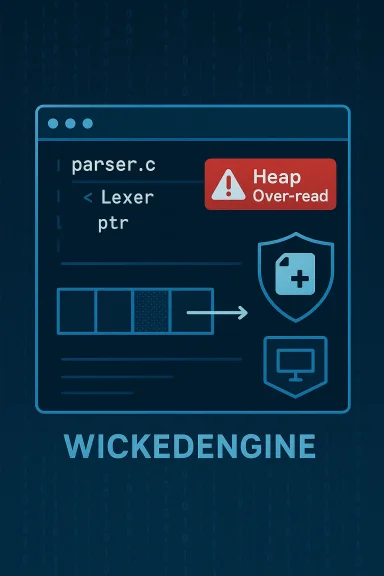
A heap-based buffer over-read has been assigned CVE-2026-24821 after researchers identified a flaw in the Lua parsing code of turanszkij’s WickedEngine that can be triggered when the engine compiles untrusted Lua code; the flaw is rooted in lparser.C and affects WickedEngine releases through 0.71.727, and maintainers have merged corrective changes upstream. (github.com)
WickedEngine is an open-source C++ 3D engine that ships with a lightweight editor and built-in Lua scripting support, used by hobbyist developers, mod authors, and lightweight tools. The engine’s convenience features — dynamic runtime scripting, editor-side script compilation, and mod support — are strengths for rapid iteration but also create an attack surface when untrusted scripts are allowed to execute or be compiled on a user’s system.
Lua is widely used as an embedded scripting language because of its small footprint and C API, but the history of vulnerabilities around Lua wrapper code and custom integrations shows that copying or cloning Lua internals without the upstream security patches can reintroduce long-resolved weaknesses. In this case, the problematic code lives in the engine’s Lua parser implementation (lparser.C), and the resulting vulnerability has been cataloged by public vulnerability databases.
Exploitability depends on:
This CVE is also a useful reminder that embedding scripting interpreters requires a disciplined process for tracking security patches and for isolating the potentially dangerous act of compiling third-party code. If you run or ship WickedEngine-based software, prioritize the update and add extended QA around any scripting and parser functionality to prevent future regressions.
Source: MSRC Security Update Guide - Microsoft Security Response Center
 Background
WickedEngine is an open-source C++ 3D engine that ships with a lightweight editor and built-in Lua scripting support, used by hobbyist developers, mod authors, and lightweight tools. The engine’s convenience features — dynamic runtime scripting, editor-side script compilation, and mod support — are strengths for rapid iteration but also create an attack surface when untrusted scripts are allowed to execute or be compiled on a user’s system.Lua is widely used as an embedded scripting language because of its small footprint and C API, but the history of vulnerabilities around Lua wrapper code and custom integrations shows that copying or cloning Lua internals without the upstream security patches can reintroduce long-resolved weaknesses. In this case, the problematic code lives in the engine’s Lua parser implementation (lparser.C), and the resulting vulnerability has been cataloged by public vulnerability databases.
What the vulnerability is (technical overview)
The flaw: heap-based buffer over-read
At its core, CVE-2026-24821 is an out-of-bounds read (heap-based buffer over-read) in WickedEngine’s Lua parsing code. An out-of-bounds read occurs when code attempts to read memory past the end of an allocated buffer, which can lead to application crashes or the disclosure of adjacent memory contents. The vulnerable component is identified as lparser.C in the WickedEngine source tree. Public vulnerability records list this as an out-of-bounds read and associate it with the Lua modules included in the engine.Where it is triggered
The vulnerability is specifically relevant in code paths that compile Lua code — not merely read plain text files — which means the most immediate risk surface is any WickedEngine-based product or editor instance that accepts or compiles untrusted Lua source. This includes, but is not limited to:- Game editors that load third-party or user-generated scripts.
- Runtime environments that accept remote or user-contributed Lua scripts and compile them dynamically.
- Any tooling built on WickedEngine that exposes Lua script compilation to non-trusted inputs.
Intended impact vs. real-world impact
A heap-based out-of-bounds read most commonly enables information disclosure (reading adjacent memory contents) and may cause instability or crashes. In some chained-exploit scenarios a memory disclosure can help an attacker defeat ASLR or otherwise facilitate a follow-on exploit that achieves code execution, but a standalone out-of-bounds read is typically not enough for unauthenticated remote RCE. The exact exploitability depends on environment details (build flags, compiler, memory layout, mitigations such as ASLR/DEP, and how Lua state and buffers are managed at runtime). Public vulnerability records list the weakness and the affected file but do not provide an endorsed public proof-of-concept.Affected versions and fixes
Versions impacted
Public vulnerability trackers and the OSV conversion indicate that WickedEngine releases up to and including 0.71.727 are affected by CVE-2026-24821. The vulnerability record explicitly lists the lparser.C source as the locus of the issue and marks engine builds up through 0.71.727 as within the vulnerable range.Upstream changes and remediation
The WickedEngine repository shows a merged pull request that applies a security patch originally applied upstream to Lua itself — the PR titled “Fix potential vulnerable cloned functions” (PR #1095) merges code to address a cloned function that hadn’t received the same security updates as Lua’s reference implementation. This PR was merged into the project’s master branch and is referenced by vulnerability databases as part of the remediation path. While that PR was originally intended to fix a related Lua cloning issue and was merged earlier (May 3, 2025), the CVE entry points to lparser.C and to the affected version range through 0.71.727; maintainers and downstream packagers should ensure they have incorporated the post-0.71.727 commits that contain the relevant fix. (github.com)- Practical takeaway: update to any WickedEngine build that includes the post-PR commits or a release explicitly labeled as patched after 0.71.727. If maintainers have not published a formal numbered release with the fix, apply the PR diff or the specific commit(s) to your local build and rebuild the binary.
Exploitability and real-world risk
Threat model
The primary risk arises where systems compile Lua content supplied by untrusted or third-party sources. Examples include mod distribution platforms, collaborative editors that accept community scripts, and any server or service that compiles and executes Lua payloads without strict validation.Exploitability depends on:
- Whether the environment compiles untrusted scripts at runtime.
- Build-time mitigations for memory errors (e.g., stack protection, hardened allocators).
- Runtime mitigations (ASLR, DEP/NX, sandboxing) and process privileges.
- Whether an attacker can trigger controlled reads that reveal useful memory for a follow-on exploit.
Public proof-of-concept and detection
As of this article’s publication there is no widely circulated, verified public proof-of-concept exploit for CVE-2026-24821 in mainstream exploit databases and advisory feeds. That lack of a public PoC should not be mistaken for a lack of risk: many impactful CVEs are weaponized rapidly once PoCs are published, and attackers frequently target widely used runtimes with scripting extensions. Organizations that embed WickedEngine or accept third-party Lua content should assume that the vulnerability can be exploited in the right conditions and prioritize mitigation. Treat the absence of public PoC as “unknown but potentially exploitable.”Recommended actions for system administrators and developers
Immediate steps (0–48 hours)
- Inventory: Identify all systems and builds that include WickedEngine and determine whether they accept or compile third-party Lua scripts. Prioritize network-facing editors, public servers, and automated build hosts.
- Short-term mitigation: If you cannot immediately patch, disable Lua script compilation for untrusted inputs, or restrict scripting features to locally hosted, signed, or whitelisted scripts only.
- Apply principle of least privilege: Run editors and build processes with unprivileged accounts and sandboxing. Block access to the editor/engine from untrusted networks where feasible.
- Monitor: Add detection rules for crashes or suspicious Lua compilation activity in your logging/EDR systems. Look for anomalous editor crashes or unexpected calls into the Lua module.
Patching (within days, depending on risk)
- Update WickedEngine to a version that includes the post-0.71.727 fixes, or cherry-pick the GitHub PR(s) that remediate cloned Lua functions and rebuild your binaries. Vulnerability records point to commits that have been merged into master; if your vendor redistributes a patched release, install it. (github.com)
- Confirm that your build incorporates the commit that closes the specific lparser.C issue (validate by comparing your local source to the repository at master after the fix commits).
Long-term developer mitigations (architecture and process)
- Minimize the use of in-process script compilation for untrusted sources. Offload compilation to isolated processes or dedicated build sandboxes where memory corruption cannot directly affect the host application.
- Use script whitelisting, digital signing, or package verification for community-contributed scripts.
- Harden CI pipelines: ensure that any continuous-integration or automated build that compiles third-party code runs in isolated, ephemeral containers with strict resource limits.
- Add fuzzing tests around the Lua parser and other scripting entry points; the vulnerability surfaced in parser code, which is prime fuzzing territory.
- Establish an upstream monitoring cadence for the projects you depend on; small open-source projects may merge fixes quickly but not immediately publish formal releases.
Mitigation checklist (concise)
- Update WickedEngine to a patched release or merge the upstream fix into your build.
- If update is not possible, disable compilation of external Lua scripts or restrict to signed/whitelisted scripts.
- Run editors/build-time processes in sandboxed, least-privilege environments.
- Monitor for crash patterns and unusual Lua compilation events in telemetry.
- Audit any third-party mods or plugins that ship or compile Lua content; scan for obfuscated or compiled artifacts that could attempt to reach the vulnerable path.
- Add regression tests for lparser.C behavior as part of your QA cycle.
How this happened: analysis of root causes and upstream practices
Cloned code and patch drift
The GitHub PR linked to this issue reveals an important pattern: the WickedEngine project had copied or “cloned” some Lua-derived functions into its codebase. Those clones did not automatically inherit subsequent security patches applied to the upstream Lua project. The PR titled “Fix potential vulnerable cloned functions” explicitly applies the same patch to the cloned function that Lua’s upstream project had already fixed. This is a common and avoidable risk when embedding interpreter code: unless the embed keeps pace with upstream security fixes, cloned internals can reintroduce known weaknesses. (github.com)The disclosure timeline and release cadence
The PR that fixed a related cloned-function issue was merged in May 2025, but the CVE assignment and public vulnerability records for CVE-2026-24821 were published in late January 2026. That timeline suggests a lag between the code-level correction, the assignment of a CVE record, and the public distribution of an official patched release. For downstream consumers this creates windows where code is fixed upstream but not yet shipped in a tagged release, complicating automated patch management for enterprises that rely on formal version numbers rather than source-level commits. Public databases that aggregate CVE data (NVD, OSV and others) now list the vulnerability and indicate fixed commits or ranges, but the onus is on integrators to pick the correct point in the repository history and rebuild. (github.com)Critical evaluation: strengths and remaining concerns
Notable strengths
- The WickedEngine maintainers accepted and merged a contributor-supplied fix that applies an established upstream Lua security patch to the engine’s cloned code, which is the correct remediation approach for this class of issue. The presence of a merged PR and public repo history makes it straightforward for downstream users and packagers to backport or rebuild with the fix applied. (github.com)
- Multiple vulnerability trackers have recorded the issue, which helps defenders by raising visibility and enabling automated scanners to detect impacted versions. The coordinated capturing of affected version ranges (through 0.71.727) gives a practical remediation threshold for administrators.
Remaining concerns and risks
- Release cadence / distribution friction: for many organizations the fix is only operational once a formal release is published and packaged by the vendor or distributor. If distributions or vendors lag in publishing patched builds, environments that cannot or will not rebuild from source remain exposed despite an upstream fix being available in the repository. This gap is a recurring supply-chain friction point in open-source dependency management. (github.com)
- Potential for undiscovered clones: the PR fixed a specific cloned function, but large codebases can contain multiple clones or similar logic elsewhere (e.g., ldebug.C and other Lua wrapper files). The related CVE-2026-24820 suggests other Lua-related components in the same project were tracked separately, indicating that multiple Lua integrations required review. A thorough code audit is advisable rather than a single-commit patch-and-forget approach.
- No public PoC does not equal no exploit: attackers frequently weaponize parser-level bugs once PoCs or minimal descriptions are available. Organizations that accept contributions or mods should assume realistic risk and prioritize mitigation even in the absence of an observed exploit in the wild.
For integrators: practical triage steps
1. Rapid triage script
- Scan your build tree for the presence of WickedEngine code and identify the engine version string included in binaries or source.
- Search your codebase for calls to Lua compilation APIs (e.g., calls that compile or load Lua source at runtime).
- Identify any network- or user-exposed paths that can deliver script content to the compilation logic.
2. Risk prioritization
- Highest priority: public servers or services that compile third-party scripts, editors that automatically import user scripts, and any build farm that executes untrusted content.
- Medium priority: local tools that accept plugins but are not network-exposed.
- Lower priority: static builds that do not accept runtime script input from external parties.
3. Prescriptive blocking
- Block or sandbox the engine from accepting remote scripts until patched.
- Apply file whitelisting or signature checks for any script uploaded to editors or mod hosting systems.
Why developers should care beyond this CVE
Embedded scripting languages are an attractive productivity tool but create perennial security responsibilities. The core lesson from CVE-2026-24821 is straightforward: when you copy or embed interpreter internals, you inherit the maintenance burden of tracking upstream security fixes. The safest long-term approach is to:- Prefer using the upstream interpreter binary or well-maintained bindings rather than cloning internals.
- Maintain an automated dependency monitoring pipeline that alerts you when upstream CVEs affect copied code.
- Add parser fuzzing and regression tests as a routine part of CI for code that touches script parsing or bytecode generation.
Final verdict and conclusion
CVE-2026-24821 is a real, practical vulnerability that specifically targets Lua parsing in WickedEngine and is especially dangerous when the engine compiles untrusted scripts. The vulnerability is an out-of-bounds read in lparser.C that can disclose memory or cause crashes; it affects versions through 0.71.727 and has been associated with upstream fixes merged into the public repository. Organizations using WickedEngine should treat this as actionable: inventory affected assets, apply the upstream fix or a patched release, and implement short-term mitigations such as disabling compilation of untrusted scripts or sandboxing the compilation process. (github.com)This CVE is also a useful reminder that embedding scripting interpreters requires a disciplined process for tracking security patches and for isolating the potentially dangerous act of compiling third-party code. If you run or ship WickedEngine-based software, prioritize the update and add extended QA around any scripting and parser functionality to prevent future regressions.
Source: MSRC Security Update Guide - Microsoft Security Response Center
