

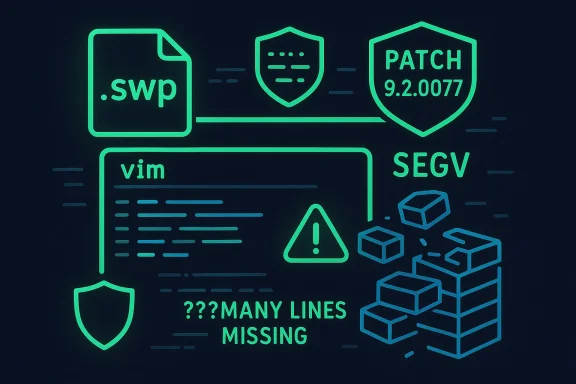
A newly assigned vulnerability, tracked as CVE-2026-28421, discloses a pair of memory-safety issues in the ubiquitous Vim editor: a heap-buffer-overflow and a segmentation fault (SEGV) in Vim’s swap-file recovery logic. The upstream Vim project issued a fix in patch 9.2.0077 (released 27 February 2026); administrators and developers should prioritize updates and apply compensating controls where immediate patching is not possible.
Vim is one of the most widely deployed command-line text editors across developer workstations, servers, containers, and build systems. It creates and uses swap files (.swp and related names) to store transient editing state and enable crash recovery and concurrent-editor detection. The new CVE describes two distinct but related failures that occur when malformed or crafted swap files are processed during the recovery operation.
In short:
Immediate steps (prioritized):
From a risk posture viewpoint, swap files share characteristics with other local-file attack vectors:
If there’s one operational priority from this disclosure: patch promptly where possible, and in parallel apply low-friction mitigations (remove stray swap files, tighten shared-directory permissions, educate users) to reduce the window of exposure while distribution packages roll out. Vigilance and quick action keep a moderate local vulnerability from becoming a larger operational problem.
Source: MSRC Security Update Guide - Microsoft Security Response Center
 Background / Overview
Vim is one of the most widely deployed command-line text editors across developer workstations, servers, containers, and build systems. It creates and uses swap files (.swp and related names) to store transient editing state and enable crash recovery and concurrent-editor detection. The new CVE describes two distinct but related failures that occur when malformed or crafted swap files are processed during the recovery operation.In short:
- The defect class is improper input validation (CWE-20) which produces a heap-based buffer overflow (CWE-122) and an out-of-bounds memory access leading to SEGV.
- The code path at issue is the swap-file recovery routine (ml_recover() reading pointer-block entries, including fields like
pe_bnum,pe_line_count, andpe_page_count). - Upstream fixed the bug in version 9.2.0077; the vulnerability was publicly disclosed and published to vulnerability databases on 27 February 2026.
What exactly goes wrong? Technical breakdown
The root cause is straightforward: during swap-file recovery, Vim reads structured pointer blocks from the swap file without sufficiently validating several numeric fields. Two concrete failure modes are described:- Heap-buffer-overflow: When a crafted swap file provides bogus block numbers (
pe_bnum) or page counts (pe_page_count) that exceed the swap file's size, an internal read (mf_get()) fails. Vim then attempts to recover by appending placeholder text such as"???MANY LINES MISSING"via theml_append()routine. If a crafted swap file causes this recovery behavior enough times, a dynamically sized data structure (thedb_indexarray in the current data block) can be pushed past its allocated bounds, producing a heap overflow. - Segmentation fault (SEGV): If the
pe_bnumvalue in the pointer block is negative, Vim attempts to read from the original file usingreadfile()with offsets and counts derived from the swap file. Because those parameters are unvalidated, Vim can pass garbage values toreadfile()and attempt to access illegal memory addresses, causing a segmentation fault.
Severity and exploitability
This issue has been assigned a CVSS v3.1 vector of AV:L/AC:L/PR:N/UI:R/S:U/C:L/I:L/A:L, corresponding to a medium severity score (reported as 5.3). Translating that vector:- Attack Vector — Local (AV:L): exploitation requires local access (or at least file-write access to a location a user will open).
- Attack Complexity — Low (AC:L): the conditions once local access is available are not complex.
- Privileges Required — None (PR:N): the attacker does not need elevated privileges to place the swap file.
- User Interaction — Required (UI:R): a user must attempt recovery by opening Vim with the affected file (or let Vim auto-recover).
- Impact — Low to Medium on confidentiality/integrity/availability as the primary practical impact is crash/DoS and potential memory corruption that could enable code execution under constrained conditions.
Affected versions and vendor response
- Affected: Vim releases prior to 9.2.0077.
- Patched: 9.2.0077 (patch published 27 February 2026).
- Disclosure timeline: the fix and advisory were published by the Vim project on 27 February 2026; the CVE record was added to public vulnerability databases the same day.
Who is at risk?
High-risk groups include:- Developers and sysadmins who edit files on shared network drives, project mount points, or synchronized folders where an attacker can place files.
- Teams that include external contributors or CI runners which might check out repositories containing stray swap files.
- Users who accept files from untrusted sources and open them directly with Vim without additional checks.
- Build systems and CI containers that run editors as part of scripts or text-processing steps (less common, but possible).
Mitigation and remediation guidance
The single most effective action is to update to the patched version. After that, implement pragmatic mitigations to reduce exposure.Immediate steps (prioritized):
- Patch: Update Vim to 9.2.0077 or later. Where you cannot immediately update, apply the mitigations below.
- Verify your Vim version: run
vim --versionand confirm the patch level or check package manager metadata to identify the package version installed. - Scan for swap files in shared locations:
- Look for files with names like
.filename.swp,.sfilename.swo,.sfilename.swn, and other Vim swap-file conventions in shared directories, project folders, and repositories. - Remove or quarantine unexpected swap files that originated from external sources.
- Don’t open untrusted files: educate users to avoid opening files from untrusted sources or unknown origins with editors that may auto-recover from swap files.
- Configure restrictive shared-directory permissions: reduce or eliminate write access for untrusted principals to folders where users run editors.
- Consider disabling swap recovery in high-risk contexts:
- Use
vim -n(no swap file) or setset noswapfilein Vim profiles only when editing files from untrusted locations. Caveat: disabling swap files removes crash-recovery protections and increases the risk of data loss; use with caution. - Containerize or sandbox editors: in environments where users frequently open unknown files, run editors in ephemeral containers or restricted sandboxes to limit blast radius.
- Monitor for signs of exploitation:
- Unexplained Vim crashes or frequent recoveries from swap files.
- Audit logs showing unexpected writes to shared directories containing .swp files.
- For packaged installations: use your OS package manager (apt, dnf, yum, pacman, zypper, etc.) and install the vendor-provided security update once available. Check your vendor’s security advisory for their release schedule.
- For source builds: fetch the patched upstream release (tag 9.2.0077) and rebuild. Confirm the Git tag or patch level before deploying to production.
- For Windows or alternative binary builds: obtain updated installers or builds from the trusted vendor or the upstream project maintainers.
Detection and investigation tips
If you suspect exploitation or want to triage exposure, these practical steps help:- Search for swap files under user home directories, project directories, and shared mounts:
- Example: find /shared/path -type f -name '.swp' -o -name '.swo' -o -name '*.swn'
- Inspect suspicious swap files in a safe, isolated environment. Do not open them in your normal interactive editor session; analyze metadata (file size, contents as binary) within a sandboxed VM or container.
- Examine audit logs and file-modification timestamps to correlate creation of swap files with other suspicious activity.
- Look for repeated Vim crashes on user machines or in logs from interactive sessions — sudden crashes during file open or during recovery are a strong indicator.
- Quarantine the affected systems.
- Capture memory and crash dumps where possible (follow your incident-response playbook).
- Preserve the malicious swap file for analysis by security teams or anti-malware vendors.
- Rotate credentials if you suspect compromise and perform forensic investigation.
Practical hardening recommendations for teams
- Add a pre-commit or CI check to remove or reject swap files and other editor temp files from repositories. Common patterns to block: .swp, .swo, .swp, .swo, .swn, .viminfo.
- Update onboarding docs and Gitignore templates to include Vim swap files so stray swap files are not committed to repositories.
- For shared network storage (NAS, SMB, NFS), restrict write permissions and enable monitoring to detect unauthorized file creation.
- For enterprise environments, create a policy to scan and remediate editor temp files on shared file servers on a scheduled basis.
- Consider enabling runtime memory protections and process hardening where Vim is used in automation (e.g., challenge-response or seccomp filters in containers).
Why swap files are an attack surface
Swap files exist to enable recovery when Vim or the host crashes, and they contain structured metadata and pointers that the recovery code expects to trust only when generated by a legitimate local Vim instance. Because swap files are just files, they can be dropped onto disk by any actor with write access. The core issue here is the historical trust model: the recovery routine assumed well-formed values and did not defend against deliberately malformed pointer-block fields.From a risk posture viewpoint, swap files share characteristics with other local-file attack vectors:
- They are easy to create and difficult to differentiate from legitimate artifacts without context.
- They may be synced into shared locations by users or tooling.
- Users often open files without verifying the surrounding directory contents.
Supply-chain and distribution considerations
Upstream fixed the issue quickly and published a security advisory and a patch release. However, real-world remediation depends on downstream packaging and vendor patch cycles. Distributors and vendors will typically:- Rebuild and push the patched package into their stable and security repositories.
- Publish distribution-specific advisories with package versions and mitigation details.
Risk analysis — strengths and limitations of the fix
Strengths:- The upstream patch addresses the root cause by validating swap-file pointer-block fields and eliminating the unsafe recovery behavior that produced buffer overflow and SEGV.
- Public disclosure and an explicit patch release enable straightforward remediation: update to Vim 9.2.0077 or later.
- The vulnerability requires a local vector and user interaction, which reduces the immediate chance of large-scale remote exploitation.
- Many environments run older, vendor-curated packages that will lag upstream; there is a window of exposure while downstream packages are rebuilt and propagated.
- The attack vector leverages the common practice of sharing work directories; organizational processes that rely on shared file systems will still be at risk until they remove or quarantine untrusted swap files.
- While the primary impact in real-world exploitation is likely crash/DoS, heap overflows can sometimes be leveraged for code execution in specific environments — the risk depends on the system’s memory-layout hardening and the way Vim is used. Systems lacking modern mitigations (ASLR, PIE, hardened malloc, non-executable heap) present higher exploitation risk.
Recommended immediate action checklist (for engineers and admins)
- Inventory: identify all systems with Vim installed and note versions.
- Patch: update to Vim 9.2.0077 or later as soon as your organization’s change control permits.
- Quarantine: search for and remove unexpected swap files in shared directories and repositories.
- Educate: advise users not to open files from untrusted sources and to avoid editing files in directories that allow untrusted write access.
- Apply compensating controls: where patching is delayed, consider running Vim in a sandbox for untrusted files or using
vim -nto disable swap file creation and recovery. - Monitor: watch for new vendor advisories and watch for crash indicators in endpoint monitoring systems.
- Harden: add ignore rules and repository hygiene to prevent swap files from being checked into shared version-control systems.
Responsible disclosure and credits
The Vim maintainers publicly acknowledged the reporters credited for identifying the issue. The fast upstream response and the published patch allow administrators to remediate quickly. The coordinated release of a fix and public advisory is the ideal outcome for responsible disclosure — it enables the community to patch promptly and vendors to incorporate the fix into distribution packages.Frequently asked practical questions
- How can I check if I’m vulnerable?
- Run
vim --versionor check your package manager’s installed version. If the version is older than the patched release (prior to 9.2.0077), plan to update. - Is remote exploitation possible?
- Not directly. The CVE’s attack vector requires local file placement and user interaction (opening the file in Vim triggers the recovery). However, file placement can occur indirectly (e.g., via shared project directories, sync tools, or supply-chain artifacts), so remote actors who can write files to shared storage still pose a risk.
- Can I safely open a suspicious swap file to inspect it?
- No. Inspect suspicious swap files in a controlled, isolated environment (sandbox or VM). Opening the file with a vulnerable Vim instance on a production workstation risks triggering the recovery logic.
Final assessment
CVE-2026-28421 is a textbook example of how a benign feature (swap-file recovery) can be turned into an attack surface when input validation is insufficient. The vulnerability is not a remote, unauthenticated wormable flaw, but it is practically exploitable in collaborative developer workflows and shared-storage environments — environments that are increasingly common in modern software development. The upstream fix in 9.2.0077, combined with sensible operational hygiene (scanning for and quarantining swap files, updating packages, and restricting write access to shared mounts), eliminates the threat for most users.If there’s one operational priority from this disclosure: patch promptly where possible, and in parallel apply low-friction mitigations (remove stray swap files, tighten shared-directory permissions, educate users) to reduce the window of exposure while distribution packages roll out. Vigilance and quick action keep a moderate local vulnerability from becoming a larger operational problem.
Source: MSRC Security Update Guide - Microsoft Security Response Center
