

A newly disclosed vulnerability in the ubiquitous Node.js tar library can be coaxed into creating symlinks that point outside the intended extraction directory by using a drive-relative link target (for example,
node-tar (published as the npm package tar) is the reference Tar implementation for Node.js and is widely embedded in developer tooling, CLI utilities, CI/CD pipelines, and server-side importers that process .tar archives. Its extraction functions are used by countless projects to unpack archives, making any path-handling mistake in the library an outsized operational risk. The problem disclosed as CVE-2026-31802 is a variant of long-standing path traversal and symlink-handling classes of vulnerabilities that have affected tar implementations and archive-processing code across languages for years. (security.snyk.io)
This specific issue arises from the way node-tar validates and then rewrites the
Common, recurring causes include:
Note: some platform-specific vendor pages may require interactive rendering (JavaScript) to view; when that is the case, refer to canonical advisories and the published GitHub advisory and commit for the authoritative technical narrative. (nvd.nist.gov)
Source: MSRC Security Update Guide - Microsoft Security Response Center
C:../../../target.txt), enabling an attacker-supplied archive to overwrite files outside the extraction root; the flaw is tracked as CVE-2026-31802 and is fixed in tar version 7.5.11. (github.com)
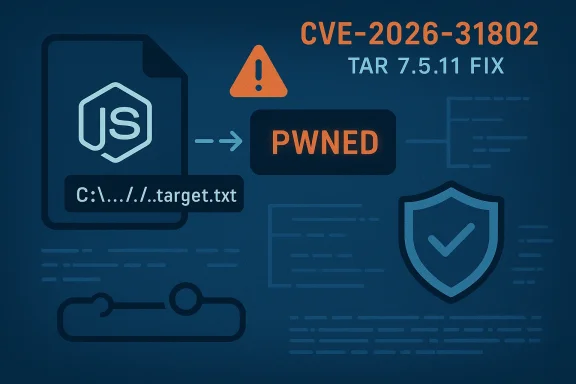 Background / Overview
node-tar (published as the npm package tar) is the reference Tar implementation for Node.js and is widely embedded in developer tooling, CLI utilities, CI/CD pipelines, and server-side importers that process .tar archives. Its extraction functions are used by countless projects to unpack archives, making any path-handling mistake in the library an outsized operational risk. The problem disclosed as CVE-2026-31802 is a variant of long-standing path traversal and symlink-handling classes of vulnerabilities that have affected tar implementations and archive-processing code across languages for years. (security.snyk.io)This specific issue arises from the way node-tar validates and then rewrites the
linkpath field for symbolic-link (and related) entries during unpacking: the check that looks for .. components runs against the original drive-relative value, but the actual symlink creation uses a stripped value after the drive root (for example, after removing C:). That ordering lets a crafted linkpath slip past the ..-segment checks while ultimately producing an outside-pointing symlink, and subsequent writes through that symlink overwrite files outside the extraction target with the privileges of the extracting process. The GitHub security advisory for the project documents a minimal, reproducible PoC demonstrating the overwrite end-to-end. (github.com)Technical analysis
What the code intended to do — and what it did instead
The unpacking logic has two distinct steps:- A sanitization/validation pass intended to prevent path traversal, typically by rejecting entries containing
..segments or absolute path roots. - The actual creation of filesystem entries (directories, files, symlinks, hardlinks) using the sanitized values.
C:../../../target.txt), which — under the path-splitting semantics used — does not present the .. segments in a way that triggers the check. Later, the code calls its path-normalization routine to remove the drive prefix (producing ../../../target.txt) and then creates a symlink using that rewritten value. Because the validation happened too early, the symlink creation actually points outside the extraction directory and is allowed to remain. The result is a standard jail escape via symlink followed by file overwrite. The vulnerability description and PoC in the maintainer’s advisory illustrate this flow. (github.com)Drive-relative paths and platform semantics
Drive-relative paths are a Windows-specific quirk: a path likeC:foo\bar is relative to the current working directory on drive C:, not an absolute path with a leading root. That makes the interplay between normalization, split/token checks, and resolution subtle: treating the drive prefix as a single token during validation hides trailing .. segments from simplistic checks, but the later normalization and resolution will make those segments effective. This inconsistency is exactly what the attacker-controlled tar entry exploits. The GitHub advisory provides a clear example and a PoC that reproduces the effect on a modern system. (github.com)Reproducible proof-of-concept
The maintainer-published PoC constructs a tar archive containing aSymbolicLink entry at a/b/l whose linkpath is C:../../../target.txt. Extracting that archive with tar.x({ cwd, file }) then writes through the extracted symlink and demonstrates that ../target.txt (outside the extraction cwd) receives the overwritten content. The advisory logs show PWNED printed from the target file after extraction, confirming file overwrite. That concrete PoC elevates this from a theoretical path-sanitization misstep to a practical arbitrary-file-overwrite primitive against processes that extract untrusted archives. (github.com)Severity and scoring
GitHub’s advisory assigns a High severity and a CVSS v4 base score of 8.2, driven primarily by the integrity impact (arbitrary overwrite) and the low complexity of exploiting the flaw in reachable usage patterns (e.g., CLI tools, CI pipelines, services that accept user tarballs). NVD and vendor records reflect the same conclusion and list the issue as fixed in 7.5.11. (github.com)Where this matters — realistic attack scenarios
The vulnerability is not a remote network bug by itself; exploitation requires the application to process an attacker-supplied tar archive. That condition, however, is common:- CLI tools that accept archive inputs (for example, self-updaters, package managers, or install utilities) and run
tar.x()in the current working directory. - Build and CI pipelines that consume third-party archives or artifacts fetched from remote registries without strict sanitization.
- Web services and microservices that let users upload tar files for import or processing (for example, content ingestion endpoints or custom plugin installers).
- Deployment automation that unpacks third-party tarballs as part of a release or provisioning workflow.
Privilege and environment factors
Because the overwrite is performed with the process’s existing permissions, the impact varies with who runs the extraction and where:- If a privileged or root-level process extracts the archive, the attacker can overwrite system files and potentially achieve code execution or persistent compromise.
- If a user-level CI agent or tool performs extraction, the attacker can overwrite files within that user’s scope — possibly sabotaging builds, injecting malicious artifacts, or corrupting repository caches.
- Containers, chroot jails, and permission-limited environments reduce risk, but only if the extractor is properly isolated and cannot access host paths that matter. Because the attack leverages filesystem semantics, isolation correctness matters more than nominal process rights.
Mitigation and remediation
Immediate action — upgrade
The single most effective and immediate remediation is to upgrade node-tar to version 7.5.11 (or later) in any project that depends on it directly, and to update transitive dependencies wherever the vulnerable version is present. The package maintainers published a fix and the advisory notes the patched version explicitly. (github.com)- Audit your projects with automated dependency tools (npm audit, Snyk, GitHub Dependabot, or your SBOM tooling) to locate usages of tar <= 7.5.10.
- Upgrade direct dependencies to tar@7.5.11 or newer and rebuild.
- For transitive dependency instances, update the higher-level packages that pull in tar or introduce package resolutions / overrides in lockfiles when necessary to force the patched version across the dependency graph.
Short-term compensations if immediate upgrade is impossible
If you cannot upgrade everywhere immediately, apply layered mitigations:- Reject archives from untrusted users or run uploads through a sanitizing service before passing them to production extractors.
- Extract untrusted archives inside short-lived, minimal-permission sandboxes such as ephemeral containers or dedicated VMs with restricted mounts; do not run extraction as an administrative user.
- Use operating system-level containment (read-only mounts, limited bind mounts) so that even an escaped symlink cannot reach high-value host files.
- If your architecture permits, offload extraction to a hardened microservice that validates
linkpathstrings and rejects entries containing drive-relative constructs or uses a safe, canonicalizing extraction implementation.
Detection — how to spot suspicious extraction events
Detection is challenging once an overwrite succeeds, because the write looks like a normal file write by the extracting process. Recommended detection and hunting techniques:- Monitor processes that perform extractions (for example, CI runners, build agents, and upload handlers) and flag unexpected writes outside the intended directories within a short window after an extraction operation.
- Use filesystem auditing (inotify, Windows Audit) to log changes to critical files and correlate modifications with extraction process PIDs and timestamps.
- Scan deployment and build logs for occurrences of
tar.x()or explicit tar extraction commands being invoked on user-supplied inputs. - Maintain tripwire files (immutable or monitored) in directories above your extraction root; tampering with those files should generate immediate alerts.
.. after a drive-letter normalization step — but implementing that correctly requires canonicalization that mirrors the patched library’s behavior. (github.com)Why this keeps happening: design lessons and ecosystem context
node-tar’s 2026 run of advisories is not an isolated trend. Over a short period the project has addressed multiple path traversal and symlink-related issues — different root causes but a similar theme: the difficulty of securely handling filesystem semantics, normalization, and platform-specific path quirks (Windows drive-relative paths, Unicode normalization collisions on macOS APFS, race conditions around path reservations, etc.). Snyk’s package pages and other vulnerability catalogs catalog a sequence of related fixes and CVEs that together show how subtle extraction logic can be. (security.snyk.io)Common, recurring causes include:
- Validation that inspects path strings before the exact same transformations the creation code applies, producing a time-of-check/time-of-use mismatch inside the library.
- Platform-specific edge cases (drive-relative semantics and 8.3 short-names on Windows, Unicode normalization on macOS, etc.) that are easy to overlook in cross-platform code.
- Performance optimizations like cached directory-state assumptions that can be invalidated during extraction ordering or exploited by an attacker-controlled archive.
- Treat filesystem path validation as a canonicalization problem: canonicalize the path to the final resolution form before validating that it lies inside the intended root.
- Prefer deny-by-default behavior for untrusted archives: skip symbolic links, hardlinks, and special device entries when content origin is untrusted unless you have a secure rationale to include them.
Practical, prioritized checklist for Windows-focused and cross-platform teams
- Upgrade to tar@7.5.11 or later across all codebases, CI agents, and images where the package appears. (github.com)
- Run a full dependency inventory (SBOM) and focus on transitive instances; use lockfile overrides or dependency manager features to force the upgrade if direct upgrades are blocked.
- For services that accept uploaded archives, make extraction a privileged-aware, auditable service that:
- Runs in minimal-privilege containers
- Rejects symlink/hardlink entries by default
- Validates
linkpathcanonicalization using the same resolution rules the runtime will use - Add filesystem guards and monitoring to detect writes outside approved directories immediately after extraction operations.
- Replace risky extraction call sites with safer patterns: use libraries and utilities that have been audited recently, or pre-verify archive contents with a policy that forbids drive-relative link targets.
- Communicate with supply-chain partners: if your build system consumes artifacts from third parties, require signed or vetted tarballs, and add automated checks in CI to reject archives that contain symlink/hardlink entries with drive-letter constructs.
Audit and long-term hardening
Upgrading is necessary but not always sufficient. Organizations should:- Conduct a focused code review of any in-house extraction helpers and custom wrappers around tar to ensure they don't inadvertently reintroduce similar logic errors.
- Run fuzzing and targeted archive-format tests against extraction endpoints to simulate tricky cases (drive-relative paths, mixed separators, Unicode normalization collisions) and see how your runtime resolves them.
- Favor extraction pipelines that perform extraction in ephemeral, disposable containers with a narrow mount profile (no access to host root, explicit bind mounts only).
- Centralize archive-processing logic into a hardened service implemented in a language and library with a strong history of secure extraction semantics, and then carefully manage its attack surface.
Community response and disclosure timeline
The vulnerability record publicly available in NVD and the project advisory shows the issue was reported and fixed promptly in the 7.5.11 patch; the maintainer’s advisory includes a clear PoC and the commit fixing the bug. The broader security ecosystem has tracked a series of related tar issues through early 2026, and multiple vulnerability databases and vendors have cataloged the problem and remediations. In practitioner forums and internal discussion threads the community has been actively exchanging mitigation strategies and hunting queries in the days after disclosure, reflecting the high operational interest of this class of bug. (nvd.nist.gov)Note: some platform-specific vendor pages may require interactive rendering (JavaScript) to view; when that is the case, refer to canonical advisories and the published GitHub advisory and commit for the authoritative technical narrative. (nvd.nist.gov)
Risks and limitations — an honest appraisal
- Attack prerequisite: Exploitation requires supplying a crafted tar archive to a vulnerable extraction call. This means systems that never accept external archives are unaffected, but in practice many pipelines and tools do process external or third-party archives, raising real exposure.
- No public mass-exploit campaign reported at the time of disclosure, but that is not a guarantee that exploits won’t appear; a public PoC lowers the bar for attackers to weaponize the technique against exposed targets.
- Mitigations that rely on manual inspection or ad-hoc logic (for example, naive regex checks for
..) are brittle and error-prone. The only robust fix is to run the canonicalization/validation as the patched library does (or to upgrade the library itself). - Detection after the fact is noisy: overwrites look like legitimate writes unless you have integrated process-to-write correlation and pre-existing monitoring.
Closing recommendation
Treat any use oftar.x() on untrusted inputs as a high-risk operation. Immediately:- Audit your dependency graph and upgrade to tar@7.5.11 (or later) wherever
tarappears. (github.com) - Isolate extraction operations, add monitoring for unexpected writes outside extraction roots, and disallow symlink/hardlink entries in uploads unless you have a rigorously tested, canonicalized validation chain.
- Communicate the urgency to build/CI teams, DevOps, and any product teams that accept archive uploads, because practical exploitation is straightforward where attacker-controlled archives reach an extractor process.
Source: MSRC Security Update Guide - Microsoft Security Response Center
