

Microsoft’s CVE-2026-32225 is the kind of Windows advisory that looks terse at first glance but matters disproportionately to defenders. It is labeled a Windows Shell Security Feature Bypass Vulnerability, and that wording alone tells us two important things: Microsoft believes the issue is real enough to publish, and the flaw lives in a trust-boundary area that attackers prize because bypasses can quietly undermine protections rather than trigger obvious crashes or alerts. The public description also includes Microsoft’s confidence-style metadata, which is increasingly important for triage because it signals how much technical certainty the vendor has about the vulnerability’s existence and mechanics. ft’s Security Update Guide uses vulnerability labels not just to name a bug, but to frame how much urgency defenders should attach to it. A security feature bypass is not necessarily as flashy as remote code execution, but it can be just as strategically useful to an attacker because it weakens controls that are supposed to separate trusted from untrusted behavior. In Windows Shell, that can translate into file-handling, object-resolution, or UI trust issues that help malware or phishing content slip past user expectations and platform safeguards.
What makes CVE-2026-ant is the combination of public confirmation and limited public detail. Microsoft has disclosed that there is a Shell bypass issue, but the advisory framing does not immediately hand attackers a step-by-step exploit recipe. That tension is common in modern Microsoft disclosures: the company wants to give customers enough information to patch quickly, while withholding low-level exploit primitives that could accelerate abuse.
This is also part of a broader shift in hoes vulnerability severity. In 2024, MSRC said it would publish root-cause data for Microsoft CVEs using the Common Weakness Enumeration standard, and it has continued expanding the Security Update Guide as a central source for vulnerability information and advisories. That context matters because the confidence signal attached to a CVE is now part of the operational data defenders are expected to read, not an obscure internal note.
For administrators, the headline is simple: a Shell security feature bypass should be treated as a trust-model problem, not a cosmetic issue. Bypasses often sit in the awkward middle ground between local abuse and broader compromise, where an attacker uses a flaw to defeat a safeguard and then chains it with other weaknesses. In enterprise environments, that chaining risk is what turns a modest-seeming advitch-management event.
The most important part of the advisory may not be the component name at all, but the classification. A security feature bypass means the product is behaving in a way that allows an attacker to sidestep a protection mechanism, policy, or trust decision. That differs from a memory-corruption bug, where the exploit goal is often direct code execution, and from a pure information disclosure, where the attacker mainly gains visibility
In practice, a bypass can be the first domino in a chain. If Windows Shell misclassifies content, mishandles a trusted source, or applies a security boundary too loosely, the attacker may not gain code execution immediately, but they may get enough leverage to stage a second payload, persuade a user to interact with unsafe content, or suppress a control that would otherwise block a malicious file or action. That is why feature-bypass bugs often punch above their apparent severity. matters
Microsoft’s confidence-style metadata is a quiet but meaningful signal. It tells defenders how certain Microsoft is that the vulnerability exists and how much technical detail is publicly grounded versus inferred or withheld. A more confident rating usually means the issue is well understood internally, even if the public write-up stays brief for safety reasons.
That matters operationally because teams often have to decide whether to patch immediately, accelerate testing, or wait for exploit evidence. For a confirmed bypass in a core Windows component, the safe default is to assume the attack surface is real even if the exploit path is not yet public. In other words, lack of exploit detail is not lack of risk.
The danger is not just theoretical. Attackers value Shell issues because they often fit well into phishing, drive-by delivery, and local post-compromise escalation workflows. Even when the flaw itself is “only” a bypass, it can help malware bypass a user warning, manipulate content trust, or make a second-stage payload look less suspicious to the operating system or to the victim. That makes Shell vulnerabilities operationally attractive in both consumer and enterprise settings.
This is particial-engineering scenarios. Windows Shell is closely tied to how users perceive files, shortcuts, downloads, and trusted content. A bypass that affects any of those areas can make phishing campaigns more effective because the operating system itself may be weakened as a source of warning or separation. That is a subtle failure mode, but subtle does not mean low impact.
ties for admins
Patching is still the first move, but patching alone is not the only task. Teams should also identify systems where users routinely handle untrusted files, where shell integrations are abundant, or where high-value accounts sign in interactively. Those systems deserve special attention because they are the most likely to turn a bypass into an incident.
A disciplined responsere inventory, patch validation, and targeted monitoring for suspicious file-based activity. That means looking beyond the CVE title and asking where Shell trust decisions matter most in the environment. In most enterprises, the answer will be “more places than expected.”
The home-user impact may look smaller on paper than the enterprise impact, but that is mre often less likely to apply updates quickly, more likely to rely on default trust behavior, and more vulnerable to socially engineered delivery. A bypass in a ubiquitous component like Shell is therefore a broad consumer risk even when the public exploit details are thin.
Consumers also benefit from the same principle as enterprises: reduce the number of unnecessary trust boundaries. The fewer legacy shoc file associations, and unverified downloads in play, the smaller the practical impact of a bypass. That is not a substitute for patching, but it does narrow the room an attacker has to maneuver.
This is a deliberate tradeoff. Security vendors have to balance transparency against exploit enablement, and Microsoft has repeatedly signaled that the Update Guide is intended to be a central, machine-readable source of truth. In that model, the absence of public exploit detail is not a gap in responsibility; it is a risk-management choice.
This also affects threat hunting. If Microsoft has not disclosed a detailed exploit path, defenders should avoid overfitting detections to a presumed technique. Instead, they should focus on generic suspicious patterns around file handling, odd shell behavior, and user-interactive abuse. That approach is more resilient when the public technical picture is incomplete.
A useful patching workflow is to start with internet-facing or user-exposed machines, then move through high-risk enterprise endpoints, and finally mop up lower-risk or lab systems. That sequencing is not glamorous, but it reduces exposure where the odds of exploitation and the potential business impact are highest. It also gives defenders time to validate application compatibility while st A practical patch sequence
The opportunity for defenders is to mature their own response process at the same time. If Microsoft is investing in confidence metadata and standardized root-cause language, enterprise teams can mirror that discipline internally by building better patch triage, asset mapping, and trust-boundary reviews. In other words, better vendor transparency should trigger better defender maturity.
A second risk is patch lag. Even when the update is available, enterprise validation, change-control delayan keep vulnerable systems exposed for far too long. In a core component like Windows Shell, that delay creates a wide window for opportunistic abuse, especially once security researchers or attackers infer more about the flaw.
Security researchers and threat intelligence teams should also monitor whether the bypass is chained with other Winld campaigns. Bypass bugs often become important when paired with phishing, malicious shortcuts, document delivery, or a second local escalation path. That means telemetry from endpoint protection, email security, and user-behavior monitoring may become more useful than any single exploit signature.
In the end, CVE-2026-32225 is less about a single dramatic exploit than about the fragility of trust in one of Windows’ most visible components. Shell is where users meet the operating system’s idea of what is safe, familiar, and expected, so a bypass there can ripple outward into every corner of endpoint defense. The smartest response is not panic, but speed: patch early, validate carefully, and assume that if a protection can be bypassed, an attacker will eventually try to prove it.
Source: MSRC Security Update Guide - Microsoft Security Response Center
What makes CVE-2026-ant is the combination of public confirmation and limited public detail. Microsoft has disclosed that there is a Shell bypass issue, but the advisory framing does not immediately hand attackers a step-by-step exploit recipe. That tension is common in modern Microsoft disclosures: the company wants to give customers enough information to patch quickly, while withholding low-level exploit primitives that could accelerate abuse.
This is also part of a broader shift in hoes vulnerability severity. In 2024, MSRC said it would publish root-cause data for Microsoft CVEs using the Common Weakness Enumeration standard, and it has continued expanding the Security Update Guide as a central source for vulnerability information and advisories. That context matters because the confidence signal attached to a CVE is now part of the operational data defenders are expected to read, not an obscure internal note.
For administrators, the headline is simple: a Shell security feature bypass should be treated as a trust-model problem, not a cosmetic issue. Bypasses often sit in the awkward middle ground between local abuse and broader compromise, where an attacker uses a flaw to defeat a safeguard and then chains it with other weaknesses. In enterprise environments, that chaining risk is what turns a modest-seeming advitch-management event.
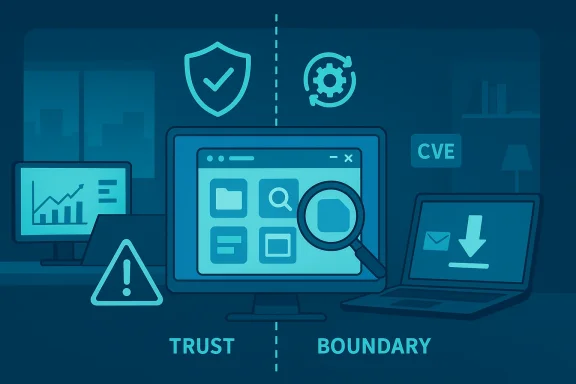 What the Classification Means
The most important part of the advisory may not be the component name at all, but the classification. A security feature bypass means the product is behaving in a way that allows an attacker to sidestep a protection mechanism, policy, or trust decision. That differs from a memory-corruption bug, where the exploit goal is often direct code execution, and from a pure information disclosure, where the attacker mainly gains visibilityIn practice, a bypass can be the first domino in a chain. If Windows Shell misclassifies content, mishandles a trusted source, or applies a security boundary too loosely, the attacker may not gain code execution immediately, but they may get enough leverage to stage a second payload, persuade a user to interact with unsafe content, or suppress a control that would otherwise block a malicious file or action. That is why feature-bypass bugs often punch above their apparent severity. matters
Microsoft’s confidence-style metadata is a quiet but meaningful signal. It tells defenders how certain Microsoft is that the vulnerability exists and how much technical detail is publicly grounded versus inferred or withheld. A more confident rating usually means the issue is well understood internally, even if the public write-up stays brief for safety reasons.
That matters operationally because teams often have to decide whether to patch immediately, accelerate testing, or wait for exploit evidence. For a confirmed bypass in a core Windows component, the safe default is to assume the attack surface is real even if the exploit path is not yet public. In other words, lack of exploit detail is not lack of risk.
- Confirmed category means Microsoft considers the mited public detail** is a defense measure, not a sign of weakness.
- Shell involvement raises the odds of user interaction and file-based triggers.
- Bypass behavior often enables chaining with other vulnerabilities.
- Patch priority should be higher than the label alone might suggest.
Windows Shell as an Attack Surface
Windows Shell has been a securitydows for years because it mediates the user’s interaction with files, shortcuts, objects, and shell extensions. That makes it a natural place for attackers to look for trust violations: if Shell can be tricked into treating untrusted content as safe, the result can be deceptive execution paths or unintended policy relaxation. Historical Microsoft advisories around Shell have shown that the component can be involved in both code execution and bypass-class weaknesses.The danger is not just theoretical. Attackers value Shell issues because they often fit well into phishing, drive-by delivery, and local post-compromise escalation workflows. Even when the flaw itself is “only” a bypass, it can help malware bypass a user warning, manipulate content trust, or make a second-stage payload look less suspicious to the operating system or to the victim. That makes Shell vulnerabilities operationally attractive in both consumer and enterprise settings.
Why Shell bugs age lities tend to persist in relevance because Windows remains deeply dependent on backward compatibility. Legacy file formats, shortcut behavior, icon handling, preview panes, and shell extensions all create edge cases that modern attackers can still weaponize. The older Microsoft Shell advisories on record show that this surface has a long history of needing security updates, including remote code execution and bypass-style fixes.
That legacy burden is one reason security teams should not dismiss a Shell bypass as “just a desktop issue.” Shell sits in the path of email attachments, downloads, Explorer actions, and user-driven workflows that exist everywhere Windows exists. The result is an enormous blast radius, even when a vulnerabilityshort.- Legacy compatibility expands the attack surface.
- User workflows often intersect with Shell more than teams realize.
- Security prompts are only useful if they are not bypassed.
- Third-party shell extensions can magnify risk.
- Enterprise desktops remain especially exposed because of his Matters to Attackers
This is particial-engineering scenarios. Windows Shell is closely tied to how users perceive files, shortcuts, downloads, and trusted content. A bypass that affects any of those areas can make phishing campaigns more effective because the operating system itself may be weakened as a source of warning or separation. That is a subtle failure mode, but subtle does not mean low impact.
Bypass bugs and chain exploitat most dangerous when paired with another weakness. For example, a second-stage payload might rely on the bypass to get through a protective check, then use a separate local elevation or code execution flaw to complete compromise. That’s why defenders should not evaluate the CVE only in isolation; they should evaluate it as part of the Windows exploitation chain.
This is also where confidence metadata becomes operationaft is confident enough to publish a CVE but not enough public detail exists to map the exploit path, defenders should still presume that skilled attackers may be able to infer enough to weaponize it. The public record may be sparse, but the underlying vulnerability can still be highly actionable.- Phishing value rises when trust cues can be bypassed.
- Execution chains become easier when defenses are weakened.
- Payload staging benefits from reduced user suspicion.
- Limited details do not eliminate attacker interest.
- Core components attractive targets.
Enterprise Impact
For enterprises, the most important question is not whether every endpoint will be exploited tomorrow. It is whether CVE-2026-32225 could help an attacker move from initial access to persistence, lateral movement, or user deception on a managed Windows fleet. Because Shell is so close to everyday file operations, even a narrow bypass can have outsized consequences when scaled across thousands of workstSecurity teams should also remember that enterprise risk is amplified by diversity of configuration. Different image types, shell extensions, legacy applications, and custom file associations can change how a bypass behaves in the real world. That means the same CVE may be trivial on one build and much more useful on another, especially in environments with long-lived line-of-business software. Consistency is the enemy of exploitability; heterogeneity is not.ties for admins
Patching is still the first move, but patching alone is not the only task. Teams should also identify systems where users routinely handle untrusted files, where shell integrations are abundant, or where high-value accounts sign in interactively. Those systems deserve special attention because they are the most likely to turn a bypass into an incident.
A disciplined responsere inventory, patch validation, and targeted monitoring for suspicious file-based activity. That means looking beyond the CVE title and asking where Shell trust decisions matter most in the environment. In most enterprises, the answer will be “more places than expected.”
- High-value workstations deserve first-User-interactive servers** can be riskier than they look.
- Line-of-business apps may depend on Shell behavior.
- Shell extensions should be reviewed as part of hardening.
- Legacy compatibility settings should be audited during testing.
Consumer Impact
Consumers tend to think about Windows secare warnings and antivirus prompts, but Shell bypasses can erode those same expectations. If an attacker can influence how Windows Shell interprets trusted content, the victim may be less able to judge whether a file, shortcut, or UI cue is safe. That is especially relevant for users who download software, open email attachments, or work with shared files.The home-user impact may look smaller on paper than the enterprise impact, but that is mre often less likely to apply updates quickly, more likely to rely on default trust behavior, and more vulnerable to socially engineered delivery. A bypass in a ubiquitous component like Shell is therefore a broad consumer risk even when the public exploit details are thin.
Why everyday users should care
A lot of Windows exploitation begins with ordinary behavior: opening a docwnload, clicking a shortcut, or navigating a shared folder. Shell security issues sit uncomfortably close to those behaviors, which means attackers can often hide in plain sight. That is exactly why Microsoft’s fix should be treated as urgent, even by users who do not consider themselves high-value targets.Consumers also benefit from the same principle as enterprises: reduce the number of unnecessary trust boundaries. The fewer legacy shoc file associations, and unverified downloads in play, the smaller the practical impact of a bypass. That is not a substitute for patching, but it does narrow the room an attacker has to maneuver.
- Download hygiene matters more when Shell trust can be bypassed.
- Consumer updates should not be deferred for convenience.
- Shared files reelivery path.
- Default Windows behavior should not be assumed safe by itself.
- Home users are often easier to socially engineer than enterprises.
Microsoft’s Disclosure Strategy
Microsoft has become more explicit about the structure of its vulnerability reporting. Since adopting CWE-based root-cause publication rity Update Guide, MSRC has been clearer that some of the most useful metadata is not a verbose exploit narrative, but a combination of classification, confidence, and affected component. That is exactly the sort of information CVE-2026-32225 appears to emphasize.This is a deliberate tradeoff. Security vendors have to balance transparency against exploit enablement, and Microsoft has repeatedly signaled that the Update Guide is intended to be a central, machine-readable source of truth. In that model, the absence of public exploit detail is not a gap in responsibility; it is a risk-management choice.
The practical meaning of a terse advisory
For defenders, terse does not mean unimportant. It means the advisory’s core value lies in signaling urgency, not in teaching exploitation. The actionable posture is to treat the CVE as a confirmed trust issue in Windows Shell and patch according to Microsoft’s guidance as soon as practical. That is a conservative response, but in security operations, conservative is often the only rational response.This also affects threat hunting. If Microsoft has not disclosed a detailed exploit path, defenders should avoid overfitting detections to a presumed technique. Instead, they should focus on generic suspicious patterns around file handling, odd shell behavior, and user-interactive abuse. That approach is more resilient when the public technical picture is incomplete.
- Metadata matters as much as prose in modese write-ups** are normal for sensitive issues.
- Machine-readable guidance helps security teams automate triage.
- Exploit secrecy does not reduce defender urgency.
- Broad detections are safer than narrow assumptions.
How to Prioritize Patch Planning
The right question for security teams is not “Is this worse than everything else?” but rather “Where does this fit in the queue?” CVE-2026-32225 belongs in the group of issues that can undermine trust and enable chaining, which usually means it should move up the list quickly even if it is not labeled critical. Security feature bypasses in core components deserve fast handling because they can quietly alte other controls.A useful patching workflow is to start with internet-facing or user-exposed machines, then move through high-risk enterprise endpoints, and finally mop up lower-risk or lab systems. That sequencing is not glamorous, but it reduces exposure where the odds of exploitation and the potential business impact are highest. It also gives defenders time to validate application compatibility while st A practical patch sequence
- Identify systems that process untrusted files or heavy shell interactions.
- Confirm whether Microsoft’s update is included in the relevant build for each platform.
- Test for compatibility issues in pilot rings or canaries.
- Deploy to high-risk endpoints first.
- Validate that the patch remains in place and that no rollback occurred.
- Pilot first when coausible.
- High-risk endpoints should not wait for perfect certainty.
- Validation matters as much as installation.
- Rollback checks prevent a false all-clear.
- Asset inventory is the foundation of rapid response.
Strengths and Opportunities
CVE-2026-3ome positive trends in Microsoft’s current security posture. The company is giving defenders a cleaner signal through the Update Guide, stronger taxonomy around vulnerability classes, and more structured disclosure practices than in earlier eras. That makes it easier for security teams to interpret risk quickly, even when the technical narrative is intentionally restrained.The opportunity for defenders is to mature their own response process at the same time. If Microsoft is investing in confidence metadata and standardized root-cause language, enterprise teams can mirror that discipline internally by building better patch triage, asset mapping, and trust-boundary reviews. In other words, better vendor transparency should trigger better defender maturity.
- Vendor confidence signals help prioritize response.
- Structured advisories improve automation.
- Core-component visibility allows sharper risk triage.
- Patch cycles can be aligned with asset criticality.
- User education can reinforce trust-boundary hygiene.
- Security baselines can be revisited after remediation.
- Legacy cleanup is an opportunity, not just a burden.
Risks and Concerns
The biggest concern is that public scarcity of detail may lead some organizations to underreact. History suggests that securityindows components can be easy to dismiss because they sound less dramatic than code execution, yet they often end up enabling the conditions that make more severe attacks practical. That is exactly the sort of false comfort defenders should avoid.A second risk is patch lag. Even when the update is available, enterprise validation, change-control delayan keep vulnerable systems exposed for far too long. In a core component like Windows Shell, that delay creates a wide window for opportunistic abuse, especially once security researchers or attackers infer more about the flaw.
- Underreaction is the most common failure mode.
- Patch latency expands the attack window.
- Legacy shell integrations may complicate validation.
- **Narrow detened exploitation.
- User trust abuse is harder to observe than overt malware.
- Endpoint diversity makes universal assumptions dangerous.
- Compatibility fear can become an excuse for inaction.
What to Watch Next
The next thing defenders should watch is whether Microsoft expands the public description, assigns additional metadata, or clarifies the precise trust boundary involved in CVE-2026-32225. Sometimes Microsoft’s first disclosure is only the opening frame, with later documentation or ecosystem analysis filling in the missing details. Until then, administrators should treat the vulnerability as credible and actionable rather than waiting for the exploit map to be fully drawn.Security researchers and threat intelligence teams should also monitor whether the bypass is chained with other Winld campaigns. Bypass bugs often become important when paired with phishing, malicious shortcuts, document delivery, or a second local escalation path. That means telemetry from endpoint protection, email security, and user-behavior monitoring may become more useful than any single exploit signature.
Items to track
- Microsoft’s Security Update Guide entry for additional details or reclassification.
- Evidence of public proof-of-concept development or exploit chaining.
- Reports of malicious file-based campaigns using Shell interactions.
- Compatibility issues affecting enterprise deployment rings.
- Any later clarification of affected Windows versions or components.
In the end, CVE-2026-32225 is less about a single dramatic exploit than about the fragility of trust in one of Windows’ most visible components. Shell is where users meet the operating system’s idea of what is safe, familiar, and expected, so a bypass there can ripple outward into every corner of endpoint defense. The smartest response is not panic, but speed: patch early, validate carefully, and assume that if a protection can be bypassed, an attacker will eventually try to prove it.
Source: MSRC Security Update Guide - Microsoft Security Response Center
Last edited:
