

CVE-2026-32241 is a reminder that Kubernetes networking can become a shell-command problem in a hurry. The flaw affects Flannel’s experimental Extension backend and can let an attacker with the right Node annotation permissions trigger root-level code execution across nodes in the cluster. Microsoft’s update guide describes the issue with an emphasis on the attacker’s ability to disrupt availability, but the practical security picture is broader: if a cluster’s network fabric can be induced to run attacker-controlled input, the result can be full cluster compromise, not just downtime.
Flannel is one of those Kubernetes components that disappears into the background until something goes wrong. It provides pod networking and overlay connectivity for clusters that need a lightweight, straightforward way to move packets between nodes, and its design has always leaned toward simplicity rather than feature sprawl. That simplicity is helpful for operators, but it also means any unsafe path from cluster metadata into system execution becomes especially dangerous.
The vulnerable code path sits in Flannel’s Extension backend, which is not the common default path most users think of when they hear “Flannel.” The backend exists to prototype new backend types and handle subnet events, and that experimental character is central to why this issue matters. Experimental features are often used by the same teams that care about flexibility and rapid iteration, but those teams can also underestimate the security assumptions hidden inside utility code.
What makes CVE-2026-32241 notable is the combination of cross-node reach and command injection. The annotation key
The broader lesson is familiar to anyone who has tracked container and orchestration vulnerabilities over the last several years. Attackers repeatedly target the seams where cluster control-plane permissions, node-local agents, and operating-system execution meet. Those seams are valuable because they collapse layered security: a single weak trust boundary can turn into an entire fleet problem.
The fact that this is an extension backend flaw should not reassure anyone. Experimental often sounds safer than core, but in practice experimental features can be far riskier because they receive less operational scrutiny, are less uniformly deployed, and are more likely to be adopted by people who understand the functionality but not the edge cases. That is exactly why command injection bugs in infrastructure plumbing tend to age badly in real environments.
The important nuance is that this is not a simple unauthenticated internet-facing RCE. The attack still depends on an actor being able to modify Kubernetes Node annotations, so the practical prerequisite is privilege within the cluster or a misconfigured RBAC posture that grants that privilege too broadly. Even so, the issue can move quickly from “somewhat privileged” to “full node takeover,” which is why Kubernetes operators should treat it as a high-severity cluster security event rather than a narrow bug. (sentinelone.com)
The vulnerable functions identified in the analysis are
There is also an operational angle beyond pure exploitation. Flannel runs on nodes, which means a compromise can produce root-level processes on the hosts that carry cluster traffic. In a Kubernetes environment, that can translate into credential theft, lateral movement, container escapes through adjacent weaknesses, or direct tampering with network policy and CNI behavior. The blast radius can be wider than the component name suggests.
Perhaps the most subtle part of the story is that the issue sits in an area many teams do not monitor closely: annotation changes on Node objects. Teams often concentrate on pod specs, deployments, secrets, and ingress resources, while Node-level metadata is treated as infrastructure housekeeping. Attackers love that blind spot because it hides the handoff between control-plane permissions and node-local execution.
That sequence matters because it collapses the difference between “metadata write” and “code execution.” Kubernetes metadata is supposed to be descriptive, not executable. Once metadata is allowed to shape shell behavior, every annotation becomes a potential command-delivery channel, and every integration becomes a security decision.
The attack also has a cross-node dimension. The vulnerable backend can affect every Flannel node in the cluster, meaning the problem is not confined to one node object or one isolated host. In a distributed system, that kind of propagation path is what turns a local security mistake into a cluster-wide incident. (sentinelone.com)
This matters for detection too. A malicious command may not look like a normal workload event at all. Instead, it may show up as an unusual child process, a file write in an unexpected directory, or a network connection originating from a component that ordinarily only handles overlay networking.
The finding also reinforces a pattern seen in other infrastructure flaws: privileged management paths are often more dangerous than public application surfaces. An attacker who can alter cluster metadata may not need a web exploit if the backend itself will do the dangerous work for them.
The MSRC-style description of sustained or persistent unavailability is a useful reminder that attackers do not always need to stay connected to cause harm. If they can leave behind a changed configuration, a poisoned annotation, or a corrupted agent state, the damage can survive the initial exploit attempt. That is especially relevant in infrastructure software where the compromise may affect startup behavior or automated reconciliation.
There is a practical reason availability bugs get treated seriously in Kubernetes environments: they often take down more than one service at once. A network component sitting on nodes can affect pod-to-pod traffic, service discovery, and external connectivity all at once. One failure mode can therefore become many failures, which is exactly why operators should not dismiss this as a “mere DoS.”
That is the operational irony of vulnerabilities like this: the public description may emphasize availability because that is easy to quantify, but defenders know the real danger is the combination of service disruption plus privileged execution. Once those two are joined, there is no benefit in arguing whether the main consequence is availability or code execution. Both matter, and they reinforce each other.
Many teams assume that RBAC has already solved this problem because Node objects are “admin only.” In reality, misdelegated cluster roles, automation accounts, legacy operational tooling, or custom controllers can widen the attack surface in ways that are not obvious during review. An adversary does not need universal cluster admin if a single controller or service account has enough rights to touch the vulnerable field.
That is why this CVE should prompt a permissions review, not just a version bump. If annotation updates are too permissive, the underlying exploit path may still be accessible through another weakly governed identity. Fixing the binary without fixing the access model leaves the organization one misconfiguration away from repeat exposure.
That seems to be exactly what makes this Flannel issue so important. The backend is designed for experimentation, but experimentation does not excuse passing user-controlled strings into shell invocation. The boundary between prototype and production disappears quickly once the code ships into real clusters.
Administrators should also tighten RBAC to restrict who can update Node annotations. That recommendation is important because it addresses the precondition needed for exploitation, even if it does not eliminate the code flaw itself. Defense in depth matters here: if the annotation path is locked down properly, the exploit window narrows significantly. (sentinelone.com)
A third short-term step is to inspect existing Node annotations for suspicious content, especially the backend-data key. If anything looks malformed, shell-like, or inconsistent with the cluster’s normal configuration patterns, it deserves immediate review. In a live environment, that kind of inspection can separate a clean patching task from a full incident response.
It is also wise to centralize Kubernetes audit logs and create alerts for changes to Flannel-related annotations. That can catch both exploitation attempts and legitimate but unusual administrative behavior. In an environment where automation is common, visibility is the difference between a transient anomaly and a silent compromise.
Shared clusters also complicate incident response. Once Flannel is suspected, the team has to determine whether the issue is isolated to a single node, spread across the node pool, or already used to pivot elsewhere. Because the backend can run with root privileges, responders cannot assume that “only networking” was touched.
The broader enterprise lesson is that infrastructure components need the same change-management rigor as business applications. Too many organizations treat CNI plugins as low-risk plumbing, yet a flaw there can undermine segmentation, service reachability, and node trust all at once. Invisible software is still software, and invisible software can still be the first thing attackers touch.
That is why inventory matters. Operators should know exactly which clusters use Flannel, which backend types are enabled, and which node pools still carry the old daemonset. Without that visibility, even a published patch can fail to reduce actual exposure.
This is where the cross-node aspect becomes especially relevant. A vulnerability that can influence multiple nodes through a shared backend or shared configuration layer gives adversaries a multiplier effect. That means one successful injection can become many compromised systems, which is exactly the kind of return on investment that motivates real-world threat actors.
The issue also pairs neatly with common post-exploitation goals. Once the attacker is root on a node, they can inspect CNI state, local credentials, mounted secrets, and kubelet-adjacent assets. That creates a path from networking bug to cluster reconnaissance to persistence mechanisms that may be difficult to unwind.
It is also prudent to assume that a limited permissions model is only as strong as its weakest delegated role. If a build system, maintenance bot, or automation service can alter Node annotations, that system becomes part of the threat model whether or not anyone intended it to be. Automation is not a safety net unless it is explicitly constrained and monitored.
A well-run response can do more than eliminate one flaw; it can improve the whole operational posture around node-level trust, auditability, and CNI hardening.
Another concern is that the vulnerable backend is experimental, which makes deployment tracking harder. Teams may not even remember that a test-oriented or prototype-oriented component was left enabled long after rollout. That kind of forgotten configuration is a classic source of surprise incidents.
The next few weeks should also reveal how widely the vulnerable backend is actually used in production. If adoption is narrow, the operational blast radius may be smaller than the headline suggests. If adoption is broader than expected, expect more operators to discover that an “experimental” feature quietly made it into their critical path. (sentinelone.com)
What to watch next:
In the end, CVE-2026-32241 is less about one Flannel backend than it is about a familiar cloud security truth: when a node agent trusts cluster metadata too much, the cluster stops being a collection of workloads and becomes a collection of opportunities. That is why this vulnerability deserves urgency, not just acknowledgment.
Source: MSRC Security Update Guide - Microsoft Security Response Center
 Background
Flannel is one of those Kubernetes components that disappears into the background until something goes wrong. It provides pod networking and overlay connectivity for clusters that need a lightweight, straightforward way to move packets between nodes, and its design has always leaned toward simplicity rather than feature sprawl. That simplicity is helpful for operators, but it also means any unsafe path from cluster metadata into system execution becomes especially dangerous.The vulnerable code path sits in Flannel’s Extension backend, which is not the common default path most users think of when they hear “Flannel.” The backend exists to prototype new backend types and handle subnet events, and that experimental character is central to why this issue matters. Experimental features are often used by the same teams that care about flexibility and rapid iteration, but those teams can also underestimate the security assumptions hidden inside utility code.
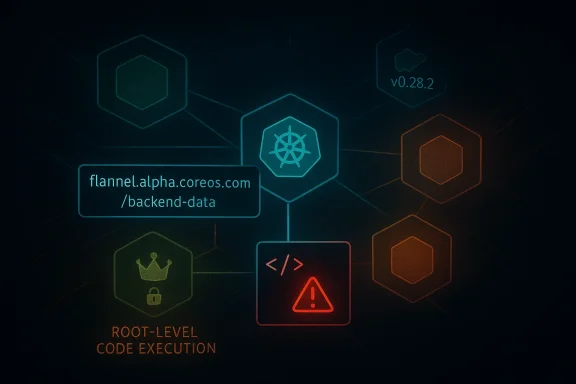
What makes CVE-2026-32241 notable is the combination of cross-node reach and command injection. The annotation key
flannel.alpha.coreos.com/backend-data becomes the delivery vehicle, and the backend’s handling of that data turns a metadata write into a shell execution path. In other words, the attack does not need a browser, a malicious file upload, or a compromised pod to be dramatic; it needs the ability to influence the Kubernetes Node object in the right way.The broader lesson is familiar to anyone who has tracked container and orchestration vulnerabilities over the last several years. Attackers repeatedly target the seams where cluster control-plane permissions, node-local agents, and operating-system execution meet. Those seams are valuable because they collapse layered security: a single weak trust boundary can turn into an entire fleet problem.
The fact that this is an extension backend flaw should not reassure anyone. Experimental often sounds safer than core, but in practice experimental features can be far riskier because they receive less operational scrutiny, are less uniformly deployed, and are more likely to be adopted by people who understand the functionality but not the edge cases. That is exactly why command injection bugs in infrastructure plumbing tend to age badly in real environments.
Overview
CVE-2026-32241 has been characterized as a command injection RCE in Flannel’s extension backend, with the issue fixed in Flannel v0.28.2 according to the vendor-adjacent security writeup that surfaced after disclosure. The vulnerable path receives data from the Node annotation and passes it to shell commands without sufficient sanitization. That is the classic recipe for remote code execution in systems code: trust a string too much, and the shell does the rest. (sentinelone.com)The important nuance is that this is not a simple unauthenticated internet-facing RCE. The attack still depends on an actor being able to modify Kubernetes Node annotations, so the practical prerequisite is privilege within the cluster or a misconfigured RBAC posture that grants that privilege too broadly. Even so, the issue can move quickly from “somewhat privileged” to “full node takeover,” which is why Kubernetes operators should treat it as a high-severity cluster security event rather than a narrow bug. (sentinelone.com)
The vulnerable functions identified in the analysis are
SubnetAddCommand and SubnetRemoveCommand, both of which are implicated in the way annotation content is unmarshalled and piped to shell execution. That detail matters because it indicates this is not a vague “bad input somewhere” problem; it is a specific, reachable command construction flaw in the path that processes subnet events. The result is that shell metacharacters and command sequences can become executable payloads. (sentinelone.com)There is also an operational angle beyond pure exploitation. Flannel runs on nodes, which means a compromise can produce root-level processes on the hosts that carry cluster traffic. In a Kubernetes environment, that can translate into credential theft, lateral movement, container escapes through adjacent weaknesses, or direct tampering with network policy and CNI behavior. The blast radius can be wider than the component name suggests.
Perhaps the most subtle part of the story is that the issue sits in an area many teams do not monitor closely: annotation changes on Node objects. Teams often concentrate on pod specs, deployments, secrets, and ingress resources, while Node-level metadata is treated as infrastructure housekeeping. Attackers love that blind spot because it hides the handoff between control-plane permissions and node-local execution.
How the exploit path works
The core of the vulnerability is a trust failure. The Flannel extension backend accepts content from theflannel.alpha.coreos.com/backend-data annotation and uses that input in a way that can reach shell execution. If an attacker can write a malicious payload into that annotation, they can influence what the backend runs, and the shell will interpret special characters and command separators. (sentinelone.com)From annotation to command
The attack chain is unusually elegant from the attacker’s point of view and unusually ugly from the defender’s point of view. First, the attacker obtains permissions to update Node annotations. Then the attacker places a crafted value into the backend-data field. Finally, when Flannel processes the subnet event, the unsanitized string is handed to shell command logic and executed with elevated privileges. (sentinelone.com)That sequence matters because it collapses the difference between “metadata write” and “code execution.” Kubernetes metadata is supposed to be descriptive, not executable. Once metadata is allowed to shape shell behavior, every annotation becomes a potential command-delivery channel, and every integration becomes a security decision.
The attack also has a cross-node dimension. The vulnerable backend can affect every Flannel node in the cluster, meaning the problem is not confined to one node object or one isolated host. In a distributed system, that kind of propagation path is what turns a local security mistake into a cluster-wide incident. (sentinelone.com)
- The malicious input rides in a Node annotation.
- The backend parses that data during subnet event handling.
- Shell command execution occurs without proper sanitization.
- The resulting code runs with root privileges on Flannel nodes. (sentinelone.com)
Why shell injection is especially dangerous here
Shell injection in infrastructure software is more serious than shell injection in a general-purpose application because the process running the code often has broad host access. Flannel is part of the network fabric, so its runtime context is not a constrained user session; it is a daemon that helps define how pods communicate. That gives the attacker a foothold close to both the operating system and the cluster control plane.This matters for detection too. A malicious command may not look like a normal workload event at all. Instead, it may show up as an unusual child process, a file write in an unexpected directory, or a network connection originating from a component that ordinarily only handles overlay networking.
The finding also reinforces a pattern seen in other infrastructure flaws: privileged management paths are often more dangerous than public application surfaces. An attacker who can alter cluster metadata may not need a web exploit if the backend itself will do the dangerous work for them.
What Microsoft’s severity language means
The text you provided describes a loss of availability condition and explains that an attacker may deny access to resources in the impacted component, either while the attack continues or persistently afterward. That language is consistent with a defensive model where availability loss is treated as a direct serious consequence even if the bug is not framed purely as a classic “crash-only” denial-of-service issue. In short, Microsoft’s wording recognizes that a security flaw can be operationally catastrophic even if its path to impact is indirect.Availability is not the whole story
From a kernel-and-cloud perspective, availability is often the first visible symptom, but it is not the only consequence. A node-level command execution bug can interrupt service, degrade networking, and destabilize workloads, yet it can also lead to integrity and confidentiality compromise if the attacker uses the foothold to harvest credentials or alter cluster state. That is why the broader Flannel analysis should not be read as merely a resiliency issue. (sentinelone.com)The MSRC-style description of sustained or persistent unavailability is a useful reminder that attackers do not always need to stay connected to cause harm. If they can leave behind a changed configuration, a poisoned annotation, or a corrupted agent state, the damage can survive the initial exploit attempt. That is especially relevant in infrastructure software where the compromise may affect startup behavior or automated reconciliation.
There is a practical reason availability bugs get treated seriously in Kubernetes environments: they often take down more than one service at once. A network component sitting on nodes can affect pod-to-pod traffic, service discovery, and external connectivity all at once. One failure mode can therefore become many failures, which is exactly why operators should not dismiss this as a “mere DoS.”
Why this changes the patching priority
If an issue can deny service and also run code as root, the patching calculus changes immediately. Security teams should treat the flaw as a high-confidence urgent fix, not as a bug to slot into the next maintenance window. In multi-tenant or shared-cluster environments, the cost of delay is amplified because one tenant’s permissions or one misconfigured operator account can become everyone’s outage.That is the operational irony of vulnerabilities like this: the public description may emphasize availability because that is easy to quantify, but defenders know the real danger is the combination of service disruption plus privileged execution. Once those two are joined, there is no benefit in arguing whether the main consequence is availability or code execution. Both matter, and they reinforce each other.
Why Kubernetes clusters are uniquely exposed
Kubernetes security is often discussed in terms of pods, namespaces, and secrets, but the real attack surface includes the glue: nodes, controllers, CNI plugins, admission paths, and logging systems. Flannel sits in that glue layer, which means its compromise is not just a single process event but a cluster architecture event.Node objects are a powerful trust boundary
Node objects are not just labels and status updates. They can carry operational metadata that other components rely on, and when those objects are modifiable by the wrong principals, they become command channels. The annotation mentioned in the vulnerability is a good example of how a benign-looking metadata field can become the bridge between authorization and execution. (sentinelone.com)Many teams assume that RBAC has already solved this problem because Node objects are “admin only.” In reality, misdelegated cluster roles, automation accounts, legacy operational tooling, or custom controllers can widen the attack surface in ways that are not obvious during review. An adversary does not need universal cluster admin if a single controller or service account has enough rights to touch the vulnerable field.
That is why this CVE should prompt a permissions review, not just a version bump. If annotation updates are too permissive, the underlying exploit path may still be accessible through another weakly governed identity. Fixing the binary without fixing the access model leaves the organization one misconfiguration away from repeat exposure.
The extension backend adds extra risk
The word extension suggests modularity, and modularity usually sounds like a clean engineering win. But extension systems are often where unsafe abstractions accumulate. They allow specialized behavior, custom commands, and experimental interfaces, which means they can become the place where developers “just get something working” before coming back later to harden it.That seems to be exactly what makes this Flannel issue so important. The backend is designed for experimentation, but experimentation does not excuse passing user-controlled strings into shell invocation. The boundary between prototype and production disappears quickly once the code ships into real clusters.
- Node annotations are powerful because they influence cluster behavior.
- RBAC errors can expose the annotation path to too many actors.
- Extension systems are attractive targets because they are flexible.
- Root-running daemons amplify the impact of small input mistakes.
Patch status and mitigations
The available guidance points to Flannel 0.28.2 as the fixed release, and the immediate recommendation is to upgrade as soon as possible. That alone is not enough in many environments, though, because cluster upgrades can be slow, and some operators will need a temporary workaround while they stage rollouts. (sentinelone.com)Short-term actions
The most direct workaround is to avoid the vulnerable Extension backend and switch to an unaffected backend such as vxlan or wireguard if the deployment model allows it. That may not be a trivial move in every environment, but it is often the fastest way to remove the risky execution path while the patch is being scheduled. (sentinelone.com)Administrators should also tighten RBAC to restrict who can update Node annotations. That recommendation is important because it addresses the precondition needed for exploitation, even if it does not eliminate the code flaw itself. Defense in depth matters here: if the annotation path is locked down properly, the exploit window narrows significantly. (sentinelone.com)
A third short-term step is to inspect existing Node annotations for suspicious content, especially the backend-data key. If anything looks malformed, shell-like, or inconsistent with the cluster’s normal configuration patterns, it deserves immediate review. In a live environment, that kind of inspection can separate a clean patching task from a full incident response.
Long-term hardening
Long-term mitigation is about reducing the number of ways a metadata field can become execution. Admission controllers can validate Node annotation updates, but they should be treated as a governance control, not a silver bullet. A robust approach combines version control, permission control, input validation, and telemetry so that no single layer has to do all the work.It is also wise to centralize Kubernetes audit logs and create alerts for changes to Flannel-related annotations. That can catch both exploitation attempts and legitimate but unusual administrative behavior. In an environment where automation is common, visibility is the difference between a transient anomaly and a silent compromise.
- Upgrade to Flannel v0.28.2 or later.
- Restrict Node annotation updates with RBAC.
- Review
flannel.alpha.coreos.com/backend-datavalues. - Consider moving away from the Extension backend.
- Add admission controls for annotation validation.
- Alert on unexpected Flannel child processes and audit events.
Enterprise impact
For enterprises, this vulnerability is not just a Kubernetes bug; it is a cloud operating model problem. Managed clusters often depend on a chain of automation, delegated permissions, and platform-specific add-ons that make it difficult to know who can change what. That environment is ideal for speed, but it also creates exactly the kind of privilege ambiguity an attacker can exploit.Multi-tenant and shared-cluster risk
The greatest concern is multi-tenant usage. If multiple teams share a cluster, annotation permissions can become a political and technical compromise, especially when one group owns networking and another owns workloads. That makes it easier for an attacker who lands in one slice of the environment to reach a component that was assumed to be operational-only. (sentinelone.com)Shared clusters also complicate incident response. Once Flannel is suspected, the team has to determine whether the issue is isolated to a single node, spread across the node pool, or already used to pivot elsewhere. Because the backend can run with root privileges, responders cannot assume that “only networking” was touched.
The broader enterprise lesson is that infrastructure components need the same change-management rigor as business applications. Too many organizations treat CNI plugins as low-risk plumbing, yet a flaw there can undermine segmentation, service reachability, and node trust all at once. Invisible software is still software, and invisible software can still be the first thing attackers touch.
Cloud-native supply chain considerations
There is also a supply-chain-style aspect to the fix. If one team patches Flannel and another forgets to rebuild images, refresh node pools, or redeploy the updated daemonset, the cluster may remain partially vulnerable. In a distributed environment, partial remediation can be more dangerous than no remediation if defenders assume the risk is gone when it is not.That is why inventory matters. Operators should know exactly which clusters use Flannel, which backend types are enabled, and which node pools still carry the old daemonset. Without that visibility, even a published patch can fail to reduce actual exposure.
Threat modeling and attacker value
CVE-2026-32241 is valuable to attackers because it sits at the intersection of cluster admin workflows and host-level execution. Those are high-value targets in almost every cloud environment, and attackers know that network tooling often has broad reach with too little oversight. Once they can influence the node annotation path, the rest becomes a matter of payload construction and post-exploitation discipline.Why attackers like infrastructure command injection
Attackers prefer bugs that give them durable operational leverage. Command injection in a node-local daemon is attractive because it can be used for reconnaissance, lateral movement, persistence, or sabotage. It is also attractive because it often survives application restarts better than a simple web shell on a disposable container.This is where the cross-node aspect becomes especially relevant. A vulnerability that can influence multiple nodes through a shared backend or shared configuration layer gives adversaries a multiplier effect. That means one successful injection can become many compromised systems, which is exactly the kind of return on investment that motivates real-world threat actors.
The issue also pairs neatly with common post-exploitation goals. Once the attacker is root on a node, they can inspect CNI state, local credentials, mounted secrets, and kubelet-adjacent assets. That creates a path from networking bug to cluster reconnaissance to persistence mechanisms that may be difficult to unwind.
What defenders should assume
Defenders should assume an attacker will not stop at proving code execution. They will likely try to understand the environment, identify other nodes with the same backend, and look for credentials or tokens that can extend the compromise. That means remediation cannot end with the patch deployment; it has to include log review, audit checks, and, if suspicious activity is found, broader threat hunting.It is also prudent to assume that a limited permissions model is only as strong as its weakest delegated role. If a build system, maintenance bot, or automation service can alter Node annotations, that system becomes part of the threat model whether or not anyone intended it to be. Automation is not a safety net unless it is explicitly constrained and monitored.
Strengths and Opportunities
This disclosure also creates an opportunity for organizations to improve cluster governance in ways that pay off beyond this single bug. The vulnerability is painful, but it exposes an area where many Kubernetes deployments can become materially stronger with modest effort.A well-run response can do more than eliminate one flaw; it can improve the whole operational posture around node-level trust, auditability, and CNI hardening.
- It gives teams a concrete reason to inventory every cluster using Flannel.
- It encourages RBAC cleanup around Node object modification rights.
- It highlights the value of admission controls for metadata governance.
- It pushes operators to test non-default backends before they are needed in a crisis.
- It creates a strong case for centralized Kubernetes audit logging.
- It encourages better visibility into daemonset behavior and child processes.
- It may accelerate the move away from experimental backend paths in production.
Risks and Concerns
Even with a patch available, there are several reasons this issue deserves attention. The first is that many Kubernetes environments are sprawling and decentralized, which makes it easy for one vulnerable cluster to be overlooked. The second is that node-level permissions are frequently inherited through automation rather than intentionally reviewed, which means exposure can hide in plain sight.Another concern is that the vulnerable backend is experimental, which makes deployment tracking harder. Teams may not even remember that a test-oriented or prototype-oriented component was left enabled long after rollout. That kind of forgotten configuration is a classic source of surprise incidents.
- RBAC may be broader than operators realize.
- Cluster inventory may be incomplete.
- The Extension backend may remain enabled by accident.
- Node annotations may not be monitored closely enough.
- Partial upgrades can leave mixed-version clusters exposed.
- Root-level process execution raises the stakes of any compromise.
- Incident responders may underestimate node metadata as an attack path.
Looking Ahead
The immediate question is whether organizations will treat this as a Flannel-only issue or as a broader reminder about cluster trust boundaries. The more mature response is to see it as part of a recurring category: infrastructure components that transform metadata into behavior need strict input controls and sharply limited write permissions. That lesson applies well beyond Flannel.The next few weeks should also reveal how widely the vulnerable backend is actually used in production. If adoption is narrow, the operational blast radius may be smaller than the headline suggests. If adoption is broader than expected, expect more operators to discover that an “experimental” feature quietly made it into their critical path. (sentinelone.com)
What to watch next:
- Whether additional public advisories clarify exploitation prerequisites and real-world abuse.
- Whether cluster security tools add detections for the
backend-dataannotation. - Whether operators accelerate migrations away from the Extension backend.
- Whether RBAC guidance for Node annotation updates becomes more explicit in the ecosystem.
- Whether incident responders publish indicators tied to abnormal Flannel child processes.
In the end, CVE-2026-32241 is less about one Flannel backend than it is about a familiar cloud security truth: when a node agent trusts cluster metadata too much, the cluster stops being a collection of workloads and becomes a collection of opportunities. That is why this vulnerability deserves urgency, not just acknowledgment.
Source: MSRC Security Update Guide - Microsoft Security Response Center
