

Microsoft’s security guidance for CVE-2026-32288 identifies an April 2026 Go
CVE-2026-32288 is a denial-of-service vulnerability in Go’s standard library, specifically the
That sounds narrow because it is narrow. The exploit does not hand an attacker administrative privileges, and it does not read secrets out of memory. But denial-of-service bugs in decompression, unpacking, and archive parsing have a long history of punching above their apparent severity because they sit at the front door of automation.
The Go project fixed the issue in Go 1.25.9 and Go 1.26.2 as part of a broader security release. The fix limits both the number of old GNU sparse map extension blocks and the total number of sparse file entries, regardless of the encoding used. In other words, the patch treats archive metadata as attacker-controlled input rather than as a benign description of a file.
That is the right instinct. A tar archive is not just a bag of files. It is a little filesystem story told by an untrusted narrator.
Sparse files complicate that story. A sparse file can contain holes: logical regions that read as zeroes but do not occupy physical storage. That is useful for disk images, databases, virtual machine artifacts, and other large files where huge zero-filled stretches would be wasteful to store literally.
GNU tar added ways to represent those sparse regions. Some of those encodings are old, awkward, and retained for compatibility rather than elegance. CVE-2026-32288 lives in that compatibility zone: the old GNU sparse map format gives an attacker a way to describe many sparse regions, and an affected Go parser could respond by allocating far too much memory.
This is the pattern that makes parser bugs dangerous. The attacker does not need to upload a huge archive. They need to upload metadata that convinces the receiver to do huge work.
That distinction matters for WindowsForum readers because “Microsoft CVE” no longer means “Windows component” in the old Patch Tuesday sense. Microsoft’s security surface now includes Azure Linux, container hosts, GitHub-linked tooling, developer CLIs, cloud agents, Kubernetes-adjacent components, and open-source dependencies maintained or redistributed under Microsoft’s umbrella.
The affected package list reported by vulnerability databases has included Azure Linux 3.0 packages such as
For a home Windows user, this CVE is probably background noise. For an enterprise running Azure Linux nodes, mixed Windows/Linux container infrastructure, or build systems that routinely unpack archives from less-trusted sources, it is an operational maintenance item.
But severity scores compress context. A denial-of-service flaw in a command-line tool used once a month is one thing. A denial-of-service flaw in an archive parser exposed through CI jobs, artifact ingestion, container image conversion, or package mirroring is another.
In many organizations, tar archives are processed automatically. Developers upload artifacts. Build systems fetch dependencies. Container tools unpack layers. Security scanners crack open packages. Backup systems verify archives. Import services ingest disk images or appliance bundles. In each case, a parser sits between untrusted or semi-trusted input and shared compute resources.
If that parser can be coerced into unbounded memory allocation, the realistic risk is resource exhaustion. A malicious archive may crash a worker, stall a pipeline, trigger retries, burn memory on a shared runner, or create noisy failure conditions that mask something else. That is not Hollywood hacking, but it is exactly the kind of disruption that turns into tickets, missed deployment windows, and confused incident reviews.
The modern enterprise does not need every vulnerability to become code execution for the day to go sideways. Sometimes it is enough for a small file to make the wrong service eat the machine.
The standard library is part of Go’s appeal. Developers can parse archives, handle TLS, serve HTTP, process templates, and manipulate files without pulling in a thicket of third-party packages. The trade-off is that a standard-library bug travels with the toolchain and with every statically linked binary that included the vulnerable code.
That static-linking model is a double-edged sword. It simplifies deployment because a Go binary often carries much of what it needs inside itself. It complicates remediation because patching the OS package may not patch every Go binary already built with an older toolchain. If a vendor shipped a statically linked binary before Go 1.25.9 or 1.26.2, that binary may need to be rebuilt, replaced, or otherwise confirmed as unaffected.
This is where vulnerability management often gets messy. A scanner may flag a host package. A container scanner may flag a base image. A software composition analysis tool may flag a Go module. A vendor advisory may say the product is not exploitable because it does not parse untrusted tar archives. All of those statements can be true in different layers of the same environment.
The practical question for administrators is not merely “Do we have Go installed?” It is “Which services or tools process tar archives, who supplies those archives, and were those tools built with a fixed Go release?”
That is why archive parsers accumulate complexity. Tar began simple, but real-world tar is an ecosystem of variants, extensions, long-name handling, PAX headers, GNU behaviors, sparse-file formats, ownership semantics, device nodes, symlinks, hard links, and compression wrappers. The more faithfully a parser tries to handle history, the more edge cases it must trust itself to handle safely.
CVE-2026-32288 is not an indictment of Go so much as a reminder that archive formats are adversarial terrain. The file format may be old, but the deployment environment is not. Today, an archive may arrive through a web upload, a GitHub release, a container registry, a build cache, a package mirror, or an automated migration pipeline.
That shift changes the threat model. Archive parsing was once something a local operator invoked knowingly. Now it is often buried inside services that act on other people’s input at machine speed.
The first place to look is the obvious one: container and archive-processing paths. If a system ingests images, converts image formats, unpacks artifacts, scans packages, imports backups, processes customer uploads, or handles CI/CD build artifacts, it deserves attention. The more automated and multi-tenant the path, the more the bug matters.
The second place is less obvious: developer workstations and build runners. Local developer risk is often dismissed because it requires a user to process a malicious archive. But build runners regularly process archives on behalf of pull requests, dependency downloads, release jobs, and test harnesses. A malicious archive that merely crashes a runner can still be useful to an attacker probing reliability, limits, and response patterns.
The third place is vendor software. Organizations that rely on appliances, proprietary agents, security scanners, backup products, and container tools written in Go should look for vendor advisories rather than assuming an OS update solves everything. Static binaries are wonderful until you need to know what is inside them.
That does not mean every Windows shop needs to become a Linux distribution maintainer. It does mean that archive-handling bugs in open-source components can become Microsoft-relevant without ever touching
The right operational response is proportionate. Do not panic over CVE-2026-32288 as if it were a wormable Windows flaw. Do not ignore it simply because the vulnerable code lives in Go’s
In particular, teams should resist the temptation to close the vulnerability based solely on the presence of a fixed system package. If the risky binary was shipped by a vendor, downloaded from a release page, baked into a container image, or copied into
A tar archive from a trusted internal release process is lower risk than an archive uploaded by an unknown user. A parser running in an isolated, memory-limited worker is lower risk than one running inside a long-lived service with broad privileges. A build job that can be retried safely is lower risk than a production import service that blocks customer operations.
Resource limits matter. Memory caps, job timeouts, container isolation, queue backpressure, and upload validation all reduce the blast radius of parser denial-of-service bugs. They are not substitutes for patching, but they are the difference between a vulnerability and an outage.
That is the broader lesson. When software automatically processes complex file formats, the parser should run as if the file is hostile, even when the surrounding business process assumes it is routine.
This is a healthier model than pretending the stack is all first-party code. Modern Microsoft depends on Go, Linux, containers, and a large open-source substrate. Publishing and tracking CVEs for those components helps administrators connect upstream fixes to downstream packages.
But the model also demands more from customers. A Windows administrator cannot simply ask whether the monthly cumulative update installed. A cloud administrator must ask whether the relevant Azure Linux packages were updated, whether containers were rebuilt, whether CI runners were refreshed, and whether vendor-supplied Go binaries have been replaced.
That is a more complicated patch story. It is also the patch story we actually have.
Here is the administrator’s short version:
archive/tar flaw in which tar.Reader can consume unbounded memory while parsing malicious archives that abuse the old GNU sparse map format. The bug is not a Windows desktop catastrophe, but it is exactly the sort of low-glamour dependency issue that keeps cloud images, container tooling, CI pipelines, and Linux-on-Microsoft estates honest. Its importance lies less in the phrase “tar file” than in the number of modern systems that still quietly trust tar files as delivery vehicles.
 A Small Parser Bug Lands in a Very Large Supply Chain
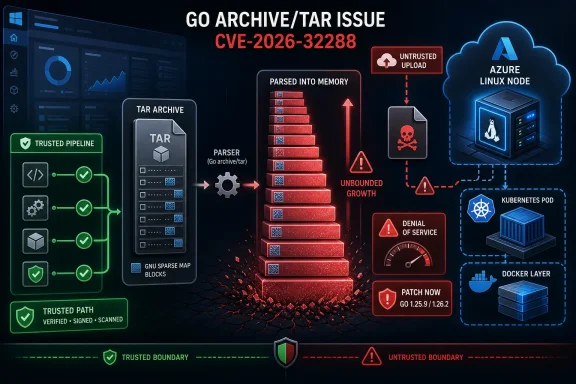
CVE-2026-32288 is a denial-of-service vulnerability in Go’s standard library, specifically the archive/tar package. The vulnerable behavior appears when a maliciously crafted tar archive contains a large number of sparse regions encoded using the old GNU sparse map format. Instead of treating that metadata as bounded, hostile input, affected versions of tar.Reader could allocate memory without a practical ceiling.That sounds narrow because it is narrow. The exploit does not hand an attacker administrative privileges, and it does not read secrets out of memory. But denial-of-service bugs in decompression, unpacking, and archive parsing have a long history of punching above their apparent severity because they sit at the front door of automation.
The Go project fixed the issue in Go 1.25.9 and Go 1.26.2 as part of a broader security release. The fix limits both the number of old GNU sparse map extension blocks and the total number of sparse file entries, regardless of the encoding used. In other words, the patch treats archive metadata as attacker-controlled input rather than as a benign description of a file.
That is the right instinct. A tar archive is not just a bag of files. It is a little filesystem story told by an untrusted narrator.
Tar Is Ancient, but the Attack Surface Is Modern
The tar format is one of computing’s durable fossils. It began as a tape archive format and survived because it was simple, portable, and good enough for Unix-like systems that needed to preserve filenames, modes, ownership, symbolic links, and directory structures. Every generation of tooling has wrapped it in compression, transported it over package managers, embedded it in containers, or used it as a build artifact.Sparse files complicate that story. A sparse file can contain holes: logical regions that read as zeroes but do not occupy physical storage. That is useful for disk images, databases, virtual machine artifacts, and other large files where huge zero-filled stretches would be wasteful to store literally.
GNU tar added ways to represent those sparse regions. Some of those encodings are old, awkward, and retained for compatibility rather than elegance. CVE-2026-32288 lives in that compatibility zone: the old GNU sparse map format gives an attacker a way to describe many sparse regions, and an affected Go parser could respond by allocating far too much memory.
This is the pattern that makes parser bugs dangerous. The attacker does not need to upload a huge archive. They need to upload metadata that convinces the receiver to do huge work.
Microsoft’s Stake Is Azure Linux, Not Notepad
The Microsoft angle here is not that Windows 11 suddenly becomes vulnerable because someone double-clicks a.tar file in File Explorer. Microsoft tracks this CVE because Go is embedded throughout contemporary infrastructure, and Microsoft ships and maintains Linux components in its own ecosystem. Azure Linux packages and container-adjacent tools are part of that world.That distinction matters for WindowsForum readers because “Microsoft CVE” no longer means “Windows component” in the old Patch Tuesday sense. Microsoft’s security surface now includes Azure Linux, container hosts, GitHub-linked tooling, developer CLIs, cloud agents, Kubernetes-adjacent components, and open-source dependencies maintained or redistributed under Microsoft’s umbrella.
The affected package list reported by vulnerability databases has included Azure Linux 3.0 packages such as
moby-engine, skopeo, gh, and containerized-data-importer in certain pre-fixed builds. Those names point directly at the environments where tar parsing is routine: image movement, container build and pull workflows, GitHub automation, and virtualized import paths.For a home Windows user, this CVE is probably background noise. For an enterprise running Azure Linux nodes, mixed Windows/Linux container infrastructure, or build systems that routinely unpack archives from less-trusted sources, it is an operational maintenance item.
The Severity Score Undersells the Operational Risk
CVE-2026-32288 has been assessed as a medium-severity issue by multiple vulnerability trackers, with scoring in the general range one expects for denial-of-service rather than remote code execution. That is sensible. A memory exhaustion bug is not a skeleton key.But severity scores compress context. A denial-of-service flaw in a command-line tool used once a month is one thing. A denial-of-service flaw in an archive parser exposed through CI jobs, artifact ingestion, container image conversion, or package mirroring is another.
In many organizations, tar archives are processed automatically. Developers upload artifacts. Build systems fetch dependencies. Container tools unpack layers. Security scanners crack open packages. Backup systems verify archives. Import services ingest disk images or appliance bundles. In each case, a parser sits between untrusted or semi-trusted input and shared compute resources.
If that parser can be coerced into unbounded memory allocation, the realistic risk is resource exhaustion. A malicious archive may crash a worker, stall a pipeline, trigger retries, burn memory on a shared runner, or create noisy failure conditions that mask something else. That is not Hollywood hacking, but it is exactly the kind of disruption that turns into tickets, missed deployment windows, and confused incident reviews.
The modern enterprise does not need every vulnerability to become code execution for the day to go sideways. Sometimes it is enough for a small file to make the wrong service eat the machine.
Go’s Standard Library Is Infrastructure Now
Go is popular in the places administrators increasingly care about: container engines, Kubernetes tooling, cloud CLIs, observability agents, service meshes, deployment controllers, and infrastructure automation. That popularity is one reason a standard-library CVE can propagate widely even when the affected function sounds obscure.The standard library is part of Go’s appeal. Developers can parse archives, handle TLS, serve HTTP, process templates, and manipulate files without pulling in a thicket of third-party packages. The trade-off is that a standard-library bug travels with the toolchain and with every statically linked binary that included the vulnerable code.
That static-linking model is a double-edged sword. It simplifies deployment because a Go binary often carries much of what it needs inside itself. It complicates remediation because patching the OS package may not patch every Go binary already built with an older toolchain. If a vendor shipped a statically linked binary before Go 1.25.9 or 1.26.2, that binary may need to be rebuilt, replaced, or otherwise confirmed as unaffected.
This is where vulnerability management often gets messy. A scanner may flag a host package. A container scanner may flag a base image. A software composition analysis tool may flag a Go module. A vendor advisory may say the product is not exploitable because it does not parse untrusted tar archives. All of those statements can be true in different layers of the same environment.
The practical question for administrators is not merely “Do we have Go installed?” It is “Which services or tools process tar archives, who supplies those archives, and were those tools built with a fixed Go release?”
Sparse Files Are a Perfect Example of Compatibility Debt
Sparse-file support is not a glamorous feature. Most users never think about it. Yet without it, archiving large disk-like files becomes inefficient, and old archives may become unreadable or improperly restored. Compatibility features survive because data outlives software fashions.That is why archive parsers accumulate complexity. Tar began simple, but real-world tar is an ecosystem of variants, extensions, long-name handling, PAX headers, GNU behaviors, sparse-file formats, ownership semantics, device nodes, symlinks, hard links, and compression wrappers. The more faithfully a parser tries to handle history, the more edge cases it must trust itself to handle safely.
CVE-2026-32288 is not an indictment of Go so much as a reminder that archive formats are adversarial terrain. The file format may be old, but the deployment environment is not. Today, an archive may arrive through a web upload, a GitHub release, a container registry, a build cache, a package mirror, or an automated migration pipeline.
That shift changes the threat model. Archive parsing was once something a local operator invoked knowingly. Now it is often buried inside services that act on other people’s input at machine speed.
The Patch Is Simple; Finding the Exposure Is Not
The engineering fix is straightforward: update to fixed Go releases or consume vendor packages rebuilt with those releases. The administrative fix is harder because exposure depends on behavior. A binary built with affected Go code is not automatically exploitable if it never reads attacker-controlled tar archives. Conversely, a forgotten internal helper may be more exposed than a highly visible product because it accepts uploads without much scrutiny.The first place to look is the obvious one: container and archive-processing paths. If a system ingests images, converts image formats, unpacks artifacts, scans packages, imports backups, processes customer uploads, or handles CI/CD build artifacts, it deserves attention. The more automated and multi-tenant the path, the more the bug matters.
The second place is less obvious: developer workstations and build runners. Local developer risk is often dismissed because it requires a user to process a malicious archive. But build runners regularly process archives on behalf of pull requests, dependency downloads, release jobs, and test harnesses. A malicious archive that merely crashes a runner can still be useful to an attacker probing reliability, limits, and response patterns.
The third place is vendor software. Organizations that rely on appliances, proprietary agents, security scanners, backup products, and container tools written in Go should look for vendor advisories rather than assuming an OS update solves everything. Static binaries are wonderful until you need to know what is inside them.
Windows Admins Are Now Linux Dependency Managers
For many Windows administrators, this is the uncomfortable new normal. The Microsoft estate is no longer a clean boundary around Windows Server, Active Directory, Exchange, SQL Server, and desktop clients. It includes WSL, Azure Linux, container hosts, AKS nodes, GitHub Actions runners, Defender components, developer tooling, and third-party agents that ship as Go binaries.That does not mean every Windows shop needs to become a Linux distribution maintainer. It does mean that archive-handling bugs in open-source components can become Microsoft-relevant without ever touching
explorer.exe. The enterprise control plane is hybrid, and the dependency graph does not care which team owns the ticket queue.The right operational response is proportionate. Do not panic over CVE-2026-32288 as if it were a wormable Windows flaw. Do not ignore it simply because the vulnerable code lives in Go’s
archive/tar. Treat it as a signal to verify patch flow through the parts of the environment that ingest artifacts.In particular, teams should resist the temptation to close the vulnerability based solely on the presence of a fixed system package. If the risky binary was shipped by a vendor, downloaded from a release page, baked into a container image, or copied into
/usr/local/bin two years ago, the OS package manager may have no say in the matter.The Real Boundary Is Trust, Not File Extension
The most useful way to think about CVE-2026-32288 is not “tar files are dangerous.” That is too broad and too vague. The useful boundary is trust: who created the archive, who transports it, who parses it, and what happens if parsing fails badly?A tar archive from a trusted internal release process is lower risk than an archive uploaded by an unknown user. A parser running in an isolated, memory-limited worker is lower risk than one running inside a long-lived service with broad privileges. A build job that can be retried safely is lower risk than a production import service that blocks customer operations.
Resource limits matter. Memory caps, job timeouts, container isolation, queue backpressure, and upload validation all reduce the blast radius of parser denial-of-service bugs. They are not substitutes for patching, but they are the difference between a vulnerability and an outage.
That is the broader lesson. When software automatically processes complex file formats, the parser should run as if the file is hostile, even when the surrounding business process assumes it is routine.
Microsoft’s Disclaimer Is Boilerplate, but the Message Is Not
The Knowledge Base disclaimer attached to the MSRC entry is standard legal language: the information is provided as-is, without warranty, and Microsoft disclaims liability for damages. That boilerplate is not the story. The story is that Microsoft’s vulnerability feed increasingly functions as a map of the open-source components that underpin its cloud and developer ecosystems.This is a healthier model than pretending the stack is all first-party code. Modern Microsoft depends on Go, Linux, containers, and a large open-source substrate. Publishing and tracking CVEs for those components helps administrators connect upstream fixes to downstream packages.
But the model also demands more from customers. A Windows administrator cannot simply ask whether the monthly cumulative update installed. A cloud administrator must ask whether the relevant Azure Linux packages were updated, whether containers were rebuilt, whether CI runners were refreshed, and whether vendor-supplied Go binaries have been replaced.
That is a more complicated patch story. It is also the patch story we actually have.
The Archive Bug That Points to a Bigger Maintenance Habit
The concrete lesson from CVE-2026-32288 is refreshingly practical. Patch Go-based tooling that parses archives, update affected Azure Linux packages, rebuild containers that include vulnerable binaries, and pay special attention to automated ingestion paths. The less concrete but more durable lesson is that old file-format compatibility remains a live security surface.Here is the administrator’s short version:
- Systems running Go 1.25 should move to Go 1.25.9 or later, and systems running Go 1.26 should move to Go 1.26.2 or later where the Go toolchain itself is part of the maintained environment.
- Azure Linux and container-related packages should be updated through the normal distribution channels, especially where
moby-engine,skopeo,gh, or import-related components appear in vulnerability reports. - Statically linked Go binaries should not be assumed fixed merely because the host operating system has been patched.
- Archive ingestion paths deserve priority when they process untrusted uploads, third-party artifacts, pull-request inputs, container images, or automated imports.
- Memory limits, sandboxing, job isolation, and retry controls can reduce the impact of parser denial-of-service bugs, but they should complement rather than replace patching.
References
- Primary source: MSRC
Published: 2026-06-03T01:48:13-07:00
Security Update Guide - Microsoft Security Response Center
 msrc.microsoft.com
- Related coverage: securityvulnerability.io
CVE-2026-32288 : Buffer Overflow Vulnerability in Go Programming Language's tar.Reader Component
Learn about the memory allocation vulnerability in Go's tar.Reader component affecting certain versions. Stay informed with CVE-2026-32288.securityvulnerability.io - Related coverage: datacomm.com
CVE-2026-32288 Unbounded allocation for old GNU sparse in archive/tar - DataComm Networks Incorporated
Information published.www.datacomm.com - Related coverage: sentinelone.com
CVE-2026-32288: tar.Reader DoS Vulnerability
CVE-2026-32288 is a denial of service vulnerability in tar.Reader. Learn about its impact, affected versions, and mitigation methods.www.sentinelone.com
- Related coverage: thewindowsupdate.com
- Related coverage: vulert.com
CVE-2026-32288: Unbounded Memory Allocation in stdlib's tar.Reader
CVE-2026-32288 affects the stdlib package in Go, allowing unbounded memory allocation in tar.Reader. Update to fixed versions to mitigate risks.vulert.com
- Related coverage: cve.imfht.com

archive/tar Vulnerabilities (3 CVEs) | Shenlong CVE Platform
All 3 CVE vulnerabilities found in archive/tar, with AI-generated Chinese analysis, references, and POCs.
cve.imfht.com
- Official source: microsoft.com
CVE-2026-31431: Copy Fail vulnerability enables Linux root privilege escalation across cloud environments | Microsoft Security Blog
A high-severity Linux vulnerability, “Copy Fail” (CVE-2026-31431), enables root privilege escalation across cloud environments and Kubernetes workloads. With a working exploit already in the wild, organizations should act quickly to detect, mitigate, and reduce risk.www.microsoft.com
