

A newly disclosed Python security issue, tracked as CVE-2026-3479, shows that
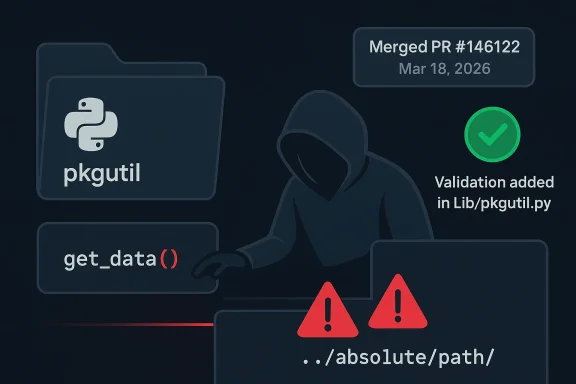
The fix landed quickly in CPython’s main branch and was merged through pull request #146122 on March 18, 2026, with backports queued across supported branches. The patch adds explicit validation in
This CVE sits in a broader pattern that Python has faced repeatedly: standard-library helpers are often used in trusted code paths, so small assumptions about path handling can have outsized security consequences. In recent releases, Python has already had to address multiple filesystem-adjacent issues, especially around extraction, path traversal, and loader behavior. Those incidents have sharpened the community’s appetite for explicit checks rather than “documented but unenforced” constraints. (nvd.nist.gov)
What makes this particular issue noteworthy is that it concerns a library contract rather than a flashy remote exploit chain. The docs said one thing, the implementation did another, and security tooling or application code that relied on the docs could be misled into a false sense of safety. In security engineering, that kind of mismatch is especially dangerous because it tends to survive review longer than obvious crashes or exceptions. (github.com)
The NVD record itself is still marked Awaiting Analysis, and that matters because early-stage CVE records can evolve as downstream analysts refine scope and impact. The Python Software Foundation’s own CVSS vector in the record characterizes the issue as locally exploitable and low-impact on integrity, with no direct confidentiality or availability effect recorded in the CNA scoring. That is consistent with a bug that can expose or redirect resource reads, but not necessarily yield immediate system compromise on its own. (nvd.nist.gov)
The code change is small but decisive. The patch splits the resource string on
The pull request was merged on March 18, 2026, and the GitHub conversation shows backports moving quickly into supported maintenance branches. That rapid propagation suggests the Python maintainers treated the issue as a security fix rather than a purely cosmetic documentation correction. The distinction is important because it signals to distributors and enterprises that this is something to patch, not merely note. (github.com)
This issue also illustrates a familiar but often underappreciated reality about Python’s import ecosystem: resource access is layered through loaders, path logic, and package metadata. A weakness in any one layer can become a gap in the whole abstraction. The safer the abstraction sounds, the more important it is that its guards are actually implemented rather than assumed. (github.com)
That matters because path traversal bugs are often exploitable through “benign-looking” APIs. Developers do not usually think of
The accompanying tests are equally important. Security fixes without tests often regress quietly during refactoring, especially in utility modules that are treated as stable infrastructure. By adding tests around both valid and invalid resource strings, the Python maintainers made the new constraint part of the module’s executable specification. (github.com)
But low severity does not mean low importance. Many security incidents begin with narrow primitives that are later chained into broader compromise, especially when the primitive can bypass assumptions in higher-level code. A resource loader that reads outside its sandbox can become a stepping stone in multi-stage attacks, even if the CVE itself is not scored as catastrophic. (nvd.nist.gov)
Another important nuance is that the CVE is about path traversal, not automatic remote compromise. The attacker generally needs a way to influence resource selection and a target that exposes sensitive data through relative path escapes. That means defenders should focus on call-site review, input provenance, and whether package resources are ever derived from outside the trust boundary. (github.com)
The GitHub pull request shows automated backports into multiple maintained lines, including 3.10 through 3.14. That is a strong indicator that this is being treated as a cross-branch security correction rather than a niche mainline-only refinement. For enterprise users, that should simplify patch planning because the fix is expected to land in the usual maintenance streams. (github.com)
Enterprise environments are also more likely to have layered packaging, custom wheel deployment, and import-time resource lookups, which can make a traversal issue harder to reason about. A supposedly internal helper can end up reachable through service configuration, metadata, or extension points. That makes inventory and call-site analysis essential rather than optional. (github.com)
The good news is that this kind of vulnerability is usually easier to contain than runtime memory corruption or RCE issues. Because the affected behavior is concentrated in a well-defined API, defenders can prioritize code search, runtime checks, and patch deployment without wholesale architectural change. That said, the actual risk depends entirely on how the function is used in each application. (github.com)
This is one of those bugs that can change the shape of compatibility in subtle ways. Code that accidentally passed an absolute path or traversal string may now fail fast with a
That trend matters for the broader open-source supply chain because Python is embedded everywhere, from automation scripts to server-side frameworks and build tooling. A standard-library change can ripple into packaging systems, internal frameworks, and third-party code that assumed the old contract. The more central the API, the more important it is that the fix is clear, conservative, and well-tested. (github.com)
This is also a reminder that CVEs are not only about exploits; they are about trust. A function that does not do what its docs promise can become a silent source of architectural weakness, especially when security reviewers rely on those docs during design assessment. When implementation and documentation diverge, the security model inherits the gap. (github.com)
The broader opportunity is for application teams to use this as a trigger for a resource-loading audit. Bugs like this are excellent reminders that security is not only about exotic exploits; it is also about tightening the ordinary APIs that developers touch every day. Stronger validation, clearer docs, and better tests all compound in value when applied together. (github.com)
There is also the compatibility risk of tightening validation in a mature API. Some applications may have relied on undocumented behavior, and they will now fail more visibly. That is the correct outcome from a security standpoint, but it can still create operational friction if maintainers have not tested for it. Unpleasant surprises are still surprises. (github.com)
It will also be worth watching whether security tools begin to flag
Source: NVD Security Update Guide - Microsoft Security Response Center
pkgutil.get_data() did not enforce the path-safety rules its documentation promised. In practice, that meant callers could pass resource names that enabled path traversal instead of being constrained to a package-relative resource path. The Python Software Foundation assigned the issue a low-severity CVSS profile, but the bug is still important because it breaks a documented security boundary in a widely used standard-library helper. (github.com)The fix landed quickly in CPython’s main branch and was merged through pull request #146122 on March 18, 2026, with backports queued across supported branches. The patch adds explicit validation in
Lib/pkgutil.py to reject absolute paths and .. segments, and the corresponding test updates confirm the intended behavior. That combination tells us this was not a theoretical documentation mismatch; it was a concrete enforcement gap that upstream Python chose to close as a security fix. (github.com)
 Background
pkgutil.get_data() has existed for years as a convenience API for loading package resources, and its documentation has long described it as a way to access data bundled with a package rather than arbitrary files on disk. The expectation is simple: a caller asks for a resource, and the import machinery resolves it within the package’s namespace and loader context. If that boundary fails, the function becomes much less like a resource accessor and much more like a generic file read primitive. (github.com)This CVE sits in a broader pattern that Python has faced repeatedly: standard-library helpers are often used in trusted code paths, so small assumptions about path handling can have outsized security consequences. In recent releases, Python has already had to address multiple filesystem-adjacent issues, especially around extraction, path traversal, and loader behavior. Those incidents have sharpened the community’s appetite for explicit checks rather than “documented but unenforced” constraints. (nvd.nist.gov)
What makes this particular issue noteworthy is that it concerns a library contract rather than a flashy remote exploit chain. The docs said one thing, the implementation did another, and security tooling or application code that relied on the docs could be misled into a false sense of safety. In security engineering, that kind of mismatch is especially dangerous because it tends to survive review longer than obvious crashes or exceptions. (github.com)
The NVD record itself is still marked Awaiting Analysis, and that matters because early-stage CVE records can evolve as downstream analysts refine scope and impact. The Python Software Foundation’s own CVSS vector in the record characterizes the issue as locally exploitable and low-impact on integrity, with no direct confidentiality or availability effect recorded in the CNA scoring. That is consistent with a bug that can expose or redirect resource reads, but not necessarily yield immediate system compromise on its own. (nvd.nist.gov)
Why this bug matters
The difference between “documented restrictions” and “actual enforcement” is not academic. Applications often compose resource names from user input, framework metadata, or plug-in identifiers, and they lean on library APIs to do the right thing by default. If those APIs do not enforce their own guardrails, application developers may mistakenly assume they are protected when they are not. (github.com)- It affects a standard-library function, which increases reach.
- It involves path traversal, a well-known security class with broad abuse potential.
- It is a policy-enforcement bug, which is harder to catch than a crash.
- It can invalidate assumptions in higher-level frameworks and packaging tools.
- It reinforces why documentation alone is never a sufficient defense.
Overview
The vulnerability was disclosed through CPython’s issue tracker as #146121, explicitly labeled with the CVE identifier and framed around undocumented behavior inpkgutil.get_data(). The issue summary states plainly that the function did not validate the resource argument as documented. The resulting behavior allowed traversals that should have been rejected before the loader ever attempted to fetch data. (github.com)The code change is small but decisive. The patch splits the resource string on
/, checks whether the path is absolute, and rejects any resource containing .. path components by raising ValueError. In other words, the implementation now enforces the package-relative contract that the documentation already implied. That is exactly the sort of fix you want in security-sensitive standard library code: minimal surface area, clear invariant, and test coverage to prevent regression. (github.com)The pull request was merged on March 18, 2026, and the GitHub conversation shows backports moving quickly into supported maintenance branches. That rapid propagation suggests the Python maintainers treated the issue as a security fix rather than a purely cosmetic documentation correction. The distinction is important because it signals to distributors and enterprises that this is something to patch, not merely note. (github.com)
This issue also illustrates a familiar but often underappreciated reality about Python’s import ecosystem: resource access is layered through loaders, path logic, and package metadata. A weakness in any one layer can become a gap in the whole abstraction. The safer the abstraction sounds, the more important it is that its guards are actually implemented rather than assumed. (github.com)
Historical context
Python has spent years tightening its file-handling APIs after repeated lessons about traversal and extraction bugs. The ecosystem has seen path-related issues in tar extraction, package download helpers, and loader behavior, which makes this CVE part of a larger hardening trend. The lesson is consistent: when a function crosses a trust boundary, it should fail closed.- The issue was raised in CPython as a security bug.
- The fix was merged upstream before broad backporting.
- The patch targets resource argument validation directly.
- The risk class is CWE-22 path traversal.
- The underlying concern is policy enforcement, not just parsing.
Technical Breakdown
At the heart of the bug is the difference between a string that names a package resource and a string that names an arbitrary filesystem location. Before the patch,pkgutil.get_data() did not sufficiently police that distinction, so the caller-supplied resource path could escape the intended package root. With the fix in place, absolute paths and parent-directory components are blocked before the path is joined to the package directory. (github.com)That matters because path traversal bugs are often exploitable through “benign-looking” APIs. Developers do not usually think of
pkgutil.get_data() as a file primitive, but if it accepts unsafe path material, an attacker can steer reads outside the package boundary. In shared hosting, plugin ecosystems, or applications that ingest user-controlled resource names, that can become a data exposure or logic-bypass problem. (github.com)What changed in the code
The patch added a validation block immediately after splitting the resource string. It rejects absolute paths and any.. segment, and only then constructs the final resource path beneath the package directory. That ordering is critical: validate first, concatenate later is the correct pattern for traversal-sensitive code. (github.com)The accompanying tests are equally important. Security fixes without tests often regress quietly during refactoring, especially in utility modules that are treated as stable infrastructure. By adding tests around both valid and invalid resource strings, the Python maintainers made the new constraint part of the module’s executable specification. (github.com)
Why documentation alone was not enough
The vulnerability description itself is a reminder that docs can promise safety that code fails to deliver. That mismatch is especially common in APIs that were written long before today’s security expectations. If callers read the docs and assume the function rejects dangerous input, they may skip their own validation and inherit the bug downstream. (github.com)- Absolute paths are now rejected.
- Parent-directory traversal is now rejected.
- The fix is implemented in the standard library, not a third-party package.
- Tests now encode the expected behavior.
- The patch reduces ambiguity for downstream users and auditors.
Severity and Exploitability
The CNA score listed in the NVD record is CVSS-B 2.1 LOW under CVSS 4.0, with local attack vector, low attack complexity, and no user interaction required. That seems consistent with a vulnerability that is narrow in scope and typically dependent on an application already exposingpkgutil.get_data() to untrusted input. The low integrity impact also suggests this is more about unintended file access or traversal than direct code execution. (nvd.nist.gov)But low severity does not mean low importance. Many security incidents begin with narrow primitives that are later chained into broader compromise, especially when the primitive can bypass assumptions in higher-level code. A resource loader that reads outside its sandbox can become a stepping stone in multi-stage attacks, even if the CVE itself is not scored as catastrophic. (nvd.nist.gov)
Attack preconditions
In practical terms, exploitation requires an application path that accepts or constructs a resource argument influenced by an attacker. That could be through a plug-in system, a dynamic module loader, an archive-aware workflow, or custom code that treats resource names as trusted. If the application never passes untrusted values intopkgutil.get_data(), the bug may be irrelevant; if it does, the boundary becomes important very quickly. Context is everything here. (github.com)Another important nuance is that the CVE is about path traversal, not automatic remote compromise. The attacker generally needs a way to influence resource selection and a target that exposes sensitive data through relative path escapes. That means defenders should focus on call-site review, input provenance, and whether package resources are ever derived from outside the trust boundary. (github.com)
Practical risk signals
- Any code that builds resource names from user input deserves review.
- Web apps that use Python packaging internals in plugin systems should be checked.
- Internal tools that read package-bundled files may still be exposed if names are dynamic.
- Sandboxed environments should not assume the loader is enforcing a boundary for them.
- Security scanners should flag
pkgutil.get_data()call sites for manual inspection.
Patch and Remediation
The upstream fix is straightforward to understand and straightforward to apply once it is packaged into a CPython release. The important point for operators is not the line count of the patch but the semantic change: resource paths are now validated to match the documented restriction. If you are running an affected Python build, the real remediation is to take the release that includes the backport for your branch. (github.com)The GitHub pull request shows automated backports into multiple maintained lines, including 3.10 through 3.14. That is a strong indicator that this is being treated as a cross-branch security correction rather than a niche mainline-only refinement. For enterprise users, that should simplify patch planning because the fix is expected to land in the usual maintenance streams. (github.com)
What administrators should do
- Identify Python runtimes that may include the affected
pkgutilimplementation. - Check whether your applications pass untrusted or semi-trusted values into
pkgutil.get_data(). - Prioritize patching branches that are still actively deployed in production.
- Re-test any code that depends on resource paths containing unusual separators or dot segments.
- Treat any custom wrapper around
pkgutil.get_data()as security-relevant until reviewed.
- Patch affected Python versions promptly.
- Audit resource-loading call sites.
- Add allowlists for resource names where feasible.
- Avoid user-controlled path fragments in loader APIs.
- Test for edge cases like
.., leading slashes, and mixed separators.
Enterprise Impact
For enterprises, the main issue is trust boundaries. Standard-library bugs are dangerous because they often sit below application-level controls and may be assumed safe by security review, code scanning, and developer folklore. Ifpkgutil.get_data() is used in internal platforms, package plugins, or modular applications, the risk is not only direct exposure but also the possibility of silent policy bypass. (github.com)Enterprise environments are also more likely to have layered packaging, custom wheel deployment, and import-time resource lookups, which can make a traversal issue harder to reason about. A supposedly internal helper can end up reachable through service configuration, metadata, or extension points. That makes inventory and call-site analysis essential rather than optional. (github.com)
Operational consequences
The likely enterprise impact is less about mass exploitation and more about selective abuse in bespoke systems. A sensitive configuration file, model artifact, template, or static asset could be exposed if the resource string is influenced upstream. In regulated environments, even a low-severity CVE can matter if it touches secrets, tenant isolation, or audit boundaries. (nvd.nist.gov)The good news is that this kind of vulnerability is usually easier to contain than runtime memory corruption or RCE issues. Because the affected behavior is concentrated in a well-defined API, defenders can prioritize code search, runtime checks, and patch deployment without wholesale architectural change. That said, the actual risk depends entirely on how the function is used in each application. (github.com)
- Standard-library issues can bypass assumptions in secure coding guides.
- Multi-tenant or plugin-heavy systems deserve extra scrutiny.
- Secrets handling should assume path validation is part of the trust model.
- Static analysis should look for dynamic resource names.
- Internal tools are often the easiest place for this bug to hide.
Consumer and Developer Impact
For most end users, this CVE will have no visible effect unless they are running software that usespkgutil.get_data() in a user-influenced way. The more immediate impact is on developers, maintainers, and platform teams that rely on the standard library for resource lookup. They may need to verify that their code was never depending on the old permissive behavior. (github.com)This is one of those bugs that can change the shape of compatibility in subtle ways. Code that accidentally passed an absolute path or traversal string may now fail fast with a
ValueError. That is the correct secure behavior, but it can surface as a regression in applications that were previously leaning on undocumented leniency. Failing closed is sometimes disruptive precisely because it removes accidental convenience. (github.com)Developer questions to ask
- Are any resource paths derived from external input?
- Did tests assume the old behavior would “just work”?
- Is a traversal-style resource string being used as a shortcut in local scripts?
- Could a loader be bypassed by a direct filesystem join elsewhere in the code?
- Would an allowlist be safer than free-form resource lookup?
- Expect some previously accepted inputs to start failing.
- Review tests that use relative resource references.
- Replace dynamic resource assembly with explicit manifests when possible.
- Preserve backward compatibility only where it does not weaken security.
- Document the new behavior for application teams.
Broader Python Security Trend
CVE-2026-3479 fits a larger pattern in Python security work: tighten filesystem boundaries, codify expectations, and prefer explicit rejection over permissive interpretation. The ecosystem has already had to deal with traversal-related extraction bugs, and those fixes often reshape how developers think about standard utilities. The common thread is that safe defaults need to be enforced in code, not merely described in docs. (nvd.nist.gov)That trend matters for the broader open-source supply chain because Python is embedded everywhere, from automation scripts to server-side frameworks and build tooling. A standard-library change can ripple into packaging systems, internal frameworks, and third-party code that assumed the old contract. The more central the API, the more important it is that the fix is clear, conservative, and well-tested. (github.com)
What this says about maintainership
The fast merge and backport process also says something positive about the CPython security workflow. Small, targeted fixes with tests are easier to disseminate than huge redesigns, and they reduce the chance of collateral damage. In security maintenance, boring is beautiful: the best patch is the one that closes the hole without creating three new ones. (github.com)This is also a reminder that CVEs are not only about exploits; they are about trust. A function that does not do what its docs promise can become a silent source of architectural weakness, especially when security reviewers rely on those docs during design assessment. When implementation and documentation diverge, the security model inherits the gap. (github.com)
- Python’s security posture continues to emphasize path-handling correctness.
- The standard library remains a high-value hardening target.
- Small validation fixes can have large ecosystem benefits.
- Documentation accuracy is itself a security control.
- Regression tests are crucial for preserving newly enforced invariants.
Strengths and Opportunities
The encouraging part of this story is that the issue was identified, assigned, fixed, and backported quickly. Python’s maintainers also chose a minimal, readable fix that aligns implementation with documentation, which lowers the chance of future confusion. That combination turns a bug report into a useful example of responsible open-source security maintenance. (github.com)The broader opportunity is for application teams to use this as a trigger for a resource-loading audit. Bugs like this are excellent reminders that security is not only about exotic exploits; it is also about tightening the ordinary APIs that developers touch every day. Stronger validation, clearer docs, and better tests all compound in value when applied together. (github.com)
- Fast upstream response reduced exposure time.
- The fix is easy to understand and review.
- Backports improve the odds of consistent remediation.
- Tests now codify the secure behavior.
- Developers get a clearer contract for future code.
- Security teams can use the CVE to justify a focused audit.
Risks and Concerns
The biggest concern is that many organizations may underestimate the issue because of the low CVSS score. Low scores can lead to deprioritization, even when a vulnerability affects a core library used in privileged or security-sensitive contexts. The risk is not only exploitation, but also the complacency that follows from assuming the problem is too small to matter. (nvd.nist.gov)There is also the compatibility risk of tightening validation in a mature API. Some applications may have relied on undocumented behavior, and they will now fail more visibly. That is the correct outcome from a security standpoint, but it can still create operational friction if maintainers have not tested for it. Unpleasant surprises are still surprises. (github.com)
- Low severity may hide high-value exposure paths.
- Legacy code may depend on unsafe behavior.
- Security teams may miss call sites in internal tools.
- Mixed Python version estates complicate remediation.
- Documentation drift can recur if tests are not maintained.
- Resource-loading APIs are easy to overlook in reviews.
Looking Ahead
The next thing to watch is how downstream vendors package the fix into their Python distributions and whether any additional clarifications are added to the documentation. The patch itself is already in place upstream, but enterprise reality depends on when the corrected behavior lands in the runtimes people actually deploy. That usually means waiting for vendor patches, Linux distro updates, and platform-specific Python builds to catch up. (github.com)It will also be worth watching whether security tools begin to flag
pkgutil.get_data() call sites more aggressively. A CVE like this often nudges static analysis, secure coding guides, and internal review checklists toward more explicit scrutiny of package-resource access. That would be a healthy outcome, because the best response to a bug in a standard helper is usually better visibility rather than more fear. (github.com)What to monitor
- CPython release notes for the affected maintenance branches.
- Distro and vendor advisories that incorporate the backport.
- Internal code scans for dynamic
pkgutil.get_data()usage. - Any follow-up documentation changes clarifying resource path rules.
- Security tooling updates that recognize traversal-prone resource APIs.
Source: NVD Security Update Guide - Microsoft Security Response Center
