

Microsoft has published CVE-2026-35421 as a Windows GDI remote code execution vulnerability in the Security Update Guide on May 12, 2026, but the public advisory currently gives defenders more signal about confidence and patch urgency than about exploit mechanics. That distinction matters. A remote-code-execution label attached to a graphics subsystem is enough to move the item into every Windows administrator’s triage queue, but the absence of rich technical detail means the first responsible response is disciplined patch management, not speculative panic.
The interesting part of this advisory is not that Windows has another graphics-related bug. It is that Microsoft’s public risk language increasingly asks administrators to make decisions from structured metadata while the exploit narrative remains deliberately sparse. CVE-2026-35421 is a case study in modern vulnerability management: a confirmed vendor advisory, a dangerous class of impact, and just enough public information to prioritize remediation without handing attackers a cookbook.
The phrase “Windows GDI Remote Code Execution Vulnerability” carries a long memory for Windows veterans. GDI, the Graphics Device Interface, is one of those old Windows components that has survived architectural revolutions because applications still need to draw text, shapes, images, printer output, and interface elements. When a vulnerability appears in that layer, it immediately raises uncomfortable questions about documents, images, fonts, print paths, preview handlers, and all the other places where rendering code touches untrusted content.
Yet the advisory text around CVE-2026-35421 is restrained. The user-facing title identifies the affected technology and impact class, while the metric description points to a confidence model: how certain the industry is that the vulnerability exists, how credible the technical details are, and how much would-be attackers can infer from what has been published. That is not the same thing as an exploit write-up.
This matters because the public often treats a CVE as if it were a complete technical dossier. It usually is not. A CVE can be a tracking number, a vendor warning, a patch reference, a scoring container, or a placeholder that becomes richer over time. For administrators, the first question is not whether the advisory satisfies curiosity. It is whether it establishes enough confidence to justify action.
On that front, CVE-2026-35421 clears the bar. Microsoft’s own Security Update Guide entry is a vendor acknowledgement. In practical risk terms, that is very different from an unverified rumor, a half-parsed crash report, or a third-party scanner flag with no upstream confirmation. The vendor has put a name on the issue, attached it to Windows GDI, and categorized the consequence as remote code execution.
That does not tell us whether exploitation is elegant, reliable, or likely in the wild. It does tell us that waiting for a proof of concept before patching would invert the purpose of Patch Tuesday. The whole point of coordinated disclosure is to close the window before curiosity becomes commodity exploitation.
That is why graphics vulnerabilities have always had an outsized operational footprint. A bug in a niche service can often be isolated to the machines that run that service. A bug in a rendering stack can intersect with email attachments, document previews, file shares, remote sessions, print workflows, browser-adjacent helpers, line-of-business applications, and legacy software that nobody wants to touch but everybody still needs.
The word “remote” also deserves careful reading. In Microsoft advisories, remote code execution does not always mean a wormable network daemon listening on an open port. It can mean that an attacker can cause code execution from outside the target system, often by persuading a user or process to open, preview, parse, or render hostile content. In other words, the attack may still require a delivery path.
That distinction is not academic. A pre-authentication network RCE in a default service is a five-alarm fire. A user-assisted rendering RCE is still serious, but the control surface is different: email filtering, attachment handling, browser isolation, file preview behavior, least privilege, and endpoint detection become part of the defense. The advisory title tells us the impact class. It does not, by itself, fully describe the exploit path.
For WindowsForum readers, the sober interpretation is this: treat the vulnerability as real and potentially serious, but do not assume details that Microsoft has not published. GDI’s reach gives the bug a broad potential blast radius. The lack of public mechanics means administrators should prioritize patching while resisting the temptation to invent attack chains from the title alone.
That is a useful metric because the vulnerability ecosystem is noisy. CVE records can be thin. Scanner vendors can disagree. Research can appear before a vendor has confirmed root cause. Social media can inflate a bug long before anyone knows whether it is exploitable in real-world conditions. A confidence measure helps separate “this might be something” from “the responsible party acknowledges there is a security flaw.”
For CVE-2026-35421, the fact that Microsoft has an MSRC entry is the strongest public confidence signal available. The advisory may not satisfy reverse engineers, but it is enough for patch managers. The vendor has acknowledged the issue in the affected technology, and that moves the vulnerability out of the rumor category.
The second half of the metric description is more uncomfortable. It notes that confidence also hints at how much technical knowledge is available to attackers. That cuts both ways. Sparse advisories slow casual attackers, but they also force defenders to work from less operational detail. Rich advisories help defenders build detections and mitigations, but they can also accelerate exploit development.
Microsoft has lived inside that trade-off for decades. Too little information, and enterprises accuse Redmond of asking for blind trust. Too much information, and unpatched systems become easier targets. CVE-2026-35421 sits in the familiar middle: enough to justify action, not enough to publish a weekend exploit guide.
But a mature patch program does not rank risk by scary acronyms alone. It weighs exploitability, exposure, required user interaction, privilege context, affected assets, compensating controls, and business impact. A GDI RCE on a fully patched, tightly managed workstation fleet is not the same operational problem as the same class of bug on internet-facing servers or unmonitored kiosk systems running stale images.
For most Windows estates, the immediate move is to identify which supported Windows versions receive the relevant security update and how quickly those updates can pass internal testing. If Microsoft ships the fix through the regular cumulative update channel, the remediation will likely be operationally familiar. That does not make it trivial. Cumulative updates are still where printer drivers, VPN clients, EDR agents, and brittle internal applications occasionally remind IT that “just patch” is a slogan, not a workflow.
The right posture is urgency without theater. Security teams should move the update into accelerated validation, especially on systems that handle untrusted documents, images, email, printing, or remote desktop workloads. They should not disable core Windows graphics functionality on the basis of an advisory title unless Microsoft publishes a specific mitigation calling for it.
This is where the difference between risk management and vulnerability fandom becomes visible. The goal is not to be the first person in the room with a dramatic exploit theory. The goal is to reduce the number of vulnerable machines before exploit details become cheaper.
But the routine can numb organizations to the specific shape of risk. A graphics rendering RCE is not just another line item because it potentially intersects with human behavior at scale. Users open files. Users preview attachments. Users drag images into chat clients. Users print. Users do all the things security policies describe in antiseptic language as “content handling.”
The modern Windows endpoint is also more complicated than the old desktop mental model suggests. Cloud sync clients replicate files between machines. Collaboration suites create automatic previews. Security tools inspect content. Remote support tools mirror sessions. Virtual desktop infrastructure centralizes user activity in ways that can amplify a client-side bug if the wrong workload is exposed.
That does not mean CVE-2026-35421 is destined to become a headline-grabbing incident. It means the class of bug deserves attention before there is a headline. The absence of public exploit chatter at the moment of disclosure should not be mistaken for absence of attacker interest. Attackers read Patch Tuesday too, and patch diffing remains a reliable way to turn a fixed vulnerability into an exploit against the machines that lag behind.
The monthly patch system works only if organizations actually use the month. If updates sit in testing for weeks without a risk-based exception path, the calendar becomes an attacker’s friend. A confirmed RCE in a broadly deployed Windows component is precisely the kind of issue that should test whether an enterprise’s “expedited patch” process is real or decorative.
That matters for CVE-2026-35421 because waiting for every downstream database to converge can waste the period when patching is most valuable. A vendor advisory does not need to be duplicated across every scanner feed before it becomes operationally relevant. If Microsoft says a Windows component has an RCE-class vulnerability and publishes an update path, that is enough to begin remediation planning.
This is not an argument for ignoring third-party intelligence. Quite the opposite. Scanner vendors, exploit trackers, incident responders, and vulnerability databases often add useful context after disclosure. They may clarify affected products, detect exploit attempts, spot proof-of-concept releases, or explain why a seemingly moderate score is more dangerous in common configurations.
But the order matters. Vendor first, enrichment second, speculation last. In the first hours of a Windows security release, administrators should anchor on Microsoft’s affected-products matrix, update availability, exploitability assessment, and mitigation language. Everything else should be treated as supporting intelligence until it proves itself.
The danger is that dashboards can make uncertainty look precise. A CVSS score appears scientific because it is numeric. A scanner status appears definitive because it is red or green. A CVE page appears complete because it has a table. CVE-2026-35421 reminds us that vulnerability management still requires judgment, especially when the most important facts are confirmed but the most interesting details are withheld.
Windows Update has improved significantly over the years, but user behavior still creates patch latency. People defer restarts. Laptops sleep through maintenance windows. Metered connections delay downloads. Enthusiasts pause updates to avoid driver regressions and then forget they did it. The result is a population of machines that are technically supported but practically exposed.
CVE-2026-35421 is a good reason to check that Windows Update is not paused. It is also a good reason to verify that Microsoft Defender or another reputable endpoint security product is active and current. Antivirus is not a substitute for patching, but it can provide useful friction against malicious attachments and known exploit artifacts once defenders begin seeing them.
Home users should also treat unsolicited documents and images with suspicion, especially when they arrive through email, messaging apps, shared drives, or download links. Again, the public advisory does not establish a specific file format or trigger path. But for a graphics subsystem vulnerability, caution around untrusted visual content is a rational temporary behavior until updates are applied.
The best security advice for consumers often lacks drama: update, restart, back up, and do not open bait. That is not because the threat is imaginary. It is because most successful defensive moves are mundane when performed early and painful only when postponed.
This is why asset prioritization should look beyond executive laptops and domain controllers. Systems that process external submissions deserve special attention. So do jump boxes and administrator workstations, where code execution in a user session can become more consequential because credentials, management tools, or privileged network paths are nearby.
Virtual desktop environments complicate the picture further. They can simplify patching because images are centralized, but they can also concentrate exposure if many users share a common host platform or golden image. A delayed update in a VDI pool can leave a large user population vulnerable even if the physical endpoint fleet looks healthier on paper.
Print servers and application servers should not be forgotten merely because GDI sounds client-side. Windows graphics components have historically shown up in server contexts through printing, rendering, report generation, document conversion, and remote application publishing. If a server processes or renders user-supplied content, it belongs in the review.
The operational question is therefore not “Do we have Windows?” It is “Where do we render untrusted content, and how quickly can we update those systems without breaking business?” CVE-2026-35421 may be a single CVE, but the answer will vary across departments, roles, and workloads.
That means watching for suspicious child processes from applications that render content. Office applications, preview handlers, image viewers, browsers, mail clients, print-related processes, and document conversion utilities should not casually spawn shells, script interpreters, credential tools, or network downloaders. Those detections are not specific to CVE-2026-35421, but they are often useful for content-driven exploitation.
Endpoint detection and response tools can help, but only if they are tuned to catch post-exploitation behavior rather than merely known malware. A new GDI exploit would not necessarily arrive with a known payload. The first public samples may vary quickly as attackers adapt. Behavioral controls are valuable precisely because they do not require the defender to have seen the exact exploit before.
Application control, attack surface reduction rules, protected view, macro restrictions, and web isolation can also reduce the probability that a rendering bug becomes a full compromise. None of these should be sold as a clean mitigation unless Microsoft names them as such. They are layers that make exploitation and follow-on activity harder.
The hard truth is that patching will probably be the cleanest fix. Detection is a safety net, not a replacement floor. The longer an organization waits for perfect indicators, the more likely it is to remain exposed to a vulnerability whose underlying code has already been changed in public updates.
But administrators also have a legitimate complaint: they are expected to make prioritization decisions under incomplete information. If a GDI RCE affects a rarely used code path, that is one operational profile. If it can be triggered by a common file preview, that is another. If exploitation requires local access or a non-default configuration, the triage changes again.
This tension is not going away. Vendors will continue to publish structured advisories that compress complex engineering reality into scores, vectors, and short descriptions. Enterprises will continue to demand more context because downtime, regression risk, and maintenance windows are real business constraints. Attackers will continue to reverse patches regardless of how much prose Microsoft publishes.
The practical compromise is to treat sparse vendor advisories as minimum viable truth. They establish the existence of a problem and the availability of a fix. They do not eliminate the need for internal prioritization, but they should prevent teams from dismissing the issue as unproven.
CVE-2026-35421 therefore becomes a test of process maturity. Organizations that already know their exposure to content-rendering workflows can act quickly. Organizations that discover during this advisory that they do not know where Windows renders untrusted files have found a larger problem than one CVE.
That patch-diff window is especially relevant for broadly deployed components. Windows updates are public. Enterprises patch at different speeds. Home users delay restarts. Unsupported machines never receive fixes. The result is a staggered landscape where the fix itself becomes a map for attackers while vulnerable systems remain plentiful.
This is why “no known exploitation” should never be read as “low priority” in isolation. Exploit status is time-sensitive. A bug can move from theoretical to weaponized faster than an enterprise change board meets. By the time exploitation is confirmed in the wild, the defenders who waited for that confirmation are already behind.
For CVE-2026-35421, the responsible assumption is that researchers and attackers will study the relevant update. Some will do so to improve defenses. Others will do so to exploit slow patchers. That does not mean exploitation is guaranteed, but it makes delay harder to justify.
The patch window is where security culture becomes visible. Teams that can accelerate a high-impact Windows update without chaos have invested in resilience. Teams that must choose between blind deployment and month-long testing have a structural problem that no CVSS metric can solve.
That bargain is not unique to Microsoft. Every mature platform carries old code because real customers build real businesses on yesterday’s interfaces. The difference with Windows is scale. A vulnerability in a compatibility-rich subsystem can matter across consumer laptops, enterprise desktops, remote workstations, servers, and specialized devices.
Security-minded readers should resist the simplistic conclusion that old components are merely bad engineering. Compatibility is a feature people pay for. The problem is that compatibility expands the set of code paths that must safely handle hostile input in 2026 threat conditions, not 1996 threat assumptions.
The better conclusion is that exposure management matters as much as patch management. If old rendering paths are reachable from modern internet-fed workflows, risk increases. If they are isolated, filtered, sandboxed, or avoided, the same underlying bug may be less useful to attackers. Architecture still matters after the CVE is published.
Microsoft can patch GDI. Customers have to patch the assumptions around it. The Windows estate that survives the next decade will be the one that treats legacy surface as something to inventory, constrain, and monitor—not merely something to hope Redmond keeps fixing fast enough.
The concrete reading is straightforward:
Source: MSRC Security Update Guide - Microsoft Security Response Center
The interesting part of this advisory is not that Windows has another graphics-related bug. It is that Microsoft’s public risk language increasingly asks administrators to make decisions from structured metadata while the exploit narrative remains deliberately sparse. CVE-2026-35421 is a case study in modern vulnerability management: a confirmed vendor advisory, a dangerous class of impact, and just enough public information to prioritize remediation without handing attackers a cookbook.
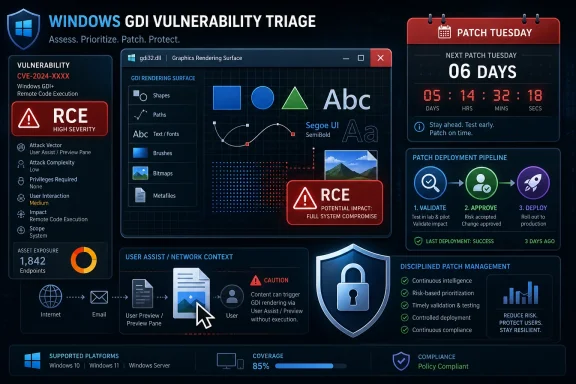 Microsoft’s Advisory Says Less Than Defenders Want, but More Than Attackers Need
The phrase “Windows GDI Remote Code Execution Vulnerability” carries a long memory for Windows veterans. GDI, the Graphics Device Interface, is one of those old Windows components that has survived architectural revolutions because applications still need to draw text, shapes, images, printer output, and interface elements. When a vulnerability appears in that layer, it immediately raises uncomfortable questions about documents, images, fonts, print paths, preview handlers, and all the other places where rendering code touches untrusted content.Yet the advisory text around CVE-2026-35421 is restrained. The user-facing title identifies the affected technology and impact class, while the metric description points to a confidence model: how certain the industry is that the vulnerability exists, how credible the technical details are, and how much would-be attackers can infer from what has been published. That is not the same thing as an exploit write-up.
This matters because the public often treats a CVE as if it were a complete technical dossier. It usually is not. A CVE can be a tracking number, a vendor warning, a patch reference, a scoring container, or a placeholder that becomes richer over time. For administrators, the first question is not whether the advisory satisfies curiosity. It is whether it establishes enough confidence to justify action.
On that front, CVE-2026-35421 clears the bar. Microsoft’s own Security Update Guide entry is a vendor acknowledgement. In practical risk terms, that is very different from an unverified rumor, a half-parsed crash report, or a third-party scanner flag with no upstream confirmation. The vendor has put a name on the issue, attached it to Windows GDI, and categorized the consequence as remote code execution.
That does not tell us whether exploitation is elegant, reliable, or likely in the wild. It does tell us that waiting for a proof of concept before patching would invert the purpose of Patch Tuesday. The whole point of coordinated disclosure is to close the window before curiosity becomes commodity exploitation.
GDI Is Old Windows Plumbing, and Old Plumbing Still Runs Through the House
GDI is not glamorous. It is not the component that gets keynote demos or cloud branding. It is infrastructure from an earlier era of Windows that remains deeply relevant because drawing is not optional. Every enterprise fleet still depends on rendering pathways in ways that are easy to underestimate until something breaks.That is why graphics vulnerabilities have always had an outsized operational footprint. A bug in a niche service can often be isolated to the machines that run that service. A bug in a rendering stack can intersect with email attachments, document previews, file shares, remote sessions, print workflows, browser-adjacent helpers, line-of-business applications, and legacy software that nobody wants to touch but everybody still needs.
The word “remote” also deserves careful reading. In Microsoft advisories, remote code execution does not always mean a wormable network daemon listening on an open port. It can mean that an attacker can cause code execution from outside the target system, often by persuading a user or process to open, preview, parse, or render hostile content. In other words, the attack may still require a delivery path.
That distinction is not academic. A pre-authentication network RCE in a default service is a five-alarm fire. A user-assisted rendering RCE is still serious, but the control surface is different: email filtering, attachment handling, browser isolation, file preview behavior, least privilege, and endpoint detection become part of the defense. The advisory title tells us the impact class. It does not, by itself, fully describe the exploit path.
For WindowsForum readers, the sober interpretation is this: treat the vulnerability as real and potentially serious, but do not assume details that Microsoft has not published. GDI’s reach gives the bug a broad potential blast radius. The lack of public mechanics means administrators should prioritize patching while resisting the temptation to invent attack chains from the title alone.
Report Confidence Is a Risk Signal, Not a Comfort Blanket
The metric description supplied with the advisory is really about report confidence. It measures certainty: whether the vulnerability’s existence is merely alleged, technically suggested, or confirmed by the vendor or author of the affected technology. In plain English, it asks how much trust defenders should place in the claim that this thing is real.That is a useful metric because the vulnerability ecosystem is noisy. CVE records can be thin. Scanner vendors can disagree. Research can appear before a vendor has confirmed root cause. Social media can inflate a bug long before anyone knows whether it is exploitable in real-world conditions. A confidence measure helps separate “this might be something” from “the responsible party acknowledges there is a security flaw.”
For CVE-2026-35421, the fact that Microsoft has an MSRC entry is the strongest public confidence signal available. The advisory may not satisfy reverse engineers, but it is enough for patch managers. The vendor has acknowledged the issue in the affected technology, and that moves the vulnerability out of the rumor category.
The second half of the metric description is more uncomfortable. It notes that confidence also hints at how much technical knowledge is available to attackers. That cuts both ways. Sparse advisories slow casual attackers, but they also force defenders to work from less operational detail. Rich advisories help defenders build detections and mitigations, but they can also accelerate exploit development.
Microsoft has lived inside that trade-off for decades. Too little information, and enterprises accuse Redmond of asking for blind trust. Too much information, and unpatched systems become easier targets. CVE-2026-35421 sits in the familiar middle: enough to justify action, not enough to publish a weekend exploit guide.
The RCE Label Should Drive Priority, but Not Hysteria
Remote code execution remains the vulnerability class that gets everyone’s attention for good reason. If exploited successfully, RCE can let an attacker run code in the context of the vulnerable process or user. From there, the story can branch into credential theft, persistence, lateral movement, ransomware deployment, or simple crash-and-burn vandalism.But a mature patch program does not rank risk by scary acronyms alone. It weighs exploitability, exposure, required user interaction, privilege context, affected assets, compensating controls, and business impact. A GDI RCE on a fully patched, tightly managed workstation fleet is not the same operational problem as the same class of bug on internet-facing servers or unmonitored kiosk systems running stale images.
For most Windows estates, the immediate move is to identify which supported Windows versions receive the relevant security update and how quickly those updates can pass internal testing. If Microsoft ships the fix through the regular cumulative update channel, the remediation will likely be operationally familiar. That does not make it trivial. Cumulative updates are still where printer drivers, VPN clients, EDR agents, and brittle internal applications occasionally remind IT that “just patch” is a slogan, not a workflow.
The right posture is urgency without theater. Security teams should move the update into accelerated validation, especially on systems that handle untrusted documents, images, email, printing, or remote desktop workloads. They should not disable core Windows graphics functionality on the basis of an advisory title unless Microsoft publishes a specific mitigation calling for it.
This is where the difference between risk management and vulnerability fandom becomes visible. The goal is not to be the first person in the room with a dramatic exploit theory. The goal is to reduce the number of vulnerable machines before exploit details become cheaper.
The Patch Tuesday Machine Has Made CVEs Feel Routine, Which Is Its Own Risk
Microsoft’s monthly update cadence has trained many organizations to treat even serious Windows bugs as entries in a queue. That is understandable. Every month brings another set of cumulative updates, Office fixes, Edge updates, .NET patches, Azure advisories, Exchange warnings, and third-party software churn. If every CVE is an emergency, nothing is.But the routine can numb organizations to the specific shape of risk. A graphics rendering RCE is not just another line item because it potentially intersects with human behavior at scale. Users open files. Users preview attachments. Users drag images into chat clients. Users print. Users do all the things security policies describe in antiseptic language as “content handling.”
The modern Windows endpoint is also more complicated than the old desktop mental model suggests. Cloud sync clients replicate files between machines. Collaboration suites create automatic previews. Security tools inspect content. Remote support tools mirror sessions. Virtual desktop infrastructure centralizes user activity in ways that can amplify a client-side bug if the wrong workload is exposed.
That does not mean CVE-2026-35421 is destined to become a headline-grabbing incident. It means the class of bug deserves attention before there is a headline. The absence of public exploit chatter at the moment of disclosure should not be mistaken for absence of attacker interest. Attackers read Patch Tuesday too, and patch diffing remains a reliable way to turn a fixed vulnerability into an exploit against the machines that lag behind.
The monthly patch system works only if organizations actually use the month. If updates sit in testing for weeks without a risk-based exception path, the calendar becomes an attacker’s friend. A confirmed RCE in a broadly deployed Windows component is precisely the kind of issue that should test whether an enterprise’s “expedited patch” process is real or decorative.
The Thin Advisory Is Also a Reminder That NVD Is Not the Whole Truth
Many administrators still use the National Vulnerability Database as a neutral index of record, and it remains a central part of the vulnerability ecosystem. But recent years have made one point impossible to ignore: NVD enrichment can lag, differ from vendor scoring, or omit context that vendors have at disclosure time. For Microsoft vulnerabilities, MSRC is usually the authoritative starting point.That matters for CVE-2026-35421 because waiting for every downstream database to converge can waste the period when patching is most valuable. A vendor advisory does not need to be duplicated across every scanner feed before it becomes operationally relevant. If Microsoft says a Windows component has an RCE-class vulnerability and publishes an update path, that is enough to begin remediation planning.
This is not an argument for ignoring third-party intelligence. Quite the opposite. Scanner vendors, exploit trackers, incident responders, and vulnerability databases often add useful context after disclosure. They may clarify affected products, detect exploit attempts, spot proof-of-concept releases, or explain why a seemingly moderate score is more dangerous in common configurations.
But the order matters. Vendor first, enrichment second, speculation last. In the first hours of a Windows security release, administrators should anchor on Microsoft’s affected-products matrix, update availability, exploitability assessment, and mitigation language. Everything else should be treated as supporting intelligence until it proves itself.
The danger is that dashboards can make uncertainty look precise. A CVSS score appears scientific because it is numeric. A scanner status appears definitive because it is red or green. A CVE page appears complete because it has a table. CVE-2026-35421 reminds us that vulnerability management still requires judgment, especially when the most important facts are confirmed but the most interesting details are withheld.
For Home Users, the Right Answer Is Boring and Effective
For individual Windows users, this is not the moment to go hunting for obscure registry tweaks or unofficial mitigations. The safest answer is to install the relevant Windows security update when it is offered, restart promptly, and avoid opening unexpected files in the meantime. That advice sounds dull because it is the advice that works most often.Windows Update has improved significantly over the years, but user behavior still creates patch latency. People defer restarts. Laptops sleep through maintenance windows. Metered connections delay downloads. Enthusiasts pause updates to avoid driver regressions and then forget they did it. The result is a population of machines that are technically supported but practically exposed.
CVE-2026-35421 is a good reason to check that Windows Update is not paused. It is also a good reason to verify that Microsoft Defender or another reputable endpoint security product is active and current. Antivirus is not a substitute for patching, but it can provide useful friction against malicious attachments and known exploit artifacts once defenders begin seeing them.
Home users should also treat unsolicited documents and images with suspicion, especially when they arrive through email, messaging apps, shared drives, or download links. Again, the public advisory does not establish a specific file format or trigger path. But for a graphics subsystem vulnerability, caution around untrusted visual content is a rational temporary behavior until updates are applied.
The best security advice for consumers often lacks drama: update, restart, back up, and do not open bait. That is not because the threat is imaginary. It is because most successful defensive moves are mundane when performed early and painful only when postponed.
Enterprise IT Has to Patch the Workflow, Not Just the File
For enterprise administrators, CVE-2026-35421 is less about one workstation and more about the workflow that carries content through the organization. A rendering vulnerability becomes more interesting when untrusted files pass through shared mailboxes, document management systems, help desk queues, HR intake folders, legal review platforms, and collaboration spaces. Those are the places where opening strange files is not reckless behavior; it is the job.This is why asset prioritization should look beyond executive laptops and domain controllers. Systems that process external submissions deserve special attention. So do jump boxes and administrator workstations, where code execution in a user session can become more consequential because credentials, management tools, or privileged network paths are nearby.
Virtual desktop environments complicate the picture further. They can simplify patching because images are centralized, but they can also concentrate exposure if many users share a common host platform or golden image. A delayed update in a VDI pool can leave a large user population vulnerable even if the physical endpoint fleet looks healthier on paper.
Print servers and application servers should not be forgotten merely because GDI sounds client-side. Windows graphics components have historically shown up in server contexts through printing, rendering, report generation, document conversion, and remote application publishing. If a server processes or renders user-supplied content, it belongs in the review.
The operational question is therefore not “Do we have Windows?” It is “Where do we render untrusted content, and how quickly can we update those systems without breaking business?” CVE-2026-35421 may be a single CVE, but the answer will vary across departments, roles, and workloads.
Detection Will Lag the Patch Unless Microsoft Reveals More
Security operations teams naturally want detections. They want file hashes, YARA rules, event IDs, command lines, crash signatures, memory indicators, and network patterns. A sparse advisory does not provide that. Until public exploit details emerge or Microsoft publishes additional guidance, defenders have to build around behavior and exposure rather than a known exploit signature.That means watching for suspicious child processes from applications that render content. Office applications, preview handlers, image viewers, browsers, mail clients, print-related processes, and document conversion utilities should not casually spawn shells, script interpreters, credential tools, or network downloaders. Those detections are not specific to CVE-2026-35421, but they are often useful for content-driven exploitation.
Endpoint detection and response tools can help, but only if they are tuned to catch post-exploitation behavior rather than merely known malware. A new GDI exploit would not necessarily arrive with a known payload. The first public samples may vary quickly as attackers adapt. Behavioral controls are valuable precisely because they do not require the defender to have seen the exact exploit before.
Application control, attack surface reduction rules, protected view, macro restrictions, and web isolation can also reduce the probability that a rendering bug becomes a full compromise. None of these should be sold as a clean mitigation unless Microsoft names them as such. They are layers that make exploitation and follow-on activity harder.
The hard truth is that patching will probably be the cleanest fix. Detection is a safety net, not a replacement floor. The longer an organization waits for perfect indicators, the more likely it is to remain exposed to a vulnerability whose underlying code has already been changed in public updates.
Microsoft’s Sparse Disclosure Model Still Leaves Administrators Holding the Risk
Microsoft has strong reasons to limit technical detail at disclosure. The Windows ecosystem is enormous, and any advisory that reads like a vulnerability research paper can become attacker training material. In the age of automated patch diffing and AI-assisted reverse engineering, even small clues may accelerate exploit development.But administrators also have a legitimate complaint: they are expected to make prioritization decisions under incomplete information. If a GDI RCE affects a rarely used code path, that is one operational profile. If it can be triggered by a common file preview, that is another. If exploitation requires local access or a non-default configuration, the triage changes again.
This tension is not going away. Vendors will continue to publish structured advisories that compress complex engineering reality into scores, vectors, and short descriptions. Enterprises will continue to demand more context because downtime, regression risk, and maintenance windows are real business constraints. Attackers will continue to reverse patches regardless of how much prose Microsoft publishes.
The practical compromise is to treat sparse vendor advisories as minimum viable truth. They establish the existence of a problem and the availability of a fix. They do not eliminate the need for internal prioritization, but they should prevent teams from dismissing the issue as unproven.
CVE-2026-35421 therefore becomes a test of process maturity. Organizations that already know their exposure to content-rendering workflows can act quickly. Organizations that discover during this advisory that they do not know where Windows renders untrusted files have found a larger problem than one CVE.
The Real Risk Window Opens After the Patch Ships
The most dangerous period for many Windows vulnerabilities is not always before disclosure. It is the interval after the patch is available but before it is widely deployed. At that point, attackers can compare patched and unpatched binaries, infer the vulnerable code path, and build exploits for the lagging population.That patch-diff window is especially relevant for broadly deployed components. Windows updates are public. Enterprises patch at different speeds. Home users delay restarts. Unsupported machines never receive fixes. The result is a staggered landscape where the fix itself becomes a map for attackers while vulnerable systems remain plentiful.
This is why “no known exploitation” should never be read as “low priority” in isolation. Exploit status is time-sensitive. A bug can move from theoretical to weaponized faster than an enterprise change board meets. By the time exploitation is confirmed in the wild, the defenders who waited for that confirmation are already behind.
For CVE-2026-35421, the responsible assumption is that researchers and attackers will study the relevant update. Some will do so to improve defenses. Others will do so to exploit slow patchers. That does not mean exploitation is guaranteed, but it makes delay harder to justify.
The patch window is where security culture becomes visible. Teams that can accelerate a high-impact Windows update without chaos have invested in resilience. Teams that must choose between blind deployment and month-long testing have a structural problem that no CVSS metric can solve.
The GDI Bug’s Lesson Is Bigger Than This Month’s Update
CVE-2026-35421 also highlights the persistence of legacy attack surfaces in modern operating systems. Windows has gained sandboxing, virtualization-based security, memory protections, application control, and cloud-connected defenses. Yet the platform still contains decades of compatibility surface because customers demand that old applications, old workflows, and old document formats keep working.That bargain is not unique to Microsoft. Every mature platform carries old code because real customers build real businesses on yesterday’s interfaces. The difference with Windows is scale. A vulnerability in a compatibility-rich subsystem can matter across consumer laptops, enterprise desktops, remote workstations, servers, and specialized devices.
Security-minded readers should resist the simplistic conclusion that old components are merely bad engineering. Compatibility is a feature people pay for. The problem is that compatibility expands the set of code paths that must safely handle hostile input in 2026 threat conditions, not 1996 threat assumptions.
The better conclusion is that exposure management matters as much as patch management. If old rendering paths are reachable from modern internet-fed workflows, risk increases. If they are isolated, filtered, sandboxed, or avoided, the same underlying bug may be less useful to attackers. Architecture still matters after the CVE is published.
Microsoft can patch GDI. Customers have to patch the assumptions around it. The Windows estate that survives the next decade will be the one that treats legacy surface as something to inventory, constrain, and monitor—not merely something to hope Redmond keeps fixing fast enough.
The Practical Reading for This Advisory
CVE-2026-35421 is not a mystery to ignore and not a catastrophe to embellish. It is a vendor-confirmed Windows GDI remote code execution vulnerability with limited public technical detail at disclosure time. That combination should push administrators toward fast, measured remediation and away from both complacency and rumor-driven overreaction.The concrete reading is straightforward:
- Microsoft’s acknowledgement gives defenders sufficient confidence to treat CVE-2026-35421 as a real Windows security issue, even if the public advisory does not disclose exploit mechanics.
- The Windows GDI label should focus attention on systems and workflows that render untrusted documents, images, previews, print jobs, or other graphical content.
- Remote code execution describes the impact class, but administrators should avoid assuming a specific attack path unless Microsoft or credible researchers publish more detail.
- Patch deployment should be accelerated through normal validation channels, with priority given to exposed endpoints, content-processing systems, administrator workstations, and shared remote environments.
- Detection should emphasize suspicious post-rendering behavior, such as unexpected process launches from document, image, mail, browser, preview, or print-related processes.
- The risk window will widen as attackers analyze the released fix, so waiting for public exploit code is a poor strategy.
Source: MSRC Security Update Guide - Microsoft Security Response Center
