

Microsoft’s Quiet Cloud CVE Says the Loud Part Softly
The strangest thing about CVE-2026-35435 is not that Microsoft says customers do not need to patch anything. In modern cloud security, that is increasingly normal: the vendor owns the service, the vendor deploys the fix, and the customer receives a disclosure after the fact. The strange thing is how much severity remains in a vulnerability that has already been neutralized.
Microsoft rates the flaw as critical, with a CVSS 3.1 base score of 8.6 and a temporal score of 7.5. The vector is the kind that makes security teams sit up: network exploitable, low attack complexity, no privileges required, no user interaction, changed scope, and high confidentiality impact. Integrity and availability are listed as unaffected, which narrows the blast radius, but it does not make the issue routine.
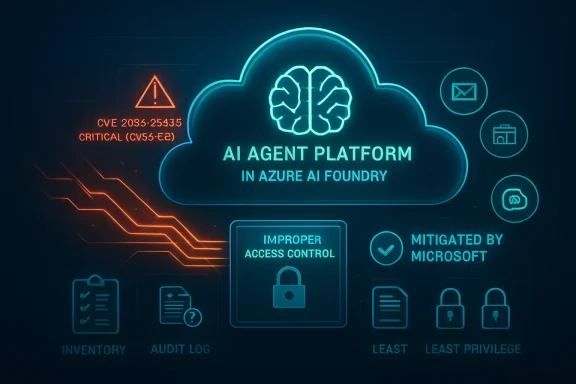
The affected product is Azure AI Foundry, specifically Microsoft 365 published agents. Microsoft’s short description says improper access control in those agents could allow an unauthorized attacker to elevate privileges over a network. That is a terse sentence, but it lands in the middle of one of Microsoft’s most strategically important product areas: the layer where enterprises are expected to build, publish, and operationalize AI agents that act across data, workflows, and identity boundaries.
This is not a Windows kernel patch, a browser memory bug, or an Exchange server emergency. It is a cloud AI platform vulnerability, and that means the old patch-management reflex only gets us part of the way. The more important question is what kind of control plane we are building around AI agents — and whether we are treating those agents as software, identities, integrations, or all three at once.
The Missing Patch Is the Point
Microsoft’s advisory states that the vulnerability has already been fully mitigated and that there is no action for users of the service to take. That will frustrate some admins, because “no action” can feel uncomfortably close to “no visibility.” There is no KB article to deploy, no MSI to test, no Windows Update ring to monitor, and no build number that proves compliance.
For cloud services, that is the bargain. Customers give up the burden of patching infrastructure in exchange for speed, abstraction, and vendor-operated remediation. When the model works, serious vulnerabilities can be fixed before most customers ever know they existed. When the model feels opaque, defenders are left with a CVE entry and a trust relationship.
This is why Microsoft’s cloud CVE transparency effort matters. Publishing a CVE for a fully mitigated service-side flaw is not the same thing as shipping a Windows patch, but it is still a signal. It says the vendor believes the issue met the bar for public vulnerability disclosure even though the operational fix occurred behind the service boundary.
That boundary is becoming one of the defining fault lines in enterprise security. In the on-premises era, customers could often inspect logs, reverse patches, diff binaries, and build their own theory of exposure. In the cloud AI era, the provider may be the only party with enough telemetry, code access, and service topology to understand what happened. CVE-2026-35435 is therefore not only a vulnerability entry; it is a reminder that cloud customers increasingly audit outcomes rather than patches.
Critical Does Not Always Mean Catastrophe, But It Does Mean Directional Risk
The CVSS details make this vulnerability worth taking seriously even in the absence of active exploitation. Network attack vector means the vulnerable component was reachable across a network path. Low attack complexity means exploitation did not depend on rare environmental conditions. No privileges required means the attacker did not need to start with an account or role inside the vulnerable service.
Those three metrics together are the reason this is not a mere compliance footnote. A flaw that is remote, repeatable, and unauthenticated sits in a different risk category from an issue that requires insider access or unusual configuration. Microsoft also marks user interaction as none, which removes the familiar comfort of phishing-style dependency; the bug, at least as scored, did not require a victim to click the wrong thing.
The “changed scope” metric is equally important. In CVSS language, changed scope means a successful exploit can affect resources beyond the security authority of the vulnerable component. In plain English, the vulnerable thing and the impacted thing are not neatly contained inside the same box. For a service that publishes AI agents into Microsoft 365-adjacent workflows, that is the part defenders should underline.
At the same time, the impact profile is not the all-red dashboard of a classic remote code execution nightmare. Confidentiality is high, but integrity and availability are none. That suggests the core harm was access to information or privileges that could reveal protected data, not necessarily the ability to modify data or bring the service down. For many enterprises, however, confidentiality is the whole ballgame: internal documents, prompts, outputs, connectors, grounding data, and user context are exactly what AI platforms are designed to assemble.
“Report Confidence: Confirmed” Is the Part Attackers Read Too
The user-supplied text focuses on the Report Confidence metric, and for good reason. Microsoft lists report confidence as confirmed. That means the vulnerability’s existence is not merely suspected, and the known technical details are credible enough for the vendor to stand behind the finding.
Report confidence is easy to overlook because it is not as dramatic as exploit code maturity. But it tells defenders and attackers something different. Exploit code maturity asks whether working public exploit code exists or whether exploitation has been observed. Report confidence asks whether the vulnerability is real enough, documented enough, or reproduced enough to be treated as fact.
In this case, Microsoft lists exploit code maturity as unproven and says the issue was not publicly disclosed or exploited at publication. That is the good news. The less soothing part is that the exploitability assessment is “exploitation more likely.” Microsoft is essentially saying that while it does not know of public exploitation, the shape of the bug makes future exploitation plausible enough to matter.
This combination is common in the uncomfortable middle of vulnerability management. There is no fire alarm, but there is smoke in the architectural diagram. Security teams should not pretend CVE-2026-35435 was an active incident based solely on the advisory. They also should not dismiss it as theoretical, because Microsoft’s own scoring says the flaw is confirmed, remotely reachable, unauthenticated, low complexity, and more likely to be exploitable.
AI Agents Turn Access Control Into Product Strategy
Azure AI Foundry is not just another Azure-branded service. It is part of Microsoft’s broader attempt to make AI development and deployment manageable for enterprises: models, prompts, evaluations, safety systems, orchestration, and agents, all wrapped in a platform that can connect to business data and workflows. The vulnerability’s reference to Microsoft 365 published agents is therefore highly specific and highly consequential.
Agents are not chatbots with better marketing. In enterprise settings, an agent can embody permissions, retrieve data, invoke tools, use connectors, and operate inside workflow contexts that were never designed around probabilistic software. If a published agent is exposed to the wrong audience or able to cross a boundary it should not cross, the result is not just a bad answer. It can become an access-control failure wearing the clothes of productivity software.
That is why improper access control is such a dangerous weakness class in this domain. Access control bugs are rarely glamorous. They are not the kind of memory corruption flaws that earn exploit writers instant admiration. But they are often where real enterprise compromise begins, because they turn legitimate features into unauthorized pathways.
AI platforms intensify that risk because they aggregate context. A normal app might expose one database table or one API response if a permission check fails. An AI agent may sit near documents, emails, Teams content, CRM records, code repositories, custom tools, and user-specific context. The more useful the agent, the more tempting the access-control boundary becomes.
The Cloud Has Moved the Patch, Not the Accountability
Microsoft says no customer action is required, and for direct remediation that appears to be the case. But “no patch to install” is not the same as “nothing to review.” A critical cloud-side access-control issue should trigger a different operational motion: inventory, exposure review, logging review, and governance review.
The first question is whether the organization uses Azure AI Foundry and whether it has published Microsoft 365 agents. Many enterprises are experimenting with AI agents faster than their security inventories can keep up. A vulnerability like this is a useful forcing function: if the security team cannot answer where agents are published, who owns them, and what data they can reach, the immediate risk may be less about this specific CVE and more about the operating model.
The second question is what logs exist around agent publication, invocation, and data access. Microsoft’s advisory says the issue was not known to be exploited, but customers with sensitive deployments may still want to understand whether unusual access patterns occurred before mitigation. In cloud services, customers may not have the complete service-side picture, but they can still examine tenant-level signals, identity logs, audit events, and downstream data access.
The third question is whether AI agents are treated as production software. If an agent can be published into a business environment, it deserves ownership, change control, permission review, and retirement procedures. Too many organizations still treat agents as experiments until the day they quietly become infrastructure.
The “No Customer Action” Sentence Has a Governance Shadow
Microsoft’s FAQ says there are no update links or protective steps because the vulnerability has already been fully mitigated. That is a clean operational message, and it prevents admins from wasting time searching for an update that does not exist. But it also highlights how thin the customer’s role can become in cloud vulnerability management.
For regulated environments, “the vendor fixed it” may not be enough by itself. Auditors may ask whether the organization was affected, whether sensitive data could have been exposed, whether the issue intersects with incident reporting obligations, and whether compensating controls exist for future events. The CVE does not automatically answer those questions.
This is where Microsoft’s disclosure leaves some predictable gaps. The advisory does not name a specific tenant configuration, does not describe the vulnerable code path beyond improper access control, and does not provide indicators of compromise. That restraint may be necessary to avoid handing attackers a recipe, especially when exploitability is considered more likely. But it also means defenders are asked to reason from scoring metadata rather than technical detail.
The best response is neither panic nor passivity. Treat the vendor mitigation as the fix, but treat the disclosure as a prompt to verify governance. The operational question is not “what patch do we deploy?” It is “what would we know if an AI agent access-control boundary failed again?”
Confidentiality Is the AI Platform’s Crown Jewel
The CVSS impact profile is revealing. Confidentiality is high. Integrity and availability are none. In old infrastructure language, that might sound less severe than a bug that lets an attacker overwrite files or crash a server. In AI platform language, confidentiality can be the highest-value target.
AI systems are only as useful as the context they can reach. That context may include private documents, meeting summaries, source code, customer records, HR material, security tickets, and the connective tissue of everyday business. A vulnerability that enables unauthorized privilege elevation for data access can be damaging even if it never changes a byte.
The agent layer also changes how data exposure feels. Users may not think of a prompt as a query against multiple protected systems, but that is often what it becomes. A published agent can abstract away the underlying data sources so effectively that even administrators may struggle to visualize what a compromised access path could reveal.
This is why least privilege for AI agents cannot remain a slogan. It needs to become an engineering discipline. Agents should have constrained scopes, explicit data boundaries, lifecycle ownership, and monitoring that treats unusual retrieval behavior as a security signal rather than merely a usage pattern.
The Anonymous Researcher and the Value of Boring Disclosure
Microsoft credits an anonymous reporter for the finding. That detail is easy to skip, but it is part of the reason the disclosure exists at all. Coordinated vulnerability disclosure is the plumbing behind many security advisories, and cloud AI services need that plumbing as much as operating systems do.
There is a temptation to treat AI security as a futuristic category full of prompt injection, model theft, jailbreaks, and autonomous misuse. Those risks are real, but CVE-2026-35435 is a reminder that the familiar classes still matter. Improper access control is not exotic. It is the old security problem of making sure the right principal can do the right thing at the right time — now applied to a platform where agents may act across human, application, and data boundaries.
The boringness is precisely why it matters. Enterprise security failures often come from mundane authorization mistakes that scale across powerful platforms. When the platform is Azure AI Foundry and the integration surface includes Microsoft 365 published agents, even a conventional weakness can acquire strategic weight.
Microsoft’s decision to publish the CVE after mitigation also suggests that cloud providers are slowly adapting disclosure norms to service realities. Customers may not get a patch, but they do get a record. That record gives security teams something to track, discuss, and fold into risk management, even if it does not provide the full technical anatomy of the bug.
Windows Admins Are Now AI Platform Admins, Whether They Asked or Not
For the WindowsForum audience, the larger shift is unavoidable. Microsoft 365, Entra ID, Azure, Defender, Copilot, and Azure AI Foundry are increasingly part of the same administrative universe. A vulnerability in an AI agent platform is not someone else’s cloud problem if those agents touch the same identities and data stores that Windows and Microsoft 365 admins already protect.
The job has expanded from patching endpoints to governing capabilities. Admins still need update rings, vulnerability scanners, and configuration baselines. But they also need to know which AI experiences have been enabled, which users can publish agents, which connectors are allowed, and how those agents inherit or request access.
This is a cultural change as much as a technical one. Traditional IT has long separated “applications” from “identity” from “security” from “data.” AI agents blur those lines because the agent is an application-like object that often acts through identity, reasons over data, and invokes tools. If nobody owns the overlap, the overlap becomes the attack surface.
CVE-2026-35435 is therefore a preview of the next category of Microsoft security work. It is not enough to ask whether Windows is patched and Defender is healthy. Organizations must ask whether their AI control plane is understandable. If the answer is no, then the next cloud-side CVE will again arrive as a terse advisory describing a risk that customers cannot fully see.
Microsoft’s Transparency Is Useful, But It Is Not a Substitute for Design
It is fair to give Microsoft credit for publishing cloud service CVEs that require no customer action. Years ago, many such issues might have disappeared into private service remediation and vague assurances. A public CVE creates a durable record and lets customers incorporate the event into their own risk calculations.
But transparency after mitigation cannot substitute for customer-visible design controls before the next bug. Enterprises need clear ways to limit agent publication, constrain data access, review permissions, and monitor behavior. They need defaults that assume agents are powerful actors, not harmless experiments. They need administrative surfaces that make the implicit access graph visible.
Microsoft also has an incentive to make this easier. The company is asking customers to build serious business processes on AI agents. That only works if admins believe the platform can be governed with the same seriousness as identity, email, endpoint, and cloud infrastructure. A critical access-control CVE does not destroy that trust, but it does spend a little of it.
The burden is shared. Vendors must design safer platforms and disclose meaningfully. Customers must stop treating AI agent deployment as a pilot-project privilege granted outside normal controls. The phrase published agent should carry the same administrative weight as “public endpoint,” “privileged app registration,” or “production automation account.”
The Concrete Reading of CVE-2026-35435
CVE-2026-35435 should not be inflated into a known breach, but it should not be filed away as harmless because Microsoft fixed it. The facts point to a serious, service-side access-control flaw in a strategically important AI platform, mitigated before the advisory but still valuable as a warning about how agent infrastructure can fail.
- Microsoft published the advisory on May 7, 2026, for Azure AI Foundry and listed Microsoft as the assigning CNA.
- The affected area is Azure AI Foundry Microsoft 365 published agents, with improper access control enabling elevation of privilege over a network.
- Microsoft rates the vulnerability as critical, with a CVSS 3.1 base score of 8.6 and a temporal score of 7.5.
- The vulnerability requires no customer action because Microsoft says it has already been fully mitigated in the cloud service.
- Microsoft says the issue was not publicly disclosed and not exploited at publication, but assesses exploitation as more likely.
- The most important practical response is to review AI agent inventory, publication rights, data scopes, and audit visibility rather than hunt for a nonexistent patch.
The forward-looking lesson is that AI security will not arrive as a separate discipline neatly parked beside endpoint, identity, and cloud; it will cut through all of them. CVE-2026-35435 is already fixed, but the class of problem it represents is not going away. As agents become a normal way to package business logic around Microsoft 365 and Azure data, the winners will be the organizations that treat agent governance as production security now — before the next terse cloud CVE turns a hidden access path into the week’s most uncomfortable meeting.