

Background
What CVE-2026-3842 affects
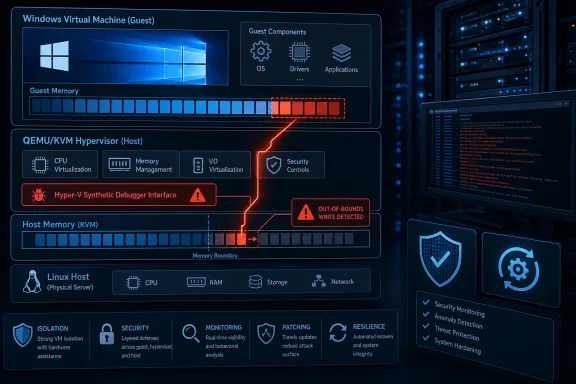
CVE-2026-3842 concerns qemu-kvm, specifically the hyperv/syndbg implementation in QEMU. The defect occurs after QEMU calls a routine intended to map guest physical memory into the host process address space. That routine accepts a requested length but can return a smaller mapped length, because the requested guest-physical range may not be fully available or continuously mappable.
The vulnerable code reportedly failed to verify that the returned mapping was large enough before writing data into it. In practical terms, QEMU asked for a buffer of a given size, received a potentially shorter buffer, and then proceeded as if the original requested size had been granted. That is a classic boundary-validation failure and can lead to a host-process out-of-bounds write.
Why the advisory emphasizes availability
Microsoft’s published impact language describes a total or serious partial loss of availability. That framing is important. A QEMU process is often the active execution environment for a VM, and a crash or unstable memory corruption in that process can make a guest unavailable immediately. Depending on orchestration and restart behavior, the disruption can be temporary, repeatedly triggerable, or persistent until an operator intervenes.
The availability rating should not be read as a guarantee that the practical result is limited to a clean denial of service. Host-side out-of-bounds writes are intrinsically security-significant primitives, because their real-world outcome can vary with allocator layout, build options, process hardening, and the exact control an attacker has over the overwrite. Microsoft’s stated impact should guide prioritization, but defenders should still handle the bug with the care normally reserved for a memory-safety flaw in a virtualization boundary.
A timestamp detail worth noting
The Microsoft advisory timestamp supplied with the report is July 21, 2026, at 01:42:10 Pacific Daylight Time, which converts to 08:42:10 UTC on July 21, 2026. That is later than the current reference time of 07:23 UTC on the same date. This discrepancy is most likely attributable to advisory-page publication, cache, or metadata timing rather than a technical contradiction, but administrators should avoid relying on a single portal’s “published” field to decide whether a patch is already available.
Distribution advisories and vulnerability records indicate that the issue had already entered the QEMU security-update ecosystem earlier in 2026. The practical response is therefore straightforward: inventory installed QEMU/KVM packages, determine whether the vulnerable Hyper-V synthetic debugger functionality is enabled, and apply the vendor-supplied fixed build rather than waiting for advisory metadata to settle.
Understanding the Vulnerable Code Path
Guest physical memory is not automatically a contiguous host buffer
QEMU’s system emulation model represents guest memory through an abstraction layer. A guest physical address is not simply a permanently valid native pointer in the QEMU process. Hardware emulation, memory regions, device mappings, migration state, RAM backends, and address-space rules all influence whether a particular guest range can be translated and how much of it is safely accessible in one operation.
cpu_physical_memory_map() exists to bridge that gap. The caller supplies a guest physical address and a length, while the function attempts to expose a usable host-side mapping. Crucially, the length parameter is not merely an input. It is also an output describing how much memory was actually mapped.
That contract is easy to underestimate. A non-null pointer tells the caller that some memory was mapped; it does not establish that the complete requested region is safe to read or write. Correct code must use the returned length as the authoritative boundary.
The missing mapped-length guard
The affected syndbg receive path reportedly requests an output area, maps it, then writes a response into the returned host pointer. The missing guard is the check that the actual mapped length is at least as large as the original requested response length.
The security fix is conceptually small: preserve the requested size, map the guest memory, and reject the operation if the mapping failed or if the returned length is shorter than the needed output. In other words, the remediation is a defensive validation step, not a redesign of the Hyper-V synthetic debugger feature.
Small code changes can close large attack surfaces. The difference between “mapping succeeded” and “the complete requested range is mapped” is precisely where this bug lives. It is an example of why systems code needs explicit validation of values returned through in/out parameters, especially when guest-controlled addresses and lengths influence the operation.
Why the write happens in the host process
The guest does not directly gain a normal host virtual-memory pointer. Instead, it interacts with an emulated or paravirtualized interface, and QEMU uses the guest-provided context to perform operations in its own process. Once QEMU receives an undersized mapping and writes beyond it, the fault occurs in host userspace, inside the QEMU process.
That distinction matters for incident response. This is not a Windows kernel crash caused by a guest driver, and it is not necessarily a Linux kernel KVM bug. It is a flaw in the userspace virtual machine monitor process that manages a guest. A failed QEMU process may be restarted by libvirt, a cloud control plane, or a high-availability stack, but the guest workload can still suffer interruption, corruption, or repeated service failure.
Hyper-V Enlightenments and Why Windows Guests Enter the Picture
Compatibility features are not the same as Hyper-V
QEMU/KVM can expose a collection of Hyper-V “enlightenments” to improve Windows guest performance and compatibility. These features let a Windows VM recognize a Hyper-V-like environment and use optimized interfaces for timing, interrupts, spinlocks, synthetic devices, and related functions.
This does not mean the host is running Microsoft Hyper-V. It means QEMU is presenting selected Hyper-V-compatible interfaces to the guest while KVM supplies hardware-assisted virtualization underneath. That combination is common in Linux-hosted Windows VM deployments, including developer machines, GPU-passthrough rigs, test labs, desktop virtualization environments, and some cloud platforms.
Synthetic debugger support is more specialized
The vulnerable subsystem, syndbg, is associated with Hyper-V synthetic debugging. This is far more specialized than broadly enabled Hyper-V timing or interrupt enlightenments. It is intended to support debugger communication through a virtualized transport, enabling certain Windows kernel-debugging workflows without requiring a conventional physical serial connection.
That narrower scope affects exposure. A Windows VM merely having generic Hyper-V enlightenments enabled does not automatically prove that the synthetic debugger path is exposed. Administrators must determine whether the specific synthetic debugging capability has been enabled in their QEMU command line, libvirt domain definition, appliance template, or cloud image configuration.
Windows developers should not dismiss it as irrelevant
The specialized nature of synthetic debugging may tempt organizations to treat CVE-2026-3842 as a niche concern. That would be a mistake in environments where Windows kernel development, driver testing, crash-dump analysis, endpoint-security research, or operating-system validation occurs. Those are exactly the environments most likely to turn on non-default debugging facilities.
A vulnerability can be narrowly reachable yet highly relevant to the organizations that use it. The affected path may be absent from many consumer VMs, but it can be present in engineering fleets where a guest compromise or malicious test artifact is a credible scenario. In those cases, the combination of privileged guest software and powerful debugging interfaces deserves a higher operational priority.
Scope: Who Should Treat This as Urgent?
Linux QEMU/KVM hosts are the primary concern
The direct exposure lies in QEMU/KVM installations that include the affected Hyper-V synthetic debugger implementation. These will most often be Linux servers or workstations running qemu-system-x86_64, libvirt-managed KVM guests, enterprise virtualization platforms, or cloud stacks that package and operate QEMU.
Windows systems used as guests are relevant because they can exercise the emulated interface. Windows systems used as the host operating system are not the typical deployment model for QEMU/KVM, although QEMU can run in multiple environments. The central question is not “Does this machine run Windows?” but rather “Does this host run a vulnerable QEMU build with the affected feature available to a guest?”
Enterprise environments face a shared-host problem
In enterprise virtualization, a guest-to-host QEMU failure can become more than an individual VM outage. One QEMU process normally corresponds to one VM, which provides some containment. However, the consequences may include service interruption, failed customer workloads, automated restart storms, noisy alerts, node evacuation, and reduced capacity on an already busy cluster.
Where multiple VMs share storage, management services, or host resources, a crash can create indirect operational effects even if the memory corruption remains contained to one QEMU process. A high-availability layer may restart the guest, but repeated exploitation can defeat the practical purpose of automated recovery by continuously pushing a VM back into failure.
Homelabs and desktop users should assess configuration, not panic
For individual users running a Windows 10 or Windows 11 VM on a Linux desktop, the exposure depends heavily on configuration. A routine Windows gaming VM with common Hyper-V enlightenments may not have the synthetic debugger function enabled at all. The correct response is not to dismantle a working setup; it is to update the host package and review the VM definition.
The update is still worthwhile because QEMU security updates frequently bundle fixes for several virtualization issues. But the immediate risk is highest where a potentially hostile or compromised guest has access to specialized Hyper-V debugging functionality, not necessarily where an enthusiast runs a trusted personal Windows VM for office applications or gaming.
The Security Significance of an Out-of-Bounds Write
Denial of service is the confirmed operational outcome
The advisory’s availability focus reflects the most defensible immediate impact: a crafted guest interaction can cause host-side memory corruption that crashes or destabilizes QEMU. Since QEMU is responsible for executing the guest, that can deny service to the VM and workloads inside it.
For an administrator, the first practical indicator may be abrupt guest termination, a QEMU segmentation fault, a libvirt error, a failed migration, or repeated restarts of the same virtual machine. In a production environment, it could look initially like a reliability event rather than a security event.
Memory corruption deserves a broader threat model
Out-of-bounds writes are dangerous because they alter memory beyond the intended target. The overwritten data might be inert padding, a crash-inducing guard area, a heap allocator structure, application state, or an object containing security-sensitive information. The exact result can differ dramatically between builds and executions.
It would be irresponsible to claim that CVE-2026-3842 reliably grants code execution without a public exploit demonstration and a rigorous technical analysis. However, it would be equally irresponsible to assume that every host-side memory write ends in only a benign crash. Treat the confirmed availability impact as the floor, not necessarily the ceiling, while avoiding unsupported claims about exploitation.
Hardening changes the outcome, not the need to patch
Modern Linux distributions compile many components with mitigations such as address-space layout randomization, non-executable memory, stack protection, fortified libraries, and sometimes stronger allocator defenses. Sandboxing and mandatory access controls can also limit what a compromised QEMU process can access.
Those mitigations are valuable, but they do not repair incorrect bounds handling. They may turn some exploit paths into crashes, make reliable exploitation more difficult, or limit post-exploitation reach. They cannot eliminate the possibility of a service outage, and they should never be used as a rationale to defer a vendor-supported QEMU update.
Patch Status and Version Discipline
Upstream remediation is available
The upstream fix adds the required length validation after the physical-memory mapping call. The corrected logic compares the returned map length with the output length originally requested, and it exits safely when the map is unavailable or too short.
Vulnerability tracking sources identify QEMU versions before the 11.0.0 release-candidate line as affected in their version model. That does not mean every enterprise distribution requires a wholesale move to an upstream prerelease build. Enterprise vendors commonly backport the minimal security patch to older QEMU package streams while preserving ABI and platform compatibility.
Distribution package versions are authoritative
Administrators should not make patch decisions based solely on the QEMU version printed by an upstream release note. The appropriate fixed version is the one published by the operating-system or virtualization-platform vendor for the installed channel. A distribution may ship an older-looking QEMU version string with the CVE fix backported, or it may package QEMU in a module, virtualization stream, appliance image, or vendor-maintained repository.
Oracle Linux, for example, published a QEMU/KVM security update in April 2026 that explicitly includes a fix described as checking the length returned by the physical-memory mapping routine for this CVE. Other vendors may have delivered the fix under different package-release identifiers and timelines.
A practical update sequence
Administrators should use a controlled sequence rather than updating only the first host that appears vulnerable:
- Identify every QEMU/KVM host, including standalone hypervisors, lab workstations, CI runners, VDI nodes, and cloud worker images.
- Determine the packaging source and installed build, including distribution repositories, vendor appliances, custom builds, or containerized virtualization stacks.
- Review VM definitions for Hyper-V synthetic debugging exposure, especially in Windows driver-development and kernel-debugging environments.
- Apply the vendor’s fixed QEMU package, following normal maintenance, live-migration, or evacuation procedures where clusters are involved.
- Restart or recreate affected QEMU processes, because updating a package on disk does not patch a QEMU process already running in memory.
- Verify the running binary and service state, then monitor guest stability and host logs for repeated failures.
The restart requirement is easy to overlook. A long-lived VM can continue operating on a vulnerable QEMU process even after package management reports that a fixed build has been installed.
Configuration Review for Windows Virtual Machines
Search for the specific exposure
The most useful mitigation review is targeted. Look for synthetic debugger options in QEMU command lines, libvirt XML extensions, automation templates, cloud-init workflows, and internal documentation used to build Windows debugging VMs. Do not infer the presence of syndbg merely from a generic <hyperv> block or a “Hyper-V enabled” checkbox.
Where the feature is not required, disabling it can reduce exposure while the patch is scheduled. This is especially sensible for test VMs that inherited broad feature sets from a debugging template but do not actively use synthetic debugging.
Preserve the enlightenments that matter
Administrators should avoid a blunt response that disables all Hyper-V enlightenments. Windows guests can rely on certain enlightenments for performance and stable behavior, particularly in workloads with high interrupt frequency, CPU contention, or demanding timer requirements. Removing them indiscriminately can create performance regressions, timing anomalies, or support complications.
The better approach is surgical: identify and disable the specific synthetic debugger capability when it is not needed, while retaining ordinary compatibility features that the workload depends on. The security update remains the durable remediation; configuration changes are a defense-in-depth measure and a useful temporary control.
Driver-development labs need stronger controls
Windows kernel-debugging labs are often designed to make guest crashes, unsigned drivers, experimental code, and privileged debugging easy. That is appropriate for their purpose, but it means they should not be treated like ordinary office VMs.
For these environments, consider the following operational controls:
- Separate experimental Windows guests from production virtualization hosts.
- Avoid sharing a debug-capable host with sensitive business workloads where practical.
- Use restrictive network and management-plane access for test guests.
- Snapshot or rebuild test VMs routinely, but do not confuse guest rollback with host remediation.
- Keep QEMU, libvirt, firmware, and guest tooling on a documented update cadence.
These controls will not substitute for patching, but they reduce the chances that a compromised or deliberately malicious guest can affect a high-value host.
Operational Detection and Incident Response
What a failed exploit may look like
An attempted exploit may manifest as a QEMU crash, abnormal VM shutdown, host-side core dump, service manager restart, or libvirt domain failure. The guest could become unresponsive, disappear from management consoles, or reboot unexpectedly if automatic recovery is configured.
Because the bug concerns a specific Hyper-V synthetic debugging path, log messages involving Hyper-V emulation, synthetic debugging, guest physical memory mapping, segmentation faults, or memory access errors deserve attention. Exact messages vary by distribution, QEMU build flags, crash handlers, and management stack.
Collect evidence before repeated restarts erase it
If an affected VM exits unexpectedly, capture the state before automated recovery cycles overwrite the evidence. Preserve QEMU logs, libvirt logs, system journal entries, core dumps, VM configuration, and the package version in use. If the guest was executing a kernel-debugging workflow or test payload, retain the relevant guest-side artifacts as well.
A disciplined triage record should include:
- The host operating system and kernel version.
- The complete QEMU package release and repository source.
- The VM’s effective QEMU command line or libvirt XML.
- Whether Hyper-V enlightenments and synthetic debugging were enabled.
- The guest workload occurring at the time of failure.
- Any repeated crash pattern after automated VM restart.
This information is valuable not only for security investigation but also for determining whether a later crash is truly related to CVE-2026-3842 or simply resembles it.
Avoid unsafe proof-of-concept testing
Administrators should not attempt to reproduce a host out-of-bounds write on production hardware. Even if the advisory highlights availability, a memory-corruption test can destabilize a host, interrupt unrelated tenants, and contaminate forensic evidence.
If validation is necessary, perform it only in an isolated environment using representative but non-production images. In most cases, package verification, configuration review, and confirmation that running QEMU processes were restarted after patching are safer and more useful than exploit reproduction.
Why This Matters Beyond One CVE
Virtualization boundaries concentrate risk
Virtual machines are often treated as a strong boundary between workloads, users, and operating systems. That model depends on the reliability of the hypervisor stack: CPU virtualization, memory management, device emulation, firmware, management tooling, and the host operating system.
QEMU is a large and capable system emulator. Its flexibility is a major advantage, but it also means that uncommon device models and compatibility features can introduce code paths that receive less routine exposure than virtual CPUs, disks, and network adapters. CVE-2026-3842 reinforces the value of minimizing enabled virtual hardware and paravirtual interfaces to the capabilities a guest actually needs.
Debug interfaces alter the trust equation
Debugging interfaces are designed to observe and influence low-level system state. They are indispensable for operating-system development and incident analysis, yet their presence changes the security posture of the VM. A guest that can access a specialized debug transport has a more complex interaction surface with the host’s virtual-machine monitor.
The lesson is not that synthetic debugging is inherently unsafe or should never be used. The lesson is that optional introspection and debugging facilities should be deliberately enabled, documented, monitored, and patched. The same principle applies to device passthrough, remote display services, shared folders, host-guest clipboard features, and custom firmware hooks.
The bug is a reminder about API contracts
At a code-engineering level, this CVE is a reminder that APIs returning a pointer plus a revised length require careful treatment. The pointer establishes the location of an object; the returned length establishes the legal range of access. Ignoring the second part is an error with potentially serious consequences.
This pattern is common across systems programming: scatter-gather I/O, mapped files, network receives, decompression output, device DMA, and guest memory translation all involve requested sizes that may differ from delivered sizes. Defensive coding requires treating the actual returned size as authoritative and validating it before copying, parsing, or writing.
Strengths and Opportunities
The fix is narrow and operationally manageable
CVE-2026-3842 has several characteristics that make remediation tractable:
- The vulnerable component is clearly identified as QEMU’s Hyper-V synthetic debugger implementation.
- The root cause is specific: missing validation of the actual mapped memory length.
- The corrective change is small and understandable, reducing uncertainty about the intended behavior.
- The exposure appears configuration-dependent rather than inherent to every Windows guest on QEMU/KVM.
- Enterprise distributions can backport the fix without forcing all customers onto a new upstream major release.
- Administrators can use configuration review to reduce exposure while maintenance windows are arranged.
The strongest opportunity is to turn this patch cycle into an inventory exercise. Teams that cannot quickly determine which Windows VMs expose specialized Hyper-V features have discovered a configuration-management gap worth fixing.
Risks and Concerns
Patch lag and incomplete restarts remain the main practical hazards
The largest operational risks are likely to come from process and visibility failures rather than from the complexity of the patch itself:
- A host may receive the fixed package while existing QEMU processes continue running the vulnerable code in memory.
- A generic “Hyper-V enabled” setting can obscure whether the narrower synthetic debugger feature is active.
- Custom QEMU builds, appliance images, and cloud templates may not inherit distribution updates automatically.
- Debugging labs may carry higher exposure because they intentionally enable low-level guest features.
- Automated restart policies can hide a recurring security-triggered crash as a routine availability incident.
- Overreacting by disabling all Hyper-V enlightenments can impair Windows guest performance without addressing the patched-code requirement.
- Assuming the impact is limited to denial of service can understate the seriousness of host-process memory corruption.
The correct balance is urgency without speculation: patch promptly, scope accurately, retain evidence of suspicious failures, and avoid unsupported claims about exploitability beyond the confirmed advisory impact.
What to Watch Next
Vendor advisories and backports
Watch the security channels for the exact operating system and virtualization platform in use. Red Hat-derived platforms, Debian-family distributions, SUSE-based systems, appliance vendors, cloud distributions, and independent QEMU build providers may issue fixes on different schedules and under different package names.
The important verification question is whether the installed vendor build contains the mapped-length validation fix, not whether its visible QEMU major version superficially matches an upstream release. Where organizations use internal repositories, immutable host images, or golden VM host templates, those artifacts must be rebuilt and redeployed as well.
Changes in Microsoft’s assessment
Microsoft’s current impact framing emphasizes serious availability loss. That assessment can evolve if additional technical analysis, exploitation evidence, or vendor investigation changes the understanding of exploit prerequisites or potential consequences. Security teams should monitor updated advisory metadata, particularly any change to severity, exploitability assessment, affected-product scope, or mitigation guidance.
Upstream hardening and regression testing
The bug may also prompt broader scrutiny of callers using guest physical memory mapping APIs. The core failure pattern is generic enough that maintainers and downstream vendors may audit similar call sites for assumptions about fully satisfied mapping lengths.
For administrators, this is a reason to expect related QEMU maintenance updates and to keep regular virtualization stack updates moving. A narrow CVE often reveals a class of coding assumptions that merits additional hardening, testing, and review.
CVE-2026-3842 is a focused but important reminder that Windows virtualization security depends as much on the Linux-hosted QEMU/KVM stack and optional compatibility features as it does on the guest operating system itself. Organizations should prioritize the fixed vendor package, restart affected VM processes, review whether Hyper-V synthetic debugging is enabled, and preserve logs from unexpected QEMU failures. The most durable outcome will be a cleaner separation between standard Windows guest optimization features and specialized debugging capabilities—allowing administrators to keep the performance benefits of virtualization compatibility while reducing unnecessary exposure at one of the system’s most consequential trust boundaries.
References
- CVE-2026-3842 Qemu-kvm: hyperv/syndbg: missing mapped-length guard after cpu_physical_memory_map causes host oob write MSRC · 2026-07-21T01:42:10-07:00