

Microsoft’s Kerberos Bug Is Small on Paper and Big in the Directory
CVE-2026-42914 is not the kind of vulnerability that usually dominates a Patch Tuesday news cycle. It is not a remote code execution flaw, it does not promise domain compromise in a single packet, and Microsoft’s own exploitability assessment says exploitation is less likely. The base CVSS score is 5.3, with a temporal score of 4.6, which places it in that awkward middle tier where risk teams may see “Important” while overloaded admins see “later.”
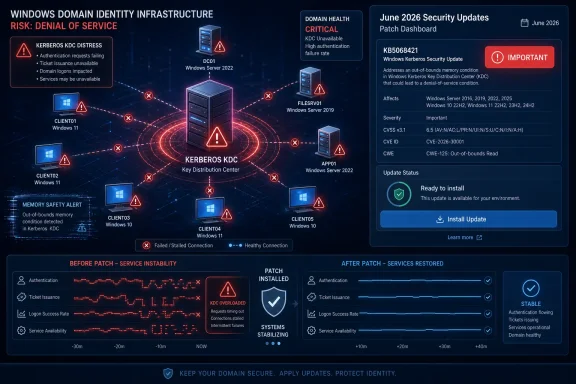
The problem is that Kerberos sits at the center of Windows identity. In a domain environment, Kerberos is not merely another protocol; it is the machinery that lets users, servers, services, and applications prove who they are without constantly resending passwords. If the vulnerable path can be pushed into a denial-of-service condition, the practical impact is not “one feature breaks.” It is authentication reliability being placed under stress.
Microsoft identifies the weakness as CWE-125, an out-of-bounds read. In plain English, the vulnerable component may read data outside the memory region it was supposed to inspect. That class of bug often sounds less alarming than a write primitive or code execution condition, but availability bugs in authentication services can be disruptive even when they do not expose secrets or let an attacker alter data.
The CVSS vector tells the story with more nuance than the headline. The attack vector is network, user interaction is not required, confidentiality and integrity impact are both rated none, and availability impact is rated high. The constraints are also real: Microsoft rates attack complexity as high and privileges required as low, which implies an attacker needs some level of authenticated foothold and specific conditions before the bug becomes useful.
That combination should shape the response. This is not a panic patch for every standalone gaming PC. It is a sober patching priority for environments where Windows authentication availability is business-critical and where attackers who already have low-level access would benefit from degrading identity services.
“Important” Is Doing a Lot of Work Here
Microsoft’s severity taxonomy can be deceptively calm. “Important” is below “Critical,” but in enterprise Windows, Important does not mean optional. It often means the vulnerability requires prerequisites, credentials, configuration, or timing that make mass exploitation harder while still leaving real organizations exposed.
CVE-2026-42914 lands exactly in that category. It is not described as publicly disclosed. It is not described as exploited in the wild. Microsoft says exploit code maturity is unproven, remediation is official, and report confidence is confirmed. That last detail matters because the issue is not speculative; Microsoft has acknowledged the vulnerability and shipped fixes.
The user-supplied MSRC metric text about report confidence is especially relevant here. “Confirmed” means defenders are not dealing with rumor, but they are also not necessarily being handed a full public exploit recipe. That is the middle ground where defenders should move before attackers do their own diffing of the patch.
Patch diffing is the quiet clock that starts after every security update. Even when no proof-of-concept exists on release day, attackers can compare patched and unpatched binaries to infer where Microsoft made changes. For a bug in a core Windows authentication path, that makes the days after disclosure more important than the hours before it.
The good news is that Microsoft’s scoring does not suggest a trivial, unauthenticated, wormable condition. The bad news is that “less likely” is not “not possible,” and denial-of-service against Kerberos is most useful to exactly the kind of adversary who has already crossed the first perimeter.
The High-Complexity Flag Narrows the Threat, but It Does Not Erase It
Microsoft’s FAQ for the vulnerability says the high attack complexity reflects the need for specific conditions, such as particular protocol settings or configurations, before an attack can succeed. That is a meaningful limiter. Opportunistic scanning across the public Internet is less concerning here than targeted abuse inside real Windows estates.
But Kerberos is rarely exposed in a simple way. Domain controllers, member servers, legacy workloads, constrained delegation, service accounts, cross-forest trusts, and application-specific authentication choices all create varied terrain. A vulnerability that depends on configuration details may be irrelevant in one organization and painfully reachable in another.
The low-privilege requirement is also a useful clue. This is not presented as a pre-authentication bug. An attacker appears to need some level of authorized access before exploitation. In modern intrusions, however, low-level credentials are not rare loot; they are often the first thing an attacker obtains through phishing, password spraying, token theft, or malware on an endpoint.
That is why availability vulnerabilities in identity systems belong in a different mental bucket from ordinary application crashes. If an intruder can degrade authentication at the right moment, the effect may be operational rather than purely technical. Failed logons, broken service authentication, stalled application dependencies, and noisy incident response channels can all help an attacker shape the defender’s environment.
The Patch List Shows This Is a Windows Platform Issue, Not a Niche Server Footnote
One reason CVE-2026-42914 deserves attention is the breadth of affected products. Microsoft lists updates across modern Windows 11 releases, Windows 10 branches, and Windows Server versions including Server 2025, Server 2022, Server 2019, Server 2016, and older Server 2012 and 2012 R2 lines under applicable servicing arrangements. The breadth is not surprising for Kerberos, but it is operationally important.
For Windows 11, Microsoft lists fixes for versions 23H2, 24H2, 25H2, and 26H1 across x64 and ARM64 where applicable. For Windows 10, the affected matrix includes 22H2, 21H2, 1809, and 1607 entries across supported architectures and servicing channels. Server releases include both full installation and Server Core variants.
That matters because many organizations patch clients and servers on different rhythms. Workstations may receive cumulative updates quickly through Windows Update for Business or Intune policies, while domain controllers and server fleets often move through more cautious rings. Kerberos bugs punish inconsistency because the systems most important to authentication are also the ones administrators are most reluctant to reboot casually.
The fixed build numbers also reinforce a familiar Windows servicing reality: there is no small Kerberos-only hotfix path for most administrators. The remediation is the relevant cumulative security update or monthly rollup for the platform. If your patch process depends on cherry-picking, this is another reminder that Windows security servicing has largely moved beyond that model.
For home users, the operational guidance is boring and correct: install the June 2026 cumulative update when offered. For IT, the question is not whether the patch exists; it is whether identity infrastructure is in the early deployment ring or still treated as a delicate exception.
Domain Controllers Turn Availability Bugs Into Business Events
A denial-of-service vulnerability against Kerberos becomes more serious when the affected machine is a domain controller. Domain controllers provide the Key Distribution Center service that issues Kerberos tickets. If that service is unavailable or unstable, the blast radius can include interactive sign-ins, service-to-service authentication, file access, application logons, and administrative workflows.
Windows environments are designed with redundancy in mind. Multiple domain controllers, site-aware authentication, DNS service records, and replication all exist to keep a single server failure from becoming a domain-wide outage. But redundancy is not magic. Misconfigured sites, overloaded branch-office DCs, stale DNS, firewall rules, time synchronization problems, and legacy application assumptions can turn a theoretical failover into a real incident.
That is why a CVSS 5.3 bug can still matter to sysadmins. The score describes the vulnerability’s technical characteristics, not the value of the service that may be disrupted. A lightly used workstation and a heavily loaded domain controller might share an affected code path, but the operational consequences are not remotely equivalent.
The right mental model is not “Can this steal credentials?” It is “Could this be used to make authentication unreliable during an attack, migration, outage, or recovery window?” If the answer is yes, then the vulnerability belongs on the same planning board as other identity availability risks.
There is also a human factor. When authentication fails, users retry, service owners restart things, help desks get flooded, and admins begin changing variables. In that fog, adversaries do not need perfect exploitation to benefit. They need confusion, and identity outages are very good at creating it.
Kerberos Keeps Absorbing the Weight of Modern Windows
Kerberos has survived because it solves a hard problem well. It lets a domain use tickets rather than passwords for repeated authentication, supports mutual authentication, and underpins a huge amount of Windows enterprise behavior. It is old enough to carry legacy baggage and important enough that Microsoft keeps tightening it rather than replacing it wholesale.
That tightening has been visible for years. Microsoft has pushed changes around RC4, certificate-based authentication, PAC validation, domain controller enforcement behavior, and other identity hardening measures. Each change has improved the security baseline while reminding administrators that authentication compatibility is never free.
CVE-2026-42914 fits into that longer pattern. It is not a flashy break in the Kerberos model. It is another implementation-level flaw in a protocol path that has to support decades of interoperability, countless deployment shapes, and an enormous install base. The more central a component is, the more pressure accumulates at its edges.
This is also why Microsoft’s wording around high attack complexity should not lull administrators into ignoring configuration debt. “Specific conditions” is a warning sign for environments with unusual Kerberos settings, older applications, third-party integrations, or legacy server versions. The vulnerability may not be broadly exploitable, but heterogeneity is where edge cases live.
Security teams should read this as another argument for reducing Kerberos weirdness where possible. Disable legacy encryption where feasible, retire unsupported configurations, review delegation, keep domain controllers current, and make sure authentication monitoring can distinguish a normal bad-password storm from a service-level failure.
The Most Dangerous Reading Is the Simplest One
The simplistic reading of CVE-2026-42914 is that it is a medium-ish denial-of-service bug with no known exploitation and a patch already available. That reading is not wrong, but it is incomplete. It treats the CVE as a standalone defect rather than as a pressure point in the identity layer.
The more useful reading is that Microsoft has confirmed a network-reachable Kerberos availability flaw that requires low privileges, does not require user interaction, has high attack complexity, and can produce high availability impact under the right conditions. That is neither catastrophic nor trivial. It is the kind of bug that should move through a disciplined patch pipeline with extra attention to domain controllers.
For defenders, the lack of public exploitation is an advantage only if it is used. Once a vulnerability is public and patches are available, attackers can work backward. The absence of exploit code on June 9 does not guarantee the absence of exploit understanding later in June.
The patch should also be considered alongside identity telemetry. If your monitoring cannot quickly show Kerberos service health, authentication failure rates, domain controller load, KDC-related event spikes, and site-specific authentication patterns, then your risk is not just the CVE. It is the difficulty of knowing whether the CVE is being touched during a noisy incident.
This is where Windows administrators often have to fight organizational gravity. Business owners notice failed logons more than they notice delayed patch approvals, but patch approvals are where the outage is often prevented. CVE-2026-42914 is a useful test of whether an organization treats identity as infrastructure or as background plumbing.
The June Patch Should Move First Where Authentication Hurts Most
The practical patching order should follow business impact. Domain controllers and servers that participate heavily in Kerberos authentication deserve earlier attention than low-risk endpoints, provided the update has passed basic validation. That does not mean recklessly patching every DC at once. It means treating identity availability as a priority class.
A sensible deployment begins with lab or pilot domain controllers where possible, then moves through a controlled ring that preserves rollback options and verifies replication, authentication, and application behavior. Administrators should watch for KDC service events, unusual authentication failures, application logon failures, and service account issues after deployment. The goal is not just to install the update; it is to prove that authentication still behaves normally afterward.
For smaller environments without formal rings, the answer is still not paralysis. Schedule a maintenance window, back up critical systems, confirm recovery paths, patch, reboot, and verify sign-ins and core services. The risk of never touching identity servers because they are important is that they remain important and vulnerable.
Clients matter too, especially laptops and workstations that roam between networks or carry privileged users. But in a Kerberos denial-of-service scenario, the most valuable defensive move is hardening the machines that issue and validate the tickets on which everything else depends.
There is no indication from Microsoft’s advisory that administrators need a special workaround beyond applying the official security updates. That is both reassuring and limiting. If your organization cannot quickly deploy cumulative Windows updates to authentication infrastructure, CVE-2026-42914 is less a one-off emergency than a mirror held up to the patch process.
The Signal Hidden in Microsoft’s Confidence Rating
The report-confidence metric is easy to skip because it sounds like CVSS bookkeeping. In this case, it is one of the more important details. Microsoft marks the issue as confirmed, meaning defenders should assume the vulnerability exists and that the vendor’s technical assessment is grounded in reproducible evidence.
That does not mean the public has full root-cause detail. Microsoft often withholds exploit-enabling specifics, especially for vulnerabilities in sensitive Windows components. This creates a familiar asymmetry: defenders receive enough information to prioritize and patch, while attackers may try to extract the missing details from the update itself.
The acknowledgement line adds another piece of context. Microsoft credits Andrew Schwartz with Huntress Labs and Charlie Clark, along with Microsoft. That suggests coordinated vulnerability disclosure rather than a surprise public drop. Coordinated disclosure is the best-case process, but it does not eliminate the need for urgency once the fix ships.
The “exploitation less likely” label is also not a promise. Microsoft’s Exploitability Index is a release-time assessment, not a permanent status. It reflects what Microsoft knows and expects when the advisory is published. If exploit research advances or real-world abuse appears, the operational picture changes.
Security programs should therefore use the advisory’s confidence rating as a trigger, not a comfort blanket. Confirmed vulnerability, official fix, no known exploitation: that is the window defenders want. Waiting until exploitation is observed means surrendering the one advantage the disclosure process was designed to provide.
The Patch Tuesday Lesson Is About Identity Resilience
CVE-2026-42914 arrives in a period when Windows identity has become both more hardened and more visible. Enterprises have spent years moving toward cloud identity, conditional access, passkeys, hybrid join, and Entra integrations. Yet Kerberos remains embedded in the daily functioning of Windows domains, file servers, line-of-business applications, SQL deployments, print services, and administrative tooling.
That hybrid reality can create complacency. Because identity strategy conversations increasingly happen in cloud terms, on-premises Kerberos can feel like yesterday’s platform. But the outages still happen today, and the dependencies still sit inside business-critical paths.
The vulnerability also underscores a broader security truth: denial of service is not the poor cousin of exploitation when the target is identity. A short authentication disruption can delay incident response, break monitoring pipelines, interrupt backups, strand users, or force administrators into emergency changes. Availability is a security property when attackers can weaponize its absence.
Organizations that already map authentication dependencies will handle this better. They know which applications require Kerberos, which domain controllers serve which sites, which service accounts are brittle, and which legacy systems object to change. Organizations that do not have that map will discover it during the outage, which is the worst possible time.
The response to this CVE should therefore include more than patch compliance. It should include a check on whether the environment can lose a domain controller gracefully, whether help desk and SOC teams can correlate authentication failures quickly, and whether incident playbooks distinguish Kerberos service instability from ordinary account lockouts.
The Concrete Read for Windows Admins This Week
CVE-2026-42914 is not a reason to invent a crisis, but it is a reason to make sure the June 2026 Windows security updates do not sink to the bottom of the queue. The vulnerability’s constraints reduce the likelihood of casual exploitation, while its location in Kerberos raises the cost of being wrong.
- Microsoft released CVE-2026-42914 on June 9, 2026, with an Important severity rating and official fixes in the June Windows security updates.
- The vulnerability affects Kerberos and is rated for high availability impact, with no confidentiality or integrity impact in Microsoft’s CVSS assessment.
- Exploitation requires low privileges, no user interaction, and high attack complexity, making broad opportunistic abuse less likely but targeted abuse still worth planning against.
- Microsoft reported no public disclosure and no active exploitation at publication, while marking the vulnerability as confirmed and exploit code maturity as unproven.
- Domain controllers and other authentication-critical servers should sit near the front of deployment rings after validation, because Kerberos availability failures can become business outages.
- Administrators should pair patching with monitoring for KDC health, authentication failure spikes, replication status, and application logon problems after updates are applied.
The real story of CVE-2026-42914 is not that Kerberos is broken, or that every Windows network is one packet away from collapse. It is that Microsoft has patched a confirmed availability flaw in one of Windows’ central trust mechanisms, and defenders have a clean chance to act before the vulnerability becomes part of somebody else’s playbook. In a year where identity remains the control plane for almost everything, the quiet Kerberos bugs deserve the same operational seriousness as the loud ones.