

CVE-2026-43491 is a newly published Linux kernel vulnerability, added to NVD on May 19, 2026, in the Qualcomm IPC Router name service code, where an unbounded stream of server registrations from a malicious client can exhaust kernel memory. The fix is not glamorous: cap registrations at 256 per node, avoid penalizing legitimate replacement registrations, and rate-limit noisy error logging. But that is exactly why this bug matters. It is a reminder that modern kernel risk increasingly lives in small, hardware-specific subsystems that many administrators barely know are present until a CVE gives them a name.
The core defect in CVE-2026-43491 is almost brutally simple. The QRTR name service accepted server registration messages without enforcing a maximum number of servers per node. A malicious client could repeatedly send
That makes this a denial-of-service bug, not a remote-code-execution barn burner. There is no public indication in the available record that it allows privilege escalation, arbitrary code execution, or data theft. NVD had not assigned CVSS scores as of publication, which leaves defenders with the familiar early-CVE problem: the record is real, the patch is real, but the severity metadata is still catching up.
The upstream fix adds a
The change also swaps a plain error log for a rate-limited one in the QRTR name-service worker path. That is not the headline fix, but it tells the same story. Once a malicious or broken client can trigger repeated failures, logging itself becomes part of the resource-exhaustion surface.
That immediately narrows the blast radius, but it does not make the issue irrelevant. Qualcomm silicon shows up in phones, tablets, embedded devices, ARM laptops, routers, development boards, and specialized appliances. The Linux kernel has spent years absorbing more of the support code needed to make those systems work without fragile userspace daemons and vendor-specific glue.
The QRTR name service itself was moved into the kernel from userspace years ago to support Qualcomm WLAN devices without requiring a separate nameservice daemon. That architectural move made sense: hardware discovery and service lookup are often better handled close to the transport. But when service bookkeeping moves into the kernel, its accounting bugs become kernel memory bugs.
This is the trade-off the kernel keeps making. Pulling functionality into the kernel can improve boot reliability, hardware enablement, and distribution integration. It also means the kernel must defend itself against malformed or abusive inputs even when those inputs come from local clients, device-facing paths, or subsystems that look obscure from the outside.
On a typical x86 Windows desktop, this CVE is unlikely to be a direct operational concern unless the machine is running a custom Linux kernel, a specialized WSL setup, a Linux VM with relevant kernel support, or hardware that actually exposes the QRTR path. On Qualcomm-based Linux systems, Android-derived environments, embedded appliances, or ARM developer hardware, the calculation changes.
Denial-of-service vulnerabilities in kernel memory accounting are also easy to underestimate. In a server environment, exhausting memory can kill workloads, trigger watchdogs, or force reboots. In embedded and edge environments, it can mean an appliance that silently drops off the network until someone power-cycles it.
The real-world severity therefore depends less on the CVE headline and more on configuration. Is
The patch adds a maximum. That sounds mundane until you remember how many denial-of-service bugs are just missing maximums wearing different costumes. Queues need limits. Registries need limits. Message paths need limits. Logs need limits. Anything that accepts attacker-influenced growth must eventually answer the question: how much is too much?
Here, upstream chose 256 server registrations per node based on current platform requirements. That phrasing is careful, and it should be. A security limit that breaks real hardware support is not a fix administrators can deploy with confidence. By leaving room to raise the ceiling later, the patch acknowledges that Qualcomm platform needs may evolve while still giving today’s kernels a defensible boundary.
There is also a subtle engineering lesson in allowing old-port replacement above the cap. The bug was not “more than 256 messages are bad.” The bug was unbounded growth. Replacing an existing registration does not create the same memory expansion, so the fix does not block it. Good hardening separates abusive growth from legitimate update behavior.
For administrators, this is normal now. Linux kernel CVEs often arrive in waves, many tied directly to upstream stable commits. Some are severe, some are narrow, and some are only meaningful on unusual hardware. The CVE record is a starting pistol, not a complete risk model.
The practical problem is that scanners and dashboards tend to flatten that nuance. A fleet may light up with a new CVE before the security team knows whether the vulnerable code is compiled, loaded, reachable, or relevant. Conversely, dismissing an unscored CVE because it lacks a number can leave embedded or appliance-heavy environments exposed.
This is where kernel patch management remains stubbornly different from application patching. With a browser or office suite, the vulnerable component is usually present if the product is installed. With the kernel, exposure may depend on architecture, modules, device tree, loaded drivers, namespace boundaries, and vendor backports. The CVE name is universal; the risk is not.
For WSL 2 specifically, Microsoft supplies the default Linux kernel and allows users to point WSL at a custom kernel through
But the existence of WSL changes the inventory conversation. Developers can and do run custom kernels. Security teams often have limited visibility into those kernels compared with Windows Update-managed components. A vulnerability like this is a good prompt to ask whether your Windows developer fleet has unofficial kernel builds quietly living under user profiles.
The more immediate Windows-adjacent concern is infrastructure. Many organizations manage Linux-based firewalls, access points, IoT gateways, mobile-device test rigs, and ARM-based build or validation hardware from Windows desktops. Those devices may not appear in the same patch dashboards as laptops and servers, but they are often the systems most likely to carry Qualcomm-related kernel code.
That matters because QRTR is especially relevant in the kind of hardware where users do not routinely install their own kernels. Routers, appliances, ARM laptops, developer kits, industrial gateways, and Android-derived products often depend on vendor kernel trees. A fix can exist upstream and still take weeks or months to appear in a firmware image, assuming the vendor ships one at all.
Administrators should resist two bad instincts. The first is panic: this is not currently described as a remote unauthenticated internet exploit. The second is indifference: local or subsystem-triggered denial of service can still be serious on unattended systems and appliances.
The right move is to map the affected class of systems. Qualcomm-based Linux devices should get priority review. Systems with untrusted local users or containerized workloads deserve a closer look. Appliances with unknown kernel provenance should be checked through vendor advisories rather than assumed safe.
That is what makes this patch more interesting than its size. It encodes an assumption about what legitimate Qualcomm IPC service topology looks like today. If future systems need more than 256 registrations per node, the limit can be raised, but the key principle should remain: legitimate complexity still needs a ceiling.
Kernel developers have increasingly learned that “the hardware would never do that” is not a security model. Hardware can be faulty. Firmware can be compromised. Local clients can be malicious. Test interfaces can leak into production. Containers can make local attack surfaces more meaningful than they looked on a single-user workstation.
CVE-2026-43491 is therefore less about QRTR alone than about accounting discipline in kernel subsystems. If a table can grow because a message tells it to grow, the table needs an upper bound. If an error path can be spammed, the log needs rate limiting. If a subsystem was designed around trusted peers, it eventually has to survive untrusted ones.
The second step is to determine reachability. A vulnerable code path that cannot be reached by untrusted users or workloads is a lower priority than one available to tenant-controlled code, sandbox escapes, development containers, or device-facing services. Local denial of service is still a security issue, but its urgency depends heavily on who can trigger it.
The third step is patch provenance. Because kernel vendors backport fixes, version numbers alone can mislead. A distribution kernel may be older than upstream but already patched, while a custom kernel may appear recent but lack a particular stable commit. Administrators should look for vendor advisories, changelog references, or the specific QRTR nameservice fix rather than relying only on
Finally, reboot planning matters. Kernel fixes do not fully protect running systems until the patched kernel is booted. Live patching can help in some environments, but a small subsystem fix like this may not be covered by every live-patch service. The most secure kernel package in the repository does nothing for a system that never restarts.
Modern estates are full of ordinary kernel attack surfaces. Some are compiled for hardware enablement. Some arrive through vendor defaults. Some exist because a subsystem migrated from userspace into the kernel years ago and became invisible to everyone except maintainers. Attackers do not need every such surface to be famous; they need one reachable bug in the wrong place.
For Windows administrators, this is the uncomfortable post-WSL, post-cloud, post-appliance reality. “Linux kernel CVE” no longer means “someone else’s server team will handle it.” It may mean your developer workstations, your container hosts, your edge gear, your Wi-Fi infrastructure, your ARM evaluation fleet, or the embedded controller hidden inside a product your business depends on.
The healthiest response is not to overstate the danger. It is to improve inventory. Know where Linux kernels live, know who owns them, know how they are updated, and know whether niche hardware subsystems are enabled by default.
 A Small Counter Becomes a Security Boundary
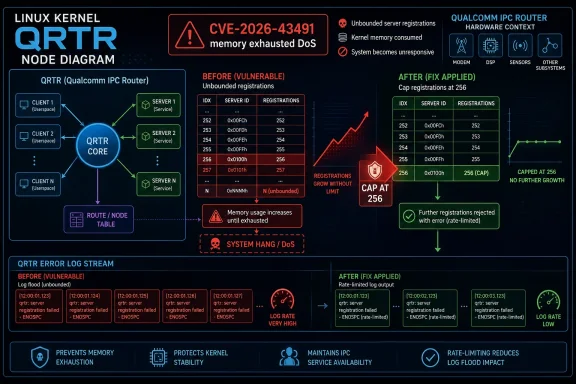
The core defect in CVE-2026-43491 is almost brutally simple. The QRTR name service accepted server registration messages without enforcing a maximum number of servers per node. A malicious client could repeatedly send NEW_SERVER messages, causing the kernel to allocate and track more registrations until memory pressure became the attack.That makes this a denial-of-service bug, not a remote-code-execution barn burner. There is no public indication in the available record that it allows privilege escalation, arbitrary code execution, or data theft. NVD had not assigned CVSS scores as of publication, which leaves defenders with the familiar early-CVE problem: the record is real, the patch is real, but the severity metadata is still catching up.
The upstream fix adds a
server_count field to each QRTR node and refuses new registrations once the node reaches 256 entries. It also preserves an important behavior: if a registration arrives for an existing port, it can still replace the old one. That distinction matters because a blunt cap would be a reliability regression; the patch is trying to stop growth, not freeze normal churn.The change also swaps a plain error log for a rate-limited one in the QRTR name-service worker path. That is not the headline fix, but it tells the same story. Once a malicious or broken client can trigger repeated failures, logging itself becomes part of the resource-exhaustion surface.
QRTR Is Niche Until Your Hardware Depends on It
QRTR, short for Qualcomm IPC Router, is not a household kernel acronym like TCP, ext4, or KVM. It exists to let Linux communicate with services exposed by other hardware blocks in Qualcomm-based systems, including subsystems such as modems, DSPs, sensors, and wireless components. In ordinary administrator language, it is plumbing for systems where the application processor is not the only computer in the box.That immediately narrows the blast radius, but it does not make the issue irrelevant. Qualcomm silicon shows up in phones, tablets, embedded devices, ARM laptops, routers, development boards, and specialized appliances. The Linux kernel has spent years absorbing more of the support code needed to make those systems work without fragile userspace daemons and vendor-specific glue.
The QRTR name service itself was moved into the kernel from userspace years ago to support Qualcomm WLAN devices without requiring a separate nameservice daemon. That architectural move made sense: hardware discovery and service lookup are often better handled close to the transport. But when service bookkeeping moves into the kernel, its accounting bugs become kernel memory bugs.
This is the trade-off the kernel keeps making. Pulling functionality into the kernel can improve boot reliability, hardware enablement, and distribution integration. It also means the kernel must defend itself against malformed or abusive inputs even when those inputs come from local clients, device-facing paths, or subsystems that look obscure from the outside.
The Exploit Story Is Less Dramatic Than the Operations Story
The phrase “malicious client” does a lot of work here. It implies an entity capable of sending QRTR name-service messages, not necessarily an arbitrary attacker somewhere on the internet. That is an important limitation for risk assessment, especially for WindowsForum readers used to sorting remote network bugs from local attack primitives.On a typical x86 Windows desktop, this CVE is unlikely to be a direct operational concern unless the machine is running a custom Linux kernel, a specialized WSL setup, a Linux VM with relevant kernel support, or hardware that actually exposes the QRTR path. On Qualcomm-based Linux systems, Android-derived environments, embedded appliances, or ARM developer hardware, the calculation changes.
Denial-of-service vulnerabilities in kernel memory accounting are also easy to underestimate. In a server environment, exhausting memory can kill workloads, trigger watchdogs, or force reboots. In embedded and edge environments, it can mean an appliance that silently drops off the network until someone power-cycles it.
The real-world severity therefore depends less on the CVE headline and more on configuration. Is
CONFIG_QRTR enabled? Is the affected name-service code present in the running kernel? Can untrusted local code, a container boundary, a service account, or an exposed device-facing path reach it? Those are the questions that matter more than whether the CVSS calculator eventually lands on medium or high.The Patch Shows How Kernel Hardening Really Happens
There is a tendency to treat kernel security as a procession of spectacular bugs: use-after-free chains, speculative execution breaks, privilege escalations with branded logos, and proof-of-concept exploits that fit in a tweet. CVE-2026-43491 is from the other school of kernel security: boring invariants enforced late, but finally enforced.The patch adds a maximum. That sounds mundane until you remember how many denial-of-service bugs are just missing maximums wearing different costumes. Queues need limits. Registries need limits. Message paths need limits. Logs need limits. Anything that accepts attacker-influenced growth must eventually answer the question: how much is too much?
Here, upstream chose 256 server registrations per node based on current platform requirements. That phrasing is careful, and it should be. A security limit that breaks real hardware support is not a fix administrators can deploy with confidence. By leaving room to raise the ceiling later, the patch acknowledges that Qualcomm platform needs may evolve while still giving today’s kernels a defensible boundary.
There is also a subtle engineering lesson in allowing old-port replacement above the cap. The bug was not “more than 256 messages are bad.” The bug was unbounded growth. Replacing an existing registration does not create the same memory expansion, so the fix does not block it. Good hardening separates abusive growth from legitimate update behavior.
The NVD Gap Is Now Part of Patch Management
As of the NVD entry’s publication on May 19, the vulnerability had no NVD CVSS 4.0, 3.x, or 2.0 assessment. That does not mean the bug is unimportant. It means the public vulnerability pipeline has once again published a kernel CVE before all enrichment, scoring, and downstream vendor advisories have fully settled.For administrators, this is normal now. Linux kernel CVEs often arrive in waves, many tied directly to upstream stable commits. Some are severe, some are narrow, and some are only meaningful on unusual hardware. The CVE record is a starting pistol, not a complete risk model.
The practical problem is that scanners and dashboards tend to flatten that nuance. A fleet may light up with a new CVE before the security team knows whether the vulnerable code is compiled, loaded, reachable, or relevant. Conversely, dismissing an unscored CVE because it lacks a number can leave embedded or appliance-heavy environments exposed.
This is where kernel patch management remains stubbornly different from application patching. With a browser or office suite, the vulnerable component is usually present if the product is installed. With the kernel, exposure may depend on architecture, modules, device tree, loaded drivers, namespace boundaries, and vendor backports. The CVE name is universal; the risk is not.
Windows Shops Still Need to Care About Linux Kernel CVEs
A Windows-focused community might reasonably ask why a Qualcomm-flavored Linux kernel bug deserves attention here. The answer is that very few Windows estates are Windows-only anymore. WSL 2, Docker Desktop, Hyper-V Linux guests, network appliances, Android-based management devices, Kubernetes nodes, developer boards, and ARM test hardware have all dragged the Linux kernel into environments that still think of themselves as Microsoft shops.For WSL 2 specifically, Microsoft supplies the default Linux kernel and allows users to point WSL at a custom kernel through
.wslconfig. That does not automatically make CVE-2026-43491 a WSL emergency. In most ordinary WSL environments, Qualcomm IPC Router support is not the feature anyone is depending on, and exposure would require the relevant kernel configuration and reachability.But the existence of WSL changes the inventory conversation. Developers can and do run custom kernels. Security teams often have limited visibility into those kernels compared with Windows Update-managed components. A vulnerability like this is a good prompt to ask whether your Windows developer fleet has unofficial kernel builds quietly living under user profiles.
The more immediate Windows-adjacent concern is infrastructure. Many organizations manage Linux-based firewalls, access points, IoT gateways, mobile-device test rigs, and ARM-based build or validation hardware from Windows desktops. Those devices may not appear in the same patch dashboards as laptops and servers, but they are often the systems most likely to carry Qualcomm-related kernel code.
Embedded Vendors Will Decide the Real Patch Timeline
Upstream stable commits are only the first step. For mainstream Linux distributions, kernel fixes flow through maintainers, advisories, package updates, and reboot windows. For embedded devices, the path can be slower and far less transparent.That matters because QRTR is especially relevant in the kind of hardware where users do not routinely install their own kernels. Routers, appliances, ARM laptops, developer kits, industrial gateways, and Android-derived products often depend on vendor kernel trees. A fix can exist upstream and still take weeks or months to appear in a firmware image, assuming the vendor ships one at all.
Administrators should resist two bad instincts. The first is panic: this is not currently described as a remote unauthenticated internet exploit. The second is indifference: local or subsystem-triggered denial of service can still be serious on unattended systems and appliances.
The right move is to map the affected class of systems. Qualcomm-based Linux devices should get priority review. Systems with untrusted local users or containerized workloads deserve a closer look. Appliances with unknown kernel provenance should be checked through vendor advisories rather than assumed safe.
The 256-Entry Limit Is a Policy Decision Disguised as Code
Security fixes often look inevitable after the fact, but every limit is also a policy decision. Why 256? Because current platform requirements apparently fit inside that number. Why per node? Because the resource growth being controlled is tied to the server registrations associated with a QRTR node. Why allow replacement? Because the system must keep functioning under normal service lifecycle behavior.That is what makes this patch more interesting than its size. It encodes an assumption about what legitimate Qualcomm IPC service topology looks like today. If future systems need more than 256 registrations per node, the limit can be raised, but the key principle should remain: legitimate complexity still needs a ceiling.
Kernel developers have increasingly learned that “the hardware would never do that” is not a security model. Hardware can be faulty. Firmware can be compromised. Local clients can be malicious. Test interfaces can leak into production. Containers can make local attack surfaces more meaningful than they looked on a single-user workstation.
CVE-2026-43491 is therefore less about QRTR alone than about accounting discipline in kernel subsystems. If a table can grow because a message tells it to grow, the table needs an upper bound. If an error path can be spammed, the log needs rate limiting. If a subsystem was designed around trusted peers, it eventually has to survive untrusted ones.
Security Teams Should Triage the Configuration, Not the Acronym
The first triage step is to determine whether QRTR support exists in the kernels you operate. On Linux systems, that means checking kernel configuration for Qualcomm IPC Router support and looking for QRTR-related modules or built-in support. On appliances, it means vendor documentation, firmware release notes, or direct support channels if shell access is not available.The second step is to determine reachability. A vulnerable code path that cannot be reached by untrusted users or workloads is a lower priority than one available to tenant-controlled code, sandbox escapes, development containers, or device-facing services. Local denial of service is still a security issue, but its urgency depends heavily on who can trigger it.
The third step is patch provenance. Because kernel vendors backport fixes, version numbers alone can mislead. A distribution kernel may be older than upstream but already patched, while a custom kernel may appear recent but lack a particular stable commit. Administrators should look for vendor advisories, changelog references, or the specific QRTR nameservice fix rather than relying only on
uname -r.Finally, reboot planning matters. Kernel fixes do not fully protect running systems until the patched kernel is booted. Live patching can help in some environments, but a small subsystem fix like this may not be covered by every live-patch service. The most secure kernel package in the repository does nothing for a system that never restarts.
The CVE Is Narrow, but the Lesson Is Broad
CVE-2026-43491 will probably not become the week’s loudest vulnerability. It lacks the cinematic ingredients: no catchy name, no public exploit chain, no obvious Windows desktop compromise path, and no emergency CVSS score at publication. Yet it belongs in the patch-management conversation precisely because it is ordinary.Modern estates are full of ordinary kernel attack surfaces. Some are compiled for hardware enablement. Some arrive through vendor defaults. Some exist because a subsystem migrated from userspace into the kernel years ago and became invisible to everyone except maintainers. Attackers do not need every such surface to be famous; they need one reachable bug in the wrong place.
For Windows administrators, this is the uncomfortable post-WSL, post-cloud, post-appliance reality. “Linux kernel CVE” no longer means “someone else’s server team will handle it.” It may mean your developer workstations, your container hosts, your edge gear, your Wi-Fi infrastructure, your ARM evaluation fleet, or the embedded controller hidden inside a product your business depends on.
The healthiest response is not to overstate the danger. It is to improve inventory. Know where Linux kernels live, know who owns them, know how they are updated, and know whether niche hardware subsystems are enabled by default.
The Practical Read Before the Patch Window Closes
CVE-2026-43491 is best understood as a bounded denial-of-service fix for a Qualcomm-specific Linux kernel communication subsystem, not as a universal Linux fire drill. The affected code allowed unbounded QRTR server registrations per node; the upstream fix caps new registrations at 256 and rate-limits related error logging.- Systems without QRTR support enabled are unlikely to be exposed to this specific flaw.
- Qualcomm-based Linux devices, embedded appliances, ARM systems, and hardware platforms using QRTR deserve the first round of review.
- Ordinary Windows desktops are not directly affected, but WSL 2 custom kernels and Linux-based infrastructure managed by Windows teams should not be ignored.
- The absence of an NVD CVSS score at publication should not be treated as proof of low risk.
- Version checks should be backed by vendor advisories or changelog evidence, because kernel fixes are often backported.
- A patched kernel package is not effective until the system is actually running the patched kernel.
References
- Primary source: NVD / Linux Kernel
Published: 2026-05-20T01:01:33-07:00
NVD - CVE-2026-43491
 nvd.nist.gov
- Security advisory: MSRC
Published: 2026-05-20T01:01:33-07:00
Original feed URL
Security Update Guide - Microsoft Security Response Center
 msrc.microsoft.com
- Related coverage: kernel.googlesource.com
- Related coverage: cdn.kernel.org

The Linux Kernel Archives
cdn.kernel.org
- Related coverage: cateee.net
- Related coverage: kernelconfig.io
config_qrtr - kernelconfig.io
CONFIG_QRTR - qrtr.ko - Say Y if you intend to use Qualcomm IPC router protocolwww.kernelconfig.io

- Related coverage: android.googlesource.com
- Related coverage: deepwiki.com
QRTR and Communication Components | qualcomm-linux/meta-qcom | DeepWiki
This document explains the Qualcomm IPC Router (QRTR) and related communication components provided by the `meta-qcom` layer. These components enable essential communication between the Linux applicatdeepwiki.com - Related coverage: boxmatrix.info
CONFIG_QRTR - Kernel-Config - BoxMatrix
CONFIG_QRTR - Qualcomm IPC Router support (ns.ko, qrtr.ko) - BoxMatrix FRITZ!Box Research Wikiwww.boxmatrix.info
- Related coverage: archives.kernel-recipes.org
- Related coverage: docs.redhat.com
- Official source: learn.microsoft.com
How to use the Microsoft Linux kernel v6 on WSL2 | Microsoft Learn
Know how to build and use the Microsoft Linux kernel v6 on WSL2 instead of the stock kernellearn.microsoft.com - Official source: github.com
GitHub - microsoft/WSL2-Linux-Kernel: The source for the Linux kernel used in Windows Subsystem for Linux 2 (WSL2) · GitHub
The source for the Linux kernel used in Windows Subsystem for Linux 2 (WSL2) - microsoft/WSL2-Linux-Kernel github.com
- Related coverage: scottibyte.com
- Related coverage: m2m.dk
