
CISA added CVE-2026-45247, a critical Mirasvit Full Page Cache Warmer vulnerability affecting Magento 2 and Adobe Commerce storefronts, to its Known Exploited Vulnerabilities catalog on June 3, 2026, after evidence emerged that attackers were exploiting it in the wild. The move turns what might have looked like a niche e-commerce plugin advisory into a federal patching deadline. For everyone else, it is a reminder that the modern Windows-and-cloud shop is only as safe as the web applications, extensions, and Linux-backed commerce stacks tied into its business systems. The uncomfortable part is not that another deserialization bug exists; it is that this one sits directly on the public storefront, where attackers need only an HTTP request and a crafted cookie to begin testing the door.
The Known Exploited Vulnerabilities catalog is not a normal vulnerability database. It is CISA’s short list of flaws that have crossed a practical threshold: someone is not merely theorizing about exploitation, but using the bug against real systems. Once a CVE lands there, federal civilian agencies must remediate it by the assigned due date, and private-sector defenders usually treat the entry as a warning that the exploit window has already opened.
CVE-2026-45247 is especially uncomfortable because it is not buried inside an obscure admin-only workflow. It affects Mirasvit Full Page Cache Warmer for Magento 2 before version 1.11.12, and the weakness is reachable through ordinary storefront traffic. The vulnerable code handles a
That makes this a classic case of boring infrastructure becoming the attack surface. Cache warmers are supposed to make stores feel faster by pre-populating pages before customers arrive. They are not supposed to become unauthenticated code execution endpoints.
The CISA deadline is also unusually tight: June 6, 2026, only three days after the catalog addition. That does not mean every private organization has a legal three-day patch mandate, but it does indicate how CISA views the operational risk. If you run affected Magento infrastructure and are still thinking in terms of “next maintenance window,” the federal timeline is telling you the maintenance window has already arrived.
In this case, the vulnerable extension used a cookie to represent cache-warming state. That design makes sense in the narrow logic of rendering pages as different visitor types, currencies, or customer groups. But according to the disclosed technical details, the relevant handling ran on storefront requests generally, not only on trusted cache warmer traffic.
That difference matters. If the vulnerable path were locked behind an admin panel, a valid session, a secret token, or a private worker, defenders could at least reason about layers of control. Instead, the attack surface is the storefront itself — the one thing an e-commerce business must keep exposed to the internet.
The exploit primitive is also attractive. The advisory describes unauthenticated remote code execution, a CVSS 3.1 score of 9.8, low attack complexity, no required privileges, and no user interaction. In plainer language: an attacker does not need a stolen password, a tricked administrator, or a complex race condition. They need a vulnerable target and a request that carries the right malicious structure.
The Mirasvit issue illustrates that tradeoff. A cache warmer is not the payment gateway, not the admin login, and not the database layer. It is performance plumbing. Yet because it runs inside the same application context as the store, a flaw in that plumbing can become a route to server-level compromise.
For WindowsForum readers, this is where the story stops being “Magento news” and becomes enterprise risk. Many organizations that think of themselves as Microsoft shops still run commerce, marketing, partner portals, and intranet tools on PHP, Linux, containers, or managed hosting. Those systems feed Entra ID identities, Microsoft 365 workflows, ERP exports, Teams alerts, Azure storage, and Windows-based back-office processes.
Attackers do not care which team owns the box. They care whether a web-facing system can be turned into a beachhead. A compromised storefront can host skimmers, steal credentials, pivot into CI/CD secrets, exfiltrate customer data, or become part of a broader campaign against business systems that sit behind it.
In practice, commerce platforms are rarely simple. Store owners often freeze changes during sales campaigns, rely on agencies for deployments, or run customized modules that make extension updates feel risky. Some stores may be using Mirasvit Cache Warmer indirectly because it is bundled with other Mirasvit packages, which means the person responsible for patching may not even recognize the component by name.
That is the trap CISA’s catalog is designed to counter. Vulnerability management teams love severity scores, but exploitation status changes the priority calculus. A bug with active exploitation is not waiting politely for a quarterly update cycle.
There is also the post-exploitation question. When a vulnerability permits remote code execution and is already being exploited, “we patched” is not the end of the incident response sentence. It should be followed by “we checked whether anyone got there first.”
Admins should look for unexpected PHP files in web-accessible directories, suspicious modifications to Magento code, unfamiliar admin accounts, cron jobs, webshell patterns, and outbound connections that do not match normal storefront behavior. Logs should be searched for suspicious
That chain of events is why defenders have spent years treating deserialization as a category of vulnerability rather than a one-off coding mistake. It is not merely that the input is malformed. It is that the application is asked to rebuild behavior from data supplied by an adversary.
The blast radius depends on the environment. On a locked-down host with least-privilege file permissions, application isolation, strong egress controls, and no exposed secrets, exploitation may still be serious but more containable. On a typical hurried commerce server with shared credentials, writable web directories, backup archives, deployment keys, and broad database permissions, remote code execution can quickly become a full compromise.
The risk is not limited to credit cards. Modern payment flows often reduce direct card exposure, but attackers have adapted. They steal session data, inject checkout skimmers, capture personal information, alter JavaScript, create persistence, and use legitimate traffic patterns to hide in the noise. A storefront is a trust machine; compromise it, and the attacker borrows that trust.
That distinction matters. A 9.8 critical vulnerability may be terrifying on paper, but if it affects an unreachable subsystem or lacks public exploitation, defenders may sequence it behind more immediate threats. A KEV-listed vulnerability removes much of that ambiguity. It says the exploit has escaped the lab.
The June 6 due date is particularly sharp because it compresses the gap between disclosure, KEV listing, and required remediation. Security teams should read that as an operational message. If a business cannot identify whether it runs the vulnerable component within three days, the asset inventory problem is as serious as the patching problem.
This is where many organizations still fail. They know their Windows endpoints, their Microsoft 365 tenants, and their server OS versions, but they do not have the same confidence in application-layer dependencies. A Magento module installed two agencies ago may not appear in a CMDB, and a vendor bundle may hide a vulnerable package inside a broader extension set.
A Magento instance may authenticate administrators through a Microsoft identity provider. It may export orders to a Windows-based ERP system. It may store backups in Azure Blob Storage, trigger Power Automate flows, or send operational alerts into Teams. Its developers may deploy from Windows laptops using SSH keys and Git tokens that also touch other environments.
That interconnectedness changes the security model. A storefront RCE can become a secret-harvesting event. Secrets can become cloud access. Cloud access can become identity abuse. Identity abuse can become lateral movement.
For WindowsForum’s IT-pro audience, the practical lesson is not to become Magento experts overnight. It is to stop treating non-Windows application stacks as someone else’s perimeter. If the system handles customer data, produces business revenue, or connects to Microsoft-managed identity and productivity infrastructure, it belongs in the same risk conversation as domain controllers, Intune policies, and Exchange Online configuration.
Web server logs, WAF logs, CDN request logs, Magento application logs, and EDR telemetry should all be in scope. If the storefront sits behind Cloudflare, Akamai, Fastly, Azure Front Door, or another edge provider, the relevant evidence may be split between the origin and the edge. Teams should not assume that the origin server alone has the complete picture.
The WAF question is delicate. A tuned WAF or virtual patch can reduce exposure, especially for teams that cannot update instantly. But WAF coverage should be treated as a bridge, not a destination. Deserialization payloads are notoriously adaptable, and a determined attacker may vary encoding, request structure, or delivery pattern to get around brittle signatures.
Incident responders should also resist the urge to stop at blocked attempts. If active exploitation is happening broadly, a few obvious probes may be the visible part of a larger campaign. The better question is whether any request reached vulnerable code before controls were updated, and whether the server shows evidence of persistence.
The problem is not necessarily vendor responsiveness. It is deployment latency. E-commerce operators often live in a world where even small changes need staging, regression testing, agency coordination, and business approval. Attackers live in a world where disclosed patch diffs and advisories can be converted into scanning logic quickly.
That asymmetry is brutal. A four-day vendor fix is good. A nine-day lag between advisory publication and KEV listing is not long. But a vulnerable store that waits two weeks for a planned release train may still be exposed for most of the attacker’s easiest window.
There is a governance lesson here. Security teams need a path for emergency extension updates that does not require reinventing the release process during a crisis. That path should include backups, rollback plans, test checkouts, monitoring, and executive acceptance of short-term operational risk. The alternative is accepting long-term compromise risk by default.
That is why this KEV entry should trigger an inventory exercise, not just a version check. Teams should enumerate Magento and Adobe Commerce instances, list installed Composer packages and modules, identify whether Mirasvit Cache Warmer or bundled Mirasvit packages are present, and confirm the installed version. They should do this across production, staging, disaster recovery, and forgotten regional storefronts.
Managed hosting does not eliminate the responsibility. It may shift who applies the patch, but the business still needs proof. A ticket that says “vendor notified” is not the same thing as a verified version number and a post-update compromise check.
The same applies to agencies. Many merchants outsource Magento operations, but active exploitation is not a normal support request. The business should ask for concrete evidence: current module version, deployment time, logs reviewed, indicators searched, suspicious files checked, and any compensating controls applied.
CVE-2026-45247 is a strong example of why that matters. It affects a third-party extension, not a flagship operating system. It sits in an application stack many infrastructure teams do not directly manage. It has a patch. It has a short federal deadline. It has active exploitation.
That combination should be familiar by now. Attackers have repeatedly found leverage in the seams between vendor responsibility, application ownership, and enterprise asset management. The KEV catalog is CISA’s attempt to force those seams into view.
For private organizations, the best use of KEV is not blind panic. It is disciplined acceleration. If a KEV item touches an internet-facing system, identity infrastructure, remote access, email, endpoint management, backup, or business-critical data, it should jump the queue. If it does not apply, the organization should be able to prove that quickly.
Private-sector teams do not have to copy the federal deadline exactly, but they should respect its intent. An unauthenticated RCE on a public storefront is not a routine backlog item. The minimum responsible response is to determine exposure immediately, update or mitigate affected systems, and hunt for evidence of compromise.
There will be organizations that discover they are not affected. That is a good outcome, but it should be documented rather than assumed. There will be organizations that are affected but cannot patch instantly. Those teams should deploy temporary blocking controls, restrict suspicious cookie patterns, increase logging, and set an emergency update plan with a named owner and time.
The worst response is ambiguity. “We might use that extension somewhere” is not a status. “The agency handles Magento” is not a control. “The WAF probably blocks it” is not remediation.
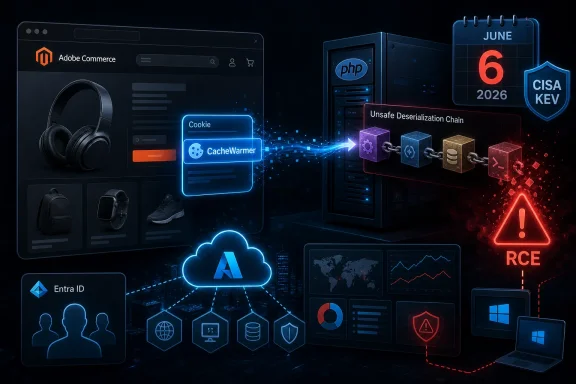 CISA Turns a Storefront Plugin Bug Into a Board-Level Timer
The Known Exploited Vulnerabilities catalog is not a normal vulnerability database. It is CISA’s short list of flaws that have crossed a practical threshold: someone is not merely theorizing about exploitation, but using the bug against real systems. Once a CVE lands there, federal civilian agencies must remediate it by the assigned due date, and private-sector defenders usually treat the entry as a warning that the exploit window has already opened.CVE-2026-45247 is especially uncomfortable because it is not buried inside an obscure admin-only workflow. It affects Mirasvit Full Page Cache Warmer for Magento 2 before version 1.11.12, and the weakness is reachable through ordinary storefront traffic. The vulnerable code handles a
CacheWarmer cookie, invokes PHP deserialization on attacker-controlled input, and can be driven toward remote code execution when usable gadget chains are present in Magento or its dependencies.That makes this a classic case of boring infrastructure becoming the attack surface. Cache warmers are supposed to make stores feel faster by pre-populating pages before customers arrive. They are not supposed to become unauthenticated code execution endpoints.
The CISA deadline is also unusually tight: June 6, 2026, only three days after the catalog addition. That does not mean every private organization has a legal three-day patch mandate, but it does indicate how CISA views the operational risk. If you run affected Magento infrastructure and are still thinking in terms of “next maintenance window,” the federal timeline is telling you the maintenance window has already arrived.
The Vulnerability Lives Where Defenders Least Want It
There is a reason deserialization flaws keep showing up in breach writeups. They turn application convenience into a control-flow problem. A program takes data, reconstructs objects from it, and assumes those objects are safe enough to load. When the data comes from a user-controlled cookie, that assumption becomes a gift to attackers.In this case, the vulnerable extension used a cookie to represent cache-warming state. That design makes sense in the narrow logic of rendering pages as different visitor types, currencies, or customer groups. But according to the disclosed technical details, the relevant handling ran on storefront requests generally, not only on trusted cache warmer traffic.
That difference matters. If the vulnerable path were locked behind an admin panel, a valid session, a secret token, or a private worker, defenders could at least reason about layers of control. Instead, the attack surface is the storefront itself — the one thing an e-commerce business must keep exposed to the internet.
The exploit primitive is also attractive. The advisory describes unauthenticated remote code execution, a CVSS 3.1 score of 9.8, low attack complexity, no required privileges, and no user interaction. In plainer language: an attacker does not need a stolen password, a tricked administrator, or a complex race condition. They need a vulnerable target and a request that carries the right malicious structure.
Magento’s Extension Economy Is the Real Attack Surface
Magento and Adobe Commerce are not just applications; they are ecosystems. A serious store is usually a stack of themes, payment connectors, analytics tags, shipping modules, SEO tools, performance extensions, and vendor-specific patches. That modularity is why merchants choose the platform, and it is also why security teams struggle to draw a clean perimeter around it.The Mirasvit issue illustrates that tradeoff. A cache warmer is not the payment gateway, not the admin login, and not the database layer. It is performance plumbing. Yet because it runs inside the same application context as the store, a flaw in that plumbing can become a route to server-level compromise.
For WindowsForum readers, this is where the story stops being “Magento news” and becomes enterprise risk. Many organizations that think of themselves as Microsoft shops still run commerce, marketing, partner portals, and intranet tools on PHP, Linux, containers, or managed hosting. Those systems feed Entra ID identities, Microsoft 365 workflows, ERP exports, Teams alerts, Azure storage, and Windows-based back-office processes.
Attackers do not care which team owns the box. They care whether a web-facing system can be turned into a beachhead. A compromised storefront can host skimmers, steal credentials, pivot into CI/CD secrets, exfiltrate customer data, or become part of a broader campaign against business systems that sit behind it.
A Patch Exists, but Patching Is Only the First Question
Mirasvit released version 1.11.12 on May 25, 2026, shortly before the CVE was published on May 26. That is the cleanest path: identify affected installations and upgrade the extension. In theory, the remediation story is simple.In practice, commerce platforms are rarely simple. Store owners often freeze changes during sales campaigns, rely on agencies for deployments, or run customized modules that make extension updates feel risky. Some stores may be using Mirasvit Cache Warmer indirectly because it is bundled with other Mirasvit packages, which means the person responsible for patching may not even recognize the component by name.
That is the trap CISA’s catalog is designed to counter. Vulnerability management teams love severity scores, but exploitation status changes the priority calculus. A bug with active exploitation is not waiting politely for a quarterly update cycle.
There is also the post-exploitation question. When a vulnerability permits remote code execution and is already being exploited, “we patched” is not the end of the incident response sentence. It should be followed by “we checked whether anyone got there first.”
Admins should look for unexpected PHP files in web-accessible directories, suspicious modifications to Magento code, unfamiliar admin accounts, cron jobs, webshell patterns, and outbound connections that do not match normal storefront behavior. Logs should be searched for suspicious
CacheWarmer cookie values, especially values containing serialized PHP object markers after base64 encoding. A clean upgrade protects the future; it does not automatically explain the past.
The Cookie Is Small, but the Blast Radius Is Not
The exploit path is almost insultingly ordinary. An attacker sends a storefront request with a craftedCacheWarmer cookie. The application reads it. Unsafe deserialization gives the attacker a chance to instantiate objects they control. If the right gadget chain is available, execution moves from application logic to arbitrary code.That chain of events is why defenders have spent years treating deserialization as a category of vulnerability rather than a one-off coding mistake. It is not merely that the input is malformed. It is that the application is asked to rebuild behavior from data supplied by an adversary.
The blast radius depends on the environment. On a locked-down host with least-privilege file permissions, application isolation, strong egress controls, and no exposed secrets, exploitation may still be serious but more containable. On a typical hurried commerce server with shared credentials, writable web directories, backup archives, deployment keys, and broad database permissions, remote code execution can quickly become a full compromise.
The risk is not limited to credit cards. Modern payment flows often reduce direct card exposure, but attackers have adapted. They steal session data, inject checkout skimmers, capture personal information, alter JavaScript, create persistence, and use legitimate traffic patterns to hide in the noise. A storefront is a trust machine; compromise it, and the attacker borrows that trust.
Federal Deadlines Signal Private-Sector Urgency
Binding Operational Directive 22-01 applies to Federal Civilian Executive Branch agencies, not to every business running Magento. But KEV entries have become a de facto prioritization layer for everyone because they answer a question CVSS does not: is this thing being used right now?That distinction matters. A 9.8 critical vulnerability may be terrifying on paper, but if it affects an unreachable subsystem or lacks public exploitation, defenders may sequence it behind more immediate threats. A KEV-listed vulnerability removes much of that ambiguity. It says the exploit has escaped the lab.
The June 6 due date is particularly sharp because it compresses the gap between disclosure, KEV listing, and required remediation. Security teams should read that as an operational message. If a business cannot identify whether it runs the vulnerable component within three days, the asset inventory problem is as serious as the patching problem.
This is where many organizations still fail. They know their Windows endpoints, their Microsoft 365 tenants, and their server OS versions, but they do not have the same confidence in application-layer dependencies. A Magento module installed two agencies ago may not appear in a CMDB, and a vendor bundle may hide a vulnerable package inside a broader extension set.
The Windows Shop Still Owns the Web Stack
It is tempting for Windows administrators to file this under “Linux/PHP problems.” That would be a mistake. Enterprises are full of hybrid dependencies, and the compromise path does not respect operating-system tribalism.A Magento instance may authenticate administrators through a Microsoft identity provider. It may export orders to a Windows-based ERP system. It may store backups in Azure Blob Storage, trigger Power Automate flows, or send operational alerts into Teams. Its developers may deploy from Windows laptops using SSH keys and Git tokens that also touch other environments.
That interconnectedness changes the security model. A storefront RCE can become a secret-harvesting event. Secrets can become cloud access. Cloud access can become identity abuse. Identity abuse can become lateral movement.
For WindowsForum’s IT-pro audience, the practical lesson is not to become Magento experts overnight. It is to stop treating non-Windows application stacks as someone else’s perimeter. If the system handles customer data, produces business revenue, or connects to Microsoft-managed identity and productivity infrastructure, it belongs in the same risk conversation as domain controllers, Intune policies, and Exchange Online configuration.
Detection Has to Move Faster Than the Change Board
The most useful detail in the public technical analysis is that exploitation leaves a recognizable request pattern. Defenders can hunt forCacheWarmer cookies containing object-like serialized payloads, including base64 strings beginning with common serialized PHP object markers. That kind of indicator is not perfect, but it gives security teams something immediate to search while patching proceeds.Web server logs, WAF logs, CDN request logs, Magento application logs, and EDR telemetry should all be in scope. If the storefront sits behind Cloudflare, Akamai, Fastly, Azure Front Door, or another edge provider, the relevant evidence may be split between the origin and the edge. Teams should not assume that the origin server alone has the complete picture.
The WAF question is delicate. A tuned WAF or virtual patch can reduce exposure, especially for teams that cannot update instantly. But WAF coverage should be treated as a bridge, not a destination. Deserialization payloads are notoriously adaptable, and a determined attacker may vary encoding, request structure, or delivery pattern to get around brittle signatures.
Incident responders should also resist the urge to stop at blocked attempts. If active exploitation is happening broadly, a few obvious probes may be the visible part of a larger campaign. The better question is whether any request reached vulnerable code before controls were updated, and whether the server shows evidence of persistence.
The Vendor Response Was Fast, but the Ecosystem Clock Is Slower
By the public timeline, Sansec discovered the bug on April 24, notified Mirasvit on May 21, and Mirasvit shipped a fix on May 25. That is a fast vendor turnaround. The CVE followed on May 26, and CISA added the vulnerability to KEV on June 3.The problem is not necessarily vendor responsiveness. It is deployment latency. E-commerce operators often live in a world where even small changes need staging, regression testing, agency coordination, and business approval. Attackers live in a world where disclosed patch diffs and advisories can be converted into scanning logic quickly.
That asymmetry is brutal. A four-day vendor fix is good. A nine-day lag between advisory publication and KEV listing is not long. But a vulnerable store that waits two weeks for a planned release train may still be exposed for most of the attacker’s easiest window.
There is a governance lesson here. Security teams need a path for emergency extension updates that does not require reinventing the release process during a crisis. That path should include backups, rollback plans, test checkouts, monitoring, and executive acceptance of short-term operational risk. The alternative is accepting long-term compromise risk by default.
The Real Failure Mode Is Not Knowing You Run It
The most dangerous vulnerable systems are not always the most technically exposed. They are the ones no one has claimed. Magento extensions installed by an agency, inherited through a migration, bundled into another package, or left behind after a redesign can sit outside normal patch routines.That is why this KEV entry should trigger an inventory exercise, not just a version check. Teams should enumerate Magento and Adobe Commerce instances, list installed Composer packages and modules, identify whether Mirasvit Cache Warmer or bundled Mirasvit packages are present, and confirm the installed version. They should do this across production, staging, disaster recovery, and forgotten regional storefronts.
Managed hosting does not eliminate the responsibility. It may shift who applies the patch, but the business still needs proof. A ticket that says “vendor notified” is not the same thing as a verified version number and a post-update compromise check.
The same applies to agencies. Many merchants outsource Magento operations, but active exploitation is not a normal support request. The business should ask for concrete evidence: current module version, deployment time, logs reviewed, indicators searched, suspicious files checked, and any compensating controls applied.
The Federal Catalog Is Becoming the Industry’s Triage Layer
CISA’s KEV catalog has become one of the most important security artifacts in day-to-day operations because it collapses a messy debate into a binary signal. Either exploitation is known, or it is not. That does not make every KEV item equally dangerous to every organization, but it does make inaction harder to justify.CVE-2026-45247 is a strong example of why that matters. It affects a third-party extension, not a flagship operating system. It sits in an application stack many infrastructure teams do not directly manage. It has a patch. It has a short federal deadline. It has active exploitation.
That combination should be familiar by now. Attackers have repeatedly found leverage in the seams between vendor responsibility, application ownership, and enterprise asset management. The KEV catalog is CISA’s attempt to force those seams into view.
For private organizations, the best use of KEV is not blind panic. It is disciplined acceleration. If a KEV item touches an internet-facing system, identity infrastructure, remote access, email, endpoint management, backup, or business-critical data, it should jump the queue. If it does not apply, the organization should be able to prove that quickly.
The June 6 Deadline Leaves Little Room for Ritual
CISA’s due date for federal agencies is June 6, 2026. That date should focus attention because it leaves little room for the usual rituals of vulnerability management: severity review, asset-owner notification, meeting scheduling, exception forms, and maintenance planning. Those processes exist for a reason, but exploited RCEs punish bureaucracy.Private-sector teams do not have to copy the federal deadline exactly, but they should respect its intent. An unauthenticated RCE on a public storefront is not a routine backlog item. The minimum responsible response is to determine exposure immediately, update or mitigate affected systems, and hunt for evidence of compromise.
There will be organizations that discover they are not affected. That is a good outcome, but it should be documented rather than assumed. There will be organizations that are affected but cannot patch instantly. Those teams should deploy temporary blocking controls, restrict suspicious cookie patterns, increase logging, and set an emergency update plan with a named owner and time.
The worst response is ambiguity. “We might use that extension somewhere” is not a status. “The agency handles Magento” is not a control. “The WAF probably blocks it” is not remediation.
The Storefront Warning Windows Admins Should Not Ignore
This incident has a narrow technical fix but a broader operational message: the exposed application layer now moves too quickly for slow asset awareness. CISA’s addition of CVE-2026-45247 compresses the response cycle because exploitation is already part of the story, not a hypothetical future phase.- Organizations running Mirasvit Full Page Cache Warmer for Magento 2 should upgrade to version 1.11.12 or later immediately.
- Teams should check whether the cache warmer is present through bundled Mirasvit packages, not only through direct installation.
- Security teams should hunt logs for suspicious
CacheWarmercookie values and review web-accessible directories for unexpected PHP files. - A WAF or edge rule can help reduce exposure temporarily, but it should not replace the vendor update.
- Any confirmed exposure should trigger a compromise assessment, not merely a patch ticket.
- Windows-centric IT teams should treat vulnerable commerce platforms as enterprise assets when they connect to Microsoft identity, cloud storage, business workflows, or back-office systems.
References
- Primary source: CISA
Published: 2026-06-03T12:00:00+00:00

CISA Adds One Known Exploited Vulnerability to Catalog | CISA
CISA has added one new vulnerability to its KEV Catalog, based on evidence of active exploitation.
www.cisa.gov
- Related coverage: techjacksolutions.com
Mirasvit / Adobe (Magento 2 ecosystem) Vulnerability Rollup (2026-05-29) — Security Intelligence
CVE-2026-45247 is a CVSS 9.8, CISA KEV-listed unauthenticated RCE vulnerability in the Mirasvit Full Page Cache Warmer extension for Magento 2, exploitable by passing a crafted serialized PHP object in the CacheWarmer cookie with no credentials or user interaction required. Active exploitation... techjacksolutions.com
- Related coverage: staksoft.com
Urgent Security Alert: CVE-2026-45247 RCE Vulnerability in Magento Cac | Staksoft
A critical CVSS 9.8 flaw is actively targeting Magento stores via full-page cache injection. Learn how to verify logs, audit your system, and apply the patch.www.staksoft.com - Related coverage: isec.news
CISA adds actively exploited Linux root flaw to known vulnerabilities list – iSec News
CISA added a Linux kernel privilege escalation flaw known as Copy Fail to its exploited vulnerabilities catalog after signs of active abuse. The issue can let a local user gain root access, and patches are already available.www.isec.news - Related coverage: thehackernews.com
CISA Adds Actively Exploited Linux Root Access Bug CVE-2026-31431 to KEV
CVE-2026-31431 exploited in Linux since 2017, enabling root access via simple PoC, increasing container and cloud risks.thehackernews.com
- Related coverage: scworld.com
CISA adds LiteSpeed cPanel plugin bug to exploited vulnerabilities list | news | SC Media
CISA warns of exploited LiteSpeed flaw putting shared hosting at risk.www.scworld.com
- Related coverage: labs.cloudsecurityalliance.org
CISA KEV Alert: Fortinet, Adobe, and Microsoft Under Attack
PDF documentlabs.cloudsecurityalliance.org
- Related coverage: hivepro.com
- Related coverage: runzero.com
