

Microsoft Turns a Spoofing Bug Into a Patch Discipline Test
CVE-2026-45500 is not floating around as a rumor from a paste site or an ambiguous scanner finding. It appears in Microsoft’s June 2026 Exchange Server security update documentation, alongside other Exchange spoofing, information disclosure, elevation-of-privilege, and remote-code-execution entries. That matters because the “confidence” around a vulnerability is not academic; it determines whether administrators should wait for more detail or move straight into change control.
Here, waiting for perfect detail would be the wrong lesson. Microsoft’s public material does not need to publish exploit primitives, proof-of-concept code, or internal root-cause analysis for the vulnerability to be operationally real. Once a vendor names the CVE in a security update for a product as exposed and historically targeted as Exchange, the practical burden shifts from “is this real?” to “how fast can we safely patch?”
Exchange has trained administrators to be suspicious of understatement. A “spoofing” label can sound less dramatic than remote code execution, but in a mail server context spoofing is rarely harmless. Exchange is identity plumbing, message transport, browser-facing access, calendaring, authentication glue, and sometimes hybrid cloud trust all wrapped into one product line.
That is why the right reading of CVE-2026-45500 is not “another medium-sounding bug.” It is “another confirmed Exchange flaw in a security update bundle that needs to be absorbed, tested, and verified before attackers turn patch notes into a targeting map.”
The Confidence Metric Says the Quiet Part Out Loud
The user-provided metric description is essentially about how much trust defenders should place in the existence and technical grounding of a vulnerability. At one end of the spectrum, a vulnerability may be whispered about with only vague impact claims. At the other end, the vendor confirms it, assigns it a CVE, and ships a fix.
CVE-2026-45500 sits much closer to the confirmed end of that spectrum. Microsoft has listed it in the Security Update Guide and in the June 9, 2026 Exchange Server update articles for Exchange Server Subscription Edition RTM and Exchange Server 2019 CU15. That is the kind of acknowledgement that gives security teams enough confidence to prioritize remediation even if Microsoft withholds exploit details.
This is not a guarantee that every technical detail is publicly known. Microsoft often limits disclosure where publishing the vulnerable code path or exploitation method would help attackers more than defenders. In Exchange’s case, that restraint is understandable: the product’s attack surface includes web-facing services and privileged internal workflows that have been repeatedly mined by criminal and state-backed groups.
The defender’s problem is that attackers do not need a full white paper to begin working. A CVE name, a product, a vulnerability class, an affected update train, and a patch diff can be enough for motivated researchers to narrow the hunt. Vendor confirmation lowers uncertainty for administrators, but it can also raise the quality of the breadcrumbs available to adversaries.
“Spoofing” Is a Mild Word for a Dangerous Class of Exchange Failure
Microsoft’s vulnerability taxonomy can make “spoofing” sound like a user-interface trick: a fake sender, a misleading page, a forged prompt. Sometimes it is exactly that. But in Exchange, spoofing can intersect with authentication flows, Outlook Web App behavior, message rendering, cross-origin assumptions, and trust boundaries between server-side and browser-side components.
That distinction matters because Exchange is not just an email store. It is often reachable from the internet, tied to Active Directory, used by executives and administrators, and connected to compliance workflows that treat messages as authoritative records. A successful spoofing attack in that environment can become a credential-harvesting step, a session-manipulation step, a business email compromise accelerator, or a way to make a malicious interaction look routine.
The June 2026 Exchange update set also includes multiple Exchange vulnerabilities, not just CVE-2026-45500. Microsoft lists CVE-2026-42897, CVE-2026-45501, CVE-2026-47631, and CVE-2026-45500 as spoofing vulnerabilities, with additional information disclosure, elevation-of-privilege, and remote-code-execution entries in the same family of updates. That clustering is the real signal.
For administrators, individual CVE labels are less useful than the release context. If several Exchange issues land in the same update, the question is not which one sounds scariest in isolation. The question is whether the Exchange estate is current enough, healthy enough, and documented enough to take the update without turning a security fix into an outage.
Exchange Server 2019 Is Now a Supported-Only-If-You-Planned-Ahead Story
The June 2026 update lands in a changed Exchange support landscape. Microsoft’s documentation for the Exchange Server 2019 CU15 security update states that Exchange Server 2016 and Exchange Server 2019 have reached end of support, and that organizations receiving later security updates for those versions need to be enrolled in the Extended Security Update program. That is a major operational dividing line.
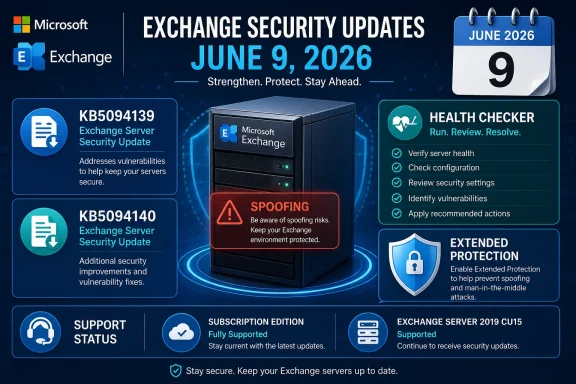
This is where CVE-2026-45500 becomes more than a vulnerability notice. It tests whether organizations treated the Exchange Server Subscription Edition transition as a real deadline or as another Microsoft lifecycle warning to defer. For Exchange Server SE, Microsoft lists the June 9, 2026 security update as KB5094139, bringing Subscription Edition RTM to SU7. For Exchange Server 2019 CU15, Microsoft lists KB5094140, identified as CU15 SU8.
The practical split is stark. Organizations on Exchange Server SE have a normal security update path. Organizations still on Exchange Server 2019 need to confirm their eligibility and access path. Organizations outside support and outside ESU are not just “a little behind”; they are operating a mail platform where new vendor-confirmed vulnerabilities may not be routinely remediable.
This is the lifecycle trap that catches Exchange shops more often than they admit. Mail infrastructure is so critical that admins hesitate to touch it, and because they hesitate to touch it, it becomes harder to patch when the next urgent vulnerability appears. CVE-2026-45500 is another reminder that leaving Exchange alone is not the same as leaving it stable.
The June Update Bundle Is Bigger Than One CVE
The Exchange Server Subscription Edition June 2026 security update resolves a set of Exchange vulnerabilities and includes an issue fix for Exchange mitigation and flighting services failing because of an “Unknown Issuer” error. That detail is easy to skip, but it matters because Exchange’s emergency mitigation pipeline has become part of Microsoft’s security story for on-premises deployments.
Microsoft’s Exchange Emergency Mitigation Service is designed to apply temporary mitigations for certain threats while administrators plan and deploy permanent updates. It is not a substitute for patching, and Microsoft has been clear in past Exchange guidance that mitigations are interim defenses. Still, a fix involving mitigation and flighting services is notable because the defensive automation itself must be trustworthy.
The same update documentation tells administrators to run the Exchange Server Health Checker to verify installation success and identify additional actions. That is not decorative language. Exchange updates have prerequisites, build dependencies, schema and configuration implications, and post-installation checks that can separate a patched system from a merely updated executable.
CVE-2026-45500 therefore belongs in a workflow, not a spreadsheet cell. The workflow starts with inventory, moves through build validation, confirms update applicability, schedules maintenance, installs, checks services, validates transport and client access, runs Health Checker, and records the resulting build state. Anything less invites the most frustrating class of security failure: the team believes it patched, but the environment remains exposed.
The Remote-Code-Execution Neighbor Changes the Risk Conversation
One reason CVE-2026-45500 deserves attention is the company it keeps. The June 2026 Exchange update documentation lists CVE-2026-45583 as a Microsoft Exchange Server remote code execution vulnerability, while also noting that its fix is not included in the security update and that administrators must follow the CVE documentation to address it. That is an unusual enough caveat to sharpen the whole release.
A spoofing vulnerability may not carry the same immediate dread as remote code execution, but defenders do not get to patch by emotional ranking alone. Attack chains often use “lesser” vulnerabilities to set up “greater” ones. A spoofing flaw that helps lure users, shape trust, manipulate browser behavior, or misrepresent identity can be valuable even if it does not directly run code on the server.
Exchange has repeatedly shown that chained risk is the real risk. Attackers do not care whether the first step in a compromise is the headline CVE. They care whether a sequence of weaknesses produces access, persistence, mailbox data, credentials, or movement into cloud-connected identity systems.
That is why organizations should resist the urge to isolate CVE-2026-45500 from the rest of the June update set. It is a confirmed spoofing vulnerability in a bundle that also includes higher-impact categories. The rational response is to treat the Exchange release as a security event with multiple paths to harm, not as a list of independent defects competing for attention.
Public Exploit Detail Is Not the Same Thing as Attacker Knowledge
At the time of Microsoft’s June 9 disclosure, the public record around CVE-2026-45500 appears constrained: Microsoft has named the vulnerability and tied it to security updates, but the detailed mechanics are not broadly exposed in mainstream reporting. That should lower panic, not urgency. It means defenders may have a window before copycat exploitation becomes easy.
But there is a common mistake in vulnerability management: equating “no public proof of concept” with “low operational risk.” For a product like Exchange, patches themselves can become research material. Attackers can compare binaries, inspect changed components, watch community threads, and test hypotheses against lab environments.
The more widely deployed and internet-facing a product is, the shorter the useful silence period can be. Exchange is exactly the sort of target where adversaries have both motivation and institutional memory. They know the architecture, they know common misconfigurations, and they know that some organizations will defer patching because mail downtime is politically expensive.
That is why the confidence metric should push administrators toward action rather than curiosity. The vulnerability is sufficiently confirmed. The technical details are sufficiently withheld. The affected product is sufficiently attractive. That combination says: patch first, reverse-engineer later if you must.
The Admin’s Real Enemy Is Estate Ambiguity
The hardest part of Exchange security in 2026 is not always installing the update. It is knowing, with confidence, what Exchange servers exist, what roles they play, what build they run, whether they are internet-facing, whether they participate in hybrid configuration, and whether they are still supported. Many organizations think they know this until an urgent Exchange advisory forces an audit.
CVE-2026-45500 is especially unforgiving of asset-management fuzziness because the June 2026 fixes land differently depending on product generation. Exchange Server SE has a current update package. Exchange Server 2019 CU15 has a security update path for eligible organizations. Unsupported or unlicensed scenarios require business decisions, not just technical ones.
A forgotten Exchange server is not necessarily forgotten by attackers. It may still answer on HTTPS, still have a certificate, still sit near Active Directory, still retain mailboxes, or still exist as a hybrid management relic. These machines are often the ones that miss the patch window because nobody owns them anymore.
The most mature Exchange shops will use this release to reconcile their inventory against reality. That means checking load balancers, DNS records, firewall rules, certificates, virtual directories, hybrid connectors, backup documentation, and monitoring systems. If the only Exchange inventory is a wiki page last edited during a migration project, CVE-2026-45500 is a good reason to distrust it.
Extended Protection Is No Longer Optional Hygiene
Microsoft’s Exchange update documentation again points administrators toward enabling Extended Protection on Exchange-based servers. That recommendation has become a recurring part of Exchange hardening because it addresses classes of authentication relay and credential misuse that patching alone cannot fully neutralize. In plain terms, it makes some kinds of man-in-the-middle and relay-style attacks harder to pull off.
The recurring nature of the recommendation is important. Microsoft is not merely saying, “Install this month’s binaries.” It is saying that Exchange security now depends on configuration posture as much as patch level. A fully updated but weakly configured Exchange deployment is better than an unpatched one, but it is not the finish line.
Extended Protection can require planning, especially in environments with load balancers, SSL offload, legacy clients, hybrid configurations, or nonstandard authentication paths. That is precisely why some organizations leave it undone. Unfortunately, the reasons that make Extended Protection complicated are often the same reasons Exchange is strategically valuable to attackers.
CVE-2026-45500 does not, by itself, prove an Extended Protection bypass or dependency. But the presence of Microsoft’s hardening guidance in the same Exchange update flow should be read as part of the modern baseline. Patch the vulnerability, then close the conditions that make future Exchange vulnerabilities easier to weaponize.
The Health Checker Is the New Minimum Bar
Microsoft’s instruction to run the Exchange Server Health Checker after installation may sound like boilerplate, but it is increasingly the line between responsible patching and wishful patching. Health Checker gives administrators a structured way to confirm build information and identify additional actions that a normal Windows Update-style mindset might miss.
Exchange has always been more application platform than simple server role. It has schema state, services, virtual directories, transport pipelines, certificates, web components, and integration points that can fail independently. An update can install successfully while a deployment remains misconfigured or partially protected.
In the context of CVE-2026-45500, Health Checker is also a documentation tool. Security teams need evidence that the remediation happened, not just a calendar invite showing a maintenance window. Change managers need to know which servers were updated, what builds they reached, and whether follow-up hardening remains.
This is especially important for organizations under audit or cyber-insurance scrutiny. “We installed the June Exchange update” is weaker than “we updated all Exchange Server SE RTM systems to SU7, updated eligible Exchange 2019 CU15 systems to SU8, ran Health Checker, and resolved or documented remaining findings.” The second sentence sounds bureaucratic because good incident prevention often does.
Microsoft’s Naming Makes the Risk Look Smaller Than the Work
One of the recurring frustrations in Microsoft security advisories is the gap between category labels and operational reality. “Spoofing” is a tidy term. “Exchange Server spoofing vulnerability in a multi-CVE June update bundle affecting supported and end-of-support product lines during a major lifecycle transition” is not tidy, but it is closer to what administrators actually face.
The label also influences executive attention. Remote code execution gets budget faster. Spoofing can be dismissed as user trickery or cosmetic deception. That instinct is dangerous in mail infrastructure, where trust presentation is the product’s job.
The better framing for CVE-2026-45500 is that it is a trust-boundary failure in Exchange. Whether the public details ultimately show browser behavior, message rendering, identity representation, or another spoofing vector, the business risk comes from Exchange’s role as an authority. Users believe what Exchange presents. Systems act on what Exchange processes. Administrators often trust its logs, headers, and workflows.
That is what makes spoofing vulnerabilities in Exchange worth taking seriously. They target not just code but confidence: confidence in who sent a message, what a user clicked, what a browser displayed, or what an authenticated session means.
Attackers Love the Organizations That Rank by CVSS Alone
CVSS is useful, but it is not a patching strategy. It gives a structured way to compare vulnerabilities, but it cannot fully express local exposure, business dependency, threat interest, or exploit-chain value. Exchange is a classic example of a product where context routinely overwhelms numeric neatness.
An Exchange spoofing bug on an isolated lab server is one thing. The same class of bug on an internet-facing production server serving executives, finance, legal, and administrators is another. The same bug in a hybrid environment connected to Microsoft 365 identity and transport flows may carry still more consequence.
That is why confidence in existence is only one dimension. Defenders should also ask whether the product is exposed, whether the user population is high-value, whether compensating controls exist, whether Extended Protection is enabled, whether emergency mitigations work, and whether the server is actually eligible for the relevant update. These are not abstract risk-management questions; they determine whether CVE-2026-45500 is a routine patch or a board-level exposure.
Attackers thrive when organizations treat vulnerability management as arithmetic. They look for the high-value systems whose CVEs were categorized as noncritical, deferred because of downtime fears, or hidden behind lifecycle confusion. Exchange has been that system before.
The Patch Window Is Also a Migration Window
For organizations still running Exchange Server 2019, the June 2026 update should intensify the migration conversation. Microsoft’s documentation is explicit that Exchange Server 2016 and 2019 have reached end of support, and that continued security updates require the Extended Security Update program. That is not a sustainable long-term posture for most organizations.
Exchange Server Subscription Edition is Microsoft’s intended on-premises path. Whether an organization likes the subscription model is now secondary to whether it can keep receiving security fixes on predictable terms. Security teams may not control licensing strategy, but they will inherit the risk if licensing strategy blocks patches.
This is where Exchange differs from many server applications. You cannot simply say “we’ll migrate someday” while leaving an exposed mail server in place. Exchange sits too close to identity, too close to users, and too close to sensitive communications. A deferred migration becomes a deferred security control.
CVE-2026-45500 is not the only reason to move, and it may not be the most severe Exchange issue in the June bundle. But it is a useful forcing function. If an organization had to scramble to understand whether it was eligible for KB5094140, it has already learned something uncomfortable about its Exchange roadmap.
The June 2026 Exchange Lesson Is Written in the Release Notes
The concrete response to CVE-2026-45500 is not mysterious, but it is easy to underdo. Microsoft has confirmed the vulnerability, listed it in the June 9, 2026 Exchange security updates, and provided update packages for Exchange Server SE and eligible Exchange Server 2019 CU15 environments. The remaining work is the unglamorous discipline of making sure the update lands everywhere it should.
- CVE-2026-45500 should be treated as a confirmed Microsoft Exchange Server spoofing vulnerability because Microsoft has acknowledged it in the Security Update Guide and in Exchange security update documentation.
- Exchange Server Subscription Edition RTM administrators should evaluate and deploy the June 9, 2026 security update identified as KB5094139, which brings that branch to SU7.
- Exchange Server 2019 CU15 administrators should verify ESU eligibility and access to KB5094140, because Exchange Server 2019 is now past standard support.
- Administrators should not assess CVE-2026-45500 in isolation, because the same June 2026 Exchange release set includes multiple spoofing vulnerabilities and other higher-impact vulnerability classes.
- Running the Exchange Server Health Checker after installation should be treated as part of remediation, not as optional post-patch housekeeping.
- Extended Protection and mitigation-service health belong in the same conversation as patching, because modern Exchange defense depends on configuration posture as well as update level.
CVE-2026-45500 is unlikely to be remembered by name the way the biggest Exchange disasters are remembered, and that may be the point. The organizations that handle it well will make it boring: inventory confirmed, support status checked, update deployed, Health Checker run, hardening reviewed, migration pressure acknowledged. The organizations that handle it badly will treat “spoofing” as a reason to wait, only to rediscover that Exchange vulnerabilities rarely stay neatly inside the boxes Microsoft’s labels give them.