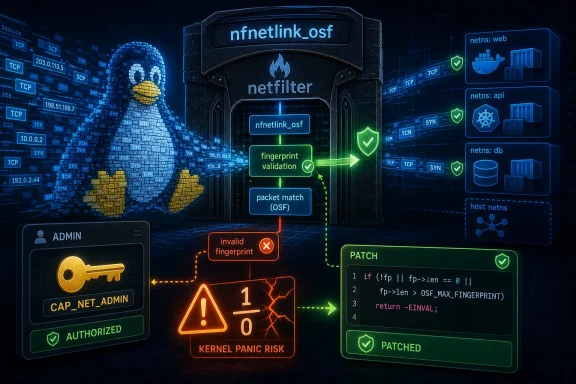
Linux kernel maintainers have assigned CVE-2026-45841 to a netfilter flaw, published by NVD on May 27, 2026, in which a privileged CAP_NET_ADMIN user can load a malformed passive OS fingerprint that later causes a divide-by-zero panic when matching TCP SYN traffic. The bug is small, the patch is smaller, and the operational lesson is larger than either. This is not a remote wormable catastrophe; it is a reminder that kernel attack surface increasingly lives in administrative control planes, containers, namespaces, and packet-processing features most users never knowingly enabled. For WindowsForum readers running Linux at the edge, in labs, in WSL-adjacent workflows, or under mixed-platform infrastructure, the sensible response is not panic — it is inventory, patch cadence, and a little skepticism toward “privileged-only” bugs.
CVE-2026-45841 sits in
The vulnerability exists because the kernel path computed
The upstream fix is almost comically modest: reject invalid fingerprints when they are added. The patch checks whether the window-size selector is outside the expected range and whether the modulo mode is paired with a zero value. If either condition is true, the kernel returns
That smallness should not make the vulnerability seem trivial. The kernel is full of interfaces where userspace hands structured data to code that later runs in a more dangerous context. The whole point of validation is to stop a bad administrative write from becoming an asynchronous crash hours, days, or packets later.
It is commonly granted to networking services, container workloads, VPN components, traffic shapers, firewall managers, test harnesses, and appliance-style stacks. It appears in Kubernetes security discussions because it is broad, sharp, and frequently requested by software that wants to create interfaces, manipulate routes, alter firewall state, or manage packet filtering. Once a workload has it, the boundary between “application compromise” and “host-level denial of service” can get uncomfortably thin.
That is why this CVE matters even though it is not a classic remote code execution story. A compromised service with the right capability does not need to write shellcode into the kernel. It can load a malformed fingerprint and wait for a matching SYN to turn a bad configuration object into a kernel panic.
For defenders, the right mental model is not “only admins can exploit it.” It is “any path to
The OS fingerprinting extension is comparatively niche. Many administrators will never knowingly use it, and many distributions may not load the relevant module by default. But netfilter modules often exist in the gray zone between “not enabled in my baseline” and “available to a sufficiently privileged local actor.” That gray zone is where vulnerability management becomes less about brand names and more about actual kernel configuration.
The crash trace in the CVE record tells a familiar story. Packet reception moves through netfilter hooks, table evaluation, the OS fingerprint match, and finally into the vulnerable function. By the time the divide-by-zero occurs, the system is not executing some exotic research-only path; it is processing network input through normal kernel machinery.
That is what makes denial-of-service bugs in packet-processing code so operationally irritating. The malicious setup may be local and privileged, but the trigger can look like ordinary network traffic. Once the bad state is installed, the eventual crash can be detached from the original administrative action.
The patch moves the guard into
This is exactly the kind of detail that separates a real fix from a cosmetic fix. Kernel validation must match the lifetime and ownership of the data being validated. If a field is per-object, it must be checked per-object; if it is per-option, it can be checked per-option; if it is later consumed in interrupt context, the system should not be trying to rediscover its validity at the point of use.
The second part of the patch rejects selector values greater than or equal to
This is especially awkward for kernel CVEs. Linux kernel security records often arrive with terse descriptions and stable-branch references before downstream distributions have shipped advisories, backports, or package-specific affected-version matrices. The result is a period where the technical fix exists, the CVE exists, but many enterprise tools still cannot cleanly answer the questions administrators actually ask: Am I affected? Is my distribution shipping the vulnerable code? Is the module enabled? Is the capability reachable by untrusted workloads?
For CVE-2026-45841, the absence of a score should not be confused with the absence of risk. The exploit condition is constrained, but the impact is severe for availability: a kernel panic. A vulnerability program that treats “no NVD score yet” as “no action needed” is outsourcing judgment to a metadata pipeline that may not be operating on the organization’s timeline.
The better approach is to classify this as a capability-gated local denial-of-service issue in a networking subsystem, then map that to your environment. Internet-facing firewall appliances, container hosts, network labs, CI systems that manipulate packet filters, and multi-tenant Linux environments deserve a closer look than ordinary desktop machines.
A container granted
If such a workload is compromised, CVE-2026-45841 offers a route from container-level control to host-level availability damage, assuming the relevant kernel functionality is present and reachable. That is not the same as a container escape that gives the attacker arbitrary host control. But for production systems, forced reboot and service interruption are not academic outcomes.
This is why security teams should not rank the bug only by exploit glamour. In a clustered environment, a repeatable panic can drain nodes, flap services, trigger failovers, and create cascading operational noise. Attackers do not always need persistence when disruption is the goal.
A Windows admin may not patch the Linux kernel on a personal laptop every week, but the same admin may own Azure-hosted Linux workloads, container build agents, firewall VMs, reverse proxies, or monitoring appliances. The practical boundary between Windows operations and Linux operations has dissolved into identity, networking, and automation.
CVE-2026-45841 is not a WSL headline unless a specific WSL kernel build includes the affected code and exposes the relevant path. It is also not a direct Windows vulnerability. But it is relevant to Windows shops because the systems that route, filter, inspect, and host Windows-facing services are often Linux systems maintained by the same infrastructure team.
That is the modern security beat in miniature. The vulnerable code may not run on Windows, but the outage it can cause may absolutely affect Windows users.
That means administrators should resist crude version comparison. A distribution kernel that appears “older” may contain the backported fix, while a self-built or vendor appliance kernel may not. The only reliable answer comes from the distribution’s security advisory, package changelog, or kernel source package.
This is especially true for enterprise Linux. Vendors often preserve a stable kernel ABI while backporting individual fixes. A scanner that looks only at
The sane workflow is to identify whether the affected module exists, determine whether the OS vendor has shipped the fix, update through the supported package channel, and reboot into the corrected kernel. For live-patching environments, administrators should verify whether this particular fix is covered; not every kernel bug is a good candidate for live patching, and packet-path validation changes may still require a conventional reboot depending on vendor support.
A kernel panic is not a polite process crash. It is the operating system losing the ability to continue safely. Depending on configuration, the machine may halt, reboot, dump core, or disappear from the network long enough to trigger a chain of secondary failures.
CVE-2026-45841 is therefore best understood as an availability vulnerability with a privilege gate. It does not appear to offer confidentiality loss or privilege escalation by itself. But in environments where untrusted or semi-trusted workloads can acquire
The fix also illustrates a larger kernel maintenance reality. Many important security improvements are not sweeping rewrites but tiny guardrails inserted exactly where malformed state enters the system. Four lines can be the difference between a rejected configuration and a machine crash.
The original code path dates back to the passive OS fingerprint xtables match. That historical depth matters. Kernel subsystems often carry decades of compatibility expectations, and even obscure extensions may remain available because someone, somewhere, depends on them.
Administrators have two ways to respond. One is to patch and move on, which is necessary. The other is to reduce unnecessary kernel attack surface, which is harder but more durable. If a host does not need a module, a namespace permission, or a privileged container capability, removing that exposure can protect against the next small bug before it has a CVE number.
That principle is not Linux-specific. Windows admins already understand it through optional features, drivers, legacy protocols, and attack surface reduction rules. The kernel may differ, but the hygiene pattern is the same: do not expose code paths merely because they exist.
This is not a reason to ignore scanners; it is a reason to understand their inputs. Tools that depend heavily on NVD scoring may under-prioritize the issue until enrichment lands. Tools with distribution-specific OVAL feeds or vendor advisories may become accurate sooner for supported platforms. Tools that rely on kernel version strings alone may generate false positives against backported enterprise kernels.
For Linux kernel CVEs, the gold standard is boring and manual: vendor advisory, package changelog, installed kernel package, running kernel after reboot, and workload exposure. If those five points line up, the organization has a defensible answer even if a dashboard remains noisy.
The same goes for exploitability. The phrase
Container platforms should be checked for workloads running with broad capabilities. If a workload only needs to bind a low port, it does not need
Network appliances and custom Linux images deserve special attention. They often carry unusual netfilter configurations, out-of-tree management layers, and delayed kernel update cycles. They are also exactly the systems where a kernel panic becomes a visible outage.
Developer workstations and labs sit at the other end of the spectrum. They may not be high-value production assets, but they often run experimental containers with elevated permissions. In those environments, the risk is less about an external attacker and more about untrusted code, proof-of-concept tooling, or compromised dependencies running with privileges the user granted for convenience.
The uncomfortable part is that the wrong assumption existed in the first place. Kernel code that accepts structured input from privileged userspace still must defend itself, because privilege is not the same as correctness. Root can make mistakes. Management daemons can have bugs. Containers can be compromised. Administrative APIs can become attack surfaces.
That is one of the quiet shifts in vulnerability analysis over the past decade. Bugs once dismissed as “local admin only” now get revisited under containers, namespaces, delegated capabilities, and automation-heavy infrastructure. The same code has a different risk profile because the deployment model changed around it.
CVE-2026-45841 is a good example of that shift. The code did not become more dangerous because modulo arithmetic changed. It became more relevant because the world around
For sysadmins, the picture depends on role. Edge systems, firewalls, routers, container hosts, CI runners, and packet-processing boxes deserve priority. So do multi-user systems where delegated network administration exists, because the difference between “trusted admin” and “semi-trusted operator” can matter in real incidents.
For security teams, the strongest signal is not the CVE score — especially while NVD enrichment is pending — but the intersection of three facts: the bug can panic the kernel, exploitation requires a powerful but commonly delegated capability, and the affected subsystem lives in network packet processing. That combination is enough to justify prompt but measured action.
For developers maintaining privileged networking software, the lesson is sharper. If your tool loads kernel objects, netfilter rules, fingerprints, BPF programs, or other structured data into privileged interfaces, validate on your side even when the kernel also should. Defense in depth is not an excuse for kernel bugs, but it can prevent your product from becoming the easiest path to them.
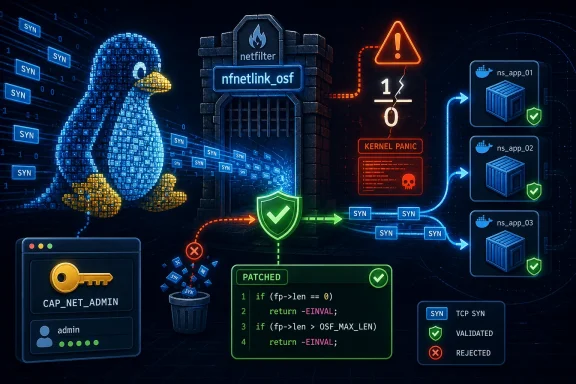 A Four-Line Patch Exposes a Bigger Kernel Truth
CVE-2026-45841 sits in nfnetlink_osf, the netfilter component used for passive operating-system fingerprint matching. Passive OS fingerprinting inspects characteristics of incoming TCP packets — such as the TCP window size and options — and tries to infer what kind of system sent them. In the Linux implementation, one matching mode uses a modulo comparison against a fingerprint-provided window-size scaling value.The vulnerability exists because the kernel path computed
ctx->window % f->wss.val without first guaranteeing that f->wss.val was nonzero. If a user with CAP_NET_ADMIN could add a fingerprint with the relevant mode set to OSF_WSS_MODULO and the divisor set to zero, a later packet match could trip a hardware divide exception and panic the kernel. That is the sort of bug every C programmer learns to fear in week one, except here it lives inside the packet path of a production kernel.The upstream fix is almost comically modest: reject invalid fingerprints when they are added. The patch checks whether the window-size selector is outside the expected range and whether the modulo mode is paired with a zero value. If either condition is true, the kernel returns
-EINVAL and refuses the fingerprint before traffic ever reaches the matching path.That smallness should not make the vulnerability seem trivial. The kernel is full of interfaces where userspace hands structured data to code that later runs in a more dangerous context. The whole point of validation is to stop a bad administrative write from becoming an asynchronous crash hours, days, or packets later.
“Privileged” Does Not Mean “Irrelevant”
The most tempting dismissal is also the least useful one: exploitation requiresCAP_NET_ADMIN. On a single-user desktop with no untrusted local users and no containerized workloads, that may indeed put CVE-2026-45841 low on the emergency scale. On a modern Linux host, though, CAP_NET_ADMIN is not a mystical root-only power that never leaks into real deployments.It is commonly granted to networking services, container workloads, VPN components, traffic shapers, firewall managers, test harnesses, and appliance-style stacks. It appears in Kubernetes security discussions because it is broad, sharp, and frequently requested by software that wants to create interfaces, manipulate routes, alter firewall state, or manage packet filtering. Once a workload has it, the boundary between “application compromise” and “host-level denial of service” can get uncomfortably thin.
That is why this CVE matters even though it is not a classic remote code execution story. A compromised service with the right capability does not need to write shellcode into the kernel. It can load a malformed fingerprint and wait for a matching SYN to turn a bad configuration object into a kernel panic.
For defenders, the right mental model is not “only admins can exploit it.” It is “any path to
CAP_NET_ADMIN may become a path to host availability impact.” Those are very different risk statements.Netfilter Remains the Kernel’s Busy Border Checkpoint
Netfilter is one of Linux’s great infrastructure successes and one of its enduring risk centers. It underpins firewalling, NAT, connection tracking, packet mangling, and much of the behavior administrators casually associate withiptables, nftables, and container networking. Because it mediates traffic at a privileged layer, small logic errors can have consequences far beyond the individual feature that contains them.The OS fingerprinting extension is comparatively niche. Many administrators will never knowingly use it, and many distributions may not load the relevant module by default. But netfilter modules often exist in the gray zone between “not enabled in my baseline” and “available to a sufficiently privileged local actor.” That gray zone is where vulnerability management becomes less about brand names and more about actual kernel configuration.
The crash trace in the CVE record tells a familiar story. Packet reception moves through netfilter hooks, table evaluation, the OS fingerprint match, and finally into the vulnerable function. By the time the divide-by-zero occurs, the system is not executing some exotic research-only path; it is processing network input through normal kernel machinery.
That is what makes denial-of-service bugs in packet-processing code so operationally irritating. The malicious setup may be local and privileged, but the trigger can look like ordinary network traffic. Once the bad state is installed, the eventual crash can be detached from the original administrative action.
The Bug Is in Validation, Not Arithmetic
There is a mundane engineering lesson here: the modulo operation is not the true culprit. The bug is the decision to trust a fingerprint structure that could encode an impossible or nonsensical state. The arithmetic merely made the trust failure visible.The patch moves the guard into
nfnl_osf_add_callback(), the place where new fingerprints arrive from userspace. That placement matters. The CVE description notes that the window-size selector belongs to the fingerprint as a whole, not to each TCP option inside the fingerprint. If the validation had been placed only inside the per-option loop, fingerprints with zero options could have bypassed the check entirely.This is exactly the kind of detail that separates a real fix from a cosmetic fix. Kernel validation must match the lifetime and ownership of the data being validated. If a field is per-object, it must be checked per-object; if it is per-option, it can be checked per-option; if it is later consumed in interrupt context, the system should not be trying to rediscover its validity at the point of use.
The second part of the patch rejects selector values greater than or equal to
OSF_WSS_MAX. The matching function already treated that case as something that should not happen. The fix makes the input layer enforce the same assumption instead of relying on downstream code to survive impossible states.NVD’s Empty Score Is Now Part of the Story
As of the record described by the submitter, NVD had published CVE-2026-45841 but had not yet assigned CVSS 4.0, CVSS 3.x, or CVSS 2.0 scores. That increasingly common gap is not just a clerical nuisance. Vulnerability programs built around scanner severity fields can stall when the public metadata is incomplete.This is especially awkward for kernel CVEs. Linux kernel security records often arrive with terse descriptions and stable-branch references before downstream distributions have shipped advisories, backports, or package-specific affected-version matrices. The result is a period where the technical fix exists, the CVE exists, but many enterprise tools still cannot cleanly answer the questions administrators actually ask: Am I affected? Is my distribution shipping the vulnerable code? Is the module enabled? Is the capability reachable by untrusted workloads?
For CVE-2026-45841, the absence of a score should not be confused with the absence of risk. The exploit condition is constrained, but the impact is severe for availability: a kernel panic. A vulnerability program that treats “no NVD score yet” as “no action needed” is outsourcing judgment to a metadata pipeline that may not be operating on the organization’s timeline.
The better approach is to classify this as a capability-gated local denial-of-service issue in a networking subsystem, then map that to your environment. Internet-facing firewall appliances, container hosts, network labs, CI systems that manipulate packet filters, and multi-tenant Linux environments deserve a closer look than ordinary desktop machines.
Containers Turn Capability Bugs Into Fleet Questions
The container angle is where this class of vulnerability becomes most interesting. Linux capabilities were designed to split root privilege into narrower pieces, but some pieces remain enormous.CAP_NET_ADMIN is one of them.A container granted
CAP_NET_ADMIN can be perfectly legitimate. VPN containers, service meshes, packet capture tools, firewall controllers, and network emulators often request it. The operational problem is that capability grants are frequently copied from examples, Helm charts, forum posts, or old deployment manifests without a fresh review of what the workload truly needs.If such a workload is compromised, CVE-2026-45841 offers a route from container-level control to host-level availability damage, assuming the relevant kernel functionality is present and reachable. That is not the same as a container escape that gives the attacker arbitrary host control. But for production systems, forced reboot and service interruption are not academic outcomes.
This is why security teams should not rank the bug only by exploit glamour. In a clustered environment, a repeatable panic can drain nodes, flap services, trigger failovers, and create cascading operational noise. Attackers do not always need persistence when disruption is the goal.
The Windows Angle Is Hybrid Infrastructure, Not Desktop Panic
WindowsForum readers may reasonably ask why a Linux netfilter CVE belongs on a Windows-centric publication. The answer is that Windows estates are rarely Windows-only anymore. Linux runs under the developer desk, inside WSL workflows, behind Windows-hosted virtualization, in appliances that protect Windows networks, and throughout cloud infrastructure that serves Microsoft-heavy organizations.A Windows admin may not patch the Linux kernel on a personal laptop every week, but the same admin may own Azure-hosted Linux workloads, container build agents, firewall VMs, reverse proxies, or monitoring appliances. The practical boundary between Windows operations and Linux operations has dissolved into identity, networking, and automation.
CVE-2026-45841 is not a WSL headline unless a specific WSL kernel build includes the affected code and exposes the relevant path. It is also not a direct Windows vulnerability. But it is relevant to Windows shops because the systems that route, filter, inspect, and host Windows-facing services are often Linux systems maintained by the same infrastructure team.
That is the modern security beat in miniature. The vulnerable code may not run on Windows, but the outage it can cause may absolutely affect Windows users.
Stable Kernel Fixes Are Only Half the Patch Story
The CVE record lists multiple stable kernel references, which indicates that fixes have been propagated across supported kernel lines. That is good news, but it is not the end of the patch story. Most organizations do not run upstream stable kernels directly; they run distribution kernels with their own version numbers, backports, configuration choices, and advisory cadence.That means administrators should resist crude version comparison. A distribution kernel that appears “older” may contain the backported fix, while a self-built or vendor appliance kernel may not. The only reliable answer comes from the distribution’s security advisory, package changelog, or kernel source package.
This is especially true for enterprise Linux. Vendors often preserve a stable kernel ABI while backporting individual fixes. A scanner that looks only at
uname -r can mislead in both directions, depending on how it maps upstream commits to downstream packages.The sane workflow is to identify whether the affected module exists, determine whether the OS vendor has shipped the fix, update through the supported package channel, and reboot into the corrected kernel. For live-patching environments, administrators should verify whether this particular fix is covered; not every kernel bug is a good candidate for live patching, and packet-path validation changes may still require a conventional reboot depending on vendor support.
Availability Bugs Deserve More Respect Than They Get
Security culture still over-rewards remote code execution and under-rates denial of service. That bias is understandable. Code execution is dramatic, measurable, and often leads to data theft. Denial of service can sound like a lesser category until the affected machine is a firewall, router, VPN concentrator, Kubernetes node, storage gateway, or authentication dependency.A kernel panic is not a polite process crash. It is the operating system losing the ability to continue safely. Depending on configuration, the machine may halt, reboot, dump core, or disappear from the network long enough to trigger a chain of secondary failures.
CVE-2026-45841 is therefore best understood as an availability vulnerability with a privilege gate. It does not appear to offer confidentiality loss or privilege escalation by itself. But in environments where untrusted or semi-trusted workloads can acquire
CAP_NET_ADMIN, availability is a serious security property.The fix also illustrates a larger kernel maintenance reality. Many important security improvements are not sweeping rewrites but tiny guardrails inserted exactly where malformed state enters the system. Four lines can be the difference between a rejected configuration and a machine crash.
The Niche Feature Problem Is a Familiar Admin Trap
One reason bugs like this linger is that niche features do not get the same real-world exercise as mainstream paths. Netfilter itself is heavily used, but passive OS fingerprint matching is not a default daily tool for every administrator. Less-used modules can accumulate assumptions that survive for years because only specialized users, fuzzers, or researchers stress the weird combinations.The original code path dates back to the passive OS fingerprint xtables match. That historical depth matters. Kernel subsystems often carry decades of compatibility expectations, and even obscure extensions may remain available because someone, somewhere, depends on them.
Administrators have two ways to respond. One is to patch and move on, which is necessary. The other is to reduce unnecessary kernel attack surface, which is harder but more durable. If a host does not need a module, a namespace permission, or a privileged container capability, removing that exposure can protect against the next small bug before it has a CVE number.
That principle is not Linux-specific. Windows admins already understand it through optional features, drivers, legacy protocols, and attack surface reduction rules. The kernel may differ, but the hygiene pattern is the same: do not expose code paths merely because they exist.
Scanner Output Will Lag the Engineering Reality
The most frustrating phase of a vulnerability like CVE-2026-45841 is the in-between period. The patch is public. The CVE is public. The NVD entry may still lack enrichment. Distribution advisories may arrive at different speeds. Scanners may flag some systems and miss others. Security dashboards may show “unknown” where engineers want “fixed” or “not affected.”This is not a reason to ignore scanners; it is a reason to understand their inputs. Tools that depend heavily on NVD scoring may under-prioritize the issue until enrichment lands. Tools with distribution-specific OVAL feeds or vendor advisories may become accurate sooner for supported platforms. Tools that rely on kernel version strings alone may generate false positives against backported enterprise kernels.
For Linux kernel CVEs, the gold standard is boring and manual: vendor advisory, package changelog, installed kernel package, running kernel after reboot, and workload exposure. If those five points line up, the organization has a defensible answer even if a dashboard remains noisy.
The same goes for exploitability. The phrase
CAP_NET_ADMIN should trigger a permissions review, not a shrug. Find out which containers, services, automation accounts, and lab users have it. Many organizations will discover that the answer is broader than expected.The Real Patch Is Also a Capability Audit
The immediate remediation is to update to a kernel build containing the fix. That sentence is simple because the engineering response is simple. The more valuable response is to treat the CVE as a prompt to review why privileged networking authority exists where it does.Container platforms should be checked for workloads running with broad capabilities. If a workload only needs to bind a low port, it does not need
CAP_NET_ADMIN. If it only needs packet capture, there may be narrower alternatives depending on the design. If it genuinely needs to reconfigure networking, the operational blast radius should be explicit rather than inherited from a sample manifest.Network appliances and custom Linux images deserve special attention. They often carry unusual netfilter configurations, out-of-tree management layers, and delayed kernel update cycles. They are also exactly the systems where a kernel panic becomes a visible outage.
Developer workstations and labs sit at the other end of the spectrum. They may not be high-value production assets, but they often run experimental containers with elevated permissions. In those environments, the risk is less about an external attacker and more about untrusted code, proof-of-concept tooling, or compromised dependencies running with privileges the user granted for convenience.
The Kernel Did the Right Thing After the Wrong Assumption
It is worth giving credit where it is due. The fix landed in the normal kernel process, was reviewed, and was propagated into stable branches. The code change rejects invalid input at the boundary, which is the correct architectural answer. There is no elaborate mitigation dance, no configuration workaround masquerading as a fix, and no attempt to blame users for reaching a bad state the kernel accepted.The uncomfortable part is that the wrong assumption existed in the first place. Kernel code that accepts structured input from privileged userspace still must defend itself, because privilege is not the same as correctness. Root can make mistakes. Management daemons can have bugs. Containers can be compromised. Administrative APIs can become attack surfaces.
That is one of the quiet shifts in vulnerability analysis over the past decade. Bugs once dismissed as “local admin only” now get revisited under containers, namespaces, delegated capabilities, and automation-heavy infrastructure. The same code has a different risk profile because the deployment model changed around it.
CVE-2026-45841 is a good example of that shift. The code did not become more dangerous because modulo arithmetic changed. It became more relevant because the world around
CAP_NET_ADMIN became more complex.Where the Risk Falls in Real Networks
For most home users, this CVE is unlikely to be an urgent event. If you run a stock desktop distribution, do not grant unusual networking capabilities to untrusted software, and install kernel updates regularly, the practical exposure is limited. You should still take the update when your distribution ships it, but there is no reason to treat it like a mass exploitation emergency.For sysadmins, the picture depends on role. Edge systems, firewalls, routers, container hosts, CI runners, and packet-processing boxes deserve priority. So do multi-user systems where delegated network administration exists, because the difference between “trusted admin” and “semi-trusted operator” can matter in real incidents.
For security teams, the strongest signal is not the CVE score — especially while NVD enrichment is pending — but the intersection of three facts: the bug can panic the kernel, exploitation requires a powerful but commonly delegated capability, and the affected subsystem lives in network packet processing. That combination is enough to justify prompt but measured action.
For developers maintaining privileged networking software, the lesson is sharper. If your tool loads kernel objects, netfilter rules, fingerprints, BPF programs, or other structured data into privileged interfaces, validate on your side even when the kernel also should. Defense in depth is not an excuse for kernel bugs, but it can prevent your product from becoming the easiest path to them.
The Signal Hidden in CVE-2026-45841’s Small Print
CVE-2026-45841 is not the vulnerability that should dominate the week, but it is the kind that separates mature operations from dashboard-driven patch theater. The concrete actions are limited, and that is a virtue.- Organizations should apply vendor kernel updates that include the
nfnetlink_osfvalidation fix and confirm that systems have rebooted into the corrected kernel. - Administrators should check whether privileged containers or services have
CAP_NET_ADMIN, especially on shared hosts, Kubernetes nodes, CI systems, and network appliances. - Security teams should treat the missing NVD score as incomplete metadata, not as evidence that the vulnerability is harmless.
- Linux fleet owners should verify distribution-specific advisories rather than relying solely on upstream kernel version numbers.
- Teams that do not use passive OS fingerprint matching should consider whether the relevant module and adjacent netfilter features need to be available on hardened systems.
- Incident responders should remember that a later TCP SYN can trigger a crash only after the malformed fingerprint has already been installed by a sufficiently privileged actor.
References
- Primary source: NVD / Linux Kernel
Published: 2026-05-28T01:02:11-07:00
NVD - CVE-2026-45841
 nvd.nist.gov
- Security advisory: MSRC
Published: 2026-05-28T01:02:11-07:00
Original feed URL
Security Update Guide - Microsoft Security Response Center
 msrc.microsoft.com
- Official source: nist.gov

National Vulnerability Database
NIST maintains the National Vulnerability Database (NVD), a repository of information on software and hardware flaws that can compromise computer security. This is a key piece of the nation’s cybersecurity infrastructure.www.nist.gov
- Related coverage: thewindowsupdate.com
- Related coverage: labs.cloudsecurityalliance.org