
CVE-2026-46101 is a newly published Linux kernel vulnerability, recorded by NVD on May 27, 2026, in which malformed nftables bitwise shift rules could trigger undefined behavior in netfilter’s
The vulnerability sits in netfilter, the Linux kernel’s long-running packet filtering and network translation framework. More specifically, it affects nftables, the newer ruleset infrastructure that has steadily displaced iptables across distributions, firewalls, containers, and appliance-like Linux deployments. The bug concerns
On paper, CVE-2026-46101 is not the kind of bug that makes executives clear their calendars. NVD has not yet assigned a CVSS score, the record is still marked as awaiting enrichment, and the published description does not claim remote code execution, privilege escalation, or active exploitation. But kernel security does not begin and end with the marketing category attached to a CVE.
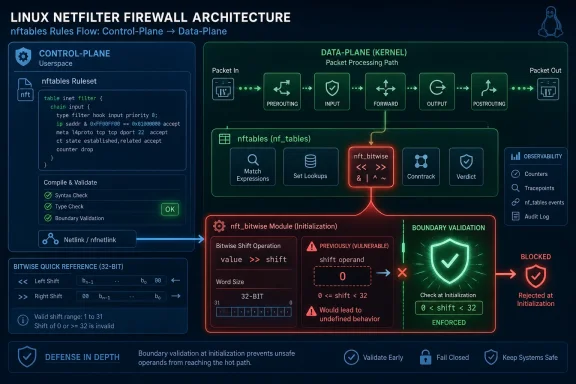
The issue is that nftables accepted a shift operand of zero for left-shift and right-shift expressions during initialization. Later, the packet path’s carry propagation logic computed a value using the width of a 32-bit word minus that shift. When the shift was zero, that calculation became a 32-bit shift on a 32-bit type — undefined behavior in C.
Undefined behavior is not “the system will definitely crash.” It is worse in a subtler way: the language gives the compiler permission to assume that situation never happens. Once that assumption leaks into optimized kernel code, the resulting behavior can become architecture-dependent, compiler-dependent, build-dependent, and very hard to reason about after the fact.
The fix rejects zero as an invalid shift count at rule initialization time, alongside the existing check that already rejected values greater than or equal to 32. In other words, the kernel now says what the code clearly meant all along: valid shift counts for this path are 1 through 31, not 0 through 31.
nftables is both a firewall configuration system and a programming interface into the kernel. User space sends rules to the kernel over netlink. Those rules are parsed, validated, stored, and later executed against packets. That makes the control plane — the moment when a rule is accepted — just as important as the packet path where the rule eventually runs.
CVE-2026-46101 is therefore not merely about one bad arithmetic edge case. It is about whether a kernel subsystem trusts its configuration language too much. If malformed bytecode-like rules can be admitted, the packet path inherits the burden of defending itself against states it should never have had to encounter.
That is the architectural significance of the patch. It does not add elaborate runtime checks around every packet. It stops malformed rules before they become live kernel objects. That is the right place to win this class of fight, because the packet path is performance-sensitive and relentlessly exercised.
For admins, the practical translation is simple: the vulnerable condition is created through rule construction, not ordinary network traffic. A random packet on the internet should not be able to manufacture this state by itself. But any local actor, management plane, container orchestration layer, firewall automation tool, or compromised service with the ability to load nftables rules becomes part of the threat model.
In C, shifting by the width of the type is undefined. On one CPU or compiler build, it may appear to do something predictable. On another, it may be optimized away under assumptions that make sense to the compiler but not to a human reading the firewall rule. In kernel space, the distance between “strange arithmetic” and “security boundary violated” depends on surrounding code, reachable states, privileges needed to trigger the path, and whether a reliable exploit primitive exists.
The current public record for CVE-2026-46101 does not establish those exploit details. NVD has not scored it. The kernel commit language describes malformed rules reaching the packet path, not attackers gaining root. That distinction matters. Overstating every kernel CVE trains users to ignore the next one.
But understating it would also be wrong. Kernel firewall code is privileged code. It handles attacker-controlled packets after being programmed by policy-controlled rules. And nftables has had enough historically interesting bugs that security teams should treat validation failures in this area with respect, even when the patch itself looks trivial.
The better reading is that this is a hardening-as-vulnerability-fix case. The kernel accepted an impossible value, then relied on later code whose arithmetic did not tolerate that value. The patch collapses that impossible state at the edge of the subsystem.
That sounds almost comically small, but small security patches can be the most revealing. Large rewrites often hide root causes beneath refactoring. Here, the root cause is visible: the lower bound was missing.
The patch also shows the kernel community’s bias toward rejecting invalid states early. Instead of trying to special-case a zero shift in the packet path, the fix treats a zero shift operand as malformed rule input. That preserves the assumption that execution-time code only receives meaningful shift operations.
This is not merely tidy engineering. In packet filtering, tiny hot-path branches matter. Every additional runtime check sits on a road that may be traveled millions of times per second. Moving validation to initialization keeps the runtime path simpler and reduces the chance that different packet paths handle the same malformed state differently.
It also improves failure semantics. A bad rule now receives an error when it is loaded. That is visible to the operator or automation system. Silent acceptance followed by undefined behavior during packet handling is the worst of both worlds: the configuration appears valid, but the runtime semantics are unstable.
The kernel receives nftables rules as structured netlink messages. Tools generate those messages. Container systems, VPN managers, orchestration agents, and firewall daemons may all touch the ruleset. In a modern Linux environment, the entity programming netfilter is not always a human administrator with a shell prompt.
That makes input validation in nftables especially important. The kernel cannot assume that user space tooling will only generate semantically clean rules. It must assume buggy generators, version skew, hostile local users where permissions allow rule manipulation, and compromised management services.
The CVE’s wording is notable because it talks about rejecting malformed rules “in the control plane.” That phrase matters. The control plane is the machinery that defines what the data plane will later do. If the control plane accepts nonsense, the data plane becomes an unwilling experiment.
For Windows-heavy shops that also run Linux-based appliances, that distinction should feel familiar. It is the same reason Group Policy validation, MDM profile validation, firewall rule validation, and hypervisor policy validation matter. A policy engine is only safe if invalid policy cannot become executable policy.
This is where mature patch management beats score chasing. A missing CVSS score is not a declaration of safety. It is a declaration that the public scoring process is incomplete.
At the same time, there is no reason to invent a crisis where the available facts do not support one. The public description points to malformed nftables rules causing undefined behavior, not to unauthenticated remote exploitation. The operational priority depends on whether affected systems allow untrusted or semi-trusted actors to create nftables rules.
A single-user desktop with no containers and a locked-down firewall stack is not in the same category as a multi-tenant Linux host, a Kubernetes worker, a VPN concentrator, or a network appliance with exposed management surfaces. The kernel bug is the same; the realistic path to triggering it is not.
That difference should guide maintenance windows. Internet-facing Linux firewalls, container hosts, and systems where automation modifies nftables deserve faster attention. Low-risk lab systems can follow the normal kernel update cadence, provided they are not quietly serving as shared infrastructure.
That points toward a local or management-plane trigger. Someone or something must be able to load the malformed nftables expression. On most traditional systems, that requires administrative privileges or a service already entrusted with firewall control.
But modern Linux complicates the word “local.” Containers, namespaces, delegated networking, orchestration agents, and appliance UIs can create paths where netfilter programming is mediated by software rather than performed directly by a root shell. If a compromised component has enough privilege to alter nftables, it may be able to reach bugs that ordinary users cannot.
That does not automatically make the CVE high severity. A vulnerability that requires firewall-management privileges may be post-compromise hardening material rather than an initial access vector. But it still matters because kernel bugs are often valuable in chains. Attackers rarely complain when a second bug turns limited control into broader instability or privilege.
The conservative enterprise view is therefore straightforward: do not treat this as a remotely exploitable firewall bypass without evidence, but do not dismiss it because the trigger is “only” malformed configuration. In 2026, malformed configuration is often generated by software running at scale.
Stable backports are one of the Linux kernel’s most important security signals. They do not always map neatly to CVSS severity, and they are not always labeled with dramatic advisories. But when a patch is marked for stable, downstream distributions and vendors have a path to pick it up for supported kernels.
For administrators, that means the next step is not to cherry-pick git commits from kernel.org onto production machines. The next step is to track the kernel packages from your distribution, appliance vendor, cloud image provider, or managed Kubernetes platform. Those parties may backport the fix without changing the visible kernel version in the way upstream users expect.
This distinction matters because Linux version strings can mislead. Enterprise distributions often maintain older long-term kernels with large backport sets. A system reporting an older base kernel may already contain the fix, while a custom-built or vendor-delayed kernel with a newer-looking version may not.
The right question is not “am I on mainline version X?” The right question is “does my vendor’s kernel include the nft_bitwise zero-shift rejection patch?” That is the kind of boring inventory question that prevents noisy CVEs from becoming late-night incident calls.
Even in Microsoft-centric shops, Linux kernel exposure arrives through Azure images, Kubernetes nodes, WSL development machines, third-party appliances, and security products built on Linux. The Windows admin who never logs into a Linux desktop may still be responsible for business services whose packet filtering depends on netfilter.
That makes CVE-2026-46101 part of the broader operational convergence story. The security boundary is no longer “Windows patching on Tuesday, Linux patching whenever the platform team gets around to it.” Attackers, auditors, and outages do not respect that organizational chart.
This is especially true for nftables because it often sits beneath higher-level platforms. A Kubernetes network policy may eventually become kernel packet filtering state. A firewall appliance rule may become nftables expressions. A cloud-init script or configuration management run may manipulate the ruleset without exposing nft syntax to the operator.
The lesson for Windows-first teams is not to become kernel developers overnight. It is to know which Linux kernels protect the Windows estate indirectly. A bug in a Linux firewall can affect availability, segmentation, and incident response even when every domain controller is fully patched.
That creates a mismatch. The people who can understand “zero shift operand causes undefined behavior in carry propagation” are not always the people running the patch SLA dashboard. The people running the dashboard may see “N/A” severity and wait. The people defending the network may see “netfilter” and worry. Both reactions are incomplete.
Kernel CVEs are particularly awkward because the same upstream flaw can have wildly different operational consequences. A desktop, a router, a container host, and a multi-tenant cloud node may all include the vulnerable code, but only some expose a plausible trigger to untrusted actors.
The better triage model starts with capability. Who can create nftables rules on the system? Which services do so automatically? Are there containers or namespaces with delegated network administration? Is the host internet-facing? Is it part of a security boundary between trust zones? Is the kernel vendor already shipping the patch?
Those questions do more useful work than waiting for a single score. CVSS is helpful, but it is not a substitute for architecture.
Netlink-based APIs are powerful, but power brings parser risk. The kernel must decode structured messages from user space and turn them into internal objects. Every missing range check becomes a possible undefined state. Every “that should never happen” assumption becomes a future patch note.
nftables is a particularly rich target for this kind of scrutiny because it is expressive. Expressive policy languages are useful precisely because they let administrators describe complex behavior. But expressiveness expands the validation surface. A firewall rule language with registers, expressions, sets, maps, payload extraction, and bitwise operations is not just a list of ports.
This is where old lessons from compiler design meet firewall engineering. If the kernel accepts a rule, it is effectively accepting a tiny program to be executed later against packets. Tiny programs need type checks, range checks, and semantic validation before they run.
CVE-2026-46101 is a reminder that the simplest semantic rule — a shift count must be within the meaningful range — still matters. Especially in C. Especially in the kernel.
That vendor layer is where many organizations will either handle the CVE cleanly or lose visibility. A server team may patch Ubuntu, Debian, Fedora, RHEL, SUSE, or Arch quickly, while a firewall appliance or NAS device remains opaque. A cloud provider may update managed nodes on one schedule while customer-managed images remain the customer’s problem.
This is why vulnerability scanners often produce conflicting answers for kernel issues. They may inspect package versions, kernel build strings, backport metadata, or CVE feeds. If the distribution backported the fix without bumping to an upstream version that the scanner recognizes, false positives are possible. If a vendor failed to document the backport, false negatives are possible too.
For high-value systems, the cleanest evidence is vendor advisory language or package changelog confirmation. If neither exists, administrators may need to consult distribution security trackers or test whether the relevant patch is present in the kernel source package. That is not glamorous work, but it is how kernel CVEs are actually closed in regulated environments.
The broader point is that upstream Linux security is only half the story. The other half is the supply chain that turns upstream commits into kernels actually booted on production machines.
Still, the blast radius can be wide because nftables is now common infrastructure. Even if exploitation requires elevated local or management-plane access, the affected hosts may include the very machines that enforce network segmentation. A fault in a firewall subsystem deserves more caution than the same class of fault in a rarely loaded driver.
There is also an availability angle. Undefined behavior in packet-processing code can manifest as crashes or erratic behavior depending on build and runtime conditions. Even without a public exploit, a malformed rule that destabilizes a packet path is operationally relevant. Firewalls failing closed can interrupt service; firewalls failing open can erode segmentation; firewalls behaving inconsistently can waste days of troubleshooting.
At the same time, administrators should resist theatrical mitigations. Disabling nftables wholesale is not a serious option for most systems and may break firewalling in ways that create greater risk. The sane response is patching, inventory, and permission review.
Permission review is the part that often gets skipped. If too many services can manipulate nftables, this CVE is a prompt to reduce that set. Least privilege around firewall control is not just a compliance phrase; it limits who can reach kernel parsing and rule-initialization code in the first place.
That is not a criticism. It is a defense of boring security engineering. The kernel cannot become safe only through heroic mitigations after dangerous states already exist. It becomes safer when subsystems define valid input precisely and reject everything else.
For nftables, that means rule initialization must be strict. A malformed expression should fail before packets ever see it. A control-plane error is visible, recoverable, and debuggable. A data-plane undefined behavior path is none of those things.
This distinction also matters for performance. Firewall code lives where latency and throughput concerns are real. Validation work belongs where configurations are loaded, not where every packet is processed. The patch aligns with that principle.
The fact that the diff is small should reassure rather than diminish the fix. A narrow bug with a narrow validation correction is exactly what maintainers and operators should want.
nft_bitwise packet-processing path. The fix is tiny, but the lesson is not. A three-line validation change tells a larger story about how modern kernels are increasingly defended not only by memory safety work, but by a more mundane discipline: refusing impossible input before it reaches code that was never meant to reason about it.
 A Small Kernel Patch Exposes a Big Boundary Problem
The vulnerability sits in netfilter, the Linux kernel’s long-running packet filtering and network translation framework. More specifically, it affects nftables, the newer ruleset infrastructure that has steadily displaced iptables across distributions, firewalls, containers, and appliance-like Linux deployments. The bug concerns nft_bitwise, an expression module used to perform bitwise operations inside nftables rules.On paper, CVE-2026-46101 is not the kind of bug that makes executives clear their calendars. NVD has not yet assigned a CVSS score, the record is still marked as awaiting enrichment, and the published description does not claim remote code execution, privilege escalation, or active exploitation. But kernel security does not begin and end with the marketing category attached to a CVE.
The issue is that nftables accepted a shift operand of zero for left-shift and right-shift expressions during initialization. Later, the packet path’s carry propagation logic computed a value using the width of a 32-bit word minus that shift. When the shift was zero, that calculation became a 32-bit shift on a 32-bit type — undefined behavior in C.
Undefined behavior is not “the system will definitely crash.” It is worse in a subtler way: the language gives the compiler permission to assume that situation never happens. Once that assumption leaks into optimized kernel code, the resulting behavior can become architecture-dependent, compiler-dependent, build-dependent, and very hard to reason about after the fact.
The fix rejects zero as an invalid shift count at rule initialization time, alongside the existing check that already rejected values greater than or equal to 32. In other words, the kernel now says what the code clearly meant all along: valid shift counts for this path are 1 through 31, not 0 through 31.
The Firewall Is Also a Kernel Programming Interface
For many WindowsForum readers, the first instinct may be to file this under “Linux firewall internals” and move on. That would be a mistake, especially in 2026. Linux netfilter is no longer just the thing running on a hand-built router under someone’s desk; it is the substrate for cloud firewalls, container networking, Kubernetes nodes, home lab gateways, NAS boxes, VPN endpoints, WSL-adjacent development stacks, and security appliances that advertise themselves at a much higher level than “Linux box with nftables rules.”nftables is both a firewall configuration system and a programming interface into the kernel. User space sends rules to the kernel over netlink. Those rules are parsed, validated, stored, and later executed against packets. That makes the control plane — the moment when a rule is accepted — just as important as the packet path where the rule eventually runs.
CVE-2026-46101 is therefore not merely about one bad arithmetic edge case. It is about whether a kernel subsystem trusts its configuration language too much. If malformed bytecode-like rules can be admitted, the packet path inherits the burden of defending itself against states it should never have had to encounter.
That is the architectural significance of the patch. It does not add elaborate runtime checks around every packet. It stops malformed rules before they become live kernel objects. That is the right place to win this class of fight, because the packet path is performance-sensitive and relentlessly exercised.
For admins, the practical translation is simple: the vulnerable condition is created through rule construction, not ordinary network traffic. A random packet on the internet should not be able to manufacture this state by itself. But any local actor, management plane, container orchestration layer, firewall automation tool, or compromised service with the ability to load nftables rules becomes part of the threat model.
Undefined Behavior Is a Security Smell, Not a Severity Rating
The phrase “undefined behavior” often causes severity whiplash. Developers know it can be serious; security scanners know it sounds serious; operators want to know whether they need to patch tonight. The honest answer is that undefined behavior is a security smell rather than a complete impact statement.In C, shifting by the width of the type is undefined. On one CPU or compiler build, it may appear to do something predictable. On another, it may be optimized away under assumptions that make sense to the compiler but not to a human reading the firewall rule. In kernel space, the distance between “strange arithmetic” and “security boundary violated” depends on surrounding code, reachable states, privileges needed to trigger the path, and whether a reliable exploit primitive exists.
The current public record for CVE-2026-46101 does not establish those exploit details. NVD has not scored it. The kernel commit language describes malformed rules reaching the packet path, not attackers gaining root. That distinction matters. Overstating every kernel CVE trains users to ignore the next one.
But understating it would also be wrong. Kernel firewall code is privileged code. It handles attacker-controlled packets after being programmed by policy-controlled rules. And nftables has had enough historically interesting bugs that security teams should treat validation failures in this area with respect, even when the patch itself looks trivial.
The better reading is that this is a hardening-as-vulnerability-fix case. The kernel accepted an impossible value, then relied on later code whose arithmetic did not tolerate that value. The patch collapses that impossible state at the edge of the subsystem.
The Three-Line Fix Is the Point
The patch changes the initialization check innft_bitwise.c so that a zero shift count fails validation. Previously, the code rejected shift counts greater than or equal to the number of bits in a 32-bit word. Now it rejects both zero and counts at or above that threshold.That sounds almost comically small, but small security patches can be the most revealing. Large rewrites often hide root causes beneath refactoring. Here, the root cause is visible: the lower bound was missing.
The patch also shows the kernel community’s bias toward rejecting invalid states early. Instead of trying to special-case a zero shift in the packet path, the fix treats a zero shift operand as malformed rule input. That preserves the assumption that execution-time code only receives meaningful shift operations.
This is not merely tidy engineering. In packet filtering, tiny hot-path branches matter. Every additional runtime check sits on a road that may be traveled millions of times per second. Moving validation to initialization keeps the runtime path simpler and reduces the chance that different packet paths handle the same malformed state differently.
It also improves failure semantics. A bad rule now receives an error when it is loaded. That is visible to the operator or automation system. Silent acceptance followed by undefined behavior during packet handling is the worst of both worlds: the configuration appears valid, but the runtime semantics are unstable.
nftables Has Become Infrastructure, Not Just a Command
The industry’s nftables transition has been gradual enough that some admins still think of it as a distro plumbing detail. On many systems, users interact with a higher-level firewall front end and never typenft directly. That abstraction is convenient, but it can obscure the importance of nftables correctness.The kernel receives nftables rules as structured netlink messages. Tools generate those messages. Container systems, VPN managers, orchestration agents, and firewall daemons may all touch the ruleset. In a modern Linux environment, the entity programming netfilter is not always a human administrator with a shell prompt.
That makes input validation in nftables especially important. The kernel cannot assume that user space tooling will only generate semantically clean rules. It must assume buggy generators, version skew, hostile local users where permissions allow rule manipulation, and compromised management services.
The CVE’s wording is notable because it talks about rejecting malformed rules “in the control plane.” That phrase matters. The control plane is the machinery that defines what the data plane will later do. If the control plane accepts nonsense, the data plane becomes an unwilling experiment.
For Windows-heavy shops that also run Linux-based appliances, that distinction should feel familiar. It is the same reason Group Policy validation, MDM profile validation, firewall rule validation, and hypervisor policy validation matter. A policy engine is only safe if invalid policy cannot become executable policy.
The Missing CVSS Score Should Slow Panic, Not Patching
NVD’s record for CVE-2026-46101 is still awaiting enrichment, and no NIST CVSS vector has been published as of the record’s initial appearance. That leaves security dashboards in an awkward place. Some tools will ingest the CVE but cannot rank it cleanly. Others may assign vendor-specific or heuristic severity. Still others may bury it until a distribution advisory gives it color.This is where mature patch management beats score chasing. A missing CVSS score is not a declaration of safety. It is a declaration that the public scoring process is incomplete.
At the same time, there is no reason to invent a crisis where the available facts do not support one. The public description points to malformed nftables rules causing undefined behavior, not to unauthenticated remote exploitation. The operational priority depends on whether affected systems allow untrusted or semi-trusted actors to create nftables rules.
A single-user desktop with no containers and a locked-down firewall stack is not in the same category as a multi-tenant Linux host, a Kubernetes worker, a VPN concentrator, or a network appliance with exposed management surfaces. The kernel bug is the same; the realistic path to triggering it is not.
That difference should guide maintenance windows. Internet-facing Linux firewalls, container hosts, and systems where automation modifies nftables deserve faster attention. Low-risk lab systems can follow the normal kernel update cadence, provided they are not quietly serving as shared infrastructure.
The Local Boundary Is Where This Gets Interesting
The natural question for any netfilter bug is whether a packet can trigger it remotely. Based on the public description, CVE-2026-46101 is not framed that way. The malformed state comes from a rule containing a zero shift operand, and the fix prevents such a rule from being initialized.That points toward a local or management-plane trigger. Someone or something must be able to load the malformed nftables expression. On most traditional systems, that requires administrative privileges or a service already entrusted with firewall control.
But modern Linux complicates the word “local.” Containers, namespaces, delegated networking, orchestration agents, and appliance UIs can create paths where netfilter programming is mediated by software rather than performed directly by a root shell. If a compromised component has enough privilege to alter nftables, it may be able to reach bugs that ordinary users cannot.
That does not automatically make the CVE high severity. A vulnerability that requires firewall-management privileges may be post-compromise hardening material rather than an initial access vector. But it still matters because kernel bugs are often valuable in chains. Attackers rarely complain when a second bug turns limited control into broader instability or privilege.
The conservative enterprise view is therefore straightforward: do not treat this as a remotely exploitable firewall bypass without evidence, but do not dismiss it because the trigger is “only” malformed configuration. In 2026, malformed configuration is often generated by software running at scale.
Stable Backports Show the Kernel Treats It as Worth Shipping
The references attached to the CVE point to multiple stable kernel commits, and the stable mailing list carried the patch as part of a 6.18 stable review series in early May 2026. That tells us the maintainers did not regard this as a theoretical cleanup suitable only for a future development branch. They sent it back through maintained stable lines.Stable backports are one of the Linux kernel’s most important security signals. They do not always map neatly to CVSS severity, and they are not always labeled with dramatic advisories. But when a patch is marked for stable, downstream distributions and vendors have a path to pick it up for supported kernels.
For administrators, that means the next step is not to cherry-pick git commits from kernel.org onto production machines. The next step is to track the kernel packages from your distribution, appliance vendor, cloud image provider, or managed Kubernetes platform. Those parties may backport the fix without changing the visible kernel version in the way upstream users expect.
This distinction matters because Linux version strings can mislead. Enterprise distributions often maintain older long-term kernels with large backport sets. A system reporting an older base kernel may already contain the fix, while a custom-built or vendor-delayed kernel with a newer-looking version may not.
The right question is not “am I on mainline version X?” The right question is “does my vendor’s kernel include the nft_bitwise zero-shift rejection patch?” That is the kind of boring inventory question that prevents noisy CVEs from becoming late-night incident calls.
Why Windows Admins Should Care About a Linux Firewall Bug
WindowsForum.com is not a Linux-only publication, and that is exactly why this CVE deserves attention here. Most Windows environments are hybrid whether they admit it or not. Linux runs the reverse proxies, the VPN gateways, the NAS appliances, the container hosts, the CI runners, the monitoring stack, the security tooling, and increasingly the network edge.Even in Microsoft-centric shops, Linux kernel exposure arrives through Azure images, Kubernetes nodes, WSL development machines, third-party appliances, and security products built on Linux. The Windows admin who never logs into a Linux desktop may still be responsible for business services whose packet filtering depends on netfilter.
That makes CVE-2026-46101 part of the broader operational convergence story. The security boundary is no longer “Windows patching on Tuesday, Linux patching whenever the platform team gets around to it.” Attackers, auditors, and outages do not respect that organizational chart.
This is especially true for nftables because it often sits beneath higher-level platforms. A Kubernetes network policy may eventually become kernel packet filtering state. A firewall appliance rule may become nftables expressions. A cloud-init script or configuration management run may manipulate the ruleset without exposing nft syntax to the operator.
The lesson for Windows-first teams is not to become kernel developers overnight. It is to know which Linux kernels protect the Windows estate indirectly. A bug in a Linux firewall can affect availability, segmentation, and incident response even when every domain controller is fully patched.
The Security Industry Still Struggles With Kernel CVE Triage
CVE-2026-46101 also illustrates a recurring weakness in vulnerability management. The public record contains a precise technical fix but lacks an immediate severity score. Many organizations are better at responding to colored boxes than to engineering descriptions.That creates a mismatch. The people who can understand “zero shift operand causes undefined behavior in carry propagation” are not always the people running the patch SLA dashboard. The people running the dashboard may see “N/A” severity and wait. The people defending the network may see “netfilter” and worry. Both reactions are incomplete.
Kernel CVEs are particularly awkward because the same upstream flaw can have wildly different operational consequences. A desktop, a router, a container host, and a multi-tenant cloud node may all include the vulnerable code, but only some expose a plausible trigger to untrusted actors.
The better triage model starts with capability. Who can create nftables rules on the system? Which services do so automatically? Are there containers or namespaces with delegated network administration? Is the host internet-facing? Is it part of a security boundary between trust zones? Is the kernel vendor already shipping the patch?
Those questions do more useful work than waiting for a single score. CVSS is helpful, but it is not a substitute for architecture.
The Patch Belongs to a Larger Cleanup Pattern
The most interesting part of this CVE is not the arithmetic. It is the pattern: reject invalid kernel-facing inputs earlier, more consistently, and closer to the control plane. That pattern has become increasingly visible across kernel subsystems.Netlink-based APIs are powerful, but power brings parser risk. The kernel must decode structured messages from user space and turn them into internal objects. Every missing range check becomes a possible undefined state. Every “that should never happen” assumption becomes a future patch note.
nftables is a particularly rich target for this kind of scrutiny because it is expressive. Expressive policy languages are useful precisely because they let administrators describe complex behavior. But expressiveness expands the validation surface. A firewall rule language with registers, expressions, sets, maps, payload extraction, and bitwise operations is not just a list of ports.
This is where old lessons from compiler design meet firewall engineering. If the kernel accepts a rule, it is effectively accepting a tiny program to be executed later against packets. Tiny programs need type checks, range checks, and semantic validation before they run.
CVE-2026-46101 is a reminder that the simplest semantic rule — a shift count must be within the meaningful range — still matters. Especially in C. Especially in the kernel.
Vendors Will Decide How Visible This Becomes
Because the upstream fix is already identifiable, the next phase belongs to distributions and vendors. Some will issue security advisories. Some will silently include the fix in routine kernel updates. Some appliance vendors will lag, especially if their products pin older kernels or heavily patch netfilter internals.That vendor layer is where many organizations will either handle the CVE cleanly or lose visibility. A server team may patch Ubuntu, Debian, Fedora, RHEL, SUSE, or Arch quickly, while a firewall appliance or NAS device remains opaque. A cloud provider may update managed nodes on one schedule while customer-managed images remain the customer’s problem.
This is why vulnerability scanners often produce conflicting answers for kernel issues. They may inspect package versions, kernel build strings, backport metadata, or CVE feeds. If the distribution backported the fix without bumping to an upstream version that the scanner recognizes, false positives are possible. If a vendor failed to document the backport, false negatives are possible too.
For high-value systems, the cleanest evidence is vendor advisory language or package changelog confirmation. If neither exists, administrators may need to consult distribution security trackers or test whether the relevant patch is present in the kernel source package. That is not glamorous work, but it is how kernel CVEs are actually closed in regulated environments.
The broader point is that upstream Linux security is only half the story. The other half is the supply chain that turns upstream commits into kernels actually booted on production machines.
The Practical Risk Is Narrow, but the Blast Radius Can Be Wide
The most likely affected systems are those with nftables support and kernels containing the vulnerablenft_bitwise shift handling. The mere presence of netfilter does not mean every system is equally exposed. The ability to load nftables rules remains the key precondition.Still, the blast radius can be wide because nftables is now common infrastructure. Even if exploitation requires elevated local or management-plane access, the affected hosts may include the very machines that enforce network segmentation. A fault in a firewall subsystem deserves more caution than the same class of fault in a rarely loaded driver.
There is also an availability angle. Undefined behavior in packet-processing code can manifest as crashes or erratic behavior depending on build and runtime conditions. Even without a public exploit, a malformed rule that destabilizes a packet path is operationally relevant. Firewalls failing closed can interrupt service; firewalls failing open can erode segmentation; firewalls behaving inconsistently can waste days of troubleshooting.
At the same time, administrators should resist theatrical mitigations. Disabling nftables wholesale is not a serious option for most systems and may break firewalling in ways that create greater risk. The sane response is patching, inventory, and permission review.
Permission review is the part that often gets skipped. If too many services can manipulate nftables, this CVE is a prompt to reduce that set. Least privilege around firewall control is not just a compliance phrase; it limits who can reach kernel parsing and rule-initialization code in the first place.
The Real Fix Is Boring, Which Is Why It Will Work
The best security patches often feel anticlimactic. This one does not introduce a new mitigation framework, rewrite nftables in a memory-safe language, or add a dramatic exploit detector. It rejects a value that should never have been accepted.That is not a criticism. It is a defense of boring security engineering. The kernel cannot become safe only through heroic mitigations after dangerous states already exist. It becomes safer when subsystems define valid input precisely and reject everything else.
For nftables, that means rule initialization must be strict. A malformed expression should fail before packets ever see it. A control-plane error is visible, recoverable, and debuggable. A data-plane undefined behavior path is none of those things.
This distinction also matters for performance. Firewall code lives where latency and throughput concerns are real. Validation work belongs where configurations are loaded, not where every packet is processed. The patch aligns with that principle.
The fact that the diff is small should reassure rather than diminish the fix. A narrow bug with a narrow validation correction is exactly what maintainers and operators should want.
The Zero-Shift CVE Gives Admins a Short, Concrete Checklist
CVE-2026-46101 is not a reason to panic, but it is a reason to make sure the Linux systems enforcing your network rules are receiving timely kernel maintenance. The absence of an NVD score should not freeze action, and the absence of public exploitation should not turn into complacency.- Systems that allow untrusted users, containers, orchestration agents, or appliance management layers to alter nftables rules should receive priority review.
- Distribution and vendor kernel updates are the preferred remediation path, because enterprise kernels often carry backported fixes without obvious upstream version changes.
- Security teams should verify whether internet-facing firewalls, VPN gateways, Kubernetes nodes, and Linux-based network appliances include the zero-shift validation patch.
- Organizations should review which services and automation accounts can modify nftables rules, because firewall-control permissions are also kernel attack-surface permissions.
- Scanners may lag or disagree until NVD enrichment and vendor advisories mature, so package changelogs and vendor security trackers matter more than the CVSS field alone.
References
- Primary source: NVD / Linux Kernel
Published: 2026-05-28T01:09:29-07:00
NVD - CVE-2026-46101
 nvd.nist.gov
- Security advisory: MSRC
Published: 2026-05-28T01:09:29-07:00
Original feed URL
Security Update Guide - Microsoft Security Response Center
 msrc.microsoft.com
- Related coverage: cateee.net
- Related coverage: kernel.googlesource.com
- Related coverage: netfilter.org
- Related coverage: lkml.indiana.edu

- Related coverage: workshop.netfilter.org
