

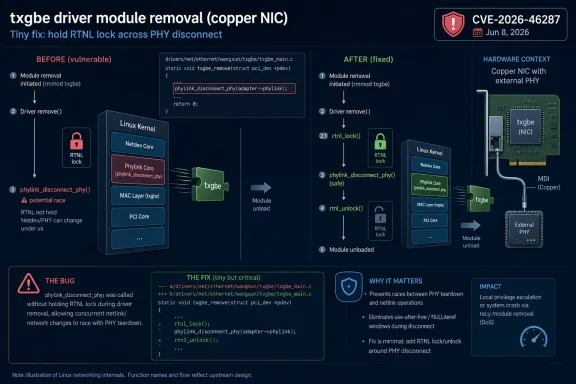
phylink_disconnect_phy() and release it afterward. But the lesson is larger than the patch. Modern kernel security bookkeeping now turns even narrowly scoped teardown warnings into CVEs, and administrators have to learn how to separate a real operational signal from the noise of vulnerability inflation.
A One-Line Locking Fix Becomes a Security Record
The affected code path lives in the Linux networking stack, not in a flashy browser sandbox or authentication layer. The txgbe driver supports Wangxun 10GbE-class network hardware, and the reported failure occurs during module removal, when a system unloads the driver and disconnects the PHY through the phylink subsystem.
That matters because the bug is not described as a remote packet-triggered compromise. The report centers on a warning emitted during rmmod, the administrative act of removing a loaded kernel module. The trace shows rmmod as the command, phylink_disconnect_phy() as the warning site, and txgbe_remove_phy() as the driver path that got there without the expected lock held.
In kernel terms, this is an assertion about state discipline. The RTNL lock is one of the big serialization mechanisms in Linux networking, and phylink expects certain operations to happen while that lock is held. When the txgbe remove path called into phylink without it, the kernel complained loudly.
The fix is therefore not a redesign of the driver, not a mitigation against a known exploit chain, and not a patch for a memory corruption primitive. It is a correctness patch that wraps the disconnect operation with rtnl_lock() and rtnl_unlock(). That does not make it irrelevant, but it does make it the sort of CVE that needs careful reading before anyone starts rewriting firewall policy.
The Kernel’s New CVE Pipeline Rewards Specificity Over Drama
The most important context is that many Linux kernel CVEs now read like commit messages because, in practice, they often are. The kernel project has increasingly mapped bug fixes to vulnerability identifiers when a flaw can have a security impact or cannot be confidently proven harmless across all supported configurations.
That is a defensible policy from a maintenance perspective. The Linux kernel runs everywhere, from cloud servers and storage appliances to embedded network boxes and enthusiast workstations. A bug that looks like a warning on one machine may be a crash, denial of service, or reliability problem somewhere else, especially if it lands in a driver stack touched by hotplug, module lifecycle, or device reset paths.
But it also shifts work onto readers. A CVE ID no longer guarantees that a vulnerability has a mature exploit narrative, a polished severity score, or a widely applicable attack model. CVE-2026-46287 arrived in NVD without NIST-provided CVSS 4.0, 3.x, or 2.0 scoring, which is an important signal: the vulnerability record exists, but the public severity enrichment had not yet caught up at publication time.
That gap is not merely bureaucratic. Security teams often ingest CVEs through scanners that flatten nuance into red, amber, and green dashboards. A newly published kernel CVE with no score can still become a ticket, an exception request, or an emergency Slack thread, even when the underlying bug is a narrow driver teardown warning.
The Trigger Is Administrative, Not Ambient
The call trace tells a plain story. The system was running a 7.0.0 release-candidate kernel, the process was rmmod, and the warning fired while unloading the txgbe module. That makes the most obvious trigger local and privileged: someone or something is removing a network driver module.
This distinction matters for WindowsForum readers who manage mixed environments and have learned to treat “network driver vulnerability” as a phrase that can imply remote exposure. In this case, the available description does not support that assumption. The described action is module removal, not traffic reception, link negotiation from an attacker-controlled peer, or malformed frame processing.
That does not reduce the issue to trivia. Kernel warnings can be disruptive in production when they trip panic-on-warn policies, pollute crash telemetry, or complicate postmortems. In hardened environments, a warning that would be harmless on a lab workstation may become a forced reboot or an availability event.
Still, there is a difference between “a remote attacker can take over your host by sending packets” and “a specific driver removal path violates an internal locking expectation.” CVE-2026-46287 belongs, based on the public record, much closer to the second category.
Why RTNL Still Matters in 2026
The RTNL lock is one of those old kernel mechanisms that rarely appears in user-facing release notes but sits under a great deal of network device behavior. Network interface registration, link state changes, address list updates, and driver teardown all intersect with shared kernel structures. Without serialization, those paths can race in subtle and ugly ways.
Phylink adds another layer. It abstracts the relationship between MAC drivers and PHY devices, especially in systems where link negotiation, SFP cages, copper PHYs, and MAC capabilities have to cooperate. It gives driver authors a common framework, but it also imposes rules about when callers must hold locks.
The txgbe bug is therefore best understood as a contract violation. The driver connected the PHY during probe and disconnected it during removal, which is normal enough. The problem was that the disconnect half did not satisfy phylink’s locking precondition.
The warning is the kernel saying, in effect, “you may be getting away with this today, but this path is not serialized the way the networking core expects.” That kind of complaint is exactly what maintainers want fixed before it becomes a rare race that only reproduces on a customer’s appliance during a midnight maintenance window.
Hardware Specificity Is the Whole Story
The CVE description narrows the affected scenario to copper NICs with an external PHY. That is not a throwaway detail. NIC drivers often support multiple board designs, media types, and PHY arrangements, and not every path is exercised on every card.
A server with a txgbe-supported adapter using the relevant copper/external PHY combination is in the zone of interest. A system with no txgbe hardware is not. A system where the driver is not built, not loaded, or not used is effectively outside the immediate operational blast radius.
This is where generic vulnerability scanners can mislead. They may flag a kernel package because the source tree contains a vulnerable driver, even if the deployed system cannot load it or has no matching PCI device. That does not mean the scanner is “wrong” in the compliance sense, but it does mean administrators should treat the result as an inventory question, not an automatic incident.
The practical first question is not “Have we been hacked?” It is “Do we run kernels containing the affected txgbe code on systems with relevant Wangxun hardware, and do our operations or automation unload that module?” For many fleets, the answer will be no.
Module Removal Is a Strange Place for Risk to Hide
Module removal paths are often less exercised than probe, transmit, receive, or reset paths. A server boots, the driver binds, the interface comes up, and nobody unloads the module until the machine is decommissioned or rebooted. That makes teardown bugs easy to miss.
The irony is that teardown is also where resource ownership must be exact. The driver has to unwind what probe set up, detach from device subsystems, cancel work, release PHY state, and unregister cleanly. If the order or locking is wrong, the problem may surface only when the module is removed under just the right hardware configuration.
That seems to be what happened here. The probe path used phylink to connect the PHY; the remove path used phylink to disconnect it; but the remove path did not hold the RTNL lock when phylink expected it. The kernel warning exposed a mismatch between lifecycle symmetry and locking symmetry.
For administrators, the operational implication is narrow but real. If a host is configured to panic on warnings, a module unload could become a bigger event than expected. If a distribution’s kernel carries the bug and a maintenance tool removes or reloads drivers dynamically, the warning could show up outside a developer’s test bench.
The Absence of a CVSS Score Is Not an All-Clear
NVD’s lack of a score at publication should not be read as proof that the issue is harmless. It means NVD had not yet attached a formal vector and severity. That can happen for newly published records, especially when the source description is technical and narrow.
At the same time, the absence of a score should slow down panic. A useful severity assessment would need to answer several questions the record does not fully settle: whether an unprivileged user can cause the module removal path to run, whether panic-on-warn changes the impact, whether any distributions build the driver in ways that alter exposure, and whether affected hardware appears in remotely managed systems.
Most environments will handle this through normal kernel update channels. The upstream stable commits referenced by the CVE indicate that fixes were propagated into maintained kernel lines. Distribution kernels will then pick up the change according to their own schedules, backport policies, and support matrices.
That cadence is appropriate for a bug like this unless an organization has a special configuration that turns warnings into outages. The exception is not the average Linux desktop. It is the shop with relevant NICs, aggressive kernel hardening, automated module churn, and strict availability requirements.
Windows Admins Should Still Care About Linux Driver CVEs
This is WindowsForum, so it is worth saying the quiet part out loud: a Linux NIC driver CVE can still matter deeply in Windows-centric environments. Hypervisors, storage appliances, routers, Kubernetes nodes, WSL-adjacent developer machines, backup boxes, NAS systems, and security sensors often run Linux underneath workflows that Windows administrators own.
The modern Windows estate is rarely Windows-only. A Microsoft-heavy organization may still have Linux-based edge devices, Proxmox or KVM labs, container hosts, or vendor appliances quietly running commodity kernels. Those systems are where driver CVEs live.
CVE-2026-46287 is not a Windows vulnerability, and it should not be presented to Windows desktop users as one. But it is exactly the kind of issue that can appear in a mixed fleet vulnerability report and land on the desk of someone whose primary tooling is Intune, Defender, SCCM, or a Windows-first SIEM.
The right response is to translate the finding into infrastructure reality. Which assets are Linux? Which kernels do they run? Which NICs are installed? Which modules are loaded? Which systems treat kernel warnings as fatal? That inventory discipline beats headline-driven patch theater every time.
The Patch Is Tiny Because the Contract Was Already Clear
There is a temptation to judge bugs by patch size. A two-line lock wrapper can look too trivial to deserve a CVE, especially beside speculative execution flaws, filesystem privilege escalations, or packet parser memory corruption bugs. That reaction is understandable but incomplete.
Small patches often fix large assumptions. The phylink core was already asserting that callers must hold RTNL in this path. The txgbe driver simply failed to meet that expectation during removal. Once the mismatch was identified, the fix was straightforward.
This is how mature subsystems evolve. The core API expresses invariants, drivers gradually align with them, and warnings catch violations before they become harder-to-debug failures. The security label is almost secondary to the engineering process.
The danger is that the public CVE ecosystem does not always preserve that nuance. It turns a locking invariant into a vulnerability record, then throws that record into the same feeds that carry actively exploited remote code execution bugs. Administrators are left to reconstruct the difference from commit messages and stack traces.
The Real Exposure Is in Automation and Policy
A human administrator manually running rmmod txgbe on a production server is not the most likely everyday scenario. But automation changes the shape of risk. Driver reloads can happen during updates, hardware reprovisioning, troubleshooting scripts, or vendor health-check routines.
Kernel warning policy also matters. Some environments deliberately set panic-on-warn to catch corruption early and fail fast. That can be wise in security-sensitive systems, but it also means warnings become availability events. A warning that merely annoys one admin can reboot another admin’s node.
This is why a narrow driver bug can deserve attention without deserving alarm. If your infrastructure never unloads the module and does not use affected hardware, the practical risk is remote. If you operate appliances or hosts with txgbe-supported copper NICs and strict warning policies, the same bug can interrupt maintenance workflows.
The patch removes the uncertainty by making the remove path obey the locking contract. That is the whole point of stable kernel maintenance: eliminate the edge cases before they become folklore.
Security Teams Need a Better Middle Gear
The industry still struggles with vulnerabilities that are real but not urgent in the dramatic sense. CVE-2026-46287 is a good example of the middle gear security teams need: acknowledge, triage, patch through normal channels, and avoid turning every kernel CVE into a war room.
A sensible triage note would say that the issue affects the Linux txgbe driver in a module removal path for copper NICs with an external PHY, that public scoring was not available at initial NVD publication, and that the known fix is an upstream locking correction. It would then identify whether the organization has affected hardware and whether the relevant module is present or loaded.
That is more useful than simply copying the CVE description into a ticket. It tells operations what to check and tells leadership why the issue is unlikely to resemble a mass-exploitation event. It also leaves room to escalate if a vendor later assigns a higher severity or a distribution advisory identifies broader impact.
The middle gear is especially important now because kernel.org-sourced CVEs arrive in volume. Treating all of them as equal trains teams to ignore the feed. Treating none of them seriously invites the one obscure bug that actually matters to slip through.
The Most Important Facts Fit on One Maintenance Card
CVE-2026-46287 is best handled as a precise maintenance item, not a generalized Linux networking scare. The fix is available upstream, the reported trigger is module removal, and the affected area is specific enough for administrators to verify exposure before disrupting production.
- The vulnerability record was published by NVD on June 8, 2026, with kernel.org as the source.
- The bug is in the Linux txgbe network driver’s remove path when handling copper NICs with an external PHY.
- The observed failure is an RTNL assertion warning in
phylink_disconnect_phy()during module removal. - The upstream fix wraps the phylink disconnect call with
rtnl_lock()andrtnl_unlock(). - NVD had not provided CVSS 4.0, 3.x, or 2.0 scoring at the time reflected in the record.
- The most relevant operational checks are whether affected txgbe hardware exists, whether the driver is loaded, and whether kernel warnings can trigger outages in local policy.
The bigger story is not that a txgbe teardown warning will upend the Linux world. It is that kernel vulnerability management has become a discipline of reading closely, mapping code paths to real assets, and resisting both complacency and dashboard panic. CVE-2026-46287 is a small fix with a useful reminder attached: in 2026, the hard part of patch management is not finding CVEs, but understanding which ones actually touch the machines you run.