

 Overview
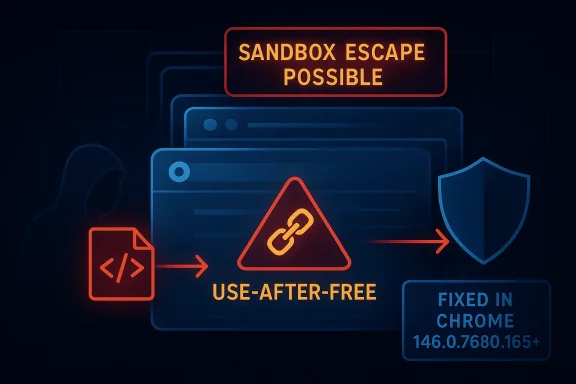
Google’s disclosure of CVE-2026-4676 is a reminder that browser security in 2026 is still defined by speed, scale, and careful operational hygiene rather than by any illusion of “safe browsing.” The flaw is a use-after-free in Dawn, the graphics stack used by Chromium, and it affects Google Chrome versions prior to 146.0.7680.165. According to the official advisory data mirrored in NVD, a remote attacker could potentially trigger a sandbox escape through a crafted HTML page, which is exactly the kind of browser bug that administrators need to treat as urgent rather than routine s://nvd.nist.gov/vuln/detail/CVE-2026-4676))What makes this CVE especially important is not just the technical class of the bug, but the broader security context around it. Google’s stable-channel release cadence in March 2026 has already shown a dense stream of security fixes, and the Chrome team explicitly notes that bug details may remain restricted until most users are updated. That means defenders must act on the version boundary and severity, not wait for a public exploit narrative to become clearer (chromereleases.googleblog.com)
Microsoft’s Security Update Guide has also picked up the vulnerability, which matters because enterprise Windows teams often rely on Microsoft’s vulnerability workflow to track Chromium-based risk across managed fleets. In practical terms, Chrome 146.0.7680.165 or later is the line between vulnerable and patched, and that line now has to be enforced across desktops, remote devices, embedded browsers, and any Chromium-derived software that inherits the same engine risk (nvd.nist.gov)
Background
Chromium’s security story has long been shaped by a simple fact: the modern browser is one of the most complex pieces of software on the desktop. It processes untrusted content from the open web, parses sprawling document trees, juggles rendering and compositing, and mediates increasingly sensitive workflows such as sign-in, federated identity, and sandboxed app execution. That complexity creates a huge attack surface, and memory-safety bugs remain a persistent problem because attackers only need one reachable code path to turn a page load into a compromise.Dawn is a particularly relevant subsystem because it sits in Chromium’s graphics and GPU-related ecosystem, where high-performance code meets attacker-influenced input. Browser graphics stacks are frequently exposed to unusual object lifetimes, asynchronous state transitions, and race-prone ownership models. Those conditions make use-after-free flaws dangerous: the bug may begin as a crash, but with the right heap shaping and reuse patterns it can become a primitive that helps an attacker escape a sandbox or chain into deeper exploitation.
The NVD record for CVE-2026-4676 captures that reality concisely. It describes the issue as a use-after-free in Dawn, remote in nature, reachable via crafted HTML, and serious enough to be categorized by Chromium as High severity. NVD’s enrichment also reflects a CVSS 3.1 vector of 8.8 High from CISA-ADP, underscoring the practical urgency even though NVD has not yet issued its own final scoring (nvd.nist.gov)
March 2026 has been a dense month for Chrome security overall. Google’s release notes show repeated stable-channel updates, including the March 12 desktop update and the March 23 release that introduced the fix for this issue. That cadence matters because it tells administrators something important: Chrome vulnerabilities are not rare one-off events, but part of a continuous hardening cycle where patch timing and rollout speed are central to risk reduction (chromereleases.googleblog.com)
There is also a downstream enterprise angle. Microsoft’s security guidance ecosystem is increasingly used to surface upstream Chromium issues to Windows administrators, especially where Edge, embedded Chromium shells, or third-party desktop applications inherit the same engine lineage. Even when the vulnerability originates in Google Chrome, the operational reality is broader: browser risk travels across vendors, management consoles, and compliance workflows very quickly.
What CVE-2026-4676 Actually Is
At the core, CVE-2026-4676 is a memory lifetime bug. A use-after-free happens when software continues to reference memory after it has already been released, which can allow attacker-influenced reuse of that memory in a way the original code never intended. In a browser, that can be the difference between a harmless crash and a path to reliable exploitation.The important technical point is that this is not a theoretical bug hidden deep in a lab-only code path. The advisory says a remote attacker could potentially perform a sandbox escape via crafted HTML, which implies that ordinary web content can reach the vulnerable path. That is the hallmark of a serious browser issue: the attacker does not need local access, admin privileges, or a special helper app. They just need the victim to load the page (nvd.nist.gov)
Why use-after-free bugs remain dangerous
Use-after-free issues remain high-value because modern browser exploit chains often begin with a memory corruption or memory disclosure primitive. Once freed memory can be reused in a predictable way, attackers may be able to influence object layout, cause the browser to read or write unexpected memory, or create the conditions for a second-stage exploit.- They are often hard to reproduce in ordinary testing.
- They can be triggered by normal-looking web content.
- They frequently sit close to sandbox boundaries.
- They may support information disclosure or code execution chains.
- They are especially valuable when paired with another browser bug.
Why the Sandbox Escape Angle Matters
The phrase sandbox escape changes the severity conversation immediately. A browser sandbox is designed to limit the blast radius of a compromise, but it is not a guarantee that an exploit is harmless. If a remote attacker can first gain execution inside the sandbox and then escape it, the bug becomes far more valuable than an isolated rendering crash.This is why the Chrome advisory language is so significant. It does not merely say the bug could crash the browser or leak data. It says the flaw could potentially permit an escape from the browser’s containment model, which is much closer to a full compromise than a simple renderer issue. That is why defenders tend to prioritize these issues immediately, even before all exploit details are public (nvd.nist.gov)
Why this matters to defenders
Browser sandboxes are one layer in a broader defense-in-depth stack. They do help, but the stack only works if users are on the fixed build and if the browser actually restarts into the patched binary. In enterprise environments, that second part is often the weak link.- A patched installer does not help if the old process is still running.
- A managed endpoint may still be exposed if restart deferrals are allowed.
- Chrome-based apps can lag behind the main browser channel.
- Remote and off-network devices may miss the update window.
- A sandbox escape becomes much more serious when paired with other flaws.
The Release Cadence and Version Boundary
For incident response, the most useful detail in the advisory is the version boundary. Chrome versions prior to 146.0.7680.165 are affected, and Google’s March 23 stable release is the public marker that the fix is available. That means version verification is not an optional housekeeping task; it is the first operational control.Google’s March 12 stable update already showed how the company handles disclosure and propagation. The release notes warn that bug details may remain restricted until most users are protected, and the Chrome team also points users to its security page and bug-filing flow. That pattern is deliberate. It reduces the chance that technical details reach attackers faster than they reach the majority of users (chromereleases.googleblog.com)
Sequential response steps
- Check the installed Chrome version on all managed endpoints.
- Confirm the build is 146.0.7680.165 or later.
- Force a browser restart where policy allows.
- Validate Chromium-based derivatives and embedded browsers.
- Review remote and unmanaged devices that may not follow your normal update cycle.
Enterprise Impact
For enterprises, CVE-2026-4676 is a fleet-management problem as much as it is a browser-security problem. Chrome is not just a browser; it is an access layer for SaaS platforms, identity providers, internal portals, collaboration suites, and administrative consoles. A remotely triggerable browser flaw can therefore become an enterprise incident with very little friction.The Microsoft Security Update Guide entry is important here because it translates an upstream Chromium issue into downstream Windows-administrator language. That helps security teams identify whether their browser estate includes affected Chrome builds, Chromium-based wrappers, or products that embed the same engine and may lag the upstream fix by days or weeks (nvd.nist.gov)
Enterprise-specific exposure points
The highest-risk environments are usually not the most obvious ones. They are the places where browser updates are delayed because users are busy or device control is fragmented.- Shared workstations and kiosks.
- VDI and virtual desktop images.
- Off-network laptops that miss update windows.
- Managed endpoints with long restart deferrals.
- Chromium-based enterprise apps with their own patch cadence.
Why identity and privilege matter
Browser vulnerabilities are especially sensitive on systems used for sign-in and privileged workflows. A flaw in the graphics stack may sound unrelated to identity, but if the browser is the primary entry point for authentication, finance, HR, or admin portals, then compromise of the browser can become compromise of the session.That is why browser patching should be treated like part of endpoint security, not like a cosmetic software update. In many organizations, the browser is the front door.
Consumer Impact
For consumers, the guidance is simpler but no less urgent: update Chrome immediately if your build is older than 146.0.7680.165. The public description says a crafted HTML page could trigger the issue remotely, which means the ordinary browsing experience is sufficient exposure. No special plugin, no local file access, and no unusual setup is required.That is what makes browser flaws so deceptive. A page can look normal while still carrying the sequence that reaches the vulnerable code path. A user does not need to understand Dawn or sandbox internals to be at risk; they only need to click a malicious link or land on a compromised page. That is why normal web hygiene still matters, but timely patching matters more (nvd.nist.gov)
Practical advice for home users
- Open Chrome’s version/about page and confirm the build.
- Let the browser complete the update and restart it.
- Avoid postponing reboots after updates.
- Treat email and messaging links with caution.
- Remove browser extensions you do not trust.
The safest mental model is simple: if the build is old, the browser is vulnerable; if the browser has not restarted, the fix may not be active; and if the browser is Chromium-based, the engine matters more than the logo.
How This Fits Chromium’s March 2026 Security Pattern
CVE-2026-4676 is not an isolated event. It lands in the middle of a broader March 2026 Chrome hardening cycle where multiple security issues were shipped through the stable channel in close succession. Google’s March 12 note and the March 23 release together show a release process built around rapid remediation, partial disclosure, and staged rollout rather than one grand annual patch moment (chromereleases.googleblog.com)That pattern is a strength, but it also creates operational fatigue. When browsers update frequently, organizations can normalize urgency and then miss the moment when a particular issue is worse than the average patch. A sandbox-escape-capable use-after-free is one of those issues.
What the cadence tells us
The release cadence tells us several things at once. First, Google is shipping fixes quickly. Second, attackers know that public patch windows create a short but meaningful exploitation opportunity. Third, enterprises need automation and telemetry, not just good intentions, to keep pace.- Security details may be withheld temporarily.
- Fixed versions arrive in small increments.
- Administrators must track exact build numbers.
- Downstream products may lag upstream Chrome.
- The patch window is measured in days, not months.
Why Dawn Is a Sensitive Subsystem
Dawn is part of Chromium’s GPU and graphics ecosystem, which is exactly where browser security often gets tricky. Graphics code has to handle high-throughput, low-latency workflows while still parsing and transforming data influenced by the web. That combination is notorious for creating edge cases that are hard to model and even harder to fuzz exhaustively.In plain terms, the browser is trying to do very fast things with very complicated data from untrusted sources. That is fertile ground for memory bugs. If a use-after-free is reachable there, the exploitability can be significant because graphics-related memory state is often complex, reusable, and timing-sensitive.
Why graphics code is a recurring target
Graphics subsystems sit in a dangerous middle ground. They are not as obviously exposed as JavaScript, but they are still deeply reachable from web content. They also frequently depend on asynchronous behavior, specialized object lifetimes, and platform-specific paths.- They process rich, attacker-controlled input.
- They often use performance-sensitive native code.
- They include complex lifetime management.
- They can be reached via ordinary page loads.
- They may interact with GPU acceleration and driver layers.
Microsoft’s Role in the Story
Microsoft did not create this vulnerability, but its Security Update Guide makes the issue more visible to the Windows ecosystem. That matters because many enterprises track browser risk through the same machinery they use for Windows patch planning, endpoint compliance, and vulnerability reporting. Microsoft’s downstream view helps teams see whether a Chromium-based product in their environment has absorbed the upstream fix.This is part of a broader reality in 2026: browser security is now a supply-chain problem. Google ships the upstream fix, Microsoft and other vendors map it into their own channels, and enterprise defenders have to confirm which browser builds actually landed on devices. That is a lot more complicated than “just update the browser” (nvd.nist.gov)
Why downstream visibility matters
The most useful thing Microsoft adds is not a duplicate vulnerability story. It is operational context. Administrators can use the entry to bridge the gap between a Chrome advisory and a real fleet inventory, especially where Edge, embedded browsers, or managed software distribution obscure the exact Chromium version in use.- It helps map upstream risk to Windows environments.
- It supports compliance and inventory reviews.
- It reduces the chance of assuming all Chromium builds move together.
- It gives security teams a second authoritative reference point.
- It reinforces the urgency of build verification.
Strengths and Opportunities
The good news is that the security ecosystem around this CVE is fairly mature. Google has a clear fixed version, Microsoft is surfacing the downstream impact, and the classification is specific enough for defenders to act without waiting for a detailed exploit write-up. That combination gives organizations an opportunity to tighten browser governance rather than simply react to another headline.- Clear remediation target: Chrome 146.0.7680.165 or later.
- Strong vendor signaling: Google and Microsoft both surface the issue.
- Well-understood bug class: use-after-free has known defensive patterns.
- Fast patch pipeline: Chromium can push fixes quickly.
- Policy leverage: auto-update and restart enforcement can be improved.
- Telemetry opportunity: inventory systems can measure version drift better.
- Security awareness: users are more likely to accept browser patch urgency.
Risks and Concerns
The main risk is underestimation. A use-after-free in a browser graphics subsystem may sound narrower than a full remote-code-execution bug, but the combination of remote reachability, crafted HTML delivery, and potential sandbox escape makes this a high-stakes issue. If teams treat it as just another weekly browser update, they may leave a meaningful exposure window open.- Delayed deployment across managed fleets.
- Restart lag after patch installation.
- Version drift in Chromium-based derivatives.
- Patch fatigue from repeated browser CVEs.
- User behavior that delays updates or ignores prompts.
- Unmanaged endpoints that bypass central compliance.
- Exploit chaining if attackers combine this with other bugs.
What to Watch Next
The next few days and weeks will tell us less about the bug itself and more about how quickly the ecosystem closes the exposure window. The key signal will be whether managed fleets move to the fixed build promptly and whether downstream Chromium-based products publish equivalent updates without delay. If a public exploit emerges later, the story will shift from patch tracking to incident response.Google’s own release behavior also matters. The company often restricts bug details until a majority of users are protected, which means additional technical clarity may arrive only after the patch has had time to propagate. For defenders, that is a strong hint to prioritize remediation now and analysis later (chromereleases.googleblog.com)
What defenders should monitor
- Chrome fleet compliance for build 146.0.7680.165+.
- Edge and other Chromium-based browser update status.
- Restart completion on managed endpoints.
- Remote workers and off-network devices.
- Signs of exploit chaining or suspicious browser behavior.
- Vendor follow-up advisories and downstream patch notes.
CVE-2026-4676 is serious because it combines a modern browser’s most difficult problem — safely handling hostile web content at scale — with a bug class that can still be weaponized in 2026. The fix exists, the version boundary is known, and the guidance is clear. What remains is execution, and in browser security, execution is usually where the real story is won or lost.
Source: NVD / Chromium Security Update Guide - Microsoft Security Response Center
