
On June 18, 2026, CISA published ICS advisory ICSA-26-169-07 for Schneider Electric Easergy, EcoStruxure, PowerLogic, Saitel, and related power-automation products affected by CVE-2026-4827, an insufficient-entropy flaw that can enable unauthorized access through weakened session management. The vulnerability is not a flashy remote-code-execution bug, and that is precisely why it deserves attention. It sits in the layer of industrial security that too many organizations still treat as administrative plumbing: sessions, timeouts, internal networks, and firmware cadence. In power environments, that plumbing is part of the control surface.
The advisory describes CVE-2026-4827 as a CWE-331 insufficient entropy vulnerability that can lead to unauthorized access when an attacker already on the network exploits weaknesses in session-management protections. In plain English, the concern is that session-related values may not be random enough, making them easier to predict or abuse than defenders would like.
That distinction matters. This is not a vulnerability that requires the attacker to rewrite protection logic or discover a brand-new physics-defying technique against electrical gear. It is a vulnerability in how access is managed after a system decides someone is allowed to interact with it, and that is often where the most stubborn industrial risk lives.
Schneider’s affected list is unusually broad. It spans protection relays, gateways, user interfaces, automation software, remote terminal units, and power-operation platforms across Easergy MiCOM, EcoStruxure Power Automation System, EcoStruxure Power Operation, iPMFLS, PowerLogic P5 and P7, PowerLogic T300 and T500, Easergy C5, Saitel DP, and EasyLogic T150-derived firmware lines.
The scope turns the story from “patch this model” into “map your power automation estate.” For WindowsForum readers running or supporting operational technology environments, that is the uncomfortable part: the vulnerable thing may not be a server in the data center, but it will still have an IP address, a maintenance path, a web interface, a Windows engineering workstation nearby, or all of the above.
In consumer software, poor randomness often becomes a story about account takeover. In industrial systems, the question becomes more unsettling: what can an attacker do if they can sidestep part of the session model for equipment that monitors, automates, or protects electrical infrastructure?
The advisory’s phrasing is careful. It does not say the vulnerability grants unauthenticated total control in all deployments. It says an attacker on the network may exploit weaknesses in session-management protections, potentially leading to unauthorized access. That makes network position a prerequisite, but it also means the security boundary has already moved inside the plant, substation, building-management network, or power-management segment.
That is a familiar OT problem. Vendors and operators spent years assuming that internal segmentation, physical access controls, and specialist protocols made exploitation unlikely. Modern reality has not abolished those defenses, but it has made them insufficient on their own. Ransomware crews, state-linked operators, compromised remote access tools, contractor laptops, and misconfigured VPNs have all taught the same lesson: “internal” is no longer synonymous with “trusted.”
EcoStruxure products are also in the mix. EcoStruxure Power Automation System Gateway, or EPAS-GTW, is affected through version 6.4.616.200.100, while EPAS-UI is affected through version 3.0.3. EcoStruxure Power Operation is affected through EPO 2022 CU6 and EPO 2024 CU2, with Schneider pointing customers to EPO 2022 CU7 and EPO 2024 CU3 respectively.
The PowerLogic side of the house is no less important. PowerLogic P5 protection relays are affected through V02.502.103, PowerLogic P7 protection and control platforms through V02.002.002, PowerLogic T300 through 2.9.4, and PowerLogic T500 through 11.08.02. The advisory also names iPMFLS through 64.2025.0.13, Saitel DP firmware, and CPU866e firmware lines.
Then there is the Easergy MiCOM P40 Series wrinkle. Model numbers with Protocol Option bit G, H, or L are affected across all firmware versions, and Schneider’s notice places them in the future-remediation bucket rather than the immediately-fixed bucket. That is the kind of footnote that can determine whether an operator’s patch plan is finished this quarter or becomes a risk register item.
That is normal in industrial environments, but normal does not mean painless. Protection relays and automation gateways are not usually patched on a whim between coffee and lunch. They sit inside change-control regimes, maintenance windows, safety assessments, and sometimes utility or regulatory obligations.
Several fixes require a reboot, including MiCOM C264, Easergy C5, PowerLogic T300, PowerLogic T500, and certain firmware upgrades referenced in the advisory. A reboot is a mundane word in IT and a loaded one in OT. Restarting a device that participates in protection, automation, telemetry, or control is not the same operational decision as restarting a print server.
EcoStruxure Power Operation updates may look more familiar to Windows administrators because they resemble software cumulative updates. EPO 2022 CU7 and EPO 2024 CU3 are the fixed update tracks. But even there, the impact is not limited to patch mechanics; power-operation software is often tied to operator consoles, historian flows, alarms, reporting, and integration points that need validation after an upgrade.
In Windows ecosystems, administrators complain about patch quality, telemetry, forced restarts, and update timing, but the update channels are usually well-defined. In industrial control, the act of getting the right firmware can itself become a project. The person who knows the device model may not be the person with the vendor portal account; the person with the vendor relationship may not know the network exposure; the person responsible for cybersecurity may not be authorized to touch the relay.
That organizational handoff is where vulnerabilities linger. It is not always negligence. Sometimes it is the predictable outcome of products designed for long service lives, installed in facilities where uptime is the primary virtue and cybersecurity arrived later as a mandatory overlay.
The lesson for administrators is to treat vendor access paths as part of vulnerability management. If your remediation plan begins with “contact the vendor,” the time to validate that contact path is not after a public advisory lands. It is before the maintenance window, before the audit, and before a network detection rule starts screaming about suspicious access to engineering ports.
That leaves some customers in the awkward territory between disclosure and fix. The vendor has acknowledged the vulnerability and identified mitigations, but there may not yet be a firmware image that fully resolves the issue for a given model or configuration. For enterprise IT teams accustomed to a monthly patch cadence, this can feel unsatisfying. For OT teams, it is familiar.
The advisory’s mitigations are the expected ones: ensure affected devices operate within physically or logically segmented internal networks, tightly control access with mechanisms such as firewalls and intrusion detection systems, and reduce the “Minimum inactivity period” using the CAE tool to shorten session timeout durations. These are sensible controls, but they are not magic.
Segmentation only works if it is real. A firewall rule that allows broad engineering access from a flat maintenance VLAN is not meaningful segmentation. An IDS that cannot see the relevant industrial traffic, or whose alerts never reach anyone empowered to act, is not meaningful detection. A shorter inactivity period reduces the usefulness of stale sessions, but it does not transform weak entropy into strong entropy.
That makes this a Windows story by adjacency. If a session-management weakness requires network access, defenders should care deeply about the Windows systems that can reach the affected devices. A compromised domain workstation with routing into the OT segment can become the attacker’s bridge. A poorly controlled remote desktop jump box can turn an internal-only vulnerability into an externally enabled incident.
Administrators should resist the urge to think of firmware vulnerabilities as somebody else’s problem. If Active Directory groups, VPN permissions, certificate stores, Windows firewall rules, remote management tools, and endpoint detection policies determine who can reach the Schneider gear, then Windows administrators are part of the exploitability equation.
This is also where asset inventory stops being a compliance slogan. Knowing that a facility has “Schneider relays” is not enough. The advisory requires model-level, firmware-level, and sometimes option-bit-level awareness. That means configuration exports, procurement records, engineering tool data, switch inventories, and vendor-maintained device lists all need to line up.
A vulnerability that helps an attacker convert network presence into unauthorized access is valuable precisely because it fits the middle stage of an intrusion. It may not be the phishing email, and it may not be the final disruptive action. It is the tool that helps bridge those moments.
The user-interaction element in the CVSS vector reported by Schneider also deserves careful reading. It may suggest that exploitation depends on some form of victim action or session state, but the advisory still rates the issue high. In practical terms, defenders should not assume the need for user interaction makes the vulnerability harmless. Many operational environments have predictable maintenance routines, shared workstations, persistent browser sessions, and long-lived consoles.
The mitigation to reduce inactivity periods is telling. Long session timeouts are convenient in control rooms and maintenance workflows because people need systems to remain available. They are also useful to attackers. If a session can be guessed, reused, or abused, shortening its life narrows the window, but the better answer remains a fixed version where one exists.
CVE-2026-4827 is a useful test of whether organizations have matured beyond that pattern. Where Schneider has fixed versions, customers should build a firmware and software update plan. Where Schneider has not yet delivered a fix, customers should document compensating controls, verify they actually exist, and set a date to revisit the vendor’s remediation status.
This does not mean rushing firmware into production without testing. In power environments, reckless patching can create its own availability and safety risks. But “do not rush” is different from “do not move.” Mature OT security is the discipline of moving deliberately, not standing still.
For mixed IT/OT shops, the most practical approach is to split the work into parallel tracks. One team validates exposure and segmentation immediately. Another confirms affected models and firmware versions. A third engages Schneider for fixed releases and upgrade procedures. Security monitoring teams look for unusual access to affected devices, while operations teams schedule the maintenance windows that cannot be avoided.
But product security is only half the system. Site security determines whether the vulnerability is reachable, whether an attacker can pivot into the relevant network, whether sessions are exposed through careless browser use, and whether firmware can be updated without derailing operations.
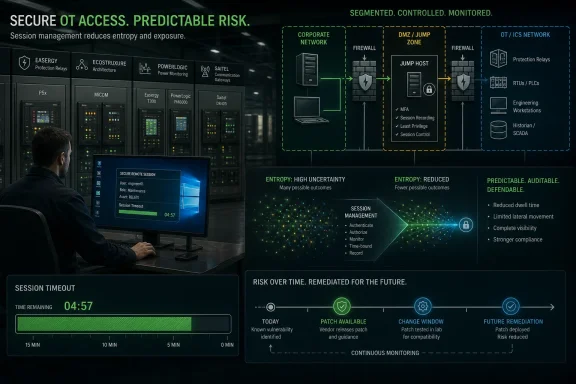
The same vulnerable device can represent very different risk in two facilities. In one, it sits behind strict segmentation, reachable only through a monitored jump host with named accounts, MFA, application allowlisting, and scheduled maintenance workflows. In another, it shares a network with general-purpose workstations, vendor laptops, and convenience remote access. The CVE is the same; the practical exposure is not.
That is why the advisory should not be reduced to a patch checklist. It should trigger architecture review. If a high-severity session-management bug in power automation equipment can be reached from too many places, the patch fixes today’s vulnerability but not tomorrow’s.
That convergence has benefits. Operators get better visibility, faster diagnostics, richer event data, and more flexible automation. But convergence also imports the assumptions of IT security into environments that were not originally built around rapid credential rotation, automated patch deployment, and internet-speed adversaries.
Session management is a perfect example. The concept is old hat to web application developers and identity teams, but it becomes harder when embedded devices, long-life relays, operator workstations, and engineering tools must maintain predictable behavior over years or decades. The more these systems expose browser-based interfaces, APIs, gateways, and integrated dashboards, the more they inherit mainstream software risks.
For Microsoft-centric shops, the implication is clear: Windows security and OT security are converging at the edges. Defender deployments, identity governance, certificate handling, privileged access workstations, and remote support architecture may decide whether an industrial CVE remains theoretical or becomes operationally relevant.
For defenders, that means precision is not pedantry. Easergy MiCOM P633 appears in more than one version path, with fixes identified for P633.678.700 and P633.680.701 depending on the affected branch. P634 similarly appears with distinct fixed-version handling. PowerLogic P5 and P7 have different target versions. EPAS Gateway’s fixed version, 6.4.610.500.101, may look counterintuitive when compared with the affected “6.4.616.200.100 and prior” wording, so customers should verify directly with Schneider rather than rely on assumptions about version ordering.
This is exactly the kind of detail that asset-management systems often fail to capture cleanly. Many inventories record product names and IP addresses but not firmware branch, protocol option bit, cumulative update level, or hardware variant. The result is a false sense of coverage.
The remedy is not glamorous. Export device inventories. Compare them line by line against the advisory. Have engineering staff validate what automated scanners cannot safely determine. Preserve evidence of version checks and upgrade decisions, because auditors and incident responders will ask for it later.
That should push organizations toward a more concrete defensive posture. Engineering access should be named, limited, logged, and time-bound. Jump hosts should be hardened and monitored like privileged infrastructure, not treated as convenience desktops. Vendor remote access should be disabled when not in use, brokered through controlled paths, and reviewed after support sessions.
Session timeout configuration is also worth taking seriously. Reducing the “Minimum inactivity period” may annoy operators who prefer long-lived sessions, but unattended sessions are a gift to attackers. In environments where shared consoles still exist, session discipline becomes even more important.
None of this is new doctrine. What is new is the frequency with which advisories like this collapse the distance between ordinary software hygiene and industrial resilience. Entropy, session identifiers, and firmware branches are not abstract software engineering trivia. They are now part of the security model for power automation.
The immediate work is not to panic. It is to stop treating the affected estate as an unknown quantity. Organizations should know which Easergy, EcoStruxure, PowerLogic, Saitel, and related devices they run; which firmware and software versions are present; which systems can reach them; and which fixes are available today.
The advisory also strengthens the case for better OT maintenance planning. If every firmware update requires a scramble to identify ownership, vendor contacts, backups, rollback procedures, and outage windows, then the organization has a process vulnerability alongside the product vulnerability. CVE-2026-4827 may be the trigger, but the underlying problem is operational readiness.
 Schneider’s Power Stack Has a Session Problem, Not Just a Firmware Problem
The advisory describes CVE-2026-4827 as a CWE-331 insufficient entropy vulnerability that can lead to unauthorized access when an attacker already on the network exploits weaknesses in session-management protections. In plain English, the concern is that session-related values may not be random enough, making them easier to predict or abuse than defenders would like.That distinction matters. This is not a vulnerability that requires the attacker to rewrite protection logic or discover a brand-new physics-defying technique against electrical gear. It is a vulnerability in how access is managed after a system decides someone is allowed to interact with it, and that is often where the most stubborn industrial risk lives.
Schneider’s affected list is unusually broad. It spans protection relays, gateways, user interfaces, automation software, remote terminal units, and power-operation platforms across Easergy MiCOM, EcoStruxure Power Automation System, EcoStruxure Power Operation, iPMFLS, PowerLogic P5 and P7, PowerLogic T300 and T500, Easergy C5, Saitel DP, and EasyLogic T150-derived firmware lines.
The scope turns the story from “patch this model” into “map your power automation estate.” For WindowsForum readers running or supporting operational technology environments, that is the uncomfortable part: the vulnerable thing may not be a server in the data center, but it will still have an IP address, a maintenance path, a web interface, a Windows engineering workstation nearby, or all of the above.
Entropy Is Boring Until It Becomes Authentication
Insufficient entropy is one of those weakness classes that can sound academic until it lands in a session-management context. Randomness is not decorative in authentication systems; it is the thing that prevents a session identifier, token, nonce, or comparable value from being guessed or replayed with practical effort.In consumer software, poor randomness often becomes a story about account takeover. In industrial systems, the question becomes more unsettling: what can an attacker do if they can sidestep part of the session model for equipment that monitors, automates, or protects electrical infrastructure?
The advisory’s phrasing is careful. It does not say the vulnerability grants unauthenticated total control in all deployments. It says an attacker on the network may exploit weaknesses in session-management protections, potentially leading to unauthorized access. That makes network position a prerequisite, but it also means the security boundary has already moved inside the plant, substation, building-management network, or power-management segment.
That is a familiar OT problem. Vendors and operators spent years assuming that internal segmentation, physical access controls, and specialist protocols made exploitation unlikely. Modern reality has not abolished those defenses, but it has made them insufficient on their own. Ransomware crews, state-linked operators, compromised remote access tools, contractor laptops, and misconfigured VPNs have all taught the same lesson: “internal” is no longer synonymous with “trusted.”
The Affected Product List Reads Like an Installed-Base Inventory
The vulnerable Easergy MiCOM C264 versions include D7.33 and prior, with Schneider identifying D7.34 as the fixed version. Easergy C5 is affected through version 1.1.17, with version 1.1.18 carrying the fix. Multiple Easergy MiCOM P30 models also appear in the advisory, including P139, P437, P439, P532, P539, P631, P632, P633, P634, P138, P436, P438, P638, and C434 lines at specified vulnerable build levels.EcoStruxure products are also in the mix. EcoStruxure Power Automation System Gateway, or EPAS-GTW, is affected through version 6.4.616.200.100, while EPAS-UI is affected through version 3.0.3. EcoStruxure Power Operation is affected through EPO 2022 CU6 and EPO 2024 CU2, with Schneider pointing customers to EPO 2022 CU7 and EPO 2024 CU3 respectively.
The PowerLogic side of the house is no less important. PowerLogic P5 protection relays are affected through V02.502.103, PowerLogic P7 protection and control platforms through V02.002.002, PowerLogic T300 through 2.9.4, and PowerLogic T500 through 11.08.02. The advisory also names iPMFLS through 64.2025.0.13, Saitel DP firmware, and CPU866e firmware lines.
Then there is the Easergy MiCOM P40 Series wrinkle. Model numbers with Protocol Option bit G, H, or L are affected across all firmware versions, and Schneider’s notice places them in the future-remediation bucket rather than the immediately-fixed bucket. That is the kind of footnote that can determine whether an operator’s patch plan is finished this quarter or becomes a risk register item.
The Patch Matrix Is a Map of Operational Friction
The remediation list is long because the affected estate is fragmented. Some products have straightforward fixed versions: MiCOM C264 moves to D7.34, Easergy C5 moves to 1.1.18, EPAS-UI moves to 3.0.4, PowerLogic T300 moves to 2.9.5, and PowerLogic T500 moves to 11.08.03. Others require contacting Schneider Electric’s Customer Care Center or a local Application Center rather than simply downloading a public update and pushing it like a Windows cumulative update.That is normal in industrial environments, but normal does not mean painless. Protection relays and automation gateways are not usually patched on a whim between coffee and lunch. They sit inside change-control regimes, maintenance windows, safety assessments, and sometimes utility or regulatory obligations.
Several fixes require a reboot, including MiCOM C264, Easergy C5, PowerLogic T300, PowerLogic T500, and certain firmware upgrades referenced in the advisory. A reboot is a mundane word in IT and a loaded one in OT. Restarting a device that participates in protection, automation, telemetry, or control is not the same operational decision as restarting a print server.
EcoStruxure Power Operation updates may look more familiar to Windows administrators because they resemble software cumulative updates. EPO 2022 CU7 and EPO 2024 CU3 are the fixed update tracks. But even there, the impact is not limited to patch mechanics; power-operation software is often tied to operator consoles, historian flows, alarms, reporting, and integration points that need validation after an upgrade.
“Contact Customer Care” Is a Security Dependency
One striking feature of the remediation guidance is how often customers are told to contact Schneider Electric’s Customer Care Center or local Application Center. That is not inherently bad; many OT vendors control firmware distribution to prevent mismatched loads, preserve certification assumptions, and ensure site-specific configuration is respected. But it creates a security dependency that does not exist in the same way for mainstream enterprise software.In Windows ecosystems, administrators complain about patch quality, telemetry, forced restarts, and update timing, but the update channels are usually well-defined. In industrial control, the act of getting the right firmware can itself become a project. The person who knows the device model may not be the person with the vendor portal account; the person with the vendor relationship may not know the network exposure; the person responsible for cybersecurity may not be authorized to touch the relay.
That organizational handoff is where vulnerabilities linger. It is not always negligence. Sometimes it is the predictable outcome of products designed for long service lives, installed in facilities where uptime is the primary virtue and cybersecurity arrived later as a mandatory overlay.
The lesson for administrators is to treat vendor access paths as part of vulnerability management. If your remediation plan begins with “contact the vendor,” the time to validate that contact path is not after a public advisory lands. It is before the maintenance window, before the audit, and before a network detection rule starts screaming about suspicious access to engineering ports.
The Future-Fix Devices Are the Real Test of Risk Management
Schneider says remediation plans are being established for future versions of several Easergy MiCOM P30 models, including P437, P532, P631, P634, P436, P438, and P638. The company also says future remediation is planned for Easergy MiCOM P40 Series model numbers with Protocol Option bit G, H, or L.That leaves some customers in the awkward territory between disclosure and fix. The vendor has acknowledged the vulnerability and identified mitigations, but there may not yet be a firmware image that fully resolves the issue for a given model or configuration. For enterprise IT teams accustomed to a monthly patch cadence, this can feel unsatisfying. For OT teams, it is familiar.
The advisory’s mitigations are the expected ones: ensure affected devices operate within physically or logically segmented internal networks, tightly control access with mechanisms such as firewalls and intrusion detection systems, and reduce the “Minimum inactivity period” using the CAE tool to shorten session timeout durations. These are sensible controls, but they are not magic.
Segmentation only works if it is real. A firewall rule that allows broad engineering access from a flat maintenance VLAN is not meaningful segmentation. An IDS that cannot see the relevant industrial traffic, or whose alerts never reach anyone empowered to act, is not meaningful detection. A shorter inactivity period reduces the usefulness of stale sessions, but it does not transform weak entropy into strong entropy.
Windows Admins Are Closer to This Than They Think
At first glance, this advisory may seem outside the WindowsForum wheelhouse. The affected products are Schneider industrial and power devices, not Windows 11 endpoints or Windows Server roles. But in real deployments, Windows is often the operational surface around the OT equipment: engineering workstations, operator HMIs, update staging machines, jump hosts, domain services, backup tools, remote support agents, and SIEM collectors.That makes this a Windows story by adjacency. If a session-management weakness requires network access, defenders should care deeply about the Windows systems that can reach the affected devices. A compromised domain workstation with routing into the OT segment can become the attacker’s bridge. A poorly controlled remote desktop jump box can turn an internal-only vulnerability into an externally enabled incident.
Administrators should resist the urge to think of firmware vulnerabilities as somebody else’s problem. If Active Directory groups, VPN permissions, certificate stores, Windows firewall rules, remote management tools, and endpoint detection policies determine who can reach the Schneider gear, then Windows administrators are part of the exploitability equation.
This is also where asset inventory stops being a compliance slogan. Knowing that a facility has “Schneider relays” is not enough. The advisory requires model-level, firmware-level, and sometimes option-bit-level awareness. That means configuration exports, procurement records, engineering tool data, switch inventories, and vendor-maintained device lists all need to line up.
Session Weaknesses Reward Attackers Who Already Have a Foothold
The attacker described in the advisory is “on the network.” That phrase should not calm anyone down. Many serious industrial incidents begin with a foothold in corporate IT, a remote access path, or a maintenance system, followed by lateral movement toward operational assets.A vulnerability that helps an attacker convert network presence into unauthorized access is valuable precisely because it fits the middle stage of an intrusion. It may not be the phishing email, and it may not be the final disruptive action. It is the tool that helps bridge those moments.
The user-interaction element in the CVSS vector reported by Schneider also deserves careful reading. It may suggest that exploitation depends on some form of victim action or session state, but the advisory still rates the issue high. In practical terms, defenders should not assume the need for user interaction makes the vulnerability harmless. Many operational environments have predictable maintenance routines, shared workstations, persistent browser sessions, and long-lived consoles.
The mitigation to reduce inactivity periods is telling. Long session timeouts are convenient in control rooms and maintenance workflows because people need systems to remain available. They are also useful to attackers. If a session can be guessed, reused, or abused, shortening its life narrows the window, but the better answer remains a fixed version where one exists.
The Industrial Patch Problem Is Not an Excuse to Wait
There is a dangerous pattern in OT security discourse: because patching is hard, mitigations become semi-permanent, and semi-permanent mitigations become folklore. A firewall rule is added, an exception is documented, a maintenance window is deferred, and two years later the site still carries the vulnerability with a note saying it was “accepted.”CVE-2026-4827 is a useful test of whether organizations have matured beyond that pattern. Where Schneider has fixed versions, customers should build a firmware and software update plan. Where Schneider has not yet delivered a fix, customers should document compensating controls, verify they actually exist, and set a date to revisit the vendor’s remediation status.
This does not mean rushing firmware into production without testing. In power environments, reckless patching can create its own availability and safety risks. But “do not rush” is different from “do not move.” Mature OT security is the discipline of moving deliberately, not standing still.
For mixed IT/OT shops, the most practical approach is to split the work into parallel tracks. One team validates exposure and segmentation immediately. Another confirms affected models and firmware versions. A third engages Schneider for fixed releases and upgrade procedures. Security monitoring teams look for unusual access to affected devices, while operations teams schedule the maintenance windows that cannot be avoided.
The Advisory Exposes the Gap Between Product Security and Site Security
Schneider Electric has done what vendors are expected to do: assign a CVE, publish affected versions, identify fixed releases where available, and provide mitigations where fixes are pending. CISA has amplified the notice through an ICS advisory, giving defenders a canonical public reference. That is the product-security machinery working.But product security is only half the system. Site security determines whether the vulnerability is reachable, whether an attacker can pivot into the relevant network, whether sessions are exposed through careless browser use, and whether firmware can be updated without derailing operations.
The same vulnerable device can represent very different risk in two facilities. In one, it sits behind strict segmentation, reachable only through a monitored jump host with named accounts, MFA, application allowlisting, and scheduled maintenance workflows. In another, it shares a network with general-purpose workstations, vendor laptops, and convenience remote access. The CVE is the same; the practical exposure is not.
That is why the advisory should not be reduced to a patch checklist. It should trigger architecture review. If a high-severity session-management bug in power automation equipment can be reached from too many places, the patch fixes today’s vulnerability but not tomorrow’s.
The Product Names Mask a Larger Convergence Story
Easergy, EcoStruxure, PowerLogic, and Saitel are not interchangeable products, but their appearance in the same advisory reflects a broader industrial trend. Power systems are no longer isolated islands of relays, meters, and serial links. They are increasingly software-defined, IP-connected, remotely managed, and integrated into enterprise monitoring and analytics stacks.That convergence has benefits. Operators get better visibility, faster diagnostics, richer event data, and more flexible automation. But convergence also imports the assumptions of IT security into environments that were not originally built around rapid credential rotation, automated patch deployment, and internet-speed adversaries.
Session management is a perfect example. The concept is old hat to web application developers and identity teams, but it becomes harder when embedded devices, long-life relays, operator workstations, and engineering tools must maintain predictable behavior over years or decades. The more these systems expose browser-based interfaces, APIs, gateways, and integrated dashboards, the more they inherit mainstream software risks.
For Microsoft-centric shops, the implication is clear: Windows security and OT security are converging at the edges. Defender deployments, identity governance, certificate handling, privileged access workstations, and remote support architecture may decide whether an industrial CVE remains theoretical or becomes operationally relevant.
The Version Details Matter Because Attackers Read Them Too
The advisory’s version matrix is dense, and dense advisories are easy to mishandle. A busy team may scan for a product family, miss a specific model line, or assume that a nearby version is safe when it is not. Attackers and vulnerability brokers do not have to make that mistake; they can parse affected versions at leisure.For defenders, that means precision is not pedantry. Easergy MiCOM P633 appears in more than one version path, with fixes identified for P633.678.700 and P633.680.701 depending on the affected branch. P634 similarly appears with distinct fixed-version handling. PowerLogic P5 and P7 have different target versions. EPAS Gateway’s fixed version, 6.4.610.500.101, may look counterintuitive when compared with the affected “6.4.616.200.100 and prior” wording, so customers should verify directly with Schneider rather than rely on assumptions about version ordering.
This is exactly the kind of detail that asset-management systems often fail to capture cleanly. Many inventories record product names and IP addresses but not firmware branch, protocol option bit, cumulative update level, or hardware variant. The result is a false sense of coverage.
The remedy is not glamorous. Export device inventories. Compare them line by line against the advisory. Have engineering staff validate what automated scanners cannot safely determine. Preserve evidence of version checks and upgrade decisions, because auditors and incident responders will ask for it later.
The Practical Lesson Is to Shrink the Blast Radius Before the Patch Lands
The advisory’s most useful message is not simply “install fixed firmware.” It is “make sure an attacker on the network does not get to treat the power environment as open terrain.” Patching closes one known weakness; segmentation, access control, monitoring, and session hygiene reduce the damage when the next weakness appears.That should push organizations toward a more concrete defensive posture. Engineering access should be named, limited, logged, and time-bound. Jump hosts should be hardened and monitored like privileged infrastructure, not treated as convenience desktops. Vendor remote access should be disabled when not in use, brokered through controlled paths, and reviewed after support sessions.
Session timeout configuration is also worth taking seriously. Reducing the “Minimum inactivity period” may annoy operators who prefer long-lived sessions, but unattended sessions are a gift to attackers. In environments where shared consoles still exist, session discipline becomes even more important.
None of this is new doctrine. What is new is the frequency with which advisories like this collapse the distance between ordinary software hygiene and industrial resilience. Entropy, session identifiers, and firmware branches are not abstract software engineering trivia. They are now part of the security model for power automation.
The Firmware Queue Now Has a Security Priority
This advisory gives defenders enough concrete action to move now, even where some fixes remain pending. It also gives management a useful lens for prioritization: devices that are reachable from broader networks, used in remote operations, or tied to critical protection and automation functions should move to the front of the assessment queue.The immediate work is not to panic. It is to stop treating the affected estate as an unknown quantity. Organizations should know which Easergy, EcoStruxure, PowerLogic, Saitel, and related devices they run; which firmware and software versions are present; which systems can reach them; and which fixes are available today.
The advisory also strengthens the case for better OT maintenance planning. If every firmware update requires a scramble to identify ownership, vendor contacts, backups, rollback procedures, and outage windows, then the organization has a process vulnerability alongside the product vulnerability. CVE-2026-4827 may be the trigger, but the underlying problem is operational readiness.
The Schneider Advisory Leaves No Room for Inventory Theater
The most concrete lessons from CVE-2026-4827 are mundane, which is another way of saying they are useful. This is a vulnerability where security teams win by doing the unglamorous work accurately, not by waiting for a dramatic proof-of-concept exploit to settle priorities.- Organizations should identify affected Schneider Electric devices and software by exact model, firmware branch, cumulative update level, and protocol-option configuration where applicable.
- Fixed releases exist for many products, including MiCOM C264 D7.34, Easergy C5 1.1.18, EPAS-UI 3.0.4, EPO 2022 CU7, EPO 2024 CU3, PowerLogic P5 V02.503.101, PowerLogic P7 V02.003.001, PowerLogic T300 2.9.5, and PowerLogic T500 11.08.03.
- Some Easergy MiCOM P30 and P40 configurations remain on a future-remediation path, so compensating controls should be documented, validated, and revisited rather than filed away indefinitely.
- Network segmentation should be tested as an actual control, not assumed from a diagram that may no longer match routing, firewall, VPN, and jump-host reality.
- Session-timeout reductions using the CAE tool are a mitigation, not a substitute for fixed firmware where fixed firmware is available.
- Windows administrators should review the workstations, servers, remote access paths, and identity controls that can reach the affected OT assets, because those systems shape the attacker’s path to the vulnerability.
References
- Primary source: CISA
Published: 2026-06-18T12:00:00+00:00
- Related coverage: incibe.es
Múltiples vulnerabilidades en productos de Schneider Electric | INCIBE-CERT | INCIBE
Schneider Electric ha publicado 4 vulnerabilidades: 3 de severidad alta y 1 de severidad media, cuya ewww.incibe.es
- Related coverage: iportal2.schneider-electric.com
- Related coverage: cvefeed.io
Schneider electric > Micom c264 firmware Vulnerability Maturity Index CVE
Product security and vulnerability maturity CVE Indexcvefeed.io - Related coverage: malware.news
[Control systems] Schneider Electric security advisory (AV26-449) - Malware News - Malware Analysis, News and Indicators
Introduction to Malware Binary Triage (IMBT) Course Looking to level up your skills? Get 10% off using coupon code: MWNEWS10 for any flavor. Enroll Now and Save 10%: Coupon Code MWNEWS10 Note: Affiliate link – your e… malware.news
- Related coverage: product-help.schneider-electric.com

- Related coverage: productinfo.schneider-electric.com
Configuration - ComPacT NSX Modbus Comm UG
www.productinfo.schneider-electric.com
- Related coverage: 365trust.me
Vulnerability in Schneider Electric products (AL05/260512/CSIRT-ITA) - 365TRUST.ME
Summary Multiple vulnerabilities, including five rated as ‘high’ severity, have been resolved in certain Schneider Electric products. If exploited, these vulnerabilities could allow a malicious user to bypass authentication mechanisms, read arbitrary files on the filesystem and elevate their...365trust.me - Related coverage: download.schneider-electric.com
- Related coverage: cdn.stevenengineering.com
Schneider Electric PowerLogic System
3D television, computer screen isolated on white with clipping pathcdn.stevenengineering.com
