

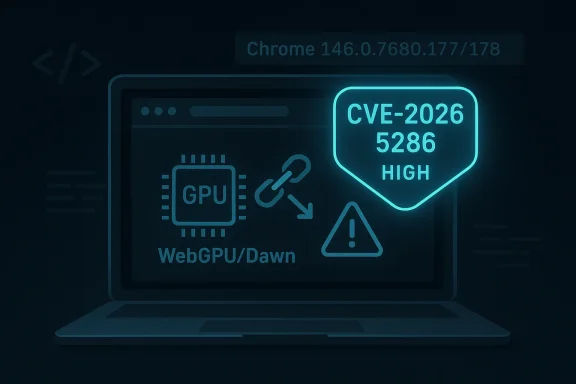
The release of CVE-2026-5286 is another reminder that browser security in 2026 is being defined less by abstract policy talk and more by relentless patch velocity. Google’s March 31 stable update for Chrome 146.0.7680.177/178 includes a High-severity use-after-free in Dawn, with the bug listed as CVE-2026-5286 and tied to a crafted HTML page that could allow remote code execution. Microsoft’s Security Update Guide mirrors the same upstream issue for Edge tracking, which matters because enterprises often discover exposure not from the Chrome blog itself, but from the downstream browser channels they actually deploy. ser vulnerabilities have evolved into a weekly operational problem rather than an occasional emergency, and the Chromium project’s release cadence reflects that reality. In late March 2026, Google’s stable desktop channel moved to 146.0.7680.177/178, packaging a long list of security fixes across rendering, graphics, media, and browser subsystems. Among them was CVE-2026-5286, a Dawn memory-safety flaw reported on March 18 and rated High, which places it squarely in the class of bugs that can turn a simple page visit into a serious compromise path.
The significance ofrestimate if you only think of the browser as a document viewer. Dawn is part of Chromium’s WebGPU stack, which means it sits close to modern accelerated graphics workloads and the complex interface between web content, GPU drivers, and browser sandboxing. That makes Dawn attractive to attackers because graphics paths are typically large, performance-sensitive, and difficult to harden without breaking compatibility or speed. That tension is the core story here: the same rendering sophistication that makes the web feel fluid also gives attackers more room to hunt for memory corruption.
This is not the first time Dawn has appety advisories, and that pattern matters. Chrome’s March 2026 release notes show multiple high-severity use-after-free and memory safety issues in adjacent graphics and web rendering areas, suggesting that the browser’s attack surface remains under constant pressure. When a project discloses several bugs of the same broad type in the same update window, it usually indicates not a single isolated slip, but a persistent engineering challenge around object lifetime, cross-thread state, and asynchronous rendering lifecycles.
Microsoft’s Security Update Guide adds another layer to the ss not own the bug, but it tracks Chromium vulnerabilities so Edge administrators can map upstream Chrome fixes to downstream Edge exposure. That makes the Microsoft record operationally important even when the exploit surface originates in Google’s browser, because enterprise patching often depends on that downstream visibility rather than on raw Chromium issue tracker data. The broader lesson is simple: in modern browser fleets, patch intelligence is distributed across vendors.
CVE-2026-5286 is described by Google as a use-after-free in Dawn that could let a remote attacker execute arbitrary code through a crafted HTML page. That phrasing is important because it tells you the vulnerability is reachable from web content, requires no local foothold, and can plausibly be weaponized through normal browsing behavior rather than exotic user action. In the Chrome release notes, the issue is tagged High, reinforcing that Google views it as a serious memory-corruption path.
Dawn is a particularly sensitive place for this kind of bug because it sits in the path of GPU-accelerated rendering. The more asynchronoer it becomes to reason about object ownership and timing. If a browser hands work off to the graphics stack and later tears down part of that object graph, a stale pointer can survive just long enough to become exploitable.
There is also a subtle operational clue in the release note structure. Google often restricts bug details until a majority of users are updated, which is a standard defensive disclosure practice designed to blunt immediate exploitation. The bnity has learned to read that silence as a signal, not as a lack of urgency. When bug details are held back, it is usually because the publisher believes attackers might still benefit from too much specificity.
The Chrome March release notes reinforce that point by showing fixes across several graphics-adjacent components in the same window. When the browser team repeatedly patches graphics code, it is not a sign of failure so much as a sign that the browser’s most powerful features remain its most heavily attacked surfaces. *Attackers go where the com WebGPU is strategic, not niche
It is tempting to think of Dawn as a specialist component relevant only to developers or gaming workloads, but that view is too narrow. WebGPU is part of the browser’s push toward richer web applications, and that means mainstream users increasingly depend on the same accelerated paths that once seemed optional. In other words, thwn bugs grows as the feature becomes more normal.
This tracking model also helps explain why downstream browser advisories matter during rapid patch cycles. If a help desk or SOC sees a Chromium issue in Microsoft’s guide, they can verify whether their Edge version has inherited the fix without waiting for a separate vulnerability class to be independently disclosed. That shortcut saves time, which is often the difference between routine patching and a security event.
Consumers should also remember that attack timing often tracks public release timing. Once Google publishes a high-severity attackers are both reading the same release notes, and the race shifts to who patches first. The closer a flaw sits to code execution, the more quickly criminal actors may attempt to operationalize it.
This is why browser CVEs have become supply-chain stories. The browser engine is a platform, not a standalone application, and every downstream integrator inherits the same trust assumptions and the same security debt. The more Chromium expands, the more one patch can matter across an entire software estate.
The second question is whether downstream vendors and enterprise software makers are moving fast enough to keep pace with Chromium’s upstream rhythm. Microsoft’s documentation approach helps, but documentation alone does not close the exposure window; only actual deployment does. In a world where browsers are platform layers, the winners will be the organizations that can translate upstream CVEs into same-day fleet action.
Source: NVD / Chromium Security Update Guide - Microsoft Security Response Center
The significance ofrestimate if you only think of the browser as a document viewer. Dawn is part of Chromium’s WebGPU stack, which means it sits close to modern accelerated graphics workloads and the complex interface between web content, GPU drivers, and browser sandboxing. That makes Dawn attractive to attackers because graphics paths are typically large, performance-sensitive, and difficult to harden without breaking compatibility or speed. That tension is the core story here: the same rendering sophistication that makes the web feel fluid also gives attackers more room to hunt for memory corruption.
This is not the first time Dawn has appety advisories, and that pattern matters. Chrome’s March 2026 release notes show multiple high-severity use-after-free and memory safety issues in adjacent graphics and web rendering areas, suggesting that the browser’s attack surface remains under constant pressure. When a project discloses several bugs of the same broad type in the same update window, it usually indicates not a single isolated slip, but a persistent engineering challenge around object lifetime, cross-thread state, and asynchronous rendering lifecycles.
Microsoft’s Security Update Guide adds another layer to the ss not own the bug, but it tracks Chromium vulnerabilities so Edge administrators can map upstream Chrome fixes to downstream Edge exposure. That makes the Microsoft record operationally important even when the exploit surface originates in Google’s browser, because enterprise patching often depends on that downstream visibility rather than on raw Chromium issue tracker data. The broader lesson is simple: in modern browser fleets, patch intelligence is distributed across vendors.
 What CVE-2026-5286 Actually Is
CVE-2026-5286 is described by Google as a use-after-free in Dawn that could let a remote attacker execute arbitrary code through a crafted HTML page. That phrasing is important because it tells you the vulnerability is reachable from web content, requires no local foothold, and can plausibly be weaponized through normal browsing behavior rather than exotic user action. In the Chrome release notes, the issue is tagged High, reinforcing that Google views it as a serious memory-corruption path.Why use-after-free is dangerous
A use-after-free occurs when software keeps using memory after it has already bowser, that often means an attacker can manipulate program state so the freed memory is reused for something attacker-influenced, turning a crash bug into a code-execution primitive. Not every use-after-free becomes a working exploit, but the class is dangerous enough that defenders treat it as a red-alert signal.Dawn is a particularly sensitive place for this kind of bug because it sits in the path of GPU-accelerated rendering. The more asynchronoer it becomes to reason about object ownership and timing. If a browser hands work off to the graphics stack and later tears down part of that object graph, a stale pointer can survive just long enough to become exploitable.
Why HTML delivery matters
The advisory language says the exploit can be triggered via a crafted HTML page, which is the sort of phrase every browser immediately translate into “web-delivered attack.” That does not necessarily mean a successful exploit is trivial, but it does mean the attack surface is broad and browser users can be targeted through phishing, malvertising, compromised sites, or embedded content. In practical terms, this is a risk to consumers and enterprise users alike.- The flaw is remote-facing, not local-only.
- The trigger is web content, not a special file format.
- The vulnerable component is Dawn, tied to WebGPU and graphics ey impact class is code execution, not merely a crash.
- The issue is serious enough to be labeled High by Google.
How Chrome’s March 2026 Patch Cycle Frames the Bug
Chrome’s March 31, 2026 stable update is more than just a single-item security fix. It bundles 21 security issues and includes multiple safety entries across CSS, GPU, Codecs, Dawn, PDF, WebView, Navigation, and Compositing. That breadth tells us the browser’s security posture is being managed as a moving target, with Google balancing disclosure timing, exploit risk, and patch rollout logistics across desktop, Android, and ChromeOS.The surrounding patch environment
The most revealing detail is not just that Dawn was fixed, but that it appears in a cluster of graphics-related bugs. Chrome’s March notes show CVE-2026-5272 in GPU, CVE-2026-52026-5285 in WebGL, and then CVE-2026-5286 in Dawn again. That clustering suggests the rendering and GPU layers continue to be among the most fertile attack surfaces in Chromium.There is also a subtle operational clue in the release note structure. Google often restricts bug details until a majority of users are updated, which is a standard defensive disclosure practice designed to blunt immediate exploitation. The bnity has learned to read that silence as a signal, not as a lack of urgency. When bug details are held back, it is usually because the publisher believes attackers might still benefit from too much specificity.
Release timing and rollout pressure
The Chrome desktop release notes say the update “will roll out over the coming days/weeks,” which is standard for Google’s staggered channel deployment. That approach reduces risk from bad updates, but it also means a vulnpresent on some machines after the fix is published. For enterprises, that lag is why patch verification and policy enforcement matter as much as the release itself.- Chrome 146.0.7680.177/178 is the fixed desktop build.
- The same security fixes also flow to Android and other platforms in related releases.
- Google’s staged rollout means not all users are patched at the same instant.
Administrators should check channel parity, not just headli
Why Dawn Keeps Showing Up in Security Advisories
Dawn is the Chromium graphics layer associated with WebGPU, and that alone makes it a high-value target. GPU-facing code tends to be complex, heavily optimized, and deeply intertwined with platform-specific driver behavior, which means even discipms can miss lifetime or synchronization errors. In memory-safety terms, that is a dangerous environment because a single stale pointer can become a serious exploit path.Graphics code is a memory-corruption magnet
Modern browsers are not just HTML parsers; they are full rendering engines with elaborate acceleration paths. Dawn, WebGPU, WebGL, ANGLE, and related subsystems all exist to make the browser fast enough for games, AI demos, visualization tools, and heavy web apps. The tradeoffabstraction layer increases state complexity, and state complexity is where use-after-free bugs thrive.The Chrome March release notes reinforce that point by showing fixes across several graphics-adjacent components in the same window. When the browser team repeatedly patches graphics code, it is not a sign of failure so much as a sign that the browser’s most powerful features remain its most heavily attacked surfaces. *Attackers go where the com WebGPU is strategic, not niche
It is tempting to think of Dawn as a specialist component relevant only to developers or gaming workloads, but that view is too narrow. WebGPU is part of the browser’s push toward richer web applications, and that means mainstream users increasingly depend on the same accelerated paths that once seemed optional. In other words, thwn bugs grows as the feature becomes more normal.
- More capabilities generally mean more code paths.
- More code paths mean more lifetime management complexity.
- More complexity increases the probability of memory-safety defects.
- Memory-safety defects in GPU stacks are often high-impact.
The Enterprise Impact Is Bigger Than the Label Suggests
For home users, CVE-2026-5286 is a reason to update Chrome immediately. For entinder that browser patching is now a fleet management problem that touches identity, device compliance, EDR telemetry, and change windows. Because the exploit path starts with ordinary web content, the risk is not confined to risky browsing habir through legitimate sites, third-party content, and compromised supply chains in advertising or embedded widgets.Why admins should care about downstream visibility
Microsoft’s Security Update Guide exists in part to tell Edge customers when Chromium fixes have landed in Microsoft’s downstream builds. That matters because many organizations run a mixed-browser environment or standardize on Edge while still depending on Chromium release intelligence. In practice, this means a Chrome CVE can become an Edge incident response task even ifd code is involved.This tracking model also helps explain why downstream browser advisories matter during rapid patch cycles. If a help desk or SOC sees a Chromium issue in Microsoft’s guide, they can verify whether their Edge version has inherited the fix without waiting for a separate vulnerability class to be independently disclosed. That shortcut saves time, which is often the difference between routine patching and a security event.
The operational risk window
The weak point is rollout latency. Even when Google publishes the fix quickly, enterprise machines may remain on older builds because of staged deployment, managed update deferrals, or compatibility testing. That means a vulnerability with web reach can remain live long enough for opportunistic exploitation, especially against high-value targets that have predictable update lag.- Identify whether Chrome is on 146.0.7680.177/178 or later.
- Verify whether Edge has ingested the corresponding Chromium fix.
- Confirm managed devices are not pinned to an older channel.
- Review browser update policies for deferrals and maintenance windows.
- Prioritize externally reachable endpoints and privileged users first.
Consumer Risk: Why Ordinary Browsing Is Enough
The consumer angle is stark because the trigger is a crafted HTML page, which means users do not need to download an obvioull a malicious extension to be at risk. Modern browser exploitation often begins with a simple lure: a link, a redirect, an ad, or a compromised website. The bug’s presence in Dawn means the attacker may not need to target the most obvious browser path at all; they can aim for the feature-rich accelerated rendering stack instead.Why “just browsing” is not a safety boundary
Many users still assume a browser exploit requires them to do something suspicious. In reality, memory corruption in a browser is dangerous precisely because it can turn ordinary browsing into an attack vector. The web page is the payload delivery mechanism, and the browser engine is the execution environment. That is why patching browsers is no longer optional hygiene; it is frontline defense.Consumers should also remember that attack timing often tracks public release timing. Once Google publishes a high-severity attackers are both reading the same release notes, and the race shifts to who patches first. The closer a flaw sits to code execution, the more quickly criminal actors may attempt to operationalize it.
What users should do
The good news is that Chrome’s update mechanism typically installs fixes quickly once the browser restarts. But the browser only becomes safe after the patched build is actually running, not after the download starts. Usen for days, never relaunch, or suppress update prompts can remain exposed longer than they realize.- Restart Chrome after updating.
- Check the version manually if you are unsure.
- Keep automatic updates enabled.
- Avoid delaying browser restarts for long periods.
- Treat browser update prompts as security notices, not convenience nags.
The Broader Chromium Security Pattern
CVE-2026-5286 fits a recurring Chromium theme: high-value memory safety fixes continue to cluster around rendering, graphics, and media. That is not unique to Chrome, but Chromium’s scale makes each disclosure more consequential because the codebase powers not only Google Chrome but also downstream browsers and embedded web runtimes. The result is a cascadinge one upstream fix can affect multiple products and enterprises at once.Upstream fix, downstream consequence
When Chromium fixes a bug, the immediate security value extends far beyond the Chrome logo. Microsoft Edge, and in many envirotion tools or embedded components that rely on Chromium, inherit the same core engine behavior. That means the vulnerability management question becomes, “Which of our software stacks consumes Chromium, and when did each one ingest the fix?” rather than simply “Did Chrome update?”This is why browser CVEs have become supply-chain stories. The browser engine is a platform, not a standalone application, and every downstream integrator inherits the same trust assumptions and the same security debt. The more Chromium expands, the more one patch can matter across an entire software estate.
Why high-severity labels matter operationally
Google’s High rating is not just a note for security nerds; it is a triage signal. In large organizations, severity labels influence ticket routing, maintenance windows, and emergency change control. A browser issue that can plausibly deliver remote code execution deserves faster treatment than a low-impact UI bug, even if both are technically “security issues.”- High-severity browser bugs can justify emergency patch windows.
- Memory-corruption issues are often prioritized ahead of logic bugs.
- Browser fixes can cascade through downstream Chromium consumers.
- A single engine flaw may affect multiple product lines simultaneously.
Strengths and Opportunities
The encouraging side of this disclosure is that Chromium’s security machinery is clearly working: researchers reported the bug, Google classified it quickly, and the company shipped a fixed stable build with broader patch coverage in the same release window. For defenders, that means the ecosystem still has functioning reporting, triage, and distribution pipelines, even if the bugs themselves remain serious. The opportunity now is to use those pipelines more aggressively in eement and browser-risk monitoring.- Fast upstream disclosure gives defenders a timely starting point.
- Clear version boundaries make exposure checks straightforward.
- Downstream tracking in Microsoft’s guide helps Edge administrators map risk.
- Broad release notes make it easier to see adjacent attack-surface trends.
- High-severity labeling helps security teams prioritize faster.
- Staged rollout channels reduce update blast radius for ordinary users.
- Cross-platform release alignment improves consistency across desktop and mobile.
Risks and Concerns
The biggest concern is not just the bug itself, but the speed at which an attacker could weaponize a web-reachable memory-safety flaw once the advisory is public. Browser exploit development is a race against patch adoption, and the window is widened when users defer updates or organizations lag on managed rollout. The fact that Dawn sits inside a graphics-heavy stack adds another layer of concern because those bugs are often both reachable and difficult to reproduce reliably in testing.- Patch lag can leave a meaningful exposure window open.
- Web-delivered attack paths make exploitation easier to distribute.
- Memory corruption can be a gateway to full compromise.
- Graphics-stack complexity increases the odds of hidden variants.
- Enterprise deferrals can delay remediation across large fleets.
- User behavior still matters because browsers must be relaunched to finish patching.
- Downstream browser diversity can create blind spots in asset inventories.
Looking Ahead
The immediate question is whether CVE-2026-5286 is an isolated Dawn issue or part of a broader run of graphics-stack memory safety bugs that will keep surfacing throughout Chrome 146 and beyond. The March release notes strongly suggest the latter is plausible, because the same update window includes multiple fixes in related areas. That means security teams should treat this as part of an ongoing hardening cycle, not as a one-off incident.The second question is whether downstream vendors and enterprise software makers are moving fast enough to keep pace with Chromium’s upstream rhythm. Microsoft’s documentation approach helps, but documentation alone does not close the exposure window; only actual deployment does. In a world where browsers are platform layers, the winners will be the organizations that can translate upstream CVEs into same-day fleet action.
- Confirm Chrome is on 146.0.7680.177/178 or later.
- Verify the corresponding Edge build has ingested the Chromium fix.
- Audit browser update deferrals and maintenance windows.
- Watch for additional Chromium graphics or WebGPU advisories.
- Reassess whether privileged users need tighter browser patch SLA targets.
Source: NVD / Chromium Security Update Guide - Microsoft Security Response Center
