

CVE-2026-53016 is a newly published Linux kernel vulnerability disclosed on June 24, 2026, in the AMD CCP crypto driver, where an AES completion path can copy a 16-byte IV into an 8-byte caller-provided buffer during AF_ALG RFC3686 CTR-AES operations. The bug is local, not remote, but its high CVSS rating is not cosmetic: it sits in kernel memory-handling code, the part of the operating system where “small” copy-length mistakes can become privilege-boundary problems. The practical story is less about panic and more about discipline — kernel crypto acceleration is infrastructure, and infrastructure bugs matter most when they are invisible until they are not.
The vulnerability turns on a deceptively mundane fact: not every AES mode exposes the same initialization-vector size to its callers. In the affected path, AF_ALG requests using
Eight bytes does not sound dramatic until one remembers where this code runs. Kernel crypto drivers are not application libraries with neat process boundaries and forgiving crash semantics. They handle buffers supplied through kernel APIs, interact with hardware acceleration, and sit close enough to privilege boundaries that an incorrect length value deserves the severity assigned to it.
The fix is equally revealing. Instead of assuming the AES block size, the corrected code uses the skcipher algorithm’s declared IV size. In other words, the patch does not introduce a new security framework or mitigation; it replaces a wrong assumption with the value the kernel crypto API already knew.
That is the most important lesson of CVE-2026-53016. Mature systems fail not only because nobody checked the length, but because one valid length in one layer was treated as universally valid in another.
That invisibility is precisely why this kind of bug is awkward for administrators. Nobody deploys “CVE-2026-53016” as an application feature. It arrives as a kernel capability, often enabled because a distribution kernel supports the hardware in the box.
The vulnerable path involves AF_ALG, the Linux interface that exposes kernel crypto algorithms to user space through sockets. AF_ALG is powerful because it lets applications use kernel-provided crypto implementations. It is also sensitive because it creates a bridge between user-space requests and kernel crypto internals.
The reported attack vector is local and requires low privileges. That matters. This is not a bug where an unauthenticated attacker can throw packets at a machine from the internet and expect compromise. But local does not mean irrelevant in 2026, when shared servers, container hosts, CI workers, HPC systems, desktop multi-user environments, and compromised low-privilege service accounts all provide plausible starting points for local exploitation.
The distinction between low and high attack complexity will matter to defenders trying to prioritize emergency maintenance windows. A buffer overrun in kernel crypto code is serious, but the details of exploitability depend on memory layout, surrounding allocations, enabled hardware, kernel configuration, hardening features, and whether an attacker can reliably shape the vulnerable call path.
This is where enterprise patch management often goes wrong. A “high” kernel CVE becomes either a reason for immediate disruption everywhere or a ticket that gets buried because it is “only local.” Both reactions flatten the actual risk.
A better reading is narrower and more useful: systems that expose local shell access, run untrusted workloads, host containers from multiple tenants, process untrusted jobs, or depend on AF_ALG-enabled crypto paths deserve faster attention. Single-user desktops and tightly controlled appliances may not warrant the same operational urgency, but they still need the fix through normal kernel update channels.
Old bugs often look obvious in hindsight. Once the problem is named, the mismatch is clean: RFC3686 skciphers expose an 8-byte IV; the completion path writes 16 bytes; the right answer is to ask the skcipher for its IV size. But hindsight hides the complexity of the environment in which the mistake lived.
Kernel crypto code is a matrix of algorithms, modes, accelerators, scatter-gather buffers, asynchronous completions, and compatibility layers. The error here sits at the intersection of a generic API and a driver-specific completion routine. That is exactly where length assumptions become dangerous, because each side can be internally consistent while the boundary between them is wrong.
The persistence of the bug also says something about testing. Unit tests and fuzzers are much better than they were a decade ago, but hardware-backed crypto paths are harder to exercise comprehensively than pure software code. If a bug only appears when a particular algorithm wrapper, IV size, and driver completion path align, it can evade broad coverage for a long time.
This is where upstream version numbers can mislead. A mainline kernel range can identify where a flaw exists in source history, but an enterprise distribution may carry fixes, omit features, disable paths, or maintain older-looking kernels with extensive vendor patch sets. Conversely, a distribution may be affected even when its version string appears distant from modern mainline numbering.
For WindowsForum readers who also administer Linux estates — and many do, especially in mixed Microsoft and cloud environments — the lesson is familiar from Windows servicing: trust the vendor advisory for the product you actually run. Kernel.org tells you what was fixed upstream. Red Hat, Canonical, SUSE, Debian, Amazon, Oracle, and others tell you whether your shipped kernel is exposed and which package closes the gap.
The Red Hat affected-state split is also a useful reminder that end-of-life or legacy platforms do not always map neatly to vulnerability exposure. “Unaffected” does not mean “healthy,” and “affected” does not mean “unsupported.” It means the vulnerable code path, as assessed by the vendor, is or is not present in the product line.
Modern Windows environments are rarely Windows-only. Developers run WSL. Enterprises host Linux workloads in Azure. Security teams monitor Linux containers on Windows-managed networks. Identity, logging, endpoint detection, and patch orchestration increasingly span operating systems even when the help desk still thinks in Windows build numbers.
There is also the virtualization angle. A Windows admin may own the Hyper-V cluster while Linux guests run business-critical workloads. A cloud administrator may manage the tenant policy while the vulnerable kernel lives inside a VM image maintained by an application team. A developer may use a Linux container toolchain on a Windows workstation without thinking about the host and guest kernel boundary.
CVE-2026-53016 should therefore be treated as a cross-platform operations issue, not because Windows inherits the bug, but because Windows shops inherit Linux dependencies. The attack surface of an organization is not defined by the logo on the laptop lid.
A local kernel bug becomes dangerous after the first compromise. Once an attacker lands as a low-privilege user, escape and escalation become the next objective. In containerized environments, the distinction between local and remote can also blur: a remotely exploitable application bug inside a container may become a local kernel attack against the underlying host if the right primitive exists.
CVE-2026-53016 is not automatically a container escape. The public description does not establish a ready-made exploit chain or show active exploitation. But the class of issue — a kernel buffer access with an incorrect length value — is the kind of primitive exploit developers study carefully.
For administrators, the right posture is neither alarmism nor complacency. Assume local kernel bugs are post-compromise accelerants. Patch them before they become part of somebody else’s exploit recipe.
AES has a 16-byte block size. RFC3686 CTR mode, as exposed through the relevant skcipher path, uses an 8-byte IV. Both statements can be true at the same time. The vulnerability exists because code treated the first truth as if it overrode the second.
This is a recurring theme in systems programming. Constants are seductive because they make code look precise. But the wrong constant, used in the wrong layer, is worse than a variable because it carries false authority.
The kernel’s crypto API already had a way to answer the question.
This can create friction inside IT teams. A vulnerability dashboard may light up with a high-severity kernel CVE, while administrators find that NVD has not yet supplied its own CVSS score and that distribution advisories differ on complexity. The result is a familiar argument: security wants the red item cleared; operations wants to know whether the affected code can actually run on their systems.
The answer is inventory. If you do not know which kernels, hardware features, crypto modules, and distribution package streams you run, you cannot reason about CVE-2026-53016. You can only react to it.
That inventory should include ephemeral systems. Build runners, lab hosts, disposable VMs, Kubernetes nodes, and developer workstations often lag behind production patching because they are treated as less critical. Attackers may disagree. A compromised CI runner with a local kernel escalation path is not a low-value asset.
The CCP driver is a good example of that tradeoff. It exists so Linux can use AMD platform crypto features rather than falling back solely to software implementations. That is useful. It also means a bug in the integration layer can affect systems not because administrators installed a risky application, but because the kernel is doing what it was designed to do.
This is not an argument against acceleration. It is an argument against treating acceleration as invisible magic. When cryptographic operations move between user space, kernel APIs, software fallbacks, and device drivers, the boundaries between those layers must be as carefully audited as the algorithms themselves.
The industry has learned to distrust homegrown cryptography. CVE-2026-53016 reminds us that even standard cryptography can be undermined by mundane buffer handling around it.
Live patching may eventually cover some environments, depending on vendor support, kernel branch, and the nature of the change. But administrators should not assume that every kernel CVE can be safely live-patched everywhere. Crypto driver code, hardware interaction, and module state can complicate the picture.
The most reliable mitigation remains the boring one: apply the vendor kernel package and reboot. That is not satisfying in a world that wants zero downtime, but kernel security still often ends at the bootloader.
Teams should also verify that systems actually booted into the fixed kernel. Package installation alone is not enough. Linux estates are littered with machines that have downloaded patched kernels but continue running vulnerable ones because nobody scheduled a restart.
Kernel patch diffs are unusually informative. When the fix changes a copy length from a constant to an algorithm-reported IV size, the vulnerable condition is not hard to understand. Turning that understanding into a reliable exploit is a separate and often difficult task, but defenders should not confuse difficulty with impossibility.
The danger window is also uneven. A well-managed enterprise with rapid kernel patch testing may close it quickly. A fleet of appliances, embedded systems, research workstations, and forgotten lab servers may carry it for months or years.
This is why CVE records are not merely advisories; they are maps of technical debt. CVE-2026-53016 points to a specific bug, but the broader exposure is the set of systems whose owners cannot quickly answer whether the bug applies.
CVE-2026-53016 is a useful case study because it resists simplistic sorting. It is high severity, but local. It is a buffer overrun, but in a specific crypto driver path. It affects important enterprise distributions, but not every legacy line. It has a small fix, but the operational act of deploying that fix may be large.
The right triage posture starts with exposure. Does the system run an affected vendor kernel? Is the CCP driver present and usable? Are untrusted local users or workloads present? Is AF_ALG available to the relevant users? Is the system part of a shared hosting, container, CI, or multi-tenant environment? Those answers shape urgency more intelligently than the score alone.
Security teams should still avoid inventing comfort. If the only reason a local kernel bug is considered low priority is that “nobody should have local access,” the organization is one phishing email, web shell, leaked SSH key, or vulnerable app away from testing that assumption.
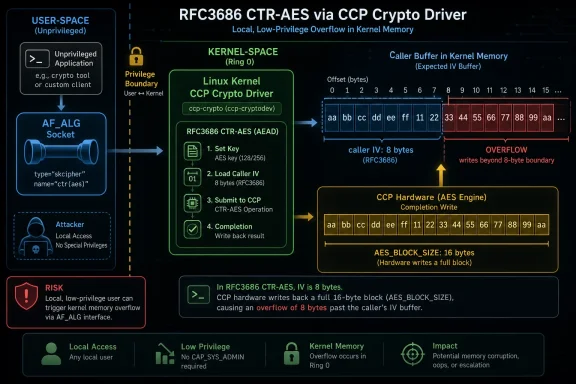 A Tiny IV Mismatch Becomes a Kernel-Sized Problem
The vulnerability turns on a deceptively mundane fact: not every AES mode exposes the same initialization-vector size to its callers. In the affected path, AF_ALG requests using rfc3686-ctr-aes-ccp provide an 8-byte IV, while the CCP AES completion routine restores AES_BLOCK_SIZE bytes — 16 bytes — back into the caller’s IV buffer. That is an eight-byte overrun in kernel-adjacent crypto plumbing.Eight bytes does not sound dramatic until one remembers where this code runs. Kernel crypto drivers are not application libraries with neat process boundaries and forgiving crash semantics. They handle buffers supplied through kernel APIs, interact with hardware acceleration, and sit close enough to privilege boundaries that an incorrect length value deserves the severity assigned to it.
The fix is equally revealing. Instead of assuming the AES block size, the corrected code uses the skcipher algorithm’s declared IV size. In other words, the patch does not introduce a new security framework or mitigation; it replaces a wrong assumption with the value the kernel crypto API already knew.
That is the most important lesson of CVE-2026-53016. Mature systems fail not only because nobody checked the length, but because one valid length in one layer was treated as universally valid in another.
The Crypto Driver Is the Wrong Place for Wishful Thinking
The affected component is the Linux kernel’s CCP crypto driver, associated with AMD’s Cryptographic Coprocessor support. CCP exists to offload cryptographic work to hardware, improving performance for operations that would otherwise consume CPU cycles. For most users, it is not a feature they knowingly turn on; it is part of the platform stack beneath storage, networking, virtualization, and application workloads.That invisibility is precisely why this kind of bug is awkward for administrators. Nobody deploys “CVE-2026-53016” as an application feature. It arrives as a kernel capability, often enabled because a distribution kernel supports the hardware in the box.
The vulnerable path involves AF_ALG, the Linux interface that exposes kernel crypto algorithms to user space through sockets. AF_ALG is powerful because it lets applications use kernel-provided crypto implementations. It is also sensitive because it creates a bridge between user-space requests and kernel crypto internals.
The reported attack vector is local and requires low privileges. That matters. This is not a bug where an unauthenticated attacker can throw packets at a machine from the internet and expect compromise. But local does not mean irrelevant in 2026, when shared servers, container hosts, CI workers, HPC systems, desktop multi-user environments, and compromised low-privilege service accounts all provide plausible starting points for local exploitation.
The CVSS Score Says “High,” but the Threat Model Says “Patch with Context”
Kernel.org assigned a CVSS 3.1 score of 7.8, with local attack vector, low attack complexity, low privileges required, no user interaction, unchanged scope, and high impact across confidentiality, integrity, and availability. Red Hat’s security analysis also rates it high, though with high attack complexity and a 7.0 score. That difference is not a contradiction so much as a reminder that CVSS is a model, not a measurement.The distinction between low and high attack complexity will matter to defenders trying to prioritize emergency maintenance windows. A buffer overrun in kernel crypto code is serious, but the details of exploitability depend on memory layout, surrounding allocations, enabled hardware, kernel configuration, hardening features, and whether an attacker can reliably shape the vulnerable call path.
This is where enterprise patch management often goes wrong. A “high” kernel CVE becomes either a reason for immediate disruption everywhere or a ticket that gets buried because it is “only local.” Both reactions flatten the actual risk.
A better reading is narrower and more useful: systems that expose local shell access, run untrusted workloads, host containers from multiple tenants, process untrusted jobs, or depend on AF_ALG-enabled crypto paths deserve faster attention. Single-user desktops and tightly controlled appliances may not warrant the same operational urgency, but they still need the fix through normal kernel update channels.
The Bug Is Old Enough to Be Boring, Which Makes It More Interesting
The affected version history traces the issue back to kernel development long before the 2026 disclosure. The record indicates Linux versions from 3.14 onward were in the affected range until stable fixes landed across maintained branches. That age is not unusual in kernel security. Long-lived subsystems accumulate assumptions, and those assumptions can survive years of refactoring, backporting, and hardware evolution.Old bugs often look obvious in hindsight. Once the problem is named, the mismatch is clean: RFC3686 skciphers expose an 8-byte IV; the completion path writes 16 bytes; the right answer is to ask the skcipher for its IV size. But hindsight hides the complexity of the environment in which the mistake lived.
Kernel crypto code is a matrix of algorithms, modes, accelerators, scatter-gather buffers, asynchronous completions, and compatibility layers. The error here sits at the intersection of a generic API and a driver-specific completion routine. That is exactly where length assumptions become dangerous, because each side can be internally consistent while the boundary between them is wrong.
The persistence of the bug also says something about testing. Unit tests and fuzzers are much better than they were a decade ago, but hardware-backed crypto paths are harder to exercise comprehensively than pure software code. If a bug only appears when a particular algorithm wrapper, IV size, and driver completion path align, it can evade broad coverage for a long time.
Red Hat’s Matrix Shows Why Distribution Status Matters More Than Upstream Drama
The NVD entry lists Red Hat Enterprise Linux 8, 9, and 10 as affected, while Red Hat Enterprise Linux 6 and 7 are marked unaffected in the referenced Red Hat data. That distribution-level view matters because most administrators do not run “the Linux kernel” in the abstract. They run a vendor-supported kernel with backports, configuration choices, module policies, and hardware enablement decisions.This is where upstream version numbers can mislead. A mainline kernel range can identify where a flaw exists in source history, but an enterprise distribution may carry fixes, omit features, disable paths, or maintain older-looking kernels with extensive vendor patch sets. Conversely, a distribution may be affected even when its version string appears distant from modern mainline numbering.
For WindowsForum readers who also administer Linux estates — and many do, especially in mixed Microsoft and cloud environments — the lesson is familiar from Windows servicing: trust the vendor advisory for the product you actually run. Kernel.org tells you what was fixed upstream. Red Hat, Canonical, SUSE, Debian, Amazon, Oracle, and others tell you whether your shipped kernel is exposed and which package closes the gap.
The Red Hat affected-state split is also a useful reminder that end-of-life or legacy platforms do not always map neatly to vulnerability exposure. “Unaffected” does not mean “healthy,” and “affected” does not mean “unsupported.” It means the vulnerable code path, as assessed by the vendor, is or is not present in the product line.
The Windows Angle Is Not That Windows Is Vulnerable
This is a Linux kernel CVE, not a Windows CVE. Microsoft’s desktop and server kernel are not affected by this specific bug in the Linux CCP driver. But that does not make the story irrelevant to a Windows-centered audience.Modern Windows environments are rarely Windows-only. Developers run WSL. Enterprises host Linux workloads in Azure. Security teams monitor Linux containers on Windows-managed networks. Identity, logging, endpoint detection, and patch orchestration increasingly span operating systems even when the help desk still thinks in Windows build numbers.
There is also the virtualization angle. A Windows admin may own the Hyper-V cluster while Linux guests run business-critical workloads. A cloud administrator may manage the tenant policy while the vulnerable kernel lives inside a VM image maintained by an application team. A developer may use a Linux container toolchain on a Windows workstation without thinking about the host and guest kernel boundary.
CVE-2026-53016 should therefore be treated as a cross-platform operations issue, not because Windows inherits the bug, but because Windows shops inherit Linux dependencies. The attack surface of an organization is not defined by the logo on the laptop lid.
Local Kernel Bugs Still Matter in the Age of Containers
Security teams have spent years training themselves to prioritize remotely exploitable bugs, and for good reason. Internet-facing remote code execution remains the fastest route from disclosure to mass exploitation. But local kernel vulnerabilities occupy a different and increasingly important tier of risk.A local kernel bug becomes dangerous after the first compromise. Once an attacker lands as a low-privilege user, escape and escalation become the next objective. In containerized environments, the distinction between local and remote can also blur: a remotely exploitable application bug inside a container may become a local kernel attack against the underlying host if the right primitive exists.
CVE-2026-53016 is not automatically a container escape. The public description does not establish a ready-made exploit chain or show active exploitation. But the class of issue — a kernel buffer access with an incorrect length value — is the kind of primitive exploit developers study carefully.
For administrators, the right posture is neither alarmism nor complacency. Assume local kernel bugs are post-compromise accelerants. Patch them before they become part of somebody else’s exploit recipe.
The Fix Is Small Because the Contract Was Already There
The elegance of the patch is that it asks the crypto API for the IV size instead of hard-coding the AES block size. That sounds almost too simple, but it is the difference between coding against an implementation detail and coding against an interface contract.AES has a 16-byte block size. RFC3686 CTR mode, as exposed through the relevant skcipher path, uses an 8-byte IV. Both statements can be true at the same time. The vulnerability exists because code treated the first truth as if it overrode the second.
This is a recurring theme in systems programming. Constants are seductive because they make code look precise. But the wrong constant, used in the wrong layer, is worse than a variable because it carries false authority.
The kernel’s crypto API already had a way to answer the question.
crypto_skcipher_ivsize() exists to report the IV size for the algorithm in use. The fix therefore reinforces a principle that applies far beyond Linux: when an abstraction publishes a size, trust the abstraction, not your memory of the underlying primitive.Security Automation Will See the CVE Before Many Humans Understand It
NVD received the CVE on June 24, 2026, and the record was modified on June 29 as Red Hat enrichment and scoring appeared. That sequence is typical of modern vulnerability publication. The identifier lands first, vendor and database metadata follow, and scanners begin flagging assets before every distribution has fully digested the operational implications.This can create friction inside IT teams. A vulnerability dashboard may light up with a high-severity kernel CVE, while administrators find that NVD has not yet supplied its own CVSS score and that distribution advisories differ on complexity. The result is a familiar argument: security wants the red item cleared; operations wants to know whether the affected code can actually run on their systems.
The answer is inventory. If you do not know which kernels, hardware features, crypto modules, and distribution package streams you run, you cannot reason about CVE-2026-53016. You can only react to it.
That inventory should include ephemeral systems. Build runners, lab hosts, disposable VMs, Kubernetes nodes, and developer workstations often lag behind production patching because they are treated as less critical. Attackers may disagree. A compromised CI runner with a local kernel escalation path is not a low-value asset.
Hardware Acceleration Expands the Patch Surface
Hardware crypto acceleration is a net positive for performance and, in many cases, security. It reduces CPU overhead, enables higher throughput, and lets systems use platform capabilities efficiently. But every acceleration path is also code, and every driver path is another place where generic assumptions meet device-specific behavior.The CCP driver is a good example of that tradeoff. It exists so Linux can use AMD platform crypto features rather than falling back solely to software implementations. That is useful. It also means a bug in the integration layer can affect systems not because administrators installed a risky application, but because the kernel is doing what it was designed to do.
This is not an argument against acceleration. It is an argument against treating acceleration as invisible magic. When cryptographic operations move between user space, kernel APIs, software fallbacks, and device drivers, the boundaries between those layers must be as carefully audited as the algorithms themselves.
The industry has learned to distrust homegrown cryptography. CVE-2026-53016 reminds us that even standard cryptography can be undermined by mundane buffer handling around it.
The Patch Queue Is Where the Real Work Begins
For individual Linux users, the advice is straightforward: install the kernel update from your distribution when it becomes available, and reboot into the fixed kernel. For enterprises, the work is less tidy. Kernel updates require coordination, testing, outage windows, live-patching policies, and rollback plans.Live patching may eventually cover some environments, depending on vendor support, kernel branch, and the nature of the change. But administrators should not assume that every kernel CVE can be safely live-patched everywhere. Crypto driver code, hardware interaction, and module state can complicate the picture.
The most reliable mitigation remains the boring one: apply the vendor kernel package and reboot. That is not satisfying in a world that wants zero downtime, but kernel security still often ends at the bootloader.
Teams should also verify that systems actually booted into the fixed kernel. Package installation alone is not enough. Linux estates are littered with machines that have downloaded patched kernels but continue running vulnerable ones because nobody scheduled a restart.
There Is No Public Exploit Panic, but There Is a Window
At the time of publication, the public record describes the vulnerability and the fix; it does not establish widespread exploitation. That should lower the temperature, not the priority. The period between CVE publication and broad patch adoption is exactly when researchers, defenders, and attackers all study the same diff.Kernel patch diffs are unusually informative. When the fix changes a copy length from a constant to an algorithm-reported IV size, the vulnerable condition is not hard to understand. Turning that understanding into a reliable exploit is a separate and often difficult task, but defenders should not confuse difficulty with impossibility.
The danger window is also uneven. A well-managed enterprise with rapid kernel patch testing may close it quickly. A fleet of appliances, embedded systems, research workstations, and forgotten lab servers may carry it for months or years.
This is why CVE records are not merely advisories; they are maps of technical debt. CVE-2026-53016 points to a specific bug, but the broader exposure is the set of systems whose owners cannot quickly answer whether the bug applies.
The Kernel CVE Firehose Rewards Triage, Not Fatigue
Linux kernel CVEs have become more frequent and more granular as the kernel security process has evolved. That is good for transparency, but it can be exhausting for administrators. A constant stream of high and medium kernel issues risks creating the very fatigue that attackers benefit from.CVE-2026-53016 is a useful case study because it resists simplistic sorting. It is high severity, but local. It is a buffer overrun, but in a specific crypto driver path. It affects important enterprise distributions, but not every legacy line. It has a small fix, but the operational act of deploying that fix may be large.
The right triage posture starts with exposure. Does the system run an affected vendor kernel? Is the CCP driver present and usable? Are untrusted local users or workloads present? Is AF_ALG available to the relevant users? Is the system part of a shared hosting, container, CI, or multi-tenant environment? Those answers shape urgency more intelligently than the score alone.
Security teams should still avoid inventing comfort. If the only reason a local kernel bug is considered low priority is that “nobody should have local access,” the organization is one phishing email, web shell, leaked SSH key, or vulnerable app away from testing that assumption.
The Eight Bytes Administrators Should Not Ignore
CVE-2026-53016 is not the kind of vulnerability that should send every admin sprinting to the data center at midnight, but it is also not a harmless bookkeeping entry. Its importance lies in the combination of kernel privilege, crypto-driver subtlety, enterprise distribution exposure, and the ease with which local bugs become escalation tools after an initial foothold.- CVE-2026-53016 affects the Linux kernel’s CCP crypto driver path for AF_ALG RFC3686 CTR-AES operations.
- The bug occurs because code restores 16 bytes of IV data into a buffer that may only be 8 bytes for the exposed skcipher algorithm.
- The upstream fix uses the algorithm’s reported IV size rather than assuming the AES block size.
- The vulnerability is local and requires low privileges, so internet-facing remote exploitation is not the primary concern.
- Shared systems, container hosts, CI runners, developer workstations, and multi-user servers should receive faster patch attention.
- Administrators should confirm that patched kernels are not only installed but actually running after reboot.
References
- Primary source: NVD / Linux Kernel
Published: 2026-07-03T01:05:17-07:00
NVD - CVE-2026-53016
 nvd.nist.gov
- Security advisory: MSRC
Published: 2026-07-03T01:05:17-07:00
Original feed URL
Security Update Guide - Microsoft Security Response Center
 msrc.microsoft.com
- Related coverage: vuldb.com
CVE-2026-53016 Linux Kernel crypto ccp_aes_complete buffer overflow
A vulnerability was determined in Linux Kernel up to 7.0.9. This vulnerability is handled as CVE-2026-53016. The affected component should be upgraded.vuldb.com - Related coverage: security.snyk.io
Buffer Access with Incorrect Length Value in kernel-zfcpdump-devel | CVE-2026-53016 | Snyk
High severity (7) Buffer Access with Incorrect Length Value in kernel-zfcpdump-devel | CVE-2026-53016security.snyk.io - Related coverage: rapid7.com
Rapid7 Vulnerability Database
Rapid7's VulnDB is curated repository of vetted computer software exploits and exploitable vulnerabilities.www.rapid7.com - Related coverage: mchehab.fedorapeople.org
- Related coverage: digi.com
</rdf:Alt> </dc:title> <dc:description> <rdf:Alt> <rdf:li xml:lang="x-default"/> </rdf:Alt> </dc:description> <dc:creator> <rdf:Seq> <rdf:li>DePietr
</rdf:Alt> </dc:description> <dc:creator> <rdf:Seq> <rdf:li>DePietro, Zachwww.digi.com
- Related coverage: support.bull.com