

CVE-2026-53199 is a newly published Linux kernel vulnerability affecting the Hyper-V network driver, hv_netvsc, where an unsafe memory-address conversion in netvsc_copy_to_send_buf can crash certain Linux guests during packet transmission on Hyper-V-based systems, including Windows-hosted and cloud-hosted virtualization environments. It is not a classic Windows desktop bug, and it is not a remote-code-execution headline waiting to happen. But it is exactly the sort of low-level interoperability flaw that matters in 2026, when “Windows infrastructure” often means Windows hosts, Linux guests, Azure images, nested virtualization, and kernel update pipelines moving at different speeds. The real story is not that a single memcpy can go wrong; it is that Microsoft’s platform now depends on Linux kernel plumbing being boring, correct, and promptly patched.
The oddity of CVE-2026-53199 is apparent before the technical details even begin. The advisory lands in Microsoft’s orbit because the affected code sits in the Linux driver stack for Hyper-V networking, not because Windows itself is mishandling packets in the traditional Patch Tuesday sense. The component name, hv_netvsc, is the tell: this is the Linux guest driver that talks to Hyper-V’s synthetic network device over VMBus.
That distinction matters because many administrators still mentally sort vulnerabilities by operating system brand. A Windows Server host running Linux virtual machines feels, operationally, like a Microsoft estate. An Azure Linux VM feels, commercially and contractually, like a Microsoft service. Yet the vulnerable code lives in the Linux kernel, is fixed through Linux kernel channels, and must flow through distributions, cloud images, appliance vendors, and sometimes frozen enterprise baselines before it reaches production.
CVE-2026-53199 is therefore a small but useful case study in hybrid platform risk. Microsoft can publish guidance, kernel maintainers can land a fix, and distributions can triage their supported kernels, but the machine that crashes is still the one your application depends on. The stack is shared; the maintenance burden is not always shared cleanly.
The problem appears when packet fragments point to pages that are not guaranteed to be in that direct mapping. On 32-bit x86 kernels built with high memory support, some pages can live above the low-memory boundary. For those pages, the old phys_to_virt approach can produce an address the kernel cannot safely dereference. The next memcpy happens in a transmit softirq path, and the result can be fatal.
The fix replaces that assumption with the kernel mechanism meant for the job: kmap_local_page. Instead of pretending every relevant page is permanently and conveniently addressable, the driver maps the page locally, copies what it needs, and then unmaps it. This is not glamorous security engineering. It is the disciplined removal of a shortcut that worked until the memory model proved it did not.
There is a second wrinkle that makes the patch more than a one-line substitution. Hyper-V page frame numbers are expressed at 4 KB granularity, while native Linux page sizes may differ on some architectures. The corrected code reconstructs the physical address carefully and copies across native page boundaries when necessary. That is the kind of detail that separates a narrowly patched crash from a fix that holds up across real kernel configurations.
That does not make it irrelevant. Kernel crashes in network transmit paths are ugly because they can turn ordinary traffic patterns into outages. Even if exploitation requires a specific guest configuration, a specific architecture, or a particular packet-buffer layout, the affected system is likely to fail at precisely the point where administrators expect virtualization abstractions to disappear into the background.
The most constrained part of the advisory is also the most reassuring. The vulnerable path is especially tied to 32-bit x86 with CONFIG_HIGHMEM enabled, a configuration that is far less common in modern cloud production than 64-bit Linux. Many enterprise Linux guests in Azure or Hyper-V are unlikely to match that exact profile. But “unlikely” is not the same as “nonexistent,” especially in industrial estates, lab systems, vendor appliances, legacy network functions, and long-lived virtual machines that nobody wants to touch until they break.
The right response is proportional rather than panicked. This is not a reason to emergency-reboot every Linux VM in sight. It is a reason to identify whether you still run 32-bit Linux guests on Hyper-V, whether any vendor-supplied virtual appliances ship with old kernels, and whether your normal kernel update process is actually normal or merely aspirational.
The hv_netvsc driver is central to that wiring. Synthetic networking is how Hyper-V avoids pretending that every VM is attached to an emulated physical NIC from another era. It is designed for performance and integration, not nostalgia. When this layer misbehaves, the failure is not cosmetic; it touches throughput, availability, and the trust boundary between guest operating systems and host virtualization services.
That is why a bug like CVE-2026-53199 deserves more attention than its likely severity score may earn. It sits at the seam where Microsoft’s virtualization platform, the Linux kernel’s memory-management rules, and enterprise workload assumptions meet. Those seams are increasingly where outages are born.
The fix also shows the quiet maturity of the Linux-on-Hyper-V ecosystem. The patch is specific, technically conservative, and shaped by cross-architecture realities. It accounts for Hyper-V’s page-size assumptions, Linux’s high-memory behavior, and earlier changes to page-buffer grouping. In other words, the ecosystem is no longer solving “make Linux run on Hyper-V.” It is solving “make Linux on Hyper-V correct under obscure but real kernel constraints.”
That makes inventory the hard part. A Windows administrator can patch a host cluster and still leave vulnerable Linux guests untouched. A cloud administrator can trust platform maintenance and still run custom images with stale kernels. A security team can see the CVE in Microsoft tooling and mistakenly assign it to the Windows patch queue, where it will sit until someone realizes the remediation path is through Linux kernel packages.
The distribution story will not be uniform. Mainline and stable kernel trees can absorb the fix quickly, while enterprise distributions evaluate backports according to supported kernel lines, severity, customer exposure, and lifecycle policy. Some vendors may mark certain combinations as not affected; others may ship fixes in routine kernel advisories; still others may leave obsolete branches to customers with extended support contracts.
That is normal, but it is also where risk hides. Kernel CVEs are often less about whether a patch exists somewhere and more about whether the specific kernel you actually run has received the backport. The version number alone may not tell the full story because enterprise kernels routinely backport fixes without rebasing to the latest upstream release.
Those systems are risky not because they are everywhere, but because they are poorly understood. They often sit outside the golden-image pipeline. Their owners may not know the kernel configuration. Their workloads may be fragile enough that nobody wants to reboot them, which is exactly why they tend to remain exposed to kernel bugs long after a fix exists.
CVE-2026-53199 is a reminder that virtualization does not make legacy disappear. It preserves it. Hyper-V has been good enough for long enough that old Linux guests can continue running quietly on modern hosts. That is operationally convenient until a guest driver bug turns the network path into a crash path.
The practical test is simple but uncomfortable: if you cannot quickly say which Linux guests are 32-bit, which use Hyper-V synthetic networking, and which kernel builds include the fix, you do not have a vulnerability-management problem so much as an asset-intelligence problem. The CVE is merely the flashlight.
Start with exposure. Linux guests running on Hyper-V or Azure are the population of interest. Within that group, older 32-bit x86 kernels with high memory support deserve the closest look. Systems handling unusual network workloads, packet-heavy services, or untrusted traffic paths should move higher in the queue, because the vulnerable path is tied to packet transmission and buffer handling.
Then look at consequences. A crash in a redundant web worker is annoying. A crash in a single-instance license server, plant-floor controller, VPN appliance, or domain-adjacent monitoring node is a business incident. Vulnerability severity scores rarely capture that difference well, because they cannot know your topology.
Finally, check the remediation channel. If the guest is distribution-managed, watch for the vendor kernel advisory and confirm the installed package includes the backport. If it is a custom kernel, appliance kernel, or manually maintained image, the question becomes more expensive: who owns the kernel, who can rebuild it, and how will you test the result?
That creates an interesting responsibility gap. Microsoft can identify the issue as relevant to its virtualization ecosystem, but it cannot patch every Linux guest in every customer estate. The company controls Azure platform infrastructure and Windows host updates; it does not control a customer’s pinned Debian kernel, a third-party firewall appliance, or a 32-bit VM restored from a long-forgotten backup.
This is the shape of modern platform security. Vendors increasingly publish advisories for components they do not wholly own because customers experience the risk through the vendor’s platform. The clean old boundary between “Microsoft vulnerability” and “Linux vulnerability” is less useful than the operational question: which team must act to prevent downtime?
For Windows administrators, that means Linux kernel literacy is no longer optional in mixed estates. You do not need to become a kernel maintainer. You do need to know when a Microsoft-branded advisory is telling you to inspect a Linux guest, not wait for a Windows cumulative update.
That matters because driver fixes live under performance suspicion. Network transmit paths are hot paths, and administrators are rightly wary of patches that trade a rare crash for a measurable throughput penalty. The available description suggests the corrected copy path remains bounded by the send section size, with larger packets taking a different partial-copy path. In other words, the fix is designed to be precise rather than punitive.
There is also a broader lesson here for kernel code that spans architectures and hypervisors. Page frame numbers, page sizes, direct maps, and buffer fragments are not interchangeable abstractions. Code that works on the most common 64-bit configuration may still be wrong in the general case. CVE assignment turns that wrongness into a security artifact, but the underlying issue is engineering discipline.
The best kernel security fixes often look like this. They do not add a new mitigation framework or a marketing-ready protection layer. They remove a lie the code was telling itself.
The most important step is to find the machines that combine Linux guests with Hyper-V synthetic networking. That includes on-prem Hyper-V, Windows Server failover clusters, Azure VMs, Azure Stack-derived environments, and lab infrastructure where old images accumulate. From there, filter for 32-bit x86 and older kernels, especially those built with high memory support.
If your estate is entirely 64-bit modern distribution images with current vendor kernels, this CVE is likely to be a routine tracking item. If you discover 32-bit Linux guests you had forgotten existed, the vulnerability may be the least interesting thing you learn. The existence of those systems should trigger a lifecycle conversation even after this patch is applied.
The operational goal is not perfection by Monday morning. It is to prevent a narrow kernel bug from exposing a broader maintenance blind spot.
 The Microsoft Advisory Points at a Linux Problem in Microsoft’s Backyard
The oddity of CVE-2026-53199 is apparent before the technical details even begin. The advisory lands in Microsoft’s orbit because the affected code sits in the Linux driver stack for Hyper-V networking, not because Windows itself is mishandling packets in the traditional Patch Tuesday sense. The component name, hv_netvsc, is the tell: this is the Linux guest driver that talks to Hyper-V’s synthetic network device over VMBus.That distinction matters because many administrators still mentally sort vulnerabilities by operating system brand. A Windows Server host running Linux virtual machines feels, operationally, like a Microsoft estate. An Azure Linux VM feels, commercially and contractually, like a Microsoft service. Yet the vulnerable code lives in the Linux kernel, is fixed through Linux kernel channels, and must flow through distributions, cloud images, appliance vendors, and sometimes frozen enterprise baselines before it reaches production.
CVE-2026-53199 is therefore a small but useful case study in hybrid platform risk. Microsoft can publish guidance, kernel maintainers can land a fix, and distributions can triage their supported kernels, but the machine that crashes is still the one your application depends on. The stack is shared; the maintenance burden is not always shared cleanly.
One Bad Assumption About Memory Was Enough
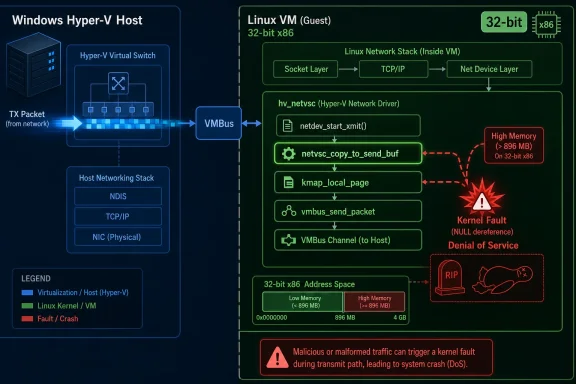
The bug is rooted in a familiar kernel programming trap: assuming that a physical page frame can be turned into a usable kernel virtual address with a simple conversion. In the affected path, netvsc_copy_to_send_buf copies packet data into a Hyper-V VMBus send buffer. For some packet pieces, that conversion is safe enough because the memory comes from ordinary kernel allocations that live in the direct map.The problem appears when packet fragments point to pages that are not guaranteed to be in that direct mapping. On 32-bit x86 kernels built with high memory support, some pages can live above the low-memory boundary. For those pages, the old phys_to_virt approach can produce an address the kernel cannot safely dereference. The next memcpy happens in a transmit softirq path, and the result can be fatal.
The fix replaces that assumption with the kernel mechanism meant for the job: kmap_local_page. Instead of pretending every relevant page is permanently and conveniently addressable, the driver maps the page locally, copies what it needs, and then unmaps it. This is not glamorous security engineering. It is the disciplined removal of a shortcut that worked until the memory model proved it did not.
There is a second wrinkle that makes the patch more than a one-line substitution. Hyper-V page frame numbers are expressed at 4 KB granularity, while native Linux page sizes may differ on some architectures. The corrected code reconstructs the physical address carefully and copies across native page boundaries when necessary. That is the kind of detail that separates a narrowly patched crash from a fix that holds up across real kernel configurations.
This Is a Denial-of-Service Class Bug, Not a Wormable Windows Scare
Nothing in the available technical description suggests that CVE-2026-53199 is a remote-code-execution vulnerability. The described failure mode is a kernel fault during transmit handling, triggered when the driver tries to copy from an invalid virtual address. In practical terms, administrators should think first about guest stability, service availability, and workload disruption.That does not make it irrelevant. Kernel crashes in network transmit paths are ugly because they can turn ordinary traffic patterns into outages. Even if exploitation requires a specific guest configuration, a specific architecture, or a particular packet-buffer layout, the affected system is likely to fail at precisely the point where administrators expect virtualization abstractions to disappear into the background.
The most constrained part of the advisory is also the most reassuring. The vulnerable path is especially tied to 32-bit x86 with CONFIG_HIGHMEM enabled, a configuration that is far less common in modern cloud production than 64-bit Linux. Many enterprise Linux guests in Azure or Hyper-V are unlikely to match that exact profile. But “unlikely” is not the same as “nonexistent,” especially in industrial estates, lab systems, vendor appliances, legacy network functions, and long-lived virtual machines that nobody wants to touch until they break.
The right response is proportional rather than panicked. This is not a reason to emergency-reboot every Linux VM in sight. It is a reason to identify whether you still run 32-bit Linux guests on Hyper-V, whether any vendor-supplied virtual appliances ship with old kernels, and whether your normal kernel update process is actually normal or merely aspirational.
Hyper-V’s Linux Story Has Become Infrastructure, Not Compatibility Theater
A decade ago, Linux support on Hyper-V was often discussed as a compatibility checkbox. Could the guest boot? Did the network adapter work? Were integration services installed? That framing now feels quaint. Linux on Hyper-V is no longer a guest at the party; it is part of the building’s wiring.The hv_netvsc driver is central to that wiring. Synthetic networking is how Hyper-V avoids pretending that every VM is attached to an emulated physical NIC from another era. It is designed for performance and integration, not nostalgia. When this layer misbehaves, the failure is not cosmetic; it touches throughput, availability, and the trust boundary between guest operating systems and host virtualization services.
That is why a bug like CVE-2026-53199 deserves more attention than its likely severity score may earn. It sits at the seam where Microsoft’s virtualization platform, the Linux kernel’s memory-management rules, and enterprise workload assumptions meet. Those seams are increasingly where outages are born.
The fix also shows the quiet maturity of the Linux-on-Hyper-V ecosystem. The patch is specific, technically conservative, and shaped by cross-architecture realities. It accounts for Hyper-V’s page-size assumptions, Linux’s high-memory behavior, and earlier changes to page-buffer grouping. In other words, the ecosystem is no longer solving “make Linux run on Hyper-V.” It is solving “make Linux on Hyper-V correct under obscure but real kernel constraints.”
The Patch Pipeline Is the Real Operational Risk
For WindowsForum readers, the instinct may be to ask which Windows update fixes this. That is the wrong first question. The relevant patch belongs to the Linux kernel you are running inside the guest, not to the Windows host alone. Hyper-V may be the platform context, but the vulnerable code path is guest-side.That makes inventory the hard part. A Windows administrator can patch a host cluster and still leave vulnerable Linux guests untouched. A cloud administrator can trust platform maintenance and still run custom images with stale kernels. A security team can see the CVE in Microsoft tooling and mistakenly assign it to the Windows patch queue, where it will sit until someone realizes the remediation path is through Linux kernel packages.
The distribution story will not be uniform. Mainline and stable kernel trees can absorb the fix quickly, while enterprise distributions evaluate backports according to supported kernel lines, severity, customer exposure, and lifecycle policy. Some vendors may mark certain combinations as not affected; others may ship fixes in routine kernel advisories; still others may leave obsolete branches to customers with extended support contracts.
That is normal, but it is also where risk hides. Kernel CVEs are often less about whether a patch exists somewhere and more about whether the specific kernel you actually run has received the backport. The version number alone may not tell the full story because enterprise kernels routinely backport fixes without rebasing to the latest upstream release.
Legacy Guests Are Where Small Kernel Bugs Become Expensive
The affected configuration details point toward legacy rather than mainstream cloud-native deployments. A 32-bit x86 Linux guest with high memory enabled is not the default mental picture of a modern Azure VM fleet. But administrators who have been around long enough know where such systems live: in vendor appliances, old monitoring stacks, embedded build systems, forgotten jump boxes, telecom components, manufacturing controllers, and “temporary” VMs that became permanent in 2014.Those systems are risky not because they are everywhere, but because they are poorly understood. They often sit outside the golden-image pipeline. Their owners may not know the kernel configuration. Their workloads may be fragile enough that nobody wants to reboot them, which is exactly why they tend to remain exposed to kernel bugs long after a fix exists.
CVE-2026-53199 is a reminder that virtualization does not make legacy disappear. It preserves it. Hyper-V has been good enough for long enough that old Linux guests can continue running quietly on modern hosts. That is operationally convenient until a guest driver bug turns the network path into a crash path.
The practical test is simple but uncomfortable: if you cannot quickly say which Linux guests are 32-bit, which use Hyper-V synthetic networking, and which kernel builds include the fix, you do not have a vulnerability-management problem so much as an asset-intelligence problem. The CVE is merely the flashlight.
The Technical Narrowness Should Shape, Not Excuse, the Response
Security teams often face a choice between overreaction and dismissal. CVE-2026-53199 deserves neither. The narrowness of the bug should guide prioritization, not become an excuse for ignoring it.Start with exposure. Linux guests running on Hyper-V or Azure are the population of interest. Within that group, older 32-bit x86 kernels with high memory support deserve the closest look. Systems handling unusual network workloads, packet-heavy services, or untrusted traffic paths should move higher in the queue, because the vulnerable path is tied to packet transmission and buffer handling.
Then look at consequences. A crash in a redundant web worker is annoying. A crash in a single-instance license server, plant-floor controller, VPN appliance, or domain-adjacent monitoring node is a business incident. Vulnerability severity scores rarely capture that difference well, because they cannot know your topology.
Finally, check the remediation channel. If the guest is distribution-managed, watch for the vendor kernel advisory and confirm the installed package includes the backport. If it is a custom kernel, appliance kernel, or manually maintained image, the question becomes more expensive: who owns the kernel, who can rebuild it, and how will you test the result?
Microsoft’s Role Is Advisory, but Its Ecosystem Role Is Larger
Microsoft’s publication of this CVE through its security machinery is useful precisely because it catches the attention of Windows-centric organizations. Many of those organizations run Linux not as a philosophical choice but as a workload requirement. They may not follow Linux kernel mailing lists, but they do follow Microsoft security feeds.That creates an interesting responsibility gap. Microsoft can identify the issue as relevant to its virtualization ecosystem, but it cannot patch every Linux guest in every customer estate. The company controls Azure platform infrastructure and Windows host updates; it does not control a customer’s pinned Debian kernel, a third-party firewall appliance, or a 32-bit VM restored from a long-forgotten backup.
This is the shape of modern platform security. Vendors increasingly publish advisories for components they do not wholly own because customers experience the risk through the vendor’s platform. The clean old boundary between “Microsoft vulnerability” and “Linux vulnerability” is less useful than the operational question: which team must act to prevent downtime?
For Windows administrators, that means Linux kernel literacy is no longer optional in mixed estates. You do not need to become a kernel maintainer. You do need to know when a Microsoft-branded advisory is telling you to inspect a Linux guest, not wait for a Windows cumulative update.
The Fix Is Boring in the Best Possible Way
The patch’s substance is the sort of work that rarely earns headlines: replace an unsafe mapping assumption, handle page boundaries correctly, and preserve performance characteristics where the expensive mapping path is unnecessary. On systems without high memory concerns, kmap_local_page can collapse to a simpler address lookup, limiting the cost of doing the right thing.That matters because driver fixes live under performance suspicion. Network transmit paths are hot paths, and administrators are rightly wary of patches that trade a rare crash for a measurable throughput penalty. The available description suggests the corrected copy path remains bounded by the send section size, with larger packets taking a different partial-copy path. In other words, the fix is designed to be precise rather than punitive.
There is also a broader lesson here for kernel code that spans architectures and hypervisors. Page frame numbers, page sizes, direct maps, and buffer fragments are not interchangeable abstractions. Code that works on the most common 64-bit configuration may still be wrong in the general case. CVE assignment turns that wrongness into a security artifact, but the underlying issue is engineering discipline.
The best kernel security fixes often look like this. They do not add a new mitigation framework or a marketing-ready protection layer. They remove a lie the code was telling itself.
The Windows Admin’s Checklist Is Shorter Than the Advisory Looks
For most WindowsForum readers, the action plan should be disciplined and limited. Do not treat this as a broad Hyper-V compromise. Do not waste cycles hunting for a Windows registry switch that does not exist. Do use it as a prompt to reconcile your virtualization inventory with your Linux patch process.The most important step is to find the machines that combine Linux guests with Hyper-V synthetic networking. That includes on-prem Hyper-V, Windows Server failover clusters, Azure VMs, Azure Stack-derived environments, and lab infrastructure where old images accumulate. From there, filter for 32-bit x86 and older kernels, especially those built with high memory support.
If your estate is entirely 64-bit modern distribution images with current vendor kernels, this CVE is likely to be a routine tracking item. If you discover 32-bit Linux guests you had forgotten existed, the vulnerability may be the least interesting thing you learn. The existence of those systems should trigger a lifecycle conversation even after this patch is applied.
The operational goal is not perfection by Monday morning. It is to prevent a narrow kernel bug from exposing a broader maintenance blind spot.
The Hyper-V Network Bug Leaves a Paper Trail Worth Following
CVE-2026-53199 should leave administrators with a handful of concrete conclusions, not a fog of kernel jargon. The vulnerability is specific, the fix is understandable, and the affected estates are likely smaller than the advisory’s Microsoft branding might imply.- CVE-2026-53199 affects the Linux Hyper-V network driver path, so remediation depends on the Linux guest kernel rather than a normal Windows cumulative update alone.
- The described crash condition is tied especially to 32-bit x86 Linux kernels with high memory support, making legacy guests and vendor appliances more interesting than mainstream 64-bit cloud images.
- The fix replaces unsafe direct physical-to-virtual address conversion with local page mapping and careful page-boundary handling.
- Administrators should verify distribution backports instead of assuming that an upstream kernel version number tells the whole patch story.
- The practical risk is availability loss from a guest kernel crash, not a broadly documented remote-code-execution scenario.
- The advisory is a useful test of whether Windows teams and Linux teams share the same inventory, ownership model, and reboot process.
References
- Primary source: MSRC
Published: 2026-06-28T01:41:25-07:00
Security Update Guide - Microsoft Security Response Center
 msrc.microsoft.com
- Official source: microsoft.com
MSRC - Microsoft Security Response Center
The Microsoft Security Response Center is part of the defender community and on the front line of security response evolution. For over twenty years, we have been engaged with security researchers working to protect customers and the broader ecosystem.www.microsoft.com
- Related coverage: sentinelone.com
CVE-2026-35199: SymCrypt Buffer Overflow Vulnerability
CVE-2026-35199 is a buffer overflow vulnerability in SymCrypt cryptographic library. Learn about its impact, affected versions, and mitigation methods.www.sentinelone.com
- Related coverage: vulnerability.circl.lu
Vulnerability-Lookup
Vulnerability-Lookup - Fast vulnerability lookup correlation from different sources.vulnerability.circl.lu - Related coverage: news.lavx.hu
Critical Remote Code Execution Vulnerability in Microsoft Windows Remote Desktop Services (CVE-2026-24306) | LavX News
Microsoft has issued an urgent security update addressing a critical remote code execution vulnerability in Windows Remote Desktop Services that allows attackers to execute arbitrary code on affected systems without user interaction.news.lavx.hu - Related coverage: sra.io
- Related coverage: kernel.googlesource.com
Loading…
kernel.googlesource.com