
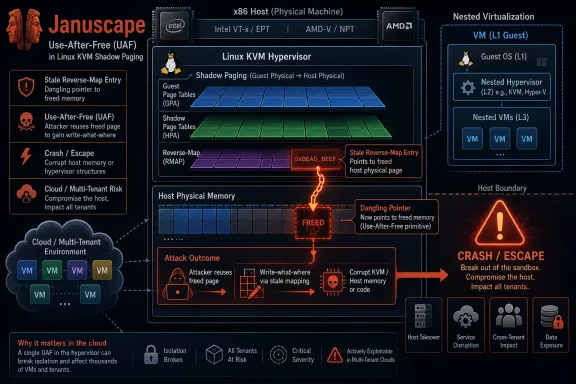
 Januscape Turns an Obscure MMU Corner into a Cloud Isolation Problem
The public disclosure on the oss-security mailing list gives the vulnerability its memorable name: Januscape. Hyunwoo Kim described it as a KVM/x86 guest-to-host escape vulnerability affecting both Intel and AMD hosts, with the immediate public proof-of-concept demonstrating host denial of service and a more serious exploit reportedly withheld. NVD’s record, by contrast, stays closer to the patch language: “KVM: x86: Fix shadow paging use-after-free due to unexpected role.”
Both accounts describe the same core failure from different altitudes. The vulnerability lives in the KVM x86 MMU code, specifically the shadow-paging machinery in arch/x86/kvm/mmu/mmu.c. That code exists because virtualization is not a single happy path; KVM sometimes has to emulate or maintain shadow translations instead of relying only on hardware-assisted second-level translation. Nested virtualization is where that distinction becomes operationally important, because running a hypervisor inside a guest can push KVM back into older shadow-MMU machinery that many administrators rarely think about directly.
The uncomfortable part is not simply that a bug exists in shadow paging. Kernel memory-management code is notoriously hard, and KVM’s MMU code has to reconcile guest page tables, host memory slots, dirty logging, invalidation, and hardware virtualization state. The uncomfortable part is that the bug sits exactly where cloud isolation is supposed to be boring: a guest is not supposed to be able to corrupt the host kernel’s tracking structures through guest-controlled page-table gymnastics.
NVD has not provided a CVSS score in the source material, but CISA’s SSVC data in the change history marks exploitation as poc, automatable as no, and technical impact as total. That combination is more useful than a premature numeric score. The public path is not a point-and-click worm, but the consequence of a successful attack against the right host configuration is not cosmetic.
The Bug Is a Role Mismatch, Not Merely a Bad Frame Number
The technical story begins with an earlier fix, commit 0cb2af2ea66ad, whose message was “KVM: x86: Fix shadow paging use-after-free due to unexpected GFN.” That earlier issue involved a mismatch between stored and computed guest frame numbers, or GFNs. NVD’s description says the old bug could be triggered by changing a PDE mapping from outside the guest and then deleting a memslot, causing rmap_remove() to miss entries because the GFN of the leaf SPTE did not match the GFN of the struct kvm_mmu_page.
CVE-2026-53359 is the sibling that survived because it is subtler. The GFN can be made to match, but the role of the shadow page does not. A large 2MB mapping can create a kvm_mmu_page with direct=1; a new 4KB path needs one with direct=0. The bug is that kvm_mmu_get_child_sp() did not compare that role before reusing the page.
That sounds like an implementation detail until you follow the cleanup path. KVM installs a 4KB leaf SPTE along the new path and records a reverse-map entry under the GFN resolved by the page-table walk. Later, when the child is zapped, the parent kvm_mmu_page still carries the wrong role, so kvm_mmu_page_get_gfn() computes the GFN as sp->gfn + index instead of using sp->shadowed_translation[], or sp->gfns[] in older kernels. The cleanup fails to remove the recorded rmap entry.
That dangling rmap entry is the fuse. When the memslot is dropped, the shadow page is freed, but the reverse-map entry remains. Later code that walks the GFN — dirty logging, MMU notifier invalidation, and similar paths — dereferences an sptep lying in the freed page. That is the use-after-free.
This is why the vulnerability is not well understood by staring only at the phrase “shadow paging.” The flaw is not that KVM forgot that a page existed. It is that KVM remembered the page under a partially correct identity: right GFN, wrong role. In isolation systems, partial identity checks are often worse than obvious failures because they allow bad state to pass through code that believes it has already validated the important thing.
Why Nested Virtualization Makes the Old Path Matter Again
Most administrators running KVM on modern Intel or AMD systems think in terms of hardware-assisted virtualization. That is fair; EPT and NPT are the familiar acceleration paths, and most VM performance discussions assume them. But nested virtualization changes the shape of the problem because the host KVM instance has to support a guest that may itself act like a hypervisor.
According to Kim’s oss-security disclosure, Januscape threatens KVM/x86 hosts that accept untrusted guests and expose nested virtualization, especially multi-tenant public cloud environments. The Hacker News’ coverage makes the same operational point: even hosts that normally use hardware EPT or NPT can be forced through the shadow MMU path when nested virtualization is exposed. That is the bridge between a narrow kernel bug and a cloud-scale risk.
This matters to WindowsForum readers because many “Windows” environments are no longer Windows-only. A Windows Server VM, a Windows 11 developer VM, or a domain-joined workload may be running on KVM infrastructure owned by an enterprise, a hosting provider, or a lab administrator. Conversely, Windows admins increasingly manage mixed estates where KVM hosts run next to Hyper-V clusters, VMware remnants, and cloud instances. CVE-2026-53359 is patched in Linux, not Windows, but the blast radius can include Windows workloads if they are tenants on a vulnerable KVM host.
It is also important not to overstate the consumer impact. This is not a Windows Update issue, not a Hyper-V advisory, and not a vulnerability in a Windows guest by itself. A Windows laptop running Hyper-V is not made vulnerable because KVM has a shadow-MMU bug. The concern is specifically Linux KVM/x86 hosts in configurations where untrusted guests can exercise the vulnerable path, with nested virtualization exposure being the central practical trigger described by the public reporting.
That distinction is not pedantry. Patching the wrong machine feels productive and changes nothing. The asset to inventory is the KVM host kernel, not the guest operating system label on the VM.
The Patch Boundary Is Clearer Than the Risk Score
NVD’s record gives unusually concrete affected and unaffected version data. The affected program file is arch/x86/kvm/mmu/mmu.c, the vendor and product are both listed as Linux, and the repository is the Linux stable tree. The affected semver lower bound is 2.6.36, while the listed unaffected boundaries include 6.1.177, 6.6.144, 6.12.95, 6.18.38, 7.1.3, and the original commit for fix version 7.2-rc1.
For administrators, this means there are two questions, not one. First, is the running kernel lineage old enough to contain the affected KVM MMU code? Second, has the distribution backported the fix even if its visible package version does not look like one of the upstream stable boundaries? Enterprise Linux vendors often backport security fixes without moving to the upstream version number that appears in NVD.
| Track | Status before fix | Unaffected boundary listed by NVD | What admins should verify |
|---|---|---|---|
| Semver baseline | 2.6.36 affected | Earlier than 2.6.36 listed unaffected | Legacy kernels are not automatically safe; verify KVM exposure and vendor support |
| 6.1 series | Affected before boundary | 6.1.177 | Confirm the distro kernel includes the KVM/x86 MMU fix |
| 6.6 series | Affected before boundary | 6.6.144 | Confirm package changelog or vendor advisory, not only uname -r |
| 6.12 series | Affected before boundary | 6.12.95 | Prioritize hosts exposing nested virtualization |
| 6.18 series | Affected before boundary | 6.18.38 | Reboot into the fixed kernel after patching |
| 7.1 / mainline fix path | Affected before boundary | 7.1.3; original fix in 7.2-rc1 | Confirm the specific fix is present or backported |
The git boundaries in the NVD record are similarly explicit. The affected lower-bound commit is 2032a93d66fa282ba0f2ea9152eeff9511fa9a96, and NVD lists fixed boundaries including b1337aae5e194324e4810d561764e7793f8b3864, 9291654d69e08542de37755cebe4d5b02c3170d1, 2ad3afa40ac6aa340dada122f9abfa46c0a6eb35, 5e470998a23e4c3d89ed24e8172cb22747e61efa, 1ae7d5a6db6c190ce183e3098ca0e0846e14d462, and 81ccda30b4e83d8f5cc4fd50503c44e3a33abfeb. Those hashes are useful for kernel builders and distribution maintainers, but most IT teams should treat them as a way to validate vendor claims rather than as a manual patching recipe.
The key operational trap is waiting for NVD to finish enrichment. NVD says its CVSS 4.0, 3.x, and 2.0 assessments are not yet provided in the source record. That absence should not become a reason to delay. CISA’s SSVC entry already says proof-of-concept exploitation exists and that the technical impact is total.
The Public Proof-of-Concept Changes the Patch Clock
The oss-security post includes a public denial-of-service proof-of-concept. Kim’s disclosure says the embargo agreed with Linux distribution maintainers had expired, that the issue was reported to [email][email protected][/email], and that it had been patched in mainline. The post also says Januscape was successfully used as a zero-day exploit in Google kvmCTF.
That last claim is important because it separates this from a purely theoretical bug discovered by inspection. kvmCTF exists to exercise exactly the class of boundary KVM operators care about: guest-to-host exploitation under controlled conditions. A bug that can win in that setting deserves a different level of attention from a bug whose exploitability is unknown.
The public PoC also shapes the immediate risk. According to the disclosure and subsequent coverage, the public artifact demonstrates host denial of service rather than handing every reader a turnkey cloud escape. That is not comforting for multi-tenant KVM operators. A guest-triggered host panic can still take down unrelated workloads on the same physical system, and denial of service against a hypervisor host is not an academic outcome in a shared environment.
The more serious claim is that a separate exploit can turn the bug into host code execution. That claim should be treated carefully: the full exploit is reportedly withheld, and administrators should not assume they can reproduce it from public material. But defenders do not need public weaponization to justify urgency when the primitive is a host-kernel use-after-free reachable from guest-side actions in exposed configurations.
The fact pattern also explains why CISA’s SSVC field says exploitation is poc and automatable is no. This is not described as a self-propagating internet-scale exploit. It is a highly specific hypervisor bug that requires the right guest privilege and host configuration. But in the environments where those conditions are normal — rented cloud instances, CI systems that expose nested virtualization, training labs, malware sandboxes, build farms, and private clouds — “specific” does not mean “rare.”
Where Windows Administrators Should Actually Look
For Windows administrators, the instinct may be to ask whether Windows guests are vulnerable. That is the wrong first question. CVE-2026-53359 is a Linux kernel KVM host vulnerability; the guest’s value to the attacker is its ability to exercise KVM’s vulnerable path. The risk lands on the host boundary and then radiates to every tenant that trusted that host.
Start with virtualization ownership. If your Windows servers run on Hyper-V, this CVE is not your hypervisor patch. If your Windows servers run on VMware, the same is true. If your Windows workloads run on Linux KVM — whether through a cloud provider, OpenStack, Proxmox, oVirt-derived infrastructure, bespoke libvirt fleets, or a managed hosting environment — you need host-side assurance that the kernel has been fixed or that nested virtualization is not exposed to untrusted guests.
The most awkward cases are mixed estates where no one owns the whole diagram. A Windows team may own the VM, a Linux platform team may own the host, a cloud team may own the templates, and a security team may own the vulnerability scanner. CVE-2026-53359 cuts across that model because the vulnerable code is below the guest, while the exploit trigger is above the hardware. The owner of the Windows workload may be the person who suffers the outage, but not the person who can patch the kernel.
There is also a tenant-assurance angle. If you buy KVM-backed hosting and use nested virtualization for Android emulators, CI workloads, security research labs, or developer hypervisors inside VMs, ask the provider directly whether nested virtualization is exposed on x86 KVM hosts and whether the host kernels include the fix. “We patched the guest images” is not an answer to this CVE.
For homelabs and small businesses, the risk calculus is different but still real. A single-user Proxmox host running trusted VMs is not the same as a public cloud host running adversarial tenants. But many labs expose nested virtualization casually because it is useful for testing Hyper-V, VMware, Android emulators, Kubernetes-in-VMs, or malware-analysis sandboxes. If a guest is untrusted, borrowed, downloaded, or intentionally hostile, then the host should be treated like a production boundary.
Timeline
July 4, 2026 — NVD published CVE-2026-53359 and recorded the issue as received from kernel.org at 8:17:01 AM, including the KVM/x86 shadow-paging use-after-free description and the stable kernel references.
July 6, 2026 — The CVE record was modified at 3:17:07 PM to add the oss-security reference, where Hyunwoo Kim publicly disclosed Januscape after the embargo with Linux distribution maintainers expired.
July 7, 2026 — CISA’s SSVC timestamp for CVE-2026-53359 recorded exploitation as poc, automatable as no, technical impact as total, with CISA Coordinator role and SSVC version 2.0.3.
July 8, 2026 — NVD’s record was last modified, and the change history shows CISA-ADP adding the SSVC data at 1:16:27 AM.
The Real Mitigation Is Boring: Patch the Host or Remove the Path
The fix described by public reporting is conceptually simple: do not reuse a shadow page merely because the GFN matches if the role does not. That is the kind of one-condition correction that can make outsiders wonder how the bug lasted so long. In MMU code, however, “small patch” and “small impact” are almost unrelated categories.
Admins should resist the temptation to hand-edit or cherry-pick unless they are already in the business of building kernels. The safe path is to apply the kernel update from the distribution or platform vendor, validate that the fixed kernel is booted, and confirm that the affected KVM hosts are no longer running vulnerable code. Kernel packages sitting installed on disk do not protect a host that has not rebooted into them.
If patching cannot happen immediately, disabling nested virtualization is the mitigation repeatedly emphasized in public coverage. The relevant switches depend on whether the host uses the Intel or AMD KVM module, commonly represented as kvm_intel.nested=0 or kvm_amd.nested=0. That mitigation removes the described guest-triggerable path for untrusted nested-virtualization workloads, but it may break legitimate use cases that depend on running a hypervisor inside a VM.
That tradeoff should be made explicitly. If nested virtualization is a revenue feature for a cloud provider, a CI requirement for engineering, or a lab dependency for security teams, disabling it is not free. But leaving it exposed on vulnerable x86 KVM hosts after public PoC disclosure is a conscious risk acceptance, not a neutral default.
Action checklist for admins
- Inventory x86 Linux KVM hosts, especially public cloud, private cloud, Proxmox, OpenStack, CI, and lab systems that expose nested virtualization.
- Confirm whether the running kernel includes the CVE-2026-53359 fix or has reached the relevant unaffected boundary for its series, such as
6.1.177,6.6.144,6.12.95,6.18.38, or7.1.3. - Check vendor advisories and package changelogs rather than relying only on visible kernel version strings, because distribution backports may not match upstream numbering.
- Reboot into the fixed kernel and verify that the active host kernel is the patched one.
- If immediate patching is not possible, disable nested virtualization for untrusted guests with the appropriate Intel or AMD KVM module setting.
- Treat any vulnerable, multi-tenant KVM host that exposed nested virtualization as a high-priority isolation boundary, not a routine guest patching task.
The Cloud Lesson Is About “Legacy” Code That Never Really Left
The word “legacy” often implies unused. CVE-2026-53359 is a case study in why that assumption fails in virtualization. Shadow paging may not be the glossy performance path administrators think about day to day, but it remains part of KVM’s compatibility and nesting story. If a feature can be reached by a supported configuration, it is not legacy in the security sense.
That is the same lesson kernel security keeps teaching in different dialects. Old code paths survive because hardware, guests, and workloads are diverse. Enterprises want nested virtualization for practical reasons: to run test hypervisors, accelerate emulators, support container-in-VM lab stacks, and let developers reproduce production-like environments. Cloud providers want to sell those capabilities. Attackers want the code reachable from those capabilities.
The bug’s shape also highlights a recurring MMU failure mode: stale metadata. The bad thing is not an obviously wild pointer created from nothing. It is a piece of tracking state that remains plausible enough to survive cleanup and dangerous enough to be dereferenced later. Reverse maps, notifier paths, dirty logging, shadow translations — these are the quiet bookkeeping structures that make virtualization work, and they are also where isolation bugs can hide for years.
Kim’s disclosure says the issue had been latent for about 16 years. That is a striking claim, and it has already become the headline hook elsewhere. But the more important point is not the age as trivia; it is that long-lived hypervisor assumptions can remain exploitable until a new configuration, new research attention, or a new exploitation technique makes them urgent.
Distribution Status Will Lag the Kernel Story
NVD gives upstream boundaries, but operational reality flows through distributions. Ubuntu’s tracker surfaced CVE-2026-53359 as high priority and vulnerable in search results. Debian’s tracker has a CVE page. SUSE has a CVE page showing affected product status in at least some lines. Those pages matter because most administrators consume KVM through distribution kernels, not by tracking stable-tree commits directly.
This is where vulnerability management gets messy. A scanner may flag the upstream CVE because a visible kernel version appears affected. A distribution may have already backported the fix without changing the major series in a way the scanner recognizes. Or the reverse may happen: a host may appear modern enough but still be waiting on a vendor kernel. The only reliable answer is vendor-specific status plus active-kernel verification.
There is also a timing issue. NVD published on July 4, modified on July 8, and had no NVD CVSS score in the source record. Public disclosure arrived through oss-security on July 6 after embargo expiration. That means defenders are operating in the typical first-week fog: upstream details are available, downstream advisories are moving, and generic vulnerability dashboards may be incomplete or noisy.
The right response is not to wait for perfect metadata. For hosts that do not expose nested virtualization to untrusted guests, the practical risk may be lower. For hosts that do, especially in multi-tenant environments, the presence of a public DoS PoC and a reported guest-to-host exploit path should move this into emergency-change territory.
What the Scoreboard Does Not Tell You
The most concrete facts of CVE-2026-53359 fit neatly into a database: ID, affected file, fixed versions, change dates, SSVC fields. The operational risk does not. A single-tenant lab host, a university research cluster, a managed Kubernetes worker pool, and a public cloud node may all run Linux KVM, but the same bug means different things in each environment.
The dividing line is trust. If every guest is controlled by the same administrator and no nested virtualization is exposed to hostile workloads, the risk is mostly a reason to patch promptly and move on. If tenants can bring their own kernels, load modules inside guests, or run nested hypervisors as a service feature, the threat model changes dramatically. Root inside a rented VM is not an exotic attacker capability; it is often the product being sold.
There is a second dividing line: density. A host panic in a homelab is annoying. A host panic in a multi-tenant cloud zone can become a customer incident. A host-code-execution exploit, if the withheld claim is accurate, would be a much deeper compromise because the host is the root of trust for every guest on the machine.
That is why nested virtualization exposure is the practical severity multiplier. The vulnerability is in KVM’s x86 shadow MMU either way, but the exposed feature determines whether an untrusted guest can realistically reach the dangerous path. Inventory that feature before debating the abstract score.
The Concrete Lessons for KVM Operators
The immediate story is a kernel patch. The durable story is an inventory failure waiting to happen. Many organizations know which workloads run on which clouds, but not which hosts expose nested virtualization or which guest populations are trusted. CVE-2026-53359 punishes that ambiguity.
- CVE-2026-53359 affects Linux KVM/x86 shadow paging, not Windows or Hyper-V directly.
- The vulnerable file is
arch/x86/kvm/mmu/mmu.c, with the bug centered onkvm_mmu_get_child_sp()reusing a page without comparing the full role. - The public disclosure describes Januscape as a guest-to-host KVM/x86 issue affecting both Intel and AMD hosts when the vulnerable path is exposed.
- NVD lists unaffected boundaries including
6.1.177,6.6.144,6.12.95,6.18.38,7.1.3, and the original fix version7.2-rc1. - The public proof-of-concept demonstrates host denial of service; CISA’s SSVC data records exploitation as
pocand technical impact astotal. - The safest immediate posture is to patch KVM hosts and disable nested virtualization for untrusted guests where patching cannot be completed quickly.
The industry tends to celebrate virtualization as a hard boundary because, most of the time, it is one. CVE-2026-53359 is a reminder that the boundary is implemented by code, and code remembers old assumptions long after administrators stop thinking about them. The next few weeks will be less about whether the upstream fix exists — it does — and more about whether every organization that sells, hosts, tests, or casually enables nested KVM virtualization can prove that the fixed kernel is actually running where it matters.
