

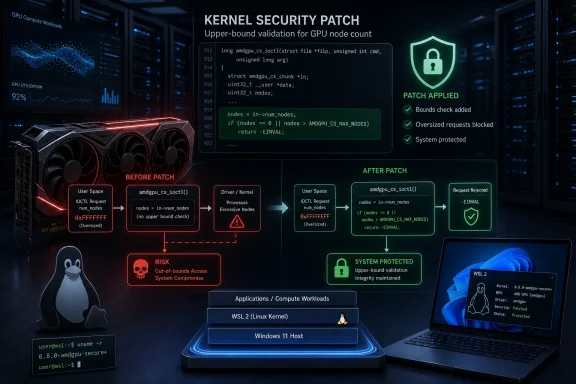
kfd_ioctl_get_process_apertures_new ioctl path. The patch adds an upper-bound validation for num_of_nodes, closing a missing input check in code used to return GPU memory-aperture information to user space.The National Vulnerability Database added the record on July 19, 2026, with kernel.org listed as the source. No CVSS score, CWE classification, exploitation report, or technical severity assessment has yet been assigned by NIST, so administrators should resist treating the CVE identifier alone as evidence of a remotely exploitable or critical flaw. The actionable point is simpler: systems using AMD KFD should take the available stable-kernel updates.
For Windows users, this is principally a Linux and GPU-compute maintenance issue. It matters most to Windows 11 systems running Linux through WSL 2, dual-boot workstations, AMD Instinct or Radeon compute environments, and developer machines where ROCm workloads can access AMD GPUs through a Linux kernel.
The Fix Is Small, but It Sits on a Privileged Boundary
AMD KFD lives under drivers/gpu/drm/amd/amdkfd and supplies the kernel-side services used by AMD’s heterogeneous GPU-compute stack. It is distinct from a conventional desktop display driver: KFD is concerned with compute queues, GPU topology, process memory access, and coordination between CPU processes and AMD GPUs.
The corrected ioctl, kfd_ioctl_get_process_apertures_new, is part of that interface. Its job is to provide a process with information about GPU memory apertures — regions and mappings relevant to how the process can interact with GPU memory. The affected parameter, num_of_nodes, represents the number of GPU topology nodes involved in the request.
According to the kernel.org advisory text carried into NVD, the resolved issue was an absent upper-bound check for that value. The stable-kernel patch is a backport of upstream commit 98ff46a5ea090c14d2cdb4f5b993b05d74f3949f.
That description does not establish the final security impact by itself. It does, however, identify a conventional kernel-hardening failure: user-controlled or request-derived counts must be constrained before downstream code uses them to index, allocate, copy, or iterate over kernel-managed data. In a graphics and compute driver, those paths deserve particular care because they bridge unprivileged application requests and privileged kernel state.
Stable Kernel Releases Carry the Repair
NVD’s affected-version data identifies four fixed stable-kernel points:
- Linux kernel 6.6.140 includes the fix.
- Linux kernel 6.12.90 includes the fix.
- Linux kernel 6.18.32 includes the fix.
- Linux kernel 7.0.9 includes the fix.
Systems on older builds in those maintenance lines are listed as affected. The record also indicates that the Linux 7.1 development line is beyond the vulnerable range, although distribution-packaged kernels may use backported fixes rather than exposing an obvious upstream version number.
That distinction matters for enterprise IT. A Red Hat Enterprise Linux, Ubuntu, SUSE, Oracle Linux, Debian, or Proxmox host can be protected even when its visible kernel release does not resemble 6.6.140 or 6.12.90. Vendors routinely import individual stable fixes while retaining their own ABI and version labels. The correct check is the distribution’s security advisory and package changelog, not a simplistic comparison with upstream kernel.org tags.
The stable references associated with CVE-2026-53376 show the fix being carried across multiple maintained kernel branches. That is generally a good signal for patch availability, but it is not the same thing as a statement that every vendor package has already shipped the update. Administrators should verify the kernel actually installed on the host, then confirm whether the vendor’s build includes the relevant AMD KFD change.
The Exposure Is Concentrated in AMD Compute Deployments
Not every Linux system with an AMD graphics adapter is equally exposed in practical terms. The code sits specifically in AMD KFD, meaning the relevant concern centers on systems where the AMD GPU compute subsystem is enabled and reachable by local workloads.
The highest-priority environments include shared research servers, GPU-accelerated CI runners, machine-learning workstations, render nodes, virtualization hosts with GPU compute access, and developer workstations running ROCm or related compute software. A local user or workload able to interact with the AMD KFD device interface is the scenario that deserves review.
A consumer Linux desktop with an AMD Radeon GPU may load the broader AMDGPU stack without routinely running compute code that reaches this ioctl. That does not make the fix irrelevant; it does mean patch urgency should be informed by actual use. Security teams should inventory hosts with AMD GPU compute workloads rather than treating this as a generic “all AMD graphics” emergency.
For WSL 2 users, the boundary is slightly different. Windows provides the host GPU driver and WSL exposes GPU acceleration into the Linux environment, while the guest Linux kernel is maintained through Microsoft’s WSL delivery model rather than a normal distribution kernel in many configurations. The NVD record concerns Linux kernel AMD KFD code, not a disclosed flaw in the Windows AMD display stack or Windows 11 itself. Still, users who rely on GPU-enabled WSL development should keep WSL and Windows fully updated, particularly where Linux-side GPU tooling is installed.
No Score Means Triage Must Follow Evidence, Not Assumption
As of July 20, NVD has marked CVE-2026-53376 as newly received and has not completed CVSS 4.0, CVSS 3.x, or CVSS 2.0 scoring. It also has not assigned a CWE. There is no public indication in the record of active exploitation, a proof of concept, required privilege level, or a confirmed confidentiality, integrity, or availability consequence.
That uncertainty should shape the response. It would be premature to call this a local privilege-escalation vulnerability, a denial-of-service issue, or an information-disclosure flaw without a technical assessment supporting one of those labels. “Upper-bound check” fixes can address a wide range of outcomes, from defensive validation that prevents malformed requests to bugs with more serious memory-safety implications.
The right operational stance is patch promptly, but do not overstate the exposure. This is a kernel-space fix in a GPU driver subsystem, so it belongs in normal accelerated patching for compute-capable Linux fleets. It does not, based on present public information, justify claims of widespread exploitation or an emergency incident response solely because a CVE has been assigned.
What Administrators Should Do This Week
Administrators responsible for AMD GPU-capable Linux machines should first identify the running kernel with uname -r, then check the vendor’s advisory stream and package metadata for the CVE or the AMD KFD bounds-check backport. Updating a package without rebooting into the new kernel does not remove exposure from a running system.
Where downtime is constrained, prioritize hosts that offer local shell access to multiple users or execute untrusted GPU workloads. Dedicated single-user desktops and systems without ROCm, accelerator workloads, or AMD KFD use can follow the organization’s established kernel maintenance window, provided the update is not delayed indefinitely.
It is also sensible to review device permissions for /dev/kfd and related render nodes. Restricting GPU-compute device access to intended users or service accounts is sound defense in depth, though it is not a substitute for installing the corrected kernel. Container operators should remember that GPU-enabled containers commonly rely on the host kernel and host device nodes; updating an image alone will not fix a vulnerable host kernel.
The immediate milestone is vendor availability rather than a promised NVD severity score. Once distribution advisories map their builds to the kernel.org fix, CVE-2026-53376 should become a straightforward patch-verification item: update the host kernel, reboot into it, and ensure AMD GPU compute workloads continue to function normally.
References
- CVE-2026-53376 drm/amdkfd: Add upper bound check for num_of_nodes NVD / Linux Kernel · 2026-07-20T01:02:57-07:00