

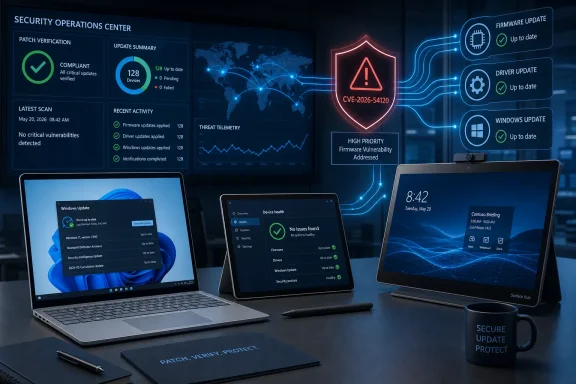
At the time of publication, the publicly available advisory information is notably limited. That restraint is not unusual for vendor-coordinated vulnerability disclosures, particularly when revealing implementation details could simplify exploitation before customers have fully deployed fixes. Still, the absence of a complete technical narrative means IT teams should avoid assuming this is a routine Windows application flaw or a narrowly scoped issue affecting only one Surface model.
For Windows administrators, the central takeaway is straightforward: CVE-2026-54120 is a Surface-specific remote code execution issue, and it should be handled as a patch-and-verify event rather than a vulnerability to monitor passively. Surface devices occupy a distinct place in enterprise fleets because their security posture depends on more than Windows Update alone. Firmware, drivers, device-specific components, management tooling, and hardware security capabilities can all play a role in remediation.
Overview of CVE-2026-54120
The public title identifies the vulnerability as a Microsoft Surface Remote Code Execution Vulnerability. Remote code execution, commonly abbreviated as RCE, is one of the most consequential vulnerability impact categories because it can allow an attacker to cause a target system to execute attacker-controlled instructions.
That label does not, by itself, establish several critical facts. It does not prove that the flaw is:
- Reachable directly from the internet
- Exploitable without authentication
- Triggered without user interaction
- Wormable across a network
- Capable of granting administrative or
SYSTEMprivileges - Present on every Surface device
- Exploited in the wild
- Supported by public proof-of-concept code
These distinctions matter. A vulnerability can carry an RCE classification while still requiring a local foothold, a specially configured service, user interaction, physical proximity, a paired peripheral, or an administrator-enabled feature. Conversely, a Surface-specific RCE flaw could be especially serious in a managed environment if it affects a broadly deployed device component that receives less routine attention than the Windows operating system itself.
The advisory’s current lack of detailed public technical information should therefore be interpreted carefully. Limited disclosure does not reduce the need for action. It means defenders should prioritize official update deployment, asset inventory validation, and telemetry review while avoiding unsupported assumptions about the attack path.
Why a Surface-Specific Vulnerability Requires Special Handling
Microsoft Surface systems are Windows PCs, but they are not interchangeable with generic desktops or laptops from the perspective of servicing. Their security stack commonly includes device-specific firmware, drivers, UEFI components, system interfaces, wireless hardware, cameras, touch controllers, docking capabilities, and proprietary management integrations.
A conventional Windows vulnerability may be resolved through a cumulative update. A Surface vulnerability may require one or more of the following:
- A Windows cumulative update
- A Surface firmware update
- A driver or system component update
- A specific update package for a device family
- An update distributed through Windows Update for Business
- An update approved and deployed through Microsoft Intune, Windows Server Update Services, or another endpoint management platform
- A restart cycle that allows firmware changes to complete
- Verification that the new firmware version is actually installed
This distinction can create a dangerous operational blind spot. A Windows endpoint may report that it is current on monthly quality updates while still carrying outdated Surface firmware or hardware drivers. In a mixed-device enterprise, Surface remediation must therefore be treated as a separate workstream rather than folded casually into the regular Patch Tuesday process.
The firmware visibility problem
Firmware updates are often less visible than ordinary application and operating system patches. They may install during a reboot, appear under a device-specific update category, or require a sequence of updates before the latest package is fully applied.
That can complicate compliance reporting. A management dashboard that confirms a Windows build number does not necessarily confirm that a Surface UEFI update, device controller update, or component-specific driver update has completed successfully.
For CVE-2026-54120, administrators should not stop at “the device checked for updates.” The more meaningful question is whether every affected Surface model has received and successfully installed the remediation intended for that exact model and Windows release.
What Remote Code Execution Means in Practical Terms
Remote code execution describes the ability to make a vulnerable system execute code chosen or influenced by an attacker. The practical consequences depend on the component involved, the privileges available to that component, and the conditions necessary to reach it.
At its most severe, RCE can lead to complete device compromise. An attacker may be able to install malware, manipulate files, harvest credentials, disable security tools, establish persistence, or use the compromised endpoint as a staging point for further movement inside a corporate network.
However, the RCE label must not be automatically equated with worst-case compromise. The actual risk is shaped by several variables:
- Attack vector
The vulnerability may be exposed over a network, through a local interface, via a connected device, during wireless communication, or through another mechanism. - Attack complexity
Some flaws are straightforward to exploit once prerequisites are met; others require precise timing, special configurations, or extensive technical knowledge. - Required privileges
An attacker may need no prior access, an ordinary user account, local execution rights, or administrative access. - User interaction
Exploitation may occur silently, or it may require a user to connect hardware, open content, approve a prompt, or perform another action. - Execution context
Code might run with standard-user permissions, a privileged service account, kernel-level rights, or within a constrained process. - Scope of affected products
A flaw affecting one discontinued Surface generation has a very different exposure profile than one affecting Surface Laptop, Surface Pro, Surface Go, Surface Hub, Surface Studio, or Surface devices managed at enterprise scale.
Until Microsoft provides a fuller technical description and product-impact matrix, the safest position is to treat the vulnerability as potentially significant while avoiding claims that cannot yet be validated.
The Confidence Metric and Why It Matters
The advisory material includes an explanation of a metric designed to measure confidence in the existence of the vulnerability and the credibility of its available technical details. This is an important signal for defenders because security teams must distinguish between a well-substantiated vendor-confirmed issue and an unverified report with incomplete evidence.
In broad terms, vulnerability confidence affects two different questions:
- How certain is it that the vulnerability exists?
- How much is publicly known about the technical path to exploitation?
These are related, but they are not identical. A vendor can confirm that a vulnerability exists while deliberately withholding root-cause details. That approach is common when a fix is newly released or when disclosure would create an unnecessary advantage for attackers.
For CVE-2026-54120, the presence of a Microsoft-issued CVE advisory is itself a meaningful indicator that the issue has passed through a formal vulnerability handling process. It should not be dismissed as speculation. At the same time, the limited public detail means defenders should be wary of third-party claims that assign a specific exploit chain, affected firmware version, attack surface, severity score, or privilege level without direct corroboration.
Limited detail can be a defensive advantage
Early-stage ambiguity is frustrating for administrators trying to prioritize remediation, but it can also slow opportunistic exploitation. Attackers generally benefit when vendors disclose exact vulnerable functions, packet structures, malformed input patterns, memory corruption conditions, or bypass techniques.
Microsoft’s decision to avoid publishing exhaustive technical details at the outset can give enterprise teams time to deploy the appropriate Surface security updates. The practical value of that window depends on how quickly organizations move from awareness to verified remediation.
The Most Important Unknowns
CVE-2026-54120 should be handled seriously, but several facts remain unconfirmed in the public advisory information currently available. These unknowns should guide investigation and risk assessment rather than become a reason for delay.
Affected Surface models
The title identifies Microsoft Surface as the affected product family, but that does not automatically mean every Surface system is impacted. Surface is a broad hardware portfolio spanning portable PCs, tablets, all-in-one systems, collaborative devices, accessories, and older products with different processor architectures and firmware stacks.
A focused hardware inventory is essential. Organizations should identify:
- Exact Surface product families
- Model numbers and generations
- Windows edition and version
- Processor architecture
- Installed firmware versions
- Driver package versions
- Management enrollment status
- Update ring or servicing channel
- Use of docks, wireless accessories, and specialized peripherals
This inventory should include devices that are rarely connected to the corporate network. Remote workers, shared meeting-room systems, executive devices, test equipment, field laptops, and loaner pools can all fall outside normal patch compliance patterns.
Attack prerequisites
The currently available information does not establish whether exploitation requires network access, local access, physical access, an authenticated session, user interaction, or specific Surface configurations.
That uncertainty should influence defensive controls. Teams should continue to enforce baseline hardening measures rather than waiting for a perfect explanation of the exploit path. Least privilege, endpoint detection and response, network segmentation, strong account protection, secure boot, and application control remain valuable whether the eventual attack vector proves to be remote, local, or hardware-adjacent.
Exploitation status
A newly published CVE should not be described as a zero-day under active attack unless the vendor explicitly confirms exploitation or credible evidence establishes it. Likewise, the absence of a public exploit report should not be confused with proof that no attacker has developed an exploit.
The responsible position is to classify CVE-2026-54120 as a confirmed vulnerability requiring remediation, while treating active exploitation as unconfirmed unless Microsoft updates the advisory.
Severity and scoring
The public title identifies the impact category, but an RCE label alone does not reveal the final severity rating. A numerical score can be useful for sorting a long list of vulnerabilities, yet it cannot replace environment-specific risk assessment.
A flaw with a lower numerical score may still be urgent if it affects an executive device, an administrator workstation, a Surface Hub in a sensitive meeting room, or a computer that handles regulated data. Conversely, a high-severity issue may have a limited immediate impact if the affected component is disabled and the endpoint is isolated. Business context matters as much as the score.
Immediate Actions for Windows and Surface Administrators
Organizations with Surface hardware should begin a structured response now. The objective is not merely to install an update, but to establish that the relevant remediation has reached every applicable device and that update failures have been investigated.
1. Identify all potentially affected Surface assets
Create or refresh an inventory of Microsoft Surface devices across corporate, educational, frontline, and shared-use environments. Include devices that may be offline, recently reassigned, held in stock, or enrolled in alternative management systems.
Asset data should capture the specific model rather than simply recording “Microsoft Surface.” The distinction between Surface generations is vital because firmware and driver packages are model-dependent.
2. Review official update availability
Check the official Microsoft servicing channels used by the organization. Depending on the environment, this may include Windows Update, Windows Update for Business, Intune-managed update policies, WSUS, Microsoft Configuration Manager, or approved offline servicing procedures.
Do not assume the relevant package will be labeled in a way that obviously references CVE-2026-54120. Surface fixes can be delivered as firmware, driver, system hardware, or cumulative update components.
3. Prioritize higher-risk endpoints
Not every Surface device presents the same business impact. Deployment should first focus on systems whose compromise would create disproportionate risk.
High-priority groups typically include:
- Privileged administrator workstations
- Executive and finance devices
- Developer systems with production credentials
- Surface Hub and meeting-room endpoints
- Devices used for remote access or VPN administration
- Shared devices used by many employees
- Devices outside the corporate network for extended periods
- Systems with sensitive customer, health, legal, or government data
- Devices whose users have local administrator rights
4. Ensure firmware updates complete successfully
Firmware servicing requires extra care. A device may download an update but remain unprotected until it has restarted and completed the installation process.
Where possible, verify:
- The device has rebooted after update deployment
- Firmware-related updates show successful installation
- The expected firmware or driver version is present
- No update rollback or installation failure occurred
- BitLocker recovery behavior is understood before large-scale deployment
- Remote users have clear instructions for keeping devices powered and connected during the update process
5. Monitor for suspicious behavior
There is no basis to claim a specific detection signature for CVE-2026-54120 without technical details. Still, organizations should review endpoint telemetry for broad signs of compromise, especially on unpatched or uncertain devices.
Useful monitoring priorities include:
- Unexpected privileged process creation
- New persistence mechanisms
- Unauthorized local administrator changes
- Security product tampering attempts
- Unusual PowerShell or command-line execution
- Suspicious outbound connections
- Unexpected driver or service modifications
- Unrecognized remote management activity
- Repeated firmware or update installation failures
This is not a substitute for patching. It is a compensating measure that can improve visibility while update deployment is underway.
Surface Hub, Shared Devices, and Physical-Space Risk
Surface Hub deployments merit special attention because they are often installed in meeting spaces, executive boardrooms, classrooms, collaboration areas, or semi-public environments. These systems may have different usage patterns, management processes, and maintenance windows than employee laptops.
A shared collaboration endpoint can carry elevated exposure because many users interact with it, peripheral connections may be frequent, and the device may remain powered on for long periods. If CVE-2026-54120 ultimately involves a component reachable through local connectivity, device interaction, or a service enabled in shared-use environments, Surface Hub systems could require tailored remediation planning.
Organizations should review:
- Update and restart policies for shared endpoints
- Physical access controls in meeting spaces
- Peripheral connection policies
- Local account and administrative access assignments
- Network segmentation for collaboration devices
- Monitoring coverage and endpoint protection status
- Whether devices are still within supported servicing lifecycles
The same principle applies to loaner devices, reception kiosks, field systems, retail units, and laboratory devices. Endpoints outside the standard laptop lifecycle often create the most persistent patch gaps.
Strong Points in Microsoft’s Disclosure Approach
Despite the limited public detail, several aspects of the CVE publication are positive from a defensive standpoint.
Clear categorization of the impact
Labeling the issue as a Microsoft Surface Remote Code Execution Vulnerability gives administrators a meaningful starting point. It identifies both the product family and the impact class without burying the core risk in vague language.
That clarity enables immediate triage. Endpoint, desktop engineering, security operations, and hardware lifecycle teams can recognize that Surface-specific remediation may be required.
Formal vulnerability tracking
The assignment of a CVE identifier allows organizations to track the issue across ticketing systems, vulnerability scanners, change-control records, endpoint management dashboards, and audit documentation. A unique identifier is especially important when update package names do not mirror the public vulnerability title.
Controlled technical disclosure
A cautious initial disclosure can reduce the likelihood of immediate copycat attacks. Publishing exploit-ready details before organizations have a reasonable chance to deploy fixes can create unnecessary risk, particularly when the affected technology may be widely deployed in enterprise environments.
Potential Risks and Operational Challenges
The same characteristics that make the advisory useful also create practical challenges.
Insufficient detail may slow prioritization
Security teams often depend on affected-version lists, exploitation assessments, CVSS vectors, prerequisites, and product matrices to decide where an issue sits in the patch queue. When those details are unavailable or incomplete, teams must make a more conservative decision.
For CVE-2026-54120, the conservative choice is justified. RCE vulnerabilities on managed endpoint hardware should be prioritized ahead of routine maintenance items, especially where remediation can be deployed through established update channels.
Firmware compliance is harder to prove
A Windows device can appear fully patched while a required firmware component remains outstanding. This creates reporting risk, particularly in organizations that use operating system build numbers as their only patch compliance measure.
The remedy is procedural rather than theoretical: report on Surface firmware and driver deployment separately, validate installation success, and investigate exceptions rather than accepting generic “up to date” status messages.
Update disruption must be planned
Firmware and driver updates can require restarts, temporarily interrupt user productivity, and occasionally expose pre-existing device issues. Enterprises with sensitive workloads should use controlled deployment rings, but they should not let the desire for a perfect pilot become an open-ended delay.
A practical balance is:
- Validate the update on representative devices.
- Deploy to a high-priority pilot group.
- Monitor installation and stability.
- Expand rapidly to the broader Surface fleet.
- Track and remediate failures individually.
A Sensible Risk Posture Until More Details Emerge
The appropriate response to CVE-2026-54120 is neither alarmism nor complacency. The vulnerability is vendor-confirmed and categorized as remote code execution, so it warrants prompt action. Yet the presently available information does not support dramatic claims about internet-wide exposure, zero-click compromise, or universal impact across every Surface product.
Security leaders should communicate the issue in precise terms:
Microsoft has published a Surface-specific remote code execution vulnerability. The full technical scope is not yet publicly detailed, so the organization is prioritizing official updates, confirming firmware compliance, and monitoring affected device groups for anomalies.
That message is clear, factual, and operationally useful. It avoids minimizing the threat while preventing unsupported speculation from distracting IT teams.
The Bottom Line
CVE-2026-54120 is a Microsoft Surface remote code execution vulnerability that should move quickly into enterprise remediation workflows. Its public disclosure confirms that Surface device security must be treated as a combined Windows, driver, firmware, and hardware-management responsibility—not simply as an operating system patching task.
The most responsible immediate action is to identify all Surface assets, deploy the applicable Microsoft updates through approved servicing channels, confirm successful firmware and driver installation, prioritize high-value and shared-use endpoints, and track exceptions until they are resolved. Organizations should also avoid filling the current information gap with assumptions about exploitability, affected models, or attack mechanisms.
Until more technical information is released, the safest conclusion is also the most practical one: patch Surface devices promptly, verify the result, and treat incomplete visibility as a reason for stronger operational discipline rather than a reason to wait.