

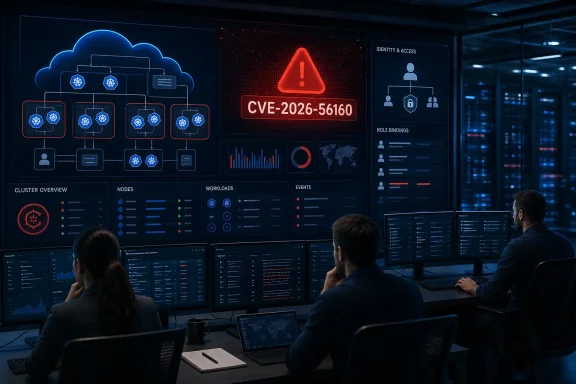
For Windows administrators, cloud architects, security teams, and platform engineers, the immediate message is straightforward. Treat CVE-2026-56160 as an active ARO security-management event, validate the Azure Red Hat OpenShift estate, review platform communications and change activity, and prepare to act quickly when Microsoft or Red Hat expands the advisory with patches, version guidance, or mitigation instructions.
Overview
Azure Red Hat OpenShift is not simply a collection of customer-managed virtual machines running Kubernetes. It is a managed OpenShift service delivered jointly by Microsoft and Red Hat, with the providers operating important parts of the underlying cluster infrastructure and customers retaining responsibility for their workloads, identities, configurations, data, and many application-level controls.
That joint operating model is a major strength of ARO. Organizations gain a supported OpenShift environment on Azure without owning every operational burden associated with control planes, worker lifecycle management, platform monitoring, or core infrastructure maintenance. However, it also makes vulnerability response more nuanced than a conventional “download and install the patch” exercise.
CVE-2026-56160 is categorized as an elevation of privilege vulnerability. In security terms, that means a successful attacker could potentially obtain permissions beyond those they should have under the intended access model. The available description does not establish whether this could involve Azure subscription privileges, OpenShift cluster-level permissions, namespace-level permissions, host access, service-account rights, or another trust boundary entirely.
That distinction matters. “Elevation of privilege” is an impact category, not a complete attack narrative. It tells security teams that authorization controls may be at risk, but it does not, by itself, reveal:
- Whether an attacker must already possess valid credentials.
- Whether exploitation is local, network-based, or dependent on a management-plane action.
- Whether the affected scope is a single namespace, an entire cluster, a customer subscription, or service infrastructure.
- Whether privileged OpenShift or Azure roles are required before exploitation.
- Whether a patch has already been silently deployed to managed service components.
- Whether customer action, such as a cluster upgrade or configuration change, is required.
- Whether exploitation has been observed in real-world attacks.
Until Microsoft provides those details, organizations should avoid filling gaps with assumptions. A managed Kubernetes vulnerability can have very different practical consequences depending on the affected component and the privileges required to trigger it.
Why an ARO Privilege-Escalation Advisory Deserves Attention
Privilege escalation is particularly consequential in Kubernetes-based environments because access is layered. A user, service account, workload, automation identity, or compromised application does not necessarily need to gain unrestricted administrative control to cause serious harm. A move from low privilege to a moderately more capable role can expose secrets, permit deployment manipulation, expand lateral movement opportunities, or enable access to sensitive internal services.
In an Azure Red Hat OpenShift environment, those layers can include:
- Microsoft Entra ID identities and Azure role assignments.
- Azure subscription, resource group, and managed-resource access controls.
- OpenShift authentication providers and role-based access control.
- Kubernetes service accounts and namespace permissions.
- Security Context Constraints and workload security settings.
- Cluster operators, API access, and admission controls.
- CI/CD pipeline identities and deployment automation.
- Secrets, certificates, tokens, registries, and storage credentials.
- Network policies, private endpoints, and egress restrictions.
A vulnerability at any one of these levels can affect how another level should be defended. For example, an issue that begins with a low-privilege identity may become more dangerous in organizations that grant broad OpenShift roles, reuse credentials across pipelines, permit privileged containers, or leave sensitive secrets accessible to too many namespaces.
The issue is not that every ARO cluster is automatically exposed to full compromise. The public information does not support that conclusion. The concern is that elevation-of-privilege vulnerabilities often turn a limited foothold into a more operationally valuable position for an attacker.
The Managed-Service Factor
The managed-service model also changes the timing and ownership of remediation. In some cases, Microsoft and Red Hat can repair an affected service-side component without customer intervention. In other cases, the providers may need customers to upgrade a cluster, rotate credentials, modify an integration, or remove an unsupported configuration.
This is why ARO administrators should not attempt to modify managed components independently in response to a sparse advisory. Unsupported changes to control-plane resources, operator-managed components, networking objects, or managed resource groups can create supportability problems and may interfere with provider-led remediation.
The correct first step is verification: determine which ARO clusters exist, who owns them, their versions, their exposure profiles, and whether any provider notifications or recommended maintenance actions are already waiting.
What Is Known — and What Remains Unclear
The confirmed elements are limited but important:
- The issue is assigned CVE-2026-56160.
- It affects Azure Red Hat OpenShift.
- Microsoft classifies it as an elevation of privilege vulnerability.
- The advisory was published on July 23, 2026.
- Publicly available advisory material emphasizes the confidence associated with vulnerability existence and the credibility of known technical details.
The last point is revealing. Vulnerability advisories commonly include exploitability and confidence-oriented fields because defenders need to distinguish between a fully documented, proven flaw and a report where technical evidence remains narrow or incomplete. A vulnerability can be real and important even when vendors intentionally withhold exploit chains or root-cause information to limit immediate attacker advantage.
At this stage, several operationally decisive details are not established in the material available for review:
- A CVSS score and vector, if assigned.
- A confirmed severity rating.
- The exact vulnerable component.
- Specific affected ARO versions or regions.
- Whether customer-managed workload configuration affects exposure.
- Attack complexity and required privileges.
- Whether user interaction is necessary.
- Whether a proof of concept exists publicly.
- Whether Microsoft is aware of active exploitation.
- Whether mitigation is automatic, customer-driven, or shared.
- Whether a fixed OpenShift release is required.
Security teams should be careful with severity labels circulating in dashboards or social media. Without a vendor-provided vector and an affected-component description, labels such as critical, remote cluster takeover, or subscription compromise are speculative. Conversely, the absence of a published score should not be interpreted as a low-risk determination.
Confidence Is Not the Same as Severity
The advisory text’s discussion of confidence describes a useful but often misunderstood concept. Confidence addresses how certain the industry is that the vulnerability exists and how credible the known technical details are. It does not independently tell administrators how damaging exploitation would be in their environment.
A high-confidence vulnerability may have constrained impact because it requires rare conditions. A lower-detail vulnerability may nevertheless warrant immediate caution because the affected service occupies a sensitive trust boundary. The prudent response to CVE-2026-56160 is therefore evidence-driven urgency, not alarmism.
Organizations should prioritize the advisory based on exposure and business importance while awaiting the precise technical data required for a final risk rating.
Understanding the Potential Attack Surface
ARO environments are often deeply integrated into Azure estates. Clusters may pull images from Azure Container Registry, authenticate users through Microsoft Entra ID, retrieve secrets from Azure Key Vault, connect to private services over virtual networks, and send logs to Azure monitoring platforms. This integration is operationally useful, but it means a compromise path can involve more than the OpenShift API alone.
Identity and Access Boundaries
Identity is the first area to examine. A privilege-escalation vulnerability may matter more where the initial identity is broadly distributed, persistently available, or overprivileged. That includes developer accounts, automation identities, service principals, managed identities, cluster-admin users, build systems, and break-glass accounts.
Review the following conditions:
- Users who retain cluster-admin privileges for day-to-day work.
- Shared administrator accounts with weak attribution.
- Service principals assigned broad Azure roles beyond their operational purpose.
- Pipeline identities that can alter cluster configuration and access registries or secrets.
- Long-lived kubeconfig files and tokens stored in developer workstations or automation systems.
- Excessive namespace role bindings.
- Service accounts that can create pods, mount secrets, or impersonate other identities.
- Unused identities that remain enabled after projects, staff, or applications are retired.
Least privilege cannot eliminate a platform vulnerability, but it can sharply reduce the opportunity for a low-privilege foothold to become a significant incident.
Workload Security and Pod Permissions
OpenShift includes security mechanisms intended to reduce the default privileges available to workloads. However, exceptions often accumulate in production environments. Teams may grant elevated permissions to support legacy software, observability agents, storage components, build jobs, or specialized networking tools.
Those exceptions deserve renewed attention when an elevation-of-privilege advisory appears. Inventory workloads that use:
- Privileged containers.
- Host networking.
- Host PID or IPC namespaces.
- HostPath mounts.
- Elevated Linux capabilities.
- Root execution where it is not strictly required.
- Custom Security Context Constraints.
- Broadly scoped service accounts.
- Direct cloud credentials mounted as secrets.
- Admission exemptions or policy exclusions.
A privilege-escalation flaw may not need every one of these conditions to be exploitable. Still, each can increase the practical impact of a compromise, complicate containment, or create additional routes to sensitive resources.
Azure Resource and Network Exposure
ARO clusters commonly reside in private network topologies, but “private” should not mean “ignored.” Internal attackers, compromised endpoints, development systems, VPN-connected users, and breached application credentials can all become meaningful sources of risk when administrative interfaces are reachable.
Security teams should validate:
- API endpoint accessibility and approved administrator network paths.
- Private DNS and routing controls for cluster access.
- Network security group configuration where customer-managed controls apply.
- Outbound egress policy, particularly for workloads that do not need unrestricted internet access.
- Connectivity from ARO namespaces to databases, management services, and identity infrastructure.
- Azure role assignments on the cluster resource group and related resources.
- Access controls around container registries, storage accounts, Key Vault instances, and monitoring workspaces.
The objective is not to redesign the environment overnight. It is to understand the blast radius if an identity or workload inside the ARO environment obtains more capability than intended.
Immediate Actions for ARO Administrators
CVE-2026-56160 should trigger a structured operational response. The strongest response is coordinated, documented, and proportionate to the currently known facts.
1. Identify Every Azure Red Hat OpenShift Cluster
Start with inventory. Many large Azure tenants have ARO clusters owned by different teams, business units, subscriptions, or managed-service partners. Security cannot rely on a single cluster list maintained informally in a spreadsheet.
Build or refresh a current register containing:
- Cluster name and Azure resource ID.
- Subscription and resource group.
- Region and environment classification.
- OpenShift version and upgrade channel.
- Cluster owner and technical escalation contact.
- Business-critical applications hosted on the cluster.
- External integrations and privileged automation.
- Internet exposure and private-network design.
- Current support status and recent maintenance history.
Clusters supporting production applications, regulated data, identity services, payment systems, or enterprise integrations should receive the earliest attention.
2. Review Microsoft and Red Hat Service Communications
Because ARO is a jointly managed platform, remediation details may arrive through service health communications, Azure portal notifications, support channels, advisory updates, or documentation changes. Monitor the relevant channels continuously until the vulnerability record is materially expanded or resolved.
Establish a single owner for tracking updates. That person or team should record:
- Advisory status changes.
- Newly disclosed affected versions.
- Patch or upgrade requirements.
- Expected maintenance windows.
- Required customer approvals.
- Recommended mitigations.
- Any provider statements about exploitation or exposure.
This simple coordination step prevents an important advisory from becoming fragmented across cloud, security, Windows infrastructure, and application-platform teams.
3. Confirm Cluster Health and Upgrade Readiness
Even if no customer upgrade is immediately required, upgrade readiness is a practical security control. Clusters that are already behind on supported releases or burdened by failed operators, unavailable capacity, broken automation, or unsupported modifications can take longer to remediate when urgent action becomes necessary.
Review:
- Current cluster version and available update paths.
- Cluster operator health.
- Node capacity and autoscaling behavior.
- Machine pool status.
- Pending upgrade blocks.
- Certificate health and expiry timelines.
- Persistent storage dependencies.
- Backup and restore procedures.
- Maintenance-window readiness.
- Change-management approvals for emergency updates.
Avoid assuming that a routine OpenShift upgrade is risk-free. Test application compatibility and rollback arrangements where possible, but do not permit avoidable process friction to delay a security update once Microsoft or Red Hat specifies a required action.
4. Reduce Unnecessary Privilege Now
The lack of detailed exploit information does not prevent organizations from improving their security posture. The safest immediate mitigations are the controls that should already exist regardless of this CVE.
Prioritize:
- Removing unnecessary cluster-admin assignments.
- Replacing broad Azure roles with narrowly scoped assignments.
- Enforcing multifactor authentication for privileged users.
- Reviewing Conditional Access policies for administrative access.
- Rotating exposed, stale, or overly long-lived credentials.
- Restricting privileged workloads to justified, approved cases.
- Tightening service-account RBAC.
- Auditing access to Kubernetes secrets.
- Limiting who can create or alter role bindings.
- Reviewing CI/CD permissions and token storage.
- Disabling unused integrations and accounts.
These actions may not be a vendor-defined fix for CVE-2026-56160. They are, however, sound compensating controls that reduce the impact of many identity and authorization failures.
5. Strengthen Detection and Logging
Privilege escalation often becomes visible through behavioral evidence before a root cause is fully understood. Teams should ensure that logging is retained, monitored, and accessible across both Azure and OpenShift layers.
Look for indicators such as:
- Unexpected role binding or cluster role binding changes.
- New cluster-admin assignments.
- Service account creation outside approved deployment pipelines.
- Privileged pod creation.
- Sudden changes to Security Context Constraints.
- Secret enumeration or unusual secret access patterns.
- Unexpected token creation or credential rotation.
- Administrative API actions from unrecognized identities or networks.
- New deployments in sensitive namespaces.
- Image pulls from unknown registries.
- Changes to network policies, routes, or ingress configuration.
- Suspicious Azure role-assignment changes involving ARO-related resources.
Detection should include both preventative policy controls and retrospective investigation capability. If an advisory later identifies a specific exploitation pattern, retained logs can become the difference between a confident “not affected” assessment and an expensive forensic gap.
Avoiding Counterproductive Responses
An under-documented vulnerability can tempt administrators toward broad emergency changes. That approach can create outages, hide useful evidence, and place managed services in unsupported states.
Do Not Alter Managed Infrastructure Directly
ARO has managed components that are not intended for customer modification. Making manual changes to provider-owned resources, internal control-plane components, or managed networking elements can disrupt service operation and complicate support.
Use documented cluster administration methods and provider guidance. If mitigation requires a service-side change, Microsoft and Red Hat should define the mechanism and operational ownership.
Do Not Assume Standard Kubernetes Advice Applies Unchanged
Azure Red Hat OpenShift shares many Kubernetes concepts, but it has OpenShift-specific controls, operators, lifecycle behavior, and support constraints. Generic scripts that modify RBAC broadly, delete operator resources, change node settings, or force component restarts can do more harm than good.
This is especially relevant for teams accustomed to self-managed Kubernetes. ARO’s value lies partly in separating customer-controlled workload administration from provider-managed infrastructure. Preserve that boundary during incident response.
Do Not Rotate Everything Without a Plan
Credential rotation is valuable when exposure is suspected, but indiscriminate rotation can break applications, pipelines, registries, monitoring integrations, and automation. Prioritize credentials with high privilege, uncertain ownership, excessive age, or suspicious activity.
An effective rotation plan includes dependency mapping, secrets management, testing, rollback preparation, and verification that old credentials truly no longer work.
The Shared-Responsibility Reality
CVE-2026-56160 highlights an uncomfortable but necessary truth about managed platforms: provider management reduces operational burden, but it does not remove customer security responsibilities. Microsoft and Red Hat may operate core ARO platform components, yet customers remain accountable for the security posture of the identities, applications, data, configurations, and integrations they control.
Provider Responsibilities
For a managed platform vulnerability, Microsoft and Red Hat are expected to assess the flaw, determine scope, develop and deploy service-side remediations where appropriate, communicate customer actions, and support affected tenants. Their shared operations model can be an advantage because patching authority and product expertise are close to the managed infrastructure.
Where a flaw is contained entirely within provider-managed service components, customers may benefit from remediation that is faster and less disruptive than patching a self-managed cluster fleet. But organizations should wait for confirmation rather than assuming that no action is necessary.
Customer Responsibilities
Customers must maintain secure access, minimize privilege, operate supported configurations, protect workloads, and respond to required platform actions. The most important customer responsibility during a developing advisory is maintaining enough operational visibility to know whether a provider request applies.
That means knowing who owns the clusters, who can approve maintenance, who controls Azure access, who administers OpenShift RBAC, and who can assess application impact. Organizations with fragmented ownership will find this harder than those with an established cloud-platform operating model.
A Practical Risk Framework for CVE-2026-56160
Until technical specifics are released, organizations can rank ARO clusters using exposure and consequence rather than an assumed severity score.
Highest Priority
Prioritize clusters that have one or more of the following characteristics:
- Production workloads with highly sensitive data.
- Broad external user populations.
- Extensive CI/CD automation with powerful deployment identities.
- Frequent administrative access from multiple teams.
- Privileged workloads or significant policy exceptions.
- Connectivity to sensitive Azure resources.
- Weakly governed cluster-admin assignments.
- Unsupported or delayed OpenShift versions.
- Incomplete logging, unclear ownership, or uncertain recovery capability.
Moderate Priority
Clusters in non-production environments still deserve review when they share identities, registries, network paths, pipelines, or subscriptions with production. Development clusters can become an attractive staging point if credentials and automation are reused.
A non-production label should never be used as a reason to ignore a privilege-escalation issue. It should only influence the order of response after actual trust relationships have been examined.
Lower Priority, Not Zero Priority
Clusters with strict private access, minimal privileges, mature logging, narrow integrations, and clear ownership may present less urgent operational risk. Even then, they should remain in scope until Microsoft clarifies the affected versions, component, and mitigation status.
The relevant question is not simply, “Is this cluster internet-facing?” It is, “What could an attacker do after reaching any legitimate or compromised entry point?”
The Bottom Line
CVE-2026-56160 is an Azure Red Hat OpenShift elevation of privilege vulnerability that requires attention even though public technical details remain limited. Its publication on July 23, 2026, should prompt ARO customers to confirm their cluster inventory, monitor official remediation guidance, assess high-privilege identities and workloads, verify upgrade readiness, and strengthen detection around authorization changes.
The limited disclosure creates uncertainty, but it also defines the correct response. Do not speculate about exploitability, do not invent a severity rating, and do not make unsupported changes to managed ARO infrastructure. Instead, focus on the controls that reduce the real-world consequence of privilege escalation: least privilege, supported cluster versions, restricted administrative access, secure workload configuration, reliable logging, and clear ownership.
For organizations running Azure Red Hat OpenShift, this advisory is a reminder that managed Kubernetes security is never fully outsourced. Provider-operated infrastructure and customer-operated workloads meet at a shared trust boundary, and elevation-of-privilege vulnerabilities are exactly where that boundary deserves the closest scrutiny.