

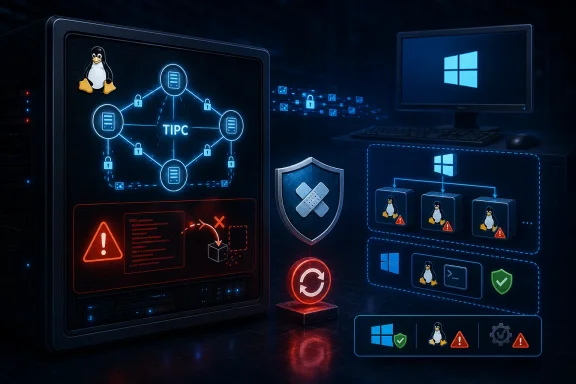
The National Vulnerability Database added the record on July 19, 2026, drawing its technical description and affected-version data from kernel.org. NIST has not assigned a CVSS score yet, and there is no indication of public exploitation. Still, this is a genuine kernel memory-safety bug in network-facing code, not a bookkeeping-only CVE entry.
For Windows users, Windows itself is not affected: the vulnerable code belongs to Linux’s net/tipc/crypto.c, not the Windows networking stack. The relevant Windows-adjacent population is narrower but real: Windows Subsystem for Linux users running custom kernels, Hyper-V hosts running Linux guests, and IT teams managing Linux infrastructure from Windows endpoints should identify any hosts that use TIPC.
An Async Decrypt Callback Can Outlive Its Network Namespace
The flaw sits in tipc_aead_decrypt(), part of TIPC’s authenticated-encryption handling. TIPC can submit a decrypt operation to the Linux kernel crypto framework, and that operation may complete later on a worker thread rather than before the original call returns.
That asynchronous behavior becomes dangerous during network-namespace teardown. If a TIPC bearer’s namespace is removed while a decrypt is still in progress, tipc_exit_net() and tipc_crypto_stop() can free the per-namespace TIPC crypto structure. The later completion routine, tipc_aead_decrypt_done(), can then read fields from the freed allocation.
In practical terms, the completion path may access crypto statistics, the network namespace pointer, encryption-key state, and TIPC node-table data after those objects no longer exist. That is the definition of a slab use-after-free: code follows a pointer to memory that has already been returned to the kernel allocator.
The vulnerability report says the condition was reproduced with KASAN, Linux’s memory-error detector, on the 7.1 release-candidate branch. The test scenario used a UDP TIPC bearer with a cluster key, crafted encrypted packets from an unknown peer, and repeated namespace destruction. To make the timing window reliable on x86 hardware, the researcher forced cryptographic work through the cryptd asynchronous offload path.
That last detail matters. The bug requires more than simply receiving a malicious TIPC packet. An environment needs TIPC encryption, an asynchronous AEAD decrypt completion, and a teardown race involving the affected network namespace. The prerequisites reduce exposure relative to a broadly reachable flaw in ordinary TCP/IP traffic, but they do not make the issue safe to ignore on systems that actually deploy the feature.
The Fix Is a Lifetime Guard, Not a Crypto Rewrite
The Linux kernel patch follows the already-fixed encryption-side logic. Before launching the decrypt request, the corrected code obtains a reference to the relevant network namespace with maybe_get_net(). It keeps that reference alive while an async decrypt is pending and releases it in tipc_aead_decrypt_done() after the callback finishes.
If decryption completes synchronously, the reference is released immediately on the normal success and error paths. If the namespace reference cannot be acquired at the outset, the request fails safely rather than risking a callback that touches dismantled state.
This is a small but important distinction for patch assessment. The fix does not change TIPC’s cryptographic algorithm, packet format, or trust model. It corrects object lifetime management around delayed work, ensuring namespace cleanup cannot race ahead of an in-flight decrypt completion.
The advisory identifies an earlier commit, e279024617134, as the equivalent fix for the TIPC encryption path. CVE-2026-63801 closes the matching gap on decrypt. Paired encrypt/decrypt bugs like this are a familiar warning sign in kernel maintenance: one half of an asynchronous workflow was hardened, while the mirrored path retained the original unsafe lifetime assumptions.
Stable Backports Matter More Than the Mainline Version
Kernel.org’s CVE data indicates that the vulnerable code was introduced in Linux 5.5. Fixes have been backported to the maintained stable lines, including updates corresponding to Linux 5.10.260, 5.15.211, 6.1.177, and 6.6.144. The record also lists fixes for newer maintained branches and the upstream development line.
Administrators should not treat those version numbers as a complete distribution checklist. Enterprise distributions commonly carry backported security fixes without changing the visible upstream version in a simple way. Red Hat Enterprise Linux, Ubuntu, Debian, SUSE, Amazon Linux, Proxmox, appliance vendors, and Kubernetes-node images may each publish the correction under a distribution-specific package build number.
The operational rule remains the same: use the kernel package supplied by the distribution or platform vendor, and verify that its changelog or security advisory identifies CVE-2026-63801 as fixed. Avoid replacing a vendor-supported enterprise kernel with a vanilla build simply to chase an upstream version number.
For administrators checking exposure, the useful questions are:
- Is the
tipckernel module installed or loaded on the host? - Is TIPC configured with
CONFIG_TIPC_CRYPTOsupport and an active cluster key? - Are TIPC UDP bearers accepting traffic from networks that are not tightly controlled?
- Does the system make significant use of network namespaces through containers, virtual networking, or isolated services?
- Has the vendor-issued kernel package containing the CVE-2026-63801 fix been installed and activated after a reboot?
A loaded TIPC module alone does not establish exploitability, and a vulnerable kernel version alone does not prove that the asynchronous path is reachable. But a host combining TIPC encryption, UDP transport, and frequent namespace lifecycle activity deserves prompt patching.
Most Windows Estates Will See This Through Linux Guests and WSL
Windows Server and Windows 11 are not directly vulnerable because they do not ship or execute the Linux TIPC implementation as part of their native network stack. The concern is operational spillover into Linux workloads.
Hyper-V administrators should inventory Linux virtual machines like any other server workload. A patched Windows host does nothing to repair an outdated Linux guest kernel, whether that guest runs Ubuntu, Debian, Azure Linux, Red Hat Enterprise Linux, or a customized appliance image.
WSL requires a more precise reading. Standard WSL deployments use a Microsoft-managed Linux kernel, but advanced users and organizations can configure custom kernels. TIPC is not part of ordinary WSL networking workflows, and many WSL users will have no TIPC module or configuration at all. Still, teams using custom WSL kernels, specialist network modules, or lab environments should include those installations in their kernel inventory rather than assuming the Windows Update status is sufficient.
Container hosts are also worth checking, though containers alone do not magically create the vulnerability. The race involves Linux network namespaces, which container platforms use extensively, but the affected TIPC crypto path must still be present and reachable. Disabling or preventing use of TIPC where it is unnecessary can reduce attack surface while a vendor kernel update is being staged.
No Severity Rating Yet, but the Patch Window Is Open
NVD’s lack of a CVSS assessment as of July 20 should not be mistaken for a finding of low risk. The record is only a day old, and NVD enrichment often trails the initial kernel.org publication. Severity scoring will need to account for environmental requirements, including TIPC crypto configuration, packet reachability, and the namespace teardown race.
The disclosed reproduction involved crafted encrypted frames and triggered a kernel use-after-free, which can lead to instability and potentially more serious consequences depending on allocator behavior and exploitability. The advisory does not claim a working exploit, so organizations should avoid overstating the impact—but a remotely reachable memory-management flaw in optional networking code is still worth closing quickly.
The practical milestone is not an eventual NVD score. It is the next kernel update from each affected Linux vendor. Once that package is installed and the machine is rebooted into it, CVE-2026-63801 becomes another reminder that optional kernel networking modules deserve the same inventory discipline as the services administrators deliberately expose.
References
- CVE-2026-63801 tipc: fix slab-use-after-free Read in tipc_aead_decrypt_done NVD / Linux Kernel · 2026-07-20T01:07:32-07:00