

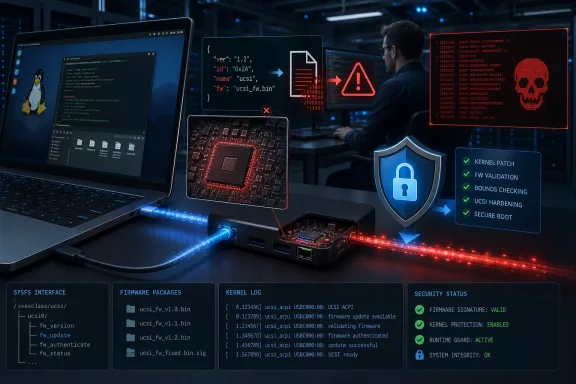
Overview
The vulnerable code is part of the Linux ucsi_ccg driver, which supports Cypress CCGx USB-C controller hardware through the USB Type-C Connector System Software Interface, or UCSI. These controllers are commonly involved in USB-C port management tasks that extend well beyond basic data transfer: cable orientation detection, USB Power Delivery negotiation, alternate modes such as DisplayPort, charging behavior, and dock interactions can all depend on the controller and its firmware.
CVE-2026-63964 is triggered during a firmware-flash path exposed by the driver. The code expects a Cypress .cyacd firmware image containing records introduced by a colon character. When the first colon is absent, the parser receives a null pointer but proceeds as though it had found a valid record boundary. The subsequent pointer arithmetic and length calculation can direct the kernel into an invalid access path.
Why this is not merely a bad-file error
A robust firmware parser should reject an invalid image before it tries to interpret its contents. In this case, a missing structural marker is enough to produce a kernel-level failure rather than a controlled “invalid firmware” response.
That distinction is central. A malformed file should result in a predictable error such as -EINVAL, preserving the integrity of the host operating system. Instead, the old path could dereference or search from an invalid address after a null-returning string scan.
The fix is deliberately small
The upstream correction adds a validation step immediately after the initial search for a colon record header. If no colon is present, the driver exits with -EINVAL.
This is a classic example of a security fix whose code change is tiny but whose consequence is significant. It restores a fundamental parser invariant: do not advance through a buffer until the initial delimiter has actually been found.
Background
USB-C has transformed a formerly simple connector into a multi-protocol physical interface. A single port may carry USB data, negotiate tens or hundreds of watts of power, expose DisplayPort output, connect a Thunderbolt or USB4 dock, and decide whether a peripheral is permitted to source or sink power. That flexibility requires more embedded logic than traditional USB-A ports ever needed.
Cypress CCGx controllers are programmable USB-C and USB Power Delivery chips. Their firmware helps determine how a machine responds to cables, chargers, batteries, monitors, docking stations, and potentially fault conditions. Linux systems that use the affected driver can expose an interface intended to flash an updated controller image when hardware vendors publish a compatible firmware package.
UCSI and the role of the CCG driver
UCSI provides a standardized software interface for USB-C connector management. Rather than requiring every operating system component to understand every controller-specific register layout, UCSI creates a common command and notification model around connector status, power roles, alternate modes, and related operations.
The ucsi_ccg driver is controller-specific glue for Cypress CCGx hardware. It manages the device over an internal bus, communicates with the controller, and includes the specialized logic needed for its firmware-update process. That firmware-update capability is the area affected by CVE-2026-63964.
Firmware updates are a privileged operation by design
Updating an embedded controller is fundamentally riskier than updating ordinary application software. A failed controller firmware flash can leave a USB-C port unreliable, disable charging behavior, break a dock workflow, or, in worst cases, require vendor recovery procedures.
For that reason, Linux exposes this capability through a sysfs attribute rather than treating it as a routine end-user action. The documented do_flash control tells the driver to attempt a firmware upgrade. In normal operation, that is an administrator-facing maintenance feature, not an interface that an ordinary desktop user should be able to invoke.
The Vulnerability Mechanism
The core bug is a null-pointer validation failure in the firmware parser. The flash routine searches the supplied firmware buffer for the first colon, because a valid .cyacd record is expected to begin with that character.
Conceptually, the sequence looks like this:
p = strnchr(fw->data, fw->size, ':');

while (p < eof) {
    s = strnchr(p + 1, eof - p - 1, ':');
    ...
}
If the firmware buffer contains at least one colon, p points into the buffer and the loop can start examining records. If the buffer contains no colon, however, the initial search returns NULL.
The invalid comparison
The flaw is that the code then compares p with eof without first ensuring that p is non-null. In the relevant execution context, NULL compares as lower than the valid end-of-buffer pointer, so the loop condition appears true.
The driver then evaluates p + 1, effectively generating an invalid pointer value near address zero, and computes a length using the difference between a legitimate buffer-end pointer and that invalid value. The result is an absurdly large scan range. A subsequent bounded-string search is no longer bounded in any meaningful sense.
Why kernel pointer bugs remain serious
A user-space parser crash usually terminates a process. A kernel-space parsing failure can terminate the entire system, trigger an oops, destabilize device state, or lead to a panic depending on configuration and follow-on behavior.
The description for CVE-2026-63964 characterizes the outcome as a crash. There is no published indication that this flaw provides reliable arbitrary code execution, privilege escalation from an unprivileged account, or a remotely reachable attack surface. That limitation should shape the severity assessment. Still, a root-triggerable kernel crash is a real availability issue, particularly on devices whose USB-C ports are operationally important.
Attack Preconditions and Exposure
The most important practical detail is that this is not a “plug in a malicious USB-C accessory and compromise Linux” vulnerability. The stated trigger requires a locally privileged actor who can both arrange a crafted firmware file under the system firmware directory and write to the driver's firmware-flash sysfs attribute.
In other words, exploitation requires capabilities that normally belong to root or a closely equivalent administrative service.
Required conditions
For the vulnerable path to be reachable, several conditions generally need to line up:
- The machine must use a Cypress CCGx controller supported by the
ucsi_ccgdriver. - The running kernel must include a vulnerable version of the relevant driver code.
- The actor must be able to place or control a malformed candidate firmware image under the firmware-loading path, typically beneath
/lib/firmware. - The actor must be able to write the
do_flashsysfs control exposed by the driver. - The driver must enter a firmware-update state that permits the image to reach the parser.
Each condition reduces the broadness of exposure. Many Linux systems do not contain this hardware, do not load the driver, or never use the manual flashing mechanism.
Root-only does not mean irrelevant
It is tempting to dismiss any root-triggerable bug as outside the security boundary. That is too simple. Root-level access may be obtained temporarily by an automation system, installer, endpoint-management agent, recovery environment, service account, hardware-maintenance process, or an attacker who has already compromised one layer of a system.
In those cases, a kernel crash can become useful for disruption, sabotage, evasion of monitoring, or forcing an unattended system into an undesirable reboot state. On a laptop, the immediate effect may be a lost work session. On a kiosk, lab device, build agent, edge appliance, or embedded deployment, it can become a service outage.
The unsigned-image angle
The vulnerability description notes paths involving unsigned blobs. That does not mean every unsigned firmware file will be accepted as valid controller firmware, nor does it mean firmware signature verification has been broadly defeated. It means the program flow could allow an unsigned malformed blob to reach this particular parser under relevant controller-state conditions.
That distinction matters. The fix is primarily about input validation before parsing, not a redesign of the CCGx firmware trust model. Organizations should not overstate the flaw as a universal firmware-signature bypass, but they should treat it as evidence that authorization checks and syntax validation must work together.
Affected Kernel Versions and Fixed Releases
The affected code entered the Linux kernel in the 5.2 era, making this a long-lived flaw in a specialized driver rather than a regression limited to a recent release. The CVE record identifies patched stable-kernel release lines that resolve the issue.
The listed fixed versions are:
- Linux 5.10.259
- Linux 5.15.210
- Linux 6.1.176
- Linux 6.6.143
- Linux 6.12.93
- Linux 6.18.35
- Linux 7.0.12
Systems on an affected branch below the applicable fixed release should be considered vulnerable if they use the affected driver and expose the described firmware-update path.
Version numbers are necessary but not sufficient
Distribution kernels rarely map one-to-one to upstream release numbers. Debian, Ubuntu, Red Hat Enterprise Linux, SUSE Linux Enterprise, Fedora, Arch Linux, and appliance vendors may backport a specific security patch while retaining a kernel version string that appears older than the upstream fixed release.
The reverse can also happen in custom deployments: a kernel may have a new-looking version number but omit a downstream security update, use a vendor-maintained branch, or carry a heavily altered driver configuration. The correct operational question is not simply “Is the version string newer?” It is:
Does the installed distribution kernel include the upstream fix for CVE-2026-63964?
Confirm the hardware and driver first
Administrators can avoid unnecessary urgency by checking whether the driver is in use. The following sequence is a reasonable starting point:
- Identify the active kernel with
uname -r. - Check whether the
ucsi_ccgmodule is loaded or built into the kernel. - Inspect system logs and device information for Cypress CCGx or UCSI CCG references.
- Determine whether a
do_flashsysfs attribute exists for the relevant device. - Consult the distribution’s security advisory or package changelog to verify whether the CVE patch is present.
The presence of a USB-C port alone is not evidence of exposure. Different laptops use different embedded controllers, and many systems use alternative UCSI implementations or separate firmware-update mechanisms.
Why the .cyacd Format Matters
The malformed input at the center of CVE-2026-63964 is not a complex exploit file requiring carefully placed machine instructions. At its simplest, the triggering condition is the absence of a colon in the supplied file.
That simplicity is precisely why format validation matters. A firmware parser is exposed to data that may be truncated during download, corrupted during packaging, copied incorrectly by an administrator, altered by a local attacker, or misidentified due to a deployment mistake.
Delimiters are part of the security boundary
Text-like record formats often use delimiters as structural anchors. A colon indicates the start of a .cyacd record, allowing the parser to locate boundaries and process each record in sequence. Before any record-length calculations, checksum processing, address extraction, or controller writes occur, the parser must prove that the expected structural marker exists.
The missing guard allowed structure discovery and record processing to blur together. The patch separates them: first establish that a record start exists; then proceed with iteration.
Input validation should happen in layers
The immediate correction rejects images with no colon. A defensible firmware-update pipeline should, in principle, apply several layers of validation:
- Filesystem and ownership controls should limit who can replace candidate firmware.
- Path selection should ensure the driver loads the intended artifact.
- Basic syntax checks should reject malformed file structure.
- Length and boundary checks should prevent integer underflow, overflow, and out-of-range access.
- Integrity and authenticity checks should ensure the blob is complete and authorized for the hardware.
- Device-state checks should prevent unsafe flashing conditions.
No single layer eliminates every risk. The value comes from preventing one failure from silently becoming another.
What This Means for Windows Users
CVE-2026-63964 affects Linux kernel code, not the Windows kernel, Windows USB stack, or Windows firmware-update framework. A Windows 11 or Windows 10 installation is not directly vulnerable merely because the laptop contains a Cypress CCGx USB-C controller.
However, WindowsForum readers increasingly operate mixed environments. Dual-boot laptops, Windows Subsystem for Linux users who also maintain native Linux installations, home labs, Linux-based NAS appliances, Hyper-V hosts with Linux guests, and organizations managing both Windows endpoints and Linux infrastructure should pay attention to the operational implications.
Dual-boot systems deserve a distinction
A dual-boot laptop may share the same physical USB-C controller between Windows and Linux installations, but the vulnerable component is the Linux driver handling the CCGx flash routine. Booting Windows does not invoke this Linux kernel path.
The more nuanced concern is administrative practice. If a technician obtains a firmware image for a USB-C controller and uses Linux to apply it, a malformed or incorrectly sourced file can trigger the flaw on an unpatched Linux environment. The safe response is to use the manufacturer’s supported update channel where available and keep the Linux maintenance environment patched.
WSL is generally outside the direct path
Windows Subsystem for Linux does not normally provide a guest Linux kernel with direct ownership of the laptop’s internal UCSI CCG controller and its associated sysfs firmware-flash interface. Therefore, this CVE should not be treated as a standard WSL exposure.
That said, a full Linux virtual machine with hardware passthrough, a Linux host, or a dedicated Linux recovery image is a different scenario. Security teams should map the driver’s actual deployment rather than using broad labels such as “Windows machine” or “Linux machine.”
Consumer Impact: Low Probability, High Annoyance
For a typical home Linux desktop or laptop user, CVE-2026-63964 is unlikely to be encountered accidentally. Most users never manually write to a USB-C controller’s do_flash sysfs attribute, and most vendor firmware tools package updates in a manner that avoids ad hoc manipulation of files under /lib/firmware.
The direct risk is therefore best described as low-probability local denial of service for ordinary users.
Where consumers can still get caught
The realistic consumer scenarios are mostly maintenance mistakes:
- A user follows an unofficial forum guide to flash a USB-C controller manually.
- A firmware archive is incomplete, corrupted, or substituted with the wrong file.
- A recovery procedure instructs the user to copy a blob into a firmware directory and manually trigger flashing.
- A system is running an old long-term-support kernel and has a compatible CCGx controller.
The result may look like an inexplicable lockup or reboot during hardware maintenance. That is disruptive, but it is not evidence that the USB-C port has necessarily been permanently damaged. A crash occurs in the host kernel’s parser path before a normal, valid flashing process can necessarily complete.
Sensible advice for individual users
Consumers should avoid treating low-level controller flashing as a generic troubleshooting step for charging or dock problems. Firmware updates can be valuable, but they should come from the PC manufacturer, dock manufacturer, Linux distribution, or another hardware authority that clearly identifies the model and update procedure.
If a manual update is unavoidable, use a patched kernel first, verify the file’s integrity, maintain AC power, and preserve a recovery option. Never use a random firmware blob simply because its filename resembles the controller or laptop model.
Enterprise and Fleet Management Impact
Enterprise exposure is more meaningful than consumer exposure because organizations are more likely to automate firmware lifecycle tasks, maintain internal firmware repositories, manage Linux endpoints at scale, and operate devices where USB-C ports are central to daily workflows.
A crash that affects one engineer’s workstation is inconvenient. The same crash across an automated deployment ring, a warehouse kiosk fleet, or a group of remote field devices can become an incident.
Automation expands the blast radius
A common operational pattern is to stage artifacts in a centrally managed directory, invoke a privileged update service, and collect logs afterward. If that workflow interacts directly with the ucsi_ccg flash mechanism, one bad package or path-selection error can translate into multiple kernel crashes.
The vulnerability is especially relevant where an agent runs as root and pulls firmware content from a repository, removable media, or a device-management platform. The attacker does not need an external network exploit if they can compromise an artifact source already trusted by the fleet process.
Separate privilege from artifact trust
Many organizations protect the command that starts an update but pay less attention to the file it consumes. CVE-2026-63964 highlights why that is incomplete. A privileged maintenance service can be safe only if both of these are true:
- The service is authorized to perform the operation.
- The artifact is known to be structurally valid and appropriate for the target hardware.
In practice, that means using signed repositories where possible, immutable or tightly permissioned firmware directories, staged rollouts, device-model allowlists, and explicit preflight validation.
Operational recommendations for administrators
A practical response plan should include the following measures:
- Patch affected kernel branches to the vendor-provided build containing the fix.
- Inventory hardware to identify machines using Cypress CCGx controllers and the
ucsi_ccgdriver. - Audit write permissions on firmware directories and relevant sysfs interfaces.
- Review automation that performs USB-C or dock-controller firmware updates.
- Validate artifacts before deployment, including model, cryptographic hash, expected record format, and source provenance.
- Canary-test updates on a small hardware-matched group before fleet-wide deployment.
- Capture console and kernel logs so failures can be distinguished from controller or power-delivery faults.
This is not a vulnerability that requires emergency shutdown of USB-C ports. It is a reason to improve the guardrails around a specialized privileged maintenance workflow.
Mitigation Before a Kernel Update Is Available
The permanent mitigation is to deploy a kernel that includes the upstream validation fix. When that cannot happen immediately, exposure can be reduced by preventing the vulnerable firmware-flash path from being used.
The objective is straightforward: do not permit unreviewed firmware files to reach the affected parser, and do not expose the firmware-flash trigger to unnecessary actors or automation.
Immediate compensating controls
- Do not perform manual CCGx controller flashes on potentially affected systems until the kernel has been updated, unless a vendor-supported emergency procedure explicitly requires it.
- Restrict write access to
/lib/firmwareand related firmware staging locations to tightly controlled administrative workflows. - Avoid granting broad root-equivalent access to desktop-support tools, update agents, and recovery scripts.
- Review sysfs permissions and custom udev rules that could make driver controls more accessible than intended.
- Remove or quarantine unverified firmware images that have been copied into staging directories for testing.
- Use vendor-packaged update tools and documented procedures rather than triggering raw sysfs flashing commands manually.
Avoid a misleading mitigation
Disabling all USB-C functionality is generally disproportionate. The affected routine concerns a firmware-update path, not routine USB-C charging, USB data, DisplayPort output, or dock use.
Likewise, merely checking whether a firmware file contains a colon is not an adequate long-term substitute for patching. It can reduce the chance of this exact trigger, but it does not establish that a file is legitimate, complete, compatible, or safe to flash.
Strengths and Opportunities
CVE-2026-63964 has several characteristics that make it comparatively manageable if organizations respond methodically.
- The patch is narrowly targeted. The correction adds a direct check for the missing delimiter and returns a standard invalid-input error.
- The exposure is not broadly remote. Published details describe a local, privileged trigger rather than a network-reachable flaw.
- Hardware scope is constrained. The vulnerable path is specific to systems using the Cypress CCGx UCSI driver.
- The fixed stable releases are identified. Administrators have clear upstream version targets for major supported kernel lines.
- The fault is testable. A basic malformed-input regression test can verify that an image without a colon fails cleanly rather than destabilizing the kernel.
- The incident can improve firmware governance. Reviewing this one driver path often reveals broader weaknesses in artifact handling and privileged update automation.
A good candidate for regression testing
The triggering condition is simple enough that distributions and hardware vendors can add a focused test case to their kernel validation suites. A firmware buffer lacking a colon should produce -EINVAL and no kernel warning, oops, or lockup.
That kind of test is valuable beyond this CVE. Parsing logic for embedded firmware files often evolves over years, crosses subsystem boundaries, and receives less fuzzing than network-facing components. Simple negative tests catch assumptions before they become availability bugs.
Risks and Concerns
The narrow scope should not obscure the operational issues that surround the flaw.
- A crash during device maintenance can create downtime. Systems may lose active work, network connectivity through a dock, or a remote administration session.
- Privileged automation can amplify an input-validation defect. A malformed artifact distributed at scale could affect many endpoints.
- Firmware directories are high-value targets. Weak permissions convert a root-only maintenance operation into a more realistic post-compromise disruption route.
- USB-C controller incidents are difficult to diagnose. A kernel oops may be mistaken for a charger, dock, cable, BIOS, or battery problem.
- Long-lived kernel deployments may lag. Appliances and embedded products often remain on old branches after mainstream desktop distributions have moved on.
- Unsigned-image behavior deserves scrutiny. The CVE does not establish a universal trust-model bypass, but it reinforces the need to understand which controller states accept which artifacts.
The risk of overreaction
Security teams should resist assigning a dramatic remote-execution narrative to a bug whose documented trigger is privileged and local. Overstating it wastes incident-response capacity and can cause unnecessary disruption to USB-C workflows.
The better message is more precise: patch the kernel, control firmware artifacts, limit access to flashing interfaces, and do not confuse this driver-specific flaw with a general compromise of USB-C security.
What to Watch Next
The immediate question is distribution adoption. Linux vendors may publish advisories and backported packages on different schedules, particularly for enterprise-maintained kernels, embedded distributions, Chromebook-like systems, and vendor-customized laptop images. Administrators should watch their own vendor’s changelog rather than assuming that an upstream release number tells the entire story.
Indicators worth monitoring
Watch for the following developments over the coming update cycles:
- Distribution security advisories that explicitly list CVE-2026-63964.
- Backport confirmations for supported enterprise and long-term-support kernels.
- Hardware-vendor notes identifying laptops, docks, or platforms that use Cypress CCGx controllers.
- Reports of kernel oops signatures connected with manual USB-C firmware update attempts.
- Changes to firmware-management tooling that add preflight validation or improve artifact signing.
- Additional audits of driver flash paths that parse line-oriented or delimiter-based firmware formats.
Do not wait for a CVSS score to act
At publication time, the CVE record does not include a completed NVD CVSS assessment. That is not unusual for a newly published entry, and it should not delay a sensible maintenance decision.
CVSS is useful for prioritization, but the technical facts are already sufficient for affected organizations: this is a patched kernel crash condition in a privileged controller-firmware update path. Patch during the normal security-update window, or sooner where firmware operations are automated, frequent, or business-critical.
The enduring lesson of CVE-2026-63964 is that the smallest parser assumptions can sit inside the most sensitive layers of a computing platform. USB-C controller firmware may feel distant from the desktop, but it governs power, connectivity, docking, and maintenance behavior that modern systems increasingly take for granted. By applying the available kernel fix and treating firmware artifacts as controlled security inputs rather than ordinary files, Linux administrators can turn a specialized crash bug into a useful prompt for stronger device-management discipline.
References
- CVE-2026-63964 usb: typec: ucsi: ccg: reject firmware images without a ':' record header NVD / Linux Kernel · 2026-07-21T01:03:23-07:00