

Overview
CVE-2026-63983 affects sch_netem.c, the Linux kernel source file that implements NetEm within the net/sched traffic-control framework. NetEm is a powerful and widely used tool for simulating hostile or imperfect network conditions: delay, jitter, loss, reordering, corruption, rate limits, and duplicate packets.
The vulnerability was published to the CVE List and included in the National Vulnerability Database on July 19, 2026. As of July 21, 2026, the NVD record does not yet include a CVSS 3.x or CVSS 4.0 score, so administrators should not equate the missing score with a lack of operational importance.
The core failure mode
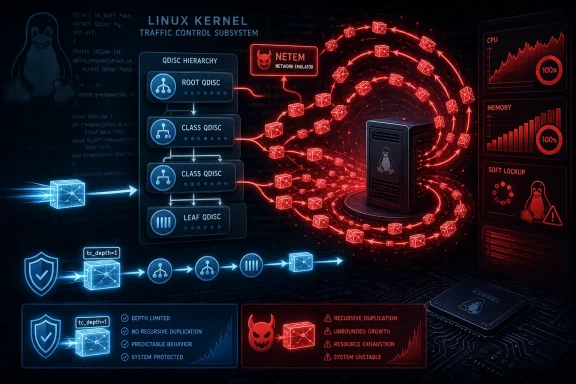
The vulnerable logic arises when NetEm duplicates a packet and reinserts that duplicate at the root queuing discipline. Re-enqueueing is necessary because the duplicate must travel through the normal traffic-control processing path rather than bypassing it entirely.
That design becomes unsafe if another NetEm instance exists somewhere in the queueing tree. The reinjected packet can be seen as a fresh candidate for duplication, producing another duplicate, which can be reinjected again. Under the right topology and configuration, the process repeats until the kernel burns CPU in a loop, exhausts memory, or fails under stack pressure.
Why it is a security issue
The immediate impact is availability. A vulnerable host can become severely degraded or unresponsive if a malicious or careless actor can install the relevant traffic-control configuration and generate traffic that reaches the problematic path.
This is not automatically an Internet-exposed remote vulnerability. In most practical deployments, an attacker would need administrative control over Linux traffic control, commonly through CAP_NET_ADMIN, root-level access, a privileged container, a delegated network namespace, or a management interface that permits the creation of queueing disciplines. That access requirement lowers broad opportunistic risk, but it does not eliminate concern in multi-tenant, test-lab, container, appliance, and service-provider environments.
Background
Linux traffic control, commonly administered through the tc utility from the iproute2 suite, is the kernel’s framework for shaping, scheduling, classifying, filtering, and manipulating packets. It is used everywhere from broadband routers and enterprise gateways to cloud virtual machines, lab hosts, cellular-network testing systems, and software-defined networking appliances.
A queueing discipline, or qdisc, determines what happens to packets queued for a network device. Some qdiscs are simple first-in, first-out queues. Others implement sophisticated policies involving bandwidth allocation, latency control, packet prioritization, congestion management, or emulation of impaired links.
NetEm’s original purpose
NetEm, short for Network Emulation, was designed to make a fast and reliable network behave like a slower, less reliable, or otherwise realistic one. Engineers can emulate an overloaded Wi-Fi link, a satellite connection with substantial latency, random packet loss, a lossy cellular connection, or a path that delivers packets out of order.
That capability is valuable because networking software often works perfectly in a local data center and fails only when real-world conditions emerge. A transport protocol, real-time conferencing platform, online game, device-management agent, or distributed database needs to withstand the kinds of delay and loss that synthetic testing can reproduce.
Packet duplication is a legitimate test condition
NetEm’s duplicate parameter intentionally produces extra copies of packets according to a configured probability. Duplicate packets are not merely theoretical. They can occur in physical and virtual networks because of retransmission behavior, redundant paths, load-balancer transitions, broken intermediary equipment, or application-level retry logic.
Testing for duplicate delivery matters especially for applications that assume “exactly once” behavior without implementing the safeguards needed to achieve it. Protocols often need sequence numbers, idempotency keys, replay protection, or duplicate-suppression logic precisely because duplicate traffic is possible.
The complexity of qdisc trees
Traffic control is not always a flat configuration with one qdisc attached directly to an interface. Linux permits hierarchical arrangements in which a root qdisc manages classes, child qdiscs, filters, and actions. A packet may therefore traverse multiple decisions before leaving the interface.
This flexibility is one of Linux networking’s strengths, but it also makes local reasoning harder. A behavior that seems safe for one NetEm instance can become dangerous when packet reinsertion allows the same packet to encounter another NetEm instance elsewhere in the hierarchy.
How the Packet Loop Occurs
The vulnerability is best understood as a recursive processing problem created by a reasonable implementation detail. NetEm needs to create a copy of a packet when the configured duplication probability is met, but the copy should still participate in the network stack’s ordinary scheduling and shaping process.
The prior design reinjected the copy at the root qdisc. In an uncomplicated topology, the original packet continues normally and the duplicate is processed once more before transmission. The problem begins when the reinjected packet encounters another duplicating NetEm qdisc.
A simplified recursive sequence
The dangerous sequence can be described in five steps:
- A packet reaches a NetEm qdisc configured to duplicate traffic.
- NetEm creates a packet copy and reinserts that copy at the root of the qdisc tree.
- The copied packet passes through the hierarchy again and reaches a NetEm instance capable of duplication.
- That second NetEm instance treats the copied packet as eligible and creates another reinjected duplicate.
- The process repeats, rapidly multiplying packet work and queued memory consumption.
The important detail is that a qdisc tree can contain more than one NetEm instance, whether deliberately or because a complex configuration combines impairment testing with class-based shaping. The packet loop does not require an exotic kernel exploit primitive; it follows from a packet being repeatedly reclassified as a candidate for duplication.
Soft lockup and out-of-memory consequences
A soft lockup occurs when a kernel task spends too long running without yielding sufficiently, preventing the system from performing work that needs CPU time. On a networking host, this can manifest as stalled packet forwarding, missed watchdog activity, highly elevated CPU usage, and a machine that appears hung even if it has not fully crashed.
Memory exhaustion is equally plausible because each new duplicate consumes packet-buffer resources and queue space. Under sustained input traffic, recursive duplication can grow faster than the kernel can drain packets, potentially invoking the out-of-memory killer or destabilizing workloads sharing the host.
Why the defect can look intermittent
Not every NetEm deployment with duplication enabled will encounter CVE-2026-63983. The triggering conditions depend on queueing topology, the placement of NetEm instances, the duplication probability, packet flow, and how traffic is classified after reinsertion.
That conditional nature can make the flaw difficult to diagnose. An administrator might see a traffic-shaping test work normally at low rates, then observe sudden CPU saturation or memory pressure when a higher-volume test activates a previously quiet classification path.
The Prior Guard Was Not Safe Enough
The earlier mitigation strategy reportedly attempted to prevent recursion by temporarily setting the qdisc’s duplication state to zero during the reinjection operation. In effect, the code tried to say: “while this copied packet is being sent back through the tree, do not permit this NetEm instance to duplicate again.”
That approach is understandable, but it uses shared qdisc state to represent a property that actually belongs to one packet. In concurrent kernel networking code, that distinction is crucial.
Shared mutable state creates a concurrency problem
A qdisc’s duplication setting applies to the qdisc as a whole. Multiple packet-enqueue paths may access the same scheduling object, and a temporary state change can affect packets unrelated to the packet being guarded.
Without extra synchronization, one concurrent path could observe duplication disabled at the wrong moment. Conversely, another NetEm instance in the same tree would not necessarily share the state being modified, so the temporary guard could fail to protect against recursion across multiple qdiscs.
Topology makes per-qdisc protection incomplete
Even perfect serialization around one qdisc would not solve every hierarchy-level case. The copied packet is reinjected at the root and can meet another NetEm qdisc on a different branch or at a different level in the tree.
The vulnerability therefore demonstrates a common systems-design lesson: local state is a poor mechanism for tracking a property that must survive a packet’s entire trip through a processing graph. The safe decision requires metadata that travels with the packet itself.
Why “just add a lock” is not the best answer
Additional locking could theoretically protect temporary changes to qdisc configuration state. But locks would add complexity to a high-performance networking path, risk performance regressions, and still would not naturally encode the fact that this specific packet is already a duplicate.
The upstream solution avoids those tradeoffs. It does not make the packet scheduler globally more serialized, and it does not require queue topology to be simplified merely to support NetEm duplication safely.
The tc_depth Fix
The correction uses the socket-buffer traffic-control depth field, tc_depth, which had been introduced by an earlier Linux networking change. Socket buffers, commonly called sk_buffs or SKBs, are kernel structures that carry packet data and packet-associated metadata through the Linux network stack.
The revised logic increments tc_depth on the duplicate before reinserting it. When NetEm later evaluates a packet for duplication, it skips the duplication operation if that packet’s tc_depth is already nonzero.
Packet-local state solves the right problem
This is a packet-local guard. The duplicate carries an explicit marker indicating that it has already been created by a NetEm duplication operation, regardless of which qdisc processes it next.
That means the guard survives traversal through the queueing tree. A second NetEm instance can see that the packet is a duplicate and decline to make another duplicate, breaking the recursive chain while preserving normal processing for the original packet.
Safe behavior under concurrency
Because each SKB has its own metadata, separate packets do not need to toggle a shared duplication switch on the qdisc. Concurrent enqueue paths can make independent decisions based on the individual packet’s state.
This is the key engineering improvement in the fix. It replaces an approach vulnerable to timing and topology with one that is naturally safe across both dimensions. The packet is the entity being protected, so the packet holds the protective state.
A deliberately narrow semantic change
The patch does not broadly disable NetEm duplication. It does not prevent an original packet from being duplicated according to configuration. It prevents a duplicate generated by NetEm from being recursively duplicated again.
That narrow scope matters for users who rely on network emulation to test protocol resilience. The desired behavior remains: simulate duplicate delivery. The undesired behavior disappears: create an unbounded recursive duplication machine inside the kernel.
Affected Kernels and Patch Status
The CVE record identifies the issue as affecting Linux NetEm code dating back to the original duplication reinsertion implementation, with affected history reaching Linux kernel version 2.6.12. That historical range should not be misread as evidence that every old distribution remains practically exposed in the same way; downstream vendors often backport fixes, alter configurations, or ship kernels with different patch combinations.
Still, the age of the underlying logic is notable. It illustrates how a bug can sit dormant for years until a particular hierarchy, workload, or testing method exposes the interaction.
Fixed upstream version lines
The published CVE data identifies fixed stable-version boundaries that include Linux 6.12.93 and Linux 7.0.12, while the original upstream fix is associated with the Linux 7.1 development line. The record also references three stable-kernel commits, indicating that the fix has been propagated to maintained branches rather than waiting only for a future mainline release.
Administrators should verify their distribution-provided kernel build rather than relying solely on the generic upstream version number. Enterprise Linux vendors, appliance makers, cloud images, and embedded-platform suppliers often backport a fix into a kernel with an older-looking release string.
Why version strings are not enough
A kernel such as 6.12.x may be vulnerable or fixed depending on the exact patch level and vendor backports. Conversely, an older long-term-support kernel could already include the corrective commit despite not matching the apparent upstream fixed release.
The correct operational question is not simply “Am I running Linux 7.1?” It is “Does my vendor state that this kernel build includes the fix for CVE-2026-63983, or does its source package contain the relevant NetEm tc_depth change?”
Patch verification priorities
Organizations should prioritize verification in the following order:
- Check the vendor security advisory and package changelog for CVE-2026-63983.
- Confirm whether the active runtime kernel, not merely an installed package, includes the remediation.
- Review traffic-control policies and automation for NetEm duplication settings.
- Identify environments where non-root users or tenants can obtain network-administration capability.
- Schedule a controlled reboot or host replacement where a patched kernel requires it.
For rolling fleets, deployment validation should include confirming that newly booted nodes are actually on the remediated kernel before declaring the issue closed.
Who Is Most Exposed
The vulnerability is concentrated in systems that actively use Linux traffic control and NetEm. A standard desktop, a typical Web server, or a general-purpose virtual machine that has never been configured with NetEm is unlikely to reach the affected behavior in normal operation.
The risk increases substantially where network impairment simulation is a routine part of engineering or where traffic-control permissions are delegated beyond the core host-administration team.
Network test labs and CI systems
Continuous integration systems may create disposable network namespaces, containers, or virtual hosts to test application behavior under induced latency, loss, and duplicate traffic. NetEm is a natural choice because it is built into Linux and scriptable with standard tooling.
These environments can be deceptively important. A soft lockup on a shared test runner can delay entire release pipelines, corrupt test reliability, consume host resources needed by other jobs, and mask the real behavior being tested.
Cloud, container, and multi-tenant platforms
Container platforms generally restrict powerful capabilities, but operational realities vary. Privileged pods, infrastructure containers, network-function workloads, build agents, and delegated network namespaces can all expand the number of principals able to configure qdiscs.
The security boundary is especially relevant where users can run arbitrary code with CAP_NET_ADMIN in a namespace whose traffic-control operations affect shared resources. Even if the vulnerability does not provide privilege escalation, it can turn a permitted networking capability into a host-availability concern.
Routers, firewalls, and virtual network appliances
Linux-based network appliances commonly use qdiscs for shaping and quality-of-service policies. NetEm itself may be less common in production edge configurations than in testing, but custom distributions, carrier labs, and diagnostics systems can use it for fault injection or service validation.
Embedded operators should treat patching as a supply-chain coordination task. The kernel may be bundled into firmware, and the availability of an upstream fix does not mean an appliance vendor has immediately shipped a remediated image.
Consumer and Windows-Adjacent Impact
For most Windows users, CVE-2026-63983 is not a direct vulnerability in Windows, the Windows networking stack, or Hyper-V itself. It is a Linux kernel issue centered on Linux traffic control and NetEm behavior.
However, Windows-heavy organizations can still be affected indirectly because Linux frequently provides the infrastructure surrounding Windows endpoints, development teams, and virtualized workloads.
Windows developers using WSL
Windows Subsystem for Linux users should distinguish between WSL distributions and the underlying kernel arrangement. In typical WSL 2 deployments, the Linux kernel is supplied and maintained through Microsoft’s WSL platform rather than solely through a distribution package manager.
Developers using NetEm inside WSL for network testing should monitor the kernel version exposed within their WSL environment and follow the platform’s update path. The practical exposure remains tied to whether NetEm duplication and a qualifying qdisc hierarchy are actually configured, but local development environments can be valuable targets for reliability testing and should not be overlooked.
Hyper-V and Linux virtual machines
Hyper-V hosts that run Linux guests are not made vulnerable at the Windows host kernel level by this flaw. The affected component exists inside the guest Linux kernel.
That said, an unpatched Linux guest can still consume its allocated CPU and memory, disrupt application availability, or generate operational noise in a shared virtualization environment. Administrators should patch the guest image, update golden templates, and ensure automated provisioning does not continue launching vulnerable kernels.
Mixed-platform DevOps pipelines
Many organizations build Windows applications while using Linux runners, containers, and Kubernetes nodes for test automation. If a fault-injection pipeline uses NetEm to emulate bad networks, CVE-2026-63983 belongs in the same operational conversation as build-runner hardening and resource isolation.
The lesson is broader than this one CVE: Windows-centered teams increasingly depend on Linux kernels in cloud infrastructure, CI services, WSL environments, gateways, and appliance platforms. Security ownership should follow the workload, not the desktop operating system.
Mitigation Before Patching
Installing a vendor-supplied fixed kernel is the preferred remediation. Because the flaw is in kernel code, configuration changes can reduce exposure but cannot replace a patch for systems where NetEm duplication is necessary.
Where immediate kernel replacement is not possible, administrators should focus on removing the trigger condition and reducing access to traffic-control administration.
Temporary defensive actions
Useful interim measures include:
- Disable NetEm packet duplication wherever it is not essential, especially in shared or production-adjacent environments.
- Avoid qdisc trees containing multiple NetEm instances until a fixed kernel is deployed and validated.
- Restrict
CAP_NET_ADMINcarefully in containers, network namespaces, CI jobs, and tenant-controlled environments. - Review automation scripts that add NetEm rules dynamically during testing, chaos engineering, or benchmark execution.
- Apply resource controls to shared test workers so an unexpected CPU or memory spiral has a smaller blast radius.
- Monitor kernel and system logs for soft-lockup warnings, out-of-memory activity, or abrupt packet-processing degradation.
These steps do not require treating NetEm as inherently unsafe. They are targeted controls designed to prevent the specific recursive duplication condition.
Configuration review guidance
Operators should search traffic-control configurations for qdiscs of type netem and inspect whether they use a nonzero duplicate probability. They should also examine parent-child relationships, classful root qdiscs, and classifier behavior that may direct reinjected traffic through a second impairment stage.
A common mistake is to inspect only the top-level interface qdisc. The vulnerability concerns the whole qdisc tree, so a complete review must include child qdiscs, classes, namespace-specific interfaces, test-created virtual Ethernet pairs, and configuration generated by orchestration tools.
Strengths and Opportunities
The response to CVE-2026-63983 contains several positive lessons for kernel engineering and for organizations that rely on Linux network emulation.
- The fix preserves NetEm’s intended purpose. Users can continue testing duplicate-packet behavior without accepting recursive packet generation as a side effect.
- The design is concurrency-aware. Moving the guard from shared qdisc state to packet metadata reduces the chance that unrelated packet paths interfere with one another.
- The remediation is topology-aware. A duplicate remains marked even after reinsertion at the root, so the protection works across complex qdisc arrangements.
- The change is operationally focused. It avoids a broad redesign of traffic control and minimizes the likelihood of performance-impacting locking in the packet path.
- The issue reinforces test-environment security. Teams can use the incident to inventory who can configure traffic control, which is valuable hardening work independent of this CVE.
Better observability may follow
Recent NetEm development has also focused on improving impairment-specific statistics. Better visibility into delayed, dropped, corrupted, duplicated, reordered, and marked traffic would help administrators distinguish a legitimate test effect from an unexpected queueing failure.
For reliability engineers, observability is not an optional convenience. If a test is meant to create a two-percent duplicate rate but instead drives unbounded packet creation, precise counters and topology visibility can shorten diagnosis dramatically.
Risks and Concerns
Despite the narrow attack surface, several practical concerns justify prompt attention from affected operators.
- A missing CVSS score can delay prioritization. NVD enrichment is incomplete as of July 21, 2026, but availability-impacting kernel flaws should be triaged based on exposure and operational consequence rather than score availability alone.
- Privileged-container assumptions are often optimistic. A platform may believe traffic control is restricted while still granting network-administration capability to debugging, observability, build, or networking workloads.
- Test infrastructure is frequently shared. A single malformed NetEm hierarchy on a CI host can affect unrelated development teams and delay deployment pipelines.
- Downstream patch visibility can be inconsistent. Embedded and appliance vendors may not publish timely, detailed kernel-security mappings, making version verification harder.
- Mitigation can reduce test fidelity. Disabling packet duplication removes one important network condition from reliability testing, so it should be treated as temporary where possible.
Availability failures can become security incidents
A locally reachable denial of service is still a security problem when it can interrupt customer-facing services, suppress monitoring, stall security controls, or impair incident response. In environments with strict uptime commitments, the difference between “kernel panic,” “soft lockup,” and “memory exhaustion” matters less than the service outage they can all produce.
Organizations should also avoid assuming that a capability requirement makes the issue unimportant. Security boundaries frequently fail at the edges: delegated namespaces, automation tokens, misconfigured containers, and internal service accounts can all create unexpected paths to privileged networking operations.
What to Watch Next
The most immediate item to watch is downstream vendor advisory activity. Upstream stable commits provide the technical basis for remediation, but actual exposure closes only when distribution maintainers, cloud-image publishers, appliance vendors, and managed-platform operators ship and deploy updated kernels.
Administrators should expect vendors to describe the fix using their own package naming and advisory systems rather than only generic upstream version numbers.
CVSS and ecosystem triage
The NVD has not yet assigned a CVSS assessment for CVE-2026-63983. A future score may help standardized reporting, but it should not dictate technical judgment.
A low or moderate base score could still mask high importance for a particular engineering organization if NetEm is central to its CI, telecom lab, or cloud-network validation strategy. Conversely, systems with no NetEm deployment and no delegated traffic-control privileges may reasonably rank the issue below remotely reachable kernel flaws.
Backport coverage
The CVE data indicates that fixes have already entered multiple stable branches. The next question is how quickly those changes appear in long-term-support distributions and vendor-maintained kernels that intentionally diverge from upstream releases.
Patch managers should track both source-level backports and runtime fleet adoption. A patched package sitting in a repository does not protect hosts that have not rebooted into the new kernel.
Configuration hygiene after remediation
Once patched, teams should not simply restore every prior NetEm hierarchy without review. The fix prevents this duplication loop, but complex traffic-control trees remain difficult to reason about and can still create performance, ordering, or test-validity problems.
A sensible post-remediation practice is to document intended qdisc topology, define ownership for test impairment rules, retain scripts as version-controlled artifacts, and alert when long-lived production interfaces unexpectedly acquire NetEm configuration.
Looking Ahead
CVE-2026-63983 is a compact example of why kernel networking fixes often matter most in the details. NetEm packet duplication is a specialized capability, but it sits inside infrastructure used to validate applications, emulate real-world failures, and shape traffic at scale. The flaw emerged from a mismatch between the scope of the state being tracked and the scope of the behavior being controlled: a packet-level recursion problem was guarded with qdisc-level mutable state.
The replacement approach is a strong corrective pattern. Mark the duplicated packet, carry that state through the hierarchy, and refuse to duplicate it again. For Linux administrators, the immediate task is straightforward: identify systems using NetEm duplication, verify vendor kernel coverage for CVE-2026-63983, restrict unnecessary traffic-control privileges, and deploy a patched kernel. For the broader ecosystem, the incident is a reminder that reliability tooling deserves the same rigorous threat modeling as production networking, because a feature designed to simulate failure must never become a mechanism for creating it uncontrollably.
References
- CVE-2026-63983 net/sched: fix packet loop on netem when duplicate is on NVD / Linux Kernel · 2026-07-21T01:03:15-07:00