

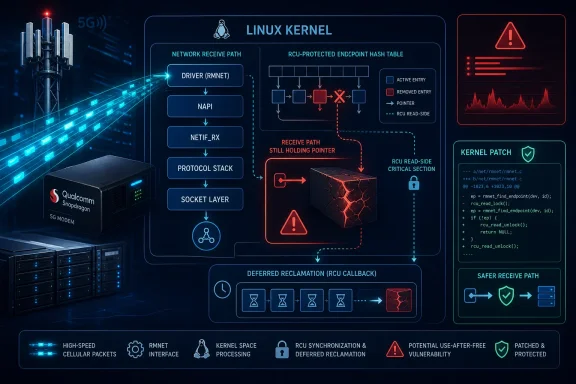
egress_dev pointer. The immediate concern is system stability, but because this is a kernel-space use-after-free, administrators should treat it as a security-relevant memory-safety defect rather than dismissing it as an ordinary driver crash.
Overview
CVE-2026-64188 affects the Linux kernel’s Qualcomm RMNET driver, specifically the endpoint teardown logic in rmnet_dellink(). The vulnerable pattern is straightforward in retrospect: code removes an endpoint from an RCU-protected hash table, then frees the endpoint immediately, even though concurrent readers may still be traversing the old view of that hash table.
The issue was introduced with RMNET support in Linux kernel 4.14 and remained present through multiple long-term stable branches. The Linux kernel CVE team published the record on July 20, 2026, and the vulnerability had already been fixed in the current upstream and relevant stable release lines by the time of publication.
The short version
The defect occurs when two activities overlap:
- One execution context deletes an RMNET endpoint.
- Another execution context receives a packet and looks up that endpoint through an RCU-protected data structure.
- The deletion path frees the endpoint before the receive-side reader is guaranteed to be finished.
- The receive-side code dereferences memory that may no longer contain a valid endpoint.
That is the essence of a use-after-free condition: software continues using a memory object after the allocator has been told that the object is no longer alive.
Why WindowsForum readers should care
For most Windows PCs, this is not a direct host-kernel vulnerability because Windows does not run the Linux RMNET driver. But the issue remains relevant in several real-world Windows-adjacent scenarios:
- WSL 2 users may run Linux distributions, containers, Android-related tooling, or custom kernels on Windows hardware.
- Developers often test mobile networking stacks, modem software, embedded Linux images, and virtual network paths from Windows workstations.
- Enterprise IT teams may manage mixed Windows/Linux fleets where endpoint, device-management, and vulnerability workflows need a single source of truth.
- Windows on Arm enthusiasts should recognize that modem-facing software stacks often combine Windows hosts, Linux development environments, Qualcomm hardware, and virtualization layers.
The key practical point is that the vulnerability belongs to the Linux guest or Linux device kernel that contains and uses RMNET, not automatically to Windows itself.
Background
Qualcomm RMNET is a Linux networking driver designed to support the multiplexing and aggregation protocol used by Qualcomm modem platforms. RMNET enables a physical transport to carry several logical packet data networks at once. Those networks may represent ordinary mobile data, tethering, multimedia messaging, IP Multimedia Subsystem traffic, or other modem-defined connections.
The driver is important because modern cellular systems do not necessarily map one physical modem interface to one conventional network interface. Instead, modem hardware can carry multiple logical traffic streams over USB, PCIe, HSIC, or accelerator-backed transports. RMNET interprets multiplexing headers, identifies the target data session, and routes packets to the correct logical network device.
RMNET’s role in cellular data paths
At a high level, RMNET processes packets arriving from a modem-facing transport:
- It parses a Qualcomm MAP header.
- It identifies the multiplexer ID associated with a packet.
- It finds the logical RMNET endpoint for that ID.
- It removes encapsulation details where needed.
- It passes the resulting IP traffic onward through the Linux networking stack.
This arrangement supports high-throughput modem connections without requiring the kernel to treat every logical cellular data connection as a separate physical link.
Why endpoint management is sensitive
An RMNET endpoint is not merely a bookkeeping entry. It connects a mux identifier and ingress path to an egress network device. During packet reception, the driver needs the endpoint to decide where traffic should go. During device deletion, it needs to remove that association safely.
The conflict is inherent: packet processing favors a lockless or minimally locked fast path, while device configuration and teardown change the topology of the network stack. RCU exists precisely to help kernel developers reconcile those competing needs. The vulnerability arose because endpoint removal followed only half of the required RCU lifecycle.
Understanding the Use-After-Free
A use-after-free occurs when a program retains a pointer to an object after the object has been released to the memory allocator. The object’s memory may still appear intact for a brief interval, may be overwritten by unrelated kernel activity, or may be recycled for a different object entirely.
In user-space software, this can cause an application crash or data corruption. In kernel code, the stakes are higher. A stale pointer can destabilize the operating system, disclose memory contents, corrupt kernel state, or—depending on the exact primitives available to an attacker—potentially contribute to privilege escalation.
The stale egress_dev pointer
The published report identifies the stale access as a read of ep->egress_dev, the endpoint’s outbound device pointer. The endpoint is described as a small allocator object, and the access at the reported offset matches the location of that pointer.
That detail matters because it confirms the bug is not merely a theoretical race uncovered by static analysis. A test case reached the receive path after endpoint removal and caused a page fault while code attempted to use the no-longer-valid device reference.
Crash evidence is not the same as an exploit
The supplied stack trace demonstrates a reproducible kernel failure. It does not by itself demonstrate reliable arbitrary code execution, data theft, remote exploitation, or a local elevation-of-privilege exploit.
That distinction is essential for defenders. Kernel use-after-free flaws deserve urgency because exploitability can evolve as researchers understand allocator behavior and reachable code paths, but organizations should not turn an unproven exploit chain into a claim of confirmed compromise capability.
The RCU Lifetime Mistake
Read-Copy-Update, commonly called RCU, is one of the Linux kernel’s most important concurrency mechanisms. It permits read-side operations to inspect shared data efficiently while writers make changes without forcing every reader through a heavyweight lock.
An RCU reader can safely continue using an object that has been unlinked from a shared list or hash table—but only if the object is not freed until all relevant pre-existing readers have completed. Removing the object and reclaiming its memory are separate operations.
What hlist_del_init_rcu() actually accomplishes
The vulnerable deletion path used hlist_del_init_rcu() to unlink the endpoint from an RCU-aware hash list. This prevents new lookups from finding the endpoint through the updated list structure.
But existing readers may already have loaded a pointer to the endpoint. Those readers are allowed to finish their read-side critical sections using the old object, provided that the updater delays reclamation.
Unlinking changes visibility. It does not automatically establish that no CPU still holds a valid reference obtained before the unlink.
Why immediate kfree() breaks the contract
The original pattern removed the endpoint from the hash table and then called kfree() immediately. From a conventional single-threaded perspective, that looks reasonable: the object is no longer reachable through the container, so free it.
Under RCU, however, reachability is not the whole story. A concurrent packet receive handler can already be operating on the object. Immediate freeing turns an otherwise legitimate lockless reader into a reader of reclaimed memory.
This is the defect at the heart of CVE-2026-64188: the deletion path effectively told the allocator that the endpoint was dead before RCU had confirmed that the receive path was done with it.
How the Fix Works
The kernel fix adds an rcu_head member to the RMNET endpoint structure and replaces ordinary immediate freeing with kfree_rcu(). This defers the final memory reclamation until the relevant RCU grace period has passed.
That change is deliberately narrow, but it is not trivial. It repairs the temporal lifetime rule that RCU readers depend on.
Deferred reclamation, not delayed unlinking
The endpoint is still removed from the hash table promptly. New packet lookups no longer discover the removed endpoint, which preserves the intended behavior of device teardown.
The difference is that the memory backing the old endpoint remains reserved until all readers that could have acquired it before removal have finished. That protects readers from allocator reuse and ensures their pointer remains valid during the grace period.
Why kfree_rcu() is the right primitive
kfree_rcu() is a common kernel helper for objects that have been removed from an RCU-protected structure and need no special destruction logic beyond freeing their memory. Rather than requiring each subsystem to create a callback that eventually calls kfree(), the helper expresses the intended lifecycle directly.
The practical effect is significant:
- Readers remain fast because the receive path can remain lockless.
- Writers remain responsive because teardown does not need to wait synchronously for every possible reader.
- Freed memory is not recycled prematurely while a reader might still dereference it.
- The code more clearly documents its concurrency model for future maintainers.
That final point matters in a large kernel codebase. Correct synchronization is not only about making one patch work; it is also about making ownership rules obvious enough that later changes do not reintroduce a race.
The Second Race the Patch Avoids
The patch does more than replace kfree() with kfree_rcu(). It also avoids calling rmnet_vnd_dellink() from the endpoint deletion path. Instead, it performs only the required decrement of the RMNET virtual-device count.
This is a subtle but important correction. Deferring the object’s free creates a grace period during which readers may still legally inspect its fields. A cleanup helper that sets ep->egress_dev to NULL during that period would create a separate race with those lockless readers.
Valid memory can still contain invalid state
A common misconception is that delaying the free solves every concurrency problem. It does not. An object can remain allocated and still be unsafe if another thread changes fields that readers assume are stable.
In this case, clearing the egress-device pointer would leave the endpoint memory valid but mutate a field that the receive path may read without locking. The result could be a null dereference, an inconsistent decision, or undefined behavior depending on how the field is used.
A carefully scoped teardown path
Inlining only the count decrement preserves the portion of teardown that is safe and necessary while avoiding mutation of the endpoint field that lockless readers may still consume.
This is good kernel engineering because it recognizes two independent dimensions of object safety:
- Lifetime safety: Is the memory still allocated?
- State consistency: Are the object’s fields still valid for the readers that may observe them?
CVE-2026-64188 is therefore more instructive than a simple “replace one free call” patch. The fix restores both the lifetime guarantee and the read-side field-stability assumption.
Affected Kernel Versions
According to the Linux kernel CVE announcement, the issue was introduced in Linux 4.14. Fixed stable releases include Linux 5.10.260, 5.15.211, 6.1.177, 6.6.144, 6.12.95, 6.18.37, and 7.0.14. The issue is also fixed in Linux 7.1.
The presence of fixes in multiple stable branches is useful, but it should not be interpreted as a complete distribution status list. Linux distributions frequently ship kernels with their own version suffixes and may backport the security fix to an older-looking package version.
The stable branches that received fixes
Administrators tracking upstream kernel releases should regard the following as fixed baselines:
| Kernel line | Fixed release |
|---|---|
| Linux 5.10 LTS | 5.10.260 |
| Linux 5.15 LTS | 5.15.211 |
| Linux 6.1 LTS | 6.1.177 |
| Linux 6.6 LTS | 6.6.144 |
| Linux 6.12 | 6.12.95 |
| Linux 6.18 | 6.18.37 |
| Linux 7.0 | 7.0.14 |
| Linux 7.1 | 7.1 or later |
Why package versions can be misleading
A distribution may advertise a kernel package such as 6.1.x-custom, 6.6.x-enterprise, or a vendor-specific build number. The visible upstream version may be lower than the fixed release while the vendor has already included the patch in its own maintenance stream.
Conversely, a system running an apparently recent mainline kernel may remain vulnerable if it is pinned to a build made before the fix was merged. Security teams should verify the vendor advisory, changelog, package metadata, or source configuration rather than relying on version appearance alone.
Exposure Conditions
CVE-2026-64188 is not a generic networking flaw that every Linux machine can trigger through a normal Ethernet or Wi-Fi interface. It is tied to the Qualcomm RMNET subsystem and requires the vulnerable code path to be present and in use.
That scope is reassuring, but it does not eliminate the need to patch. Cellular gateways, Android-derived systems, embedded platforms, lab environments, and hardware-integrated Linux devices can make RMNET highly relevant.
Systems more likely to be exposed
The most likely candidates include:
- Linux devices using Qualcomm modem hardware with RMNET configured for cellular data handling.
- Embedded appliances and gateways that depend on cellular uplinks for primary or backup connectivity.
- Android-adjacent and mobile Linux engineering environments where RMNET traffic and logical devices are actively created or removed.
- Test systems using TUN interfaces or synthetic packet paths to emulate modem-facing traffic.
- Custom kernels that enable Qualcomm RMNET support despite running on hardware where it is not typically used.
Systems less likely to be exposed
Ordinary desktop Linux installations with no Qualcomm cellular modem and no RMNET configuration are unlikely to exercise the vulnerable path. A Windows desktop with no Linux guest or embedded component is outside the direct scope of the kernel CVE.
However, “unlikely to be exposed” should not be confused with “safe to ignore indefinitely.” General-purpose kernels are often deployed across varied hardware, and a standard image may later be repurposed for a mobile, edge, or appliance workload without receiving the same security scrutiny as a dedicated cellular platform.
Enterprise Impact
For enterprises, the principal operational risk is not that every Linux server will suddenly be compromised. It is that a relatively specialized networking driver can be quietly present in an overlooked class of devices—especially remote appliances, field equipment, cellular routers, industrial systems, and development hardware.
The business impact of a crash in a cellular data path can be disproportionate. A gateway that loses its kernel networking stack may drop telemetry, disconnect remote management, fail over unsuccessfully, or require physical intervention.
Asset discovery matters more than panic
A sensible enterprise response begins with identifying systems that satisfy all three conditions:
- They run an affected Linux kernel or a vendor kernel without the backport.
- Their kernel includes the Qualcomm RMNET driver.
- RMNET is configured or can be reached through the organization’s hardware and workload design.
This is a far better approach than treating the CVE as either universally catastrophic or entirely irrelevant.
Container isolation does not fix host-kernel flaws
Containers share the host kernel. If an RMNET-capable Linux host runs workloads that can interact with vulnerable networking configuration or packet paths, container boundaries do not patch the race condition.
The practical reachability question is still important. Many of the relevant networking configuration operations are privileged, and a typical unprivileged container will not have the necessary capabilities. But enterprises should be cautious about containers granted broad networking privileges, host networking access, CAP_NET_ADMIN, device passthrough, or access to custom test interfaces.
Consumer and Developer Impact
Consumers are most likely to encounter this issue indirectly. A laptop, desktop, or gaming handheld using a conventional Wi-Fi or Ethernet connection probably has no active RMNET exposure. The same is often true for a standard WSL 2 installation used for programming, because the Linux environment is normally virtualized and does not directly control a Qualcomm modem via RMNET.
Still, Windows users increasingly run Linux tools locally, attach development boards, test mobile stacks, and operate home-lab network devices. Those use cases blur the old boundary between “desktop computer” and “embedded networking platform.”
WSL 2 considerations
WSL 2 uses a real Linux kernel in a lightweight virtual machine. That makes kernel updates important, but the presence of WSL 2 alone does not mean RMNET is configured, exposed to physical modem hardware, or exploitable from a distribution.
Users who build or boot custom WSL kernels, attach USB modem hardware to Linux environments, or develop cellular networking software should inventory their configuration more carefully. In these cases, the host Windows patch level and the Linux kernel patch level are separate maintenance concerns.
Practical advice for enthusiasts
For individuals who maintain their own Linux kernels or custom devices, the response is uncomplicated:
- Update to a kernel release containing the fix.
- Reboot into the updated kernel rather than merely installing the package.
- Avoid carrying isolated cherry-picked security patches unless maintaining a controlled vendor kernel.
- Review custom RMNET, TUN, modem, and virtual networking test setups.
- Remove unnecessary administrative capabilities from containers and test workloads.
The Linux kernel community generally recommends moving to an updated stable release rather than applying a single patch in isolation. That advice is especially relevant for concurrency fixes, which often depend on surrounding code and stable-branch testing.
Patch Management Guidance
Administrators should approach this CVE as a kernel maintenance task, not a configuration-only issue. Disabling an unused module can be a temporary exposure reduction, but it is not equivalent to deploying the fix across systems that require RMNET functionality.
A disciplined remediation process should include verification after the maintenance window, because the most common operational failure is not installing the wrong package—it is continuing to run the old kernel after the new one is available.
Recommended remediation sequence
- Identify the installed and currently running kernel separately. A package manager may show a new kernel installed while the system is still executing the prior build.
- Check vendor security advisories and changelogs. Confirm whether the vendor backported the CVE-2026-64188 fix into its kernel package.
- Prioritize RMNET-capable systems. Start with cellular gateways, mobile development systems, appliances, and custom Qualcomm modem deployments.
- Schedule a reboot. Kernel-space fixes do not protect the active kernel until the updated image is booted.
- Validate service recovery. Confirm modem registration, logical RMNET interfaces, routing, failover behavior, and remote-management connectivity after reboot.
- Document exceptions. If a device cannot be updated, record whether RMNET is disabled, whether the driver can be removed, and what compensating controls apply.
Avoid a false sense of security from module blacklisting
If RMNET is definitively unused, preventing the module from loading may reduce exposure. But this needs to be validated carefully. A remote system that depends on cellular backup connectivity may appear healthy until its primary network fails, at which point the blacklisted module becomes an availability incident.
For managed fleets, update-first remains the preferred answer. Configuration mitigations are best reserved for unsupported platforms, emergency containment, or environments where a tested kernel rollout cannot happen immediately.
Strengths and Opportunities
CVE-2026-64188 also highlights several positive aspects of the modern Linux security process.
- The issue was assigned a CVE and mapped to specific stable fixes, giving administrators concrete remediation targets instead of leaving the bug buried in a changelog.
- The patch is focused and technically coherent, addressing both premature object reclamation and the related field-mutation race.
- Multiple stable branches received fixes, which is particularly important for enterprises that rely on long-term kernels rather than fast-moving mainline builds.
- The crash report identifies a real failing code path, helping maintainers and distributors understand the operational consequence of the race.
- The fix preserves lockless receive-path performance, avoiding a simplistic solution that might damage throughput or latency in modem-heavy deployments.
A useful lesson for kernel developers
The broader lesson is that RCU correctness requires explicit thinking about both readers and reclaimers. Developers cannot assume that an RCU list deletion makes an object immediately disposable, and they cannot assume that a deferred free makes arbitrary teardown writes safe.
Security fixes like this are valuable beyond their individual CVE numbers because they reinforce review patterns that can catch similar races elsewhere in the networking stack.
Risks and Concerns
Despite the narrow fix and limited scope, several concerns remain relevant for administrators and security teams.
- The CVE record does not yet include a completed NVD CVSS assessment, so teams should not wait for a numerical score before evaluating affected assets.
- Use-after-free bugs have variable exploitability, meaning a crash-only proof today does not guarantee the risk will remain limited to denial of service.
- Reachability depends on configuration, which complicates automated vulnerability prioritization and can lead to both overreaction and underreaction.
- Vendor backports can obscure status, especially where distribution kernel package names differ substantially from upstream release numbers.
- Cellular and edge devices may be difficult to patch, particularly if they are deployed remotely, have strict uptime requirements, or depend on customized kernels.
- Testing is important after remediation, because RMNET changes affect network device lifecycle behavior and can expose previously hidden deployment-specific assumptions.
The danger of score-driven security
A missing CVSS score does not mean a vulnerability is harmless. CVSS is useful for triage, but it cannot substitute for environmental context. A medium-scoring issue in a remotely deployed cellular gateway may deserve faster action than a theoretically severe issue in a subsystem absent from every production machine.
For CVE-2026-64188, the relevant question is simple: does the organization run a vulnerable kernel with Qualcomm RMNET functionality that can be exercised? If yes, patching should move into the normal accelerated kernel-update queue.
What to Watch Next
The next development to watch is distribution-level advisory activity. Because the upstream fixes landed across several stable branches, major Linux vendors may publish package updates or confirm that their existing maintenance kernels already contain the backport.
Administrators should also monitor whether researchers publish an exploitability analysis. The currently available technical details establish a kernel use-after-free and an observed page fault, but they do not establish a practical privilege-escalation technique or remote attack vector.
Indicators that would raise urgency
The risk assessment should be revised upward if any of the following emerges:
- A public proof of concept demonstrates more than a system crash.
- Researchers show that unprivileged local users can reliably reach the vulnerable race.
- A remote or modem-originated packet sequence is shown to trigger the condition without trusted local configuration access.
- Affected device vendors identify widespread deployment in cellular routers, edge appliances, or managed endpoint hardware.
- Threat intelligence reports indicate active exploitation or scanning tied to vulnerable RMNET environments.
Indicators that reduce practical exposure
Conversely, the operational priority may be lower for systems where RMNET is unavailable, disabled, absent from the kernel build, or impossible to reach through the deployed hardware architecture. That does not change the vulnerability’s existence; it changes the probability that the vulnerable code will execute.
Security teams should preserve that distinction in their asset records. Accurate scope is more useful than blanket severity labels.
CVE-2026-64188 is a contained but meaningful Linux kernel security fix: a race in Qualcomm RMNET endpoint teardown allowed packet-processing code to outlive the endpoint it was using. The upstream solution follows established RCU practice by separating unlinking from memory reclamation and by avoiding unsafe state changes during the grace period. For ordinary Windows users, the direct impact will usually be minimal; for Linux systems that use Qualcomm cellular networking, custom kernels, embedded modem stacks, or privileged networking test environments, the right response is clear—confirm the running kernel, apply the vendor-supported update, reboot, and validate the cellular networking path before this small lifetime bug becomes a large operational outage.
References
- CVE-2026-64188 net: qualcomm: rmnet: fix endpoint use-after-free in rmnet_dellink() NVD / Linux Kernel · 2026-07-22T01:02:10-07:00