

Overview
CVE-2026-64190 was published on July 20, 2026, after the Linux kernel project classified a fix for a crash in the Team network driver as a security-relevant vulnerability. The issue dates back to Linux kernel version 3.3, when the Team driver was introduced, and affects the implementation in drivers/net/team/team_core.c.
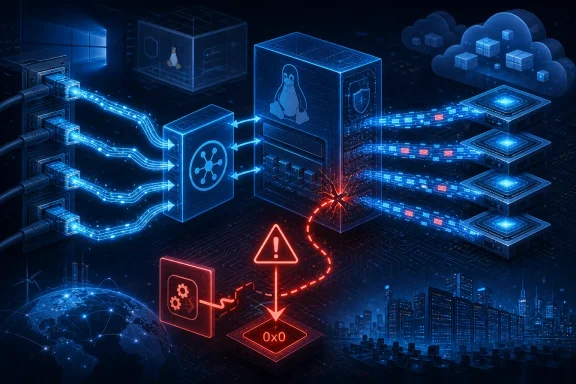
At its core, the defect is a race condition. One CPU can be changing the operating mode of a Team network interface while another CPU is transmitting traffic through that same virtual interface. During an extremely small transition window, the transmit callback can temporarily become NULL. If the transmitting CPU observes that state and attempts to call it, the system crashes in kernel mode.
The Linux kernel CVE announcement identifies fixes in Linux 6.18.35 and Linux 7.1. Those versions are useful upstream reference points, but distribution users should not treat them as the only safe releases. Enterprise distributions routinely backport fixes into long-term kernels while keeping an older-looking version number, so the decisive question is whether the vendor’s kernel package includes the relevant patch.
Why this is a crash bug rather than an ordinary networking glitch
The failure occurs in the networking fast path, where the kernel is trying to send a packet. Rather than returning a recoverable error to an application, the driver can attempt to execute code through a NULL function pointer. That produces a kernel oops or panic depending on configuration and distribution policy.
The reported stack trace begins at address zero, then passes through team_xmit, the generic network-device transmit path, packet-socket handling, and the socket send path. In practical terms, the system can fail while a local application is sending a packet—not necessarily while an administrator is directly interacting with the Team interface.
The immediate security framing
The known impact is denial of service through a kernel crash. The published description does not establish arbitrary code execution, data disclosure, or privilege escalation. That distinction matters: this should not be described as a remote takeover bug.
However, a kernel-level denial of service can still have serious operational consequences. A crash can interrupt virtual-machine hosts, storage traffic, firewall appliances, CI runners, container nodes, industrial gateways, or application servers. Depending on crash-dump configuration, it may also create diagnostic and recovery work far beyond the short duration of the actual fault.
Background
Linux Team interfaces are virtual network devices that combine multiple physical or virtual ports under a single logical interface. They can provide redundancy, traffic distribution, and selectable behavior through a userspace control component commonly associated with teamd.
Team was designed as a more modular alternative to the older Linux bonding driver. Whereas bonding has long offered a set of well-known modes inside the kernel, Team separates much of the policy and control-plane logic from the kernel implementation. Administrators can select runners such as active-backup, load balancing, broadcast, or link aggregation-style operation, with userspace helping determine which ports should carry traffic.
That design can be attractive in flexible Linux networking deployments. It also means that the boundary between control-plane changes and data-plane traffic deserves careful synchronization. CVE-2026-64190 is a reminder that a configuration transition is not automatically a quiet state: packets may still be queued, locally generated, redirected, or injected through interfaces that the administrator believes are momentarily inactive.
Team versus bonding
The vulnerable component is the Team driver, not the Linux bonding driver. Administrators should not assume that every aggregated interface is a Team interface merely because it has multiple ports or supports redundancy.
A quick distinction is useful:
- A Team device is typically created with the
teamkernel driver and may be managed withteamdorteamnl. - A bonding device normally uses the
bondingkernel module and exposes configuration through bond-specific settings. - A bridge, Open vSwitch device, VLAN interface, or NetworkManager connection profile is not automatically a Team device.
- A Windows NIC Teaming configuration is a separate technology and is not affected by this Linux kernel CVE.
The overlap in terminology can cause unnecessary alarm. Linux Team, Linux bonding, Windows Server NIC Teaming, Hyper-V virtual switches, and vendor-specific link aggregation features solve related networking problems, but they do not share the same kernel code.
A vulnerability with a long lineage
The CVE record traces the affected code back to Linux 3.3. That does not mean every system using a kernel numerically newer than 3.3 is necessarily exposed in a practical sense. The Team driver must be present and used, and the race requires a specific overlap between mode transition activity and packet transmission.
Still, the age of the flaw matters. It illustrates how concurrent systems bugs can survive for years when normal operating assumptions hide them. The original code path assumed that removing ports during a mode transition effectively meant no traffic would be transmitted. Later testing showed that this assumption could be invalid.
The Technical Root Cause
The vulnerable path lies in the handling of mode changes within the Team driver. During a transition, the function responsible for changing mode, __team_change_mode(), historically cleared a structure holding driver operation callbacks and then copied or restored the callbacks associated with the newly selected mode.
The problematic detail is that the structure includes transmit and receive handler pointers. If the structure is broadly cleared with memset() before safe replacement handlers are fully installed, another CPU using the transmit fast path can observe the transient zeroed field.
The result is straightforward and severe at kernel level: team_xmit() reads team->ops.transmit, receives a NULL value, and tries to invoke it as a function. Execution jumps to address zero, triggering the NULL pointer dereference reported in the advisory.
The unsafe transition window
The issue is not that the Team driver permanently leaves its transmit operation unset. The danger is the tiny interval between clearing old operations and restoring an appropriate handler.
In sequential code, that interval may appear harmless. But modern kernels execute on multiple CPUs, use lockless read-side mechanisms for performance, and must tolerate concurrent packet processing. A writer updating a control structure cannot safely assume a reader will wait until the update is aesthetically complete.
The logical sequence behind the crash looks like this:
- An administrator or privileged service initiates a mode change on a Team interface.
- The driver begins replacing the operation callbacks associated with the old mode.
- The transmit callback is temporarily cleared as part of a broad structure update.
- Another CPU simultaneously processes a packet queued for the Team device.
- The transmit path reads the transient NULL callback and attempts to execute it.
- The kernel faults, potentially stopping or rebooting the machine.
The exact timing is difficult to hit accidentally on an idle host, but high-throughput systems, automated reconfiguration, packet generators, and network-heavy virtualized environments create more opportunities for concurrency bugs to surface.
Why broad memory updates were the wrong primitive
Using memset() and memcpy() on a whole operations structure is convenient because it expresses “replace one mode’s behavior with another.” But convenience at the structure level can conceal different synchronization requirements for individual fields.
The transmit and receive pointers are not ordinary configuration data. They sit directly on paths that may be executing concurrently. Treating them exactly like lower-risk mode metadata created the opportunity for a reader to see an invalid intermediate state.
The fix therefore does something more disciplined: it updates the fields that are genuinely mode-specific while deliberately avoiding broad modification of the transmit and receive handler fields during the mode-change path.
RCU, Callback Pointers, and synchronize_net()
The vulnerability is best understood through the Linux networking subsystem’s use of read-copy-update, or RCU. RCU is a synchronization approach designed to let frequent readers proceed with minimal overhead while writers coordinate changes safely.
Networking needs that efficiency. Packet processing can occur at high rates across multiple CPU cores, and placing a heavyweight lock around every transmit operation would hurt throughput and latency. Instead, readers may observe data under RCU protections while writers make carefully ordered changes and, when necessary, wait for pre-existing readers to finish.
The reader and writer mismatch
In this case, team_xmit() can execute concurrently with the mode-change path. The writer thought it could temporarily empty the operations structure because no active ports were expected during the transition. The reader did not share that guarantee; it could still be invoked with traffic for the Team device.
This is a classic concurrency-design mismatch. One path reasoned about the intended topology—no active ports—while another path reasoned about the existence of a device capable of receiving a packet for transmission. Both states can coexist.
The fix avoids creating the NULL state in the first place. Rather than making the NULL callback safe to call, which would be poor defensive design, it preserves valid transmit and receive handlers throughout the transition.
Why dummy handlers matter
The Team driver already has a safer model for cases where no transmit-enabled port exists: dummy handlers. A dummy transmit handler can decline or safely absorb the operation without jumping through an invalid pointer.
During mode changes, the number of transmit-enabled ports is expected to be zero. Therefore, the existing adjustment logic can install the appropriate safe dummy handlers. The patch narrows responsibility so that team_adjust_ops() remains the component that manages those fast-path handlers.
That division of responsibility is important. It avoids duplicate ownership of function-pointer lifetime and reduces the chance that a later maintenance change reintroduces a gap.
Atomic visibility is not enough by itself
The patch also uses READ_ONCE() and WRITE_ONCE() for handler-pointer access. These primitives prevent compiler optimizations and undesirable load or store behavior from undermining the intended synchronization model.
They do not, by themselves, solve every concurrency problem. A pointer can be read atomically and still refer to stale or logically invalid state. The broader fix combines disciplined field updates, safe dummy operations, and a network synchronization barrier.
The addition of synchronize_net() before the old mode’s exit operation is particularly notable. It ensures that in-flight networking readers that might still hold references to the old mode state are allowed to drain before cleanup continues. That is the lifecycle guarantee the original transition lacked.
The AF_PACKET and Forced-Carrier Trigger
One of the most useful parts of the vulnerability description is its explanation of how the original assumption breaks: AF_PACKET with forced carrier can create traffic even when the Team interface has no active ports.
AF_PACKET is a Linux socket family that gives applications direct access to link-layer packets. It is used by packet analyzers, traffic-generation tools, network test suites, monitoring software, specialized security tooling, and certain appliance-style applications. Unlike a conventional TCP or UDP application, an AF_PACKET user can operate much closer to the network device layer.
Why “no ports” did not mean “no packets”
The vulnerable code assumed that, during a mode change with no active Team ports, packet transmission would not occur. That can be true under many normal network states, especially when carrier state and ordinary route selection discourage output.
Forced carrier invalidates that assumption. If the interface is made to appear carrier-up, software may continue to submit packets toward it. An AF_PACKET socket can then inject frames into the transmit path while the driver is changing modes.
This does not mean every packet capture application is dangerous, nor does it mean AF_PACKET is inherently flawed. The issue is that the Team driver’s control path incorrectly treated interface topology as a complete guarantee about fast-path activity.
Practical trigger conditions
A real-world trigger requires several conditions to overlap:
- The system must use the Linux Team driver rather than bonding or another aggregation mechanism.
- A Team interface must undergo a mode change, not merely ordinary packet transmission.
- Traffic must be transmitted through that Team device during the short mode-change interval.
- The reported triggering scenario involves AF_PACKET traffic and a forced-carrier condition.
- The actor changing the Team mode needs
CAP_NET_ADMIN, which is a significant Linux networking privilege.
These requirements substantially limit broad, unauthenticated exposure. They do not eliminate risk in environments where network-management privileges are delegated to services, containers, automation platforms, or tenants.
Exploitability and Severity Context
No CVSS score had been assigned by NVD at publication time. That is not unusual for recently ingested Linux kernel CVEs, and it should not be mistaken for evidence that the issue is harmless or unimportant.
A missing score means organizations need to perform their own early triage. For this CVE, the most defensible initial assessment is that it is a conditional local or privileged denial-of-service issue affecting systems that actively use Linux Team interfaces.
CAP_NET_ADMIN changes the threat model
The need for CAP_NET_ADMIN is a critical constraint. On a conventional Linux server, that capability is normally held by root or by tightly controlled system-management components. An unprivileged desktop user usually cannot reconfigure a Team mode at will.
But Linux capability boundaries can be more complicated in modern infrastructure. Containers may receive networking capabilities, privileged workload agents can run with broad authority, and orchestration systems may let automation mutate network state. The effective exposure depends on who can alter Team settings and whether that same actor, or a cooperating process, can drive traffic at the right time.
Denial of service can be a security boundary issue
A crash is sometimes dismissed as an availability bug rather than a security problem. That view is too simplistic for infrastructure systems.
On a hypervisor or gateway, a kernel crash can drop many downstream connections. On a node participating in a clustered workload, it can cause failover storms, temporary split-brain conditions, or storage-path disruption. On an appliance, it can become a repeatable reboot loop if the triggering configuration returns automatically at startup.
The absence of demonstrated code execution should lower panic, not lower patching discipline.
Who Is Affected
The affected population is much smaller than “all Linux users.” The vulnerable code is in a particular network driver, and the driver must be both built into or available to the kernel and actually used for a Team interface.
Administrators should begin with asset identification rather than treating the CVE as a generic operating-system emergency. The goal is to identify systems where the Team driver is active, determine how they are configured, and verify whether the distribution’s current kernel package contains the vendor backport.
Enterprise Linux servers and appliances
Enterprise risk is highest where Linux Team interfaces provide production uplinks, redundancy, or traffic distribution. This can include physical servers, gateway appliances, network-function virtualization platforms, lab environments, and specialized infrastructure systems.
Automation increases the relevance. A configuration-management job that changes Team runners during maintenance, failover software that adjusts links, or an orchestration component that repeatedly applies network state can make the transition path more common than it would be on a static server.
Virtualization and private-cloud environments
Virtual machines can use Team interfaces, although virtual network designs more often rely on bridges, bonds, Open vSwitch, or platform-specific virtual switching. The CVE becomes relevant if a guest or host has a Team device and can perform live mode changes under load.
For hypervisor hosts, availability impact can be disproportionate. A single host crash may interrupt many guests, even if the underlying flaw is triggered by a configuration operation associated with one virtual network design.
Containers and Kubernetes-adjacent systems
Container environments deserve a nuanced assessment. Most containers do not need the Team driver and should not receive broad networking capabilities. A typical unprivileged application container is therefore unlikely to satisfy the prerequisite conditions.
The picture changes for privileged containers, CNIs, network troubleshooting pods, node-level agents, and appliances that deliberately grant CAP_NET_ADMIN. Security teams should inventory those permissions carefully. The relevant question is not simply whether a container exists, but whether it can control Team configuration or influence a component that can.
WSL 2, Windows, and Microsoft-hosted Linux
Native Windows installations are not affected because the vulnerable code belongs to the Linux kernel’s Team driver. Windows Server NIC Teaming and Hyper-V’s networking stack do not use this Linux source file.
WSL 2 uses a real Linux kernel in a lightweight virtual-machine architecture, so the distinction is more subtle. A standard WSL distribution ordinarily does not use Linux Team interfaces, and the virtualized networking setup is not a typical Team deployment. The practical exposure for everyday WSL users is therefore very low, but administrators running customized WSL kernels or unusual Linux networking laboratories should still verify their configuration.
Microsoft-hosted Linux workloads should be assessed like any other Linux workload. Whether the environment runs in Azure, on Hyper-V, or on a Windows-managed edge device does not change the relevant technical facts: the guest kernel version, the presence of the Team driver, the use of Team devices, and the privilege model determine exposure.
How Administrators Should Assess Their Environment
The correct response is targeted verification followed by a normal, controlled kernel-update process. Do not assume that a version string alone answers the question, especially on enterprise distributions with security backports.
A useful assessment sequence is:
- Identify active Team devices by examining network configuration and checking whether any interface uses the Team driver.
- Determine whether Team mode changes occur operationally, including through
teamd, NetworkManager profiles, scripts, failover tooling, or orchestration automation. - Review kernel package advisories from the operating-system vendor to see whether the fix has been incorporated into the distribution kernel.
- Install the vendor-supported kernel update through standard change-management procedures.
- Reboot or otherwise activate the updated kernel, because installing a kernel package alone does not replace the kernel already running.
- Validate the interface after reboot, including link redundancy, runner behavior, routing, monitoring, and application connectivity.
Configuration discovery
On Linux, administrators can inspect available and loaded drivers, network interface details, and NetworkManager connection profiles. The exact commands vary by distribution and operational tooling, but the investigation should distinguish Team interfaces from bonds and bridges.
A useful operational principle is to inspect both the running state and the declared state. A Team device may not be carrying production traffic at the moment of inspection but could still be defined in configuration management, appliance templates, disaster-recovery plans, or dormant failover configurations.
Patch verification beyond version numbers
Upstream Linux 6.18.35 and Linux 7.1 contain the identified fixes, but many organizations do not deploy upstream kernels directly. Red Hat Enterprise Linux, Ubuntu LTS, SUSE Linux Enterprise, Debian stable derivatives, appliance vendors, and cloud images often maintain their own patch cadence.
The right verification evidence is a vendor advisory, changelog, package update note, or source package record confirming that CVE-2026-64190 or the underlying commit has been backported. A vendor kernel can be safe even when its visible base version predates the upstream release containing the fix.
Avoid unsupported cherry-picks
The Linux kernel project explicitly discourages applying isolated stable commits as a substitute for updating to a tested stable kernel release. That advice is particularly appropriate here because the patch modifies synchronization and callback-lifetime behavior in networking code.
A hand-applied patch may compile and still interact badly with distribution-specific changes, older backports, out-of-tree drivers, or local modifications. For production systems, the preferred route is the vendor’s tested kernel package.
Strengths and Opportunities
CVE-2026-64190 is a useful example of the Linux kernel security process working as intended: a subtle crash condition was identified, a technically narrow fix was developed, and affected and fixed commit ranges were published.
- The fix preserves fast-path safety rather than merely masking the symptom. It removes the transient NULL callback condition instead of adding a late defensive check around an unsafe state.
- The patch uses existing Team-driver behavior. Reusing safe dummy handlers through the established operation-adjustment logic reduces the chance of conflicting ownership over transmit and receive callbacks.
- The synchronization model is clearer after the change.
READ_ONCE(),WRITE_ONCE(), andsynchronize_net()document that pointer visibility and reader lifetime are deliberate concerns. - The vulnerability is operationally identifiable. Organizations can determine exposure by looking for Team interfaces and Team mode-change workflows rather than trying to infer risk from every Linux host.
- The flaw provides a chance to reduce unnecessary privileges. Reviewing which services, containers, and automation agents possess
CAP_NET_ADMINcan improve security well beyond this specific CVE.
A lesson for kernel and driver engineering
The broader engineering lesson is that “temporarily invalid” state is often not valid at all in concurrent kernel code. If a callback can be read by a fast-path CPU, it must remain callable—or readers must be explicitly excluded—throughout a configuration transition.
That lesson applies far beyond Linux Team. Virtual switches, storage multipathing, device hotplug, scheduler transitions, and driver callbacks all face similar risks when a control path attempts to rebuild shared state while active work continues.
Risks and Concerns
The limited exposure conditions should not create complacency. Infrastructure failures frequently occur at the intersection of rare races and unusual operational workflows—the exact conditions that are hardest to reproduce during routine testing.
- Automated reconfiguration can magnify a rare race. A system that changes Team modes programmatically may create far more trigger opportunities than a manually managed server.
- Forced-carrier settings can invalidate intuitive assumptions. Administrators should be cautious about any configuration that makes an interface appear operational when its underlying ports are unavailable.
- Privileged containers can blur the local-versus-remote distinction. A tenant or workload with
CAP_NET_ADMINmay be locally privileged inside a namespace while still being remote from the host operator’s perspective. - Crash-loop behavior is possible in poorly designed automation. If a boot-time or watchdog process repeatedly applies the triggering network transition under traffic, a node may fail again shortly after recovery.
- Incomplete inventory is the main practical hazard. Teams often know about bonds and bridges but may overlook older Team configurations embedded in appliances, templates, or inherited network profiles.
Do not overstate the threat
There is currently no published indication that CVE-2026-64190 permits an unauthenticated Internet attacker to crash arbitrary Linux machines simply by sending traffic to them. The trigger is tied to local network configuration activity and a concurrent transmit path.
That matters for prioritization. Internet-facing servers without Team devices should not divert emergency-response resources from actively exploited remote vulnerabilities. At the same time, a production host that uses Team networking and grants configuration authority to automated or semi-trusted components should treat the update as a meaningful availability fix.
Competitive and Platform Implications
The vulnerability also highlights a practical difference between network aggregation technologies. Linux environments offer several paths to redundancy and load distribution—Team, bonding, bridges, Open vSwitch, hardware LAGs, software-defined networking overlays, and cloud-managed virtual NIC abstractions.
No single implementation is universally superior. Team’s architecture can offer flexibility and a userspace-driven control model, while bonding remains widely familiar and deeply integrated into established Linux administration practices. The CVE does not prove that Team is inherently unsafe, but it does remind operators that less-common components can receive less routine operational scrutiny.
Implications for Windows-centric IT teams
Windows administrators managing mixed fleets should resist the temptation to map Linux Team directly onto Windows NIC Teaming. The conceptual similarities are useful for understanding redundancy, but security advisories, driver ownership, update channels, and configuration tools differ completely.
For Windows-centric organizations, the best response is to ask Linux platform owners four simple questions:
- Do any systems use Linux Team interfaces?
- Which kernel packages are currently running on those systems?
- Are Team mode changes automated or exposed to delegated administrative tools?
- Has the vendor kernel update containing the fix been deployed and activated?
That approach is more productive than attempting to alter Windows networking settings in response to a Linux kernel driver issue.
What to Watch Next
As of July 22, 2026, the most important follow-up is distribution-level patch availability. The upstream fix is identified, but NVD had not yet supplied a CVSS assessment when the record was initially published. Security teams should expect distribution advisories and package metadata to evolve as maintainers evaluate and backport the change.
The CVE record itself may also receive updates. Linux kernel vulnerability records can be amended as additional stable branches receive backports, affected-version expressions are refined, or downstream vendors publish their own status. A static assessment made on publication day should therefore be revisited during normal vulnerability-management cycles.
Signals that deserve attention
Administrators should monitor several practical developments:
- Vendor advisories that explicitly list CVE-2026-64190 or the relevant upstream fix.
- Kernel package releases for supported enterprise and cloud distributions.
- Changes to Team-driver configuration in infrastructure-as-code repositories and appliance images.
- Crash reports involving
team_xmit, address-zero instruction pointers, or mode-transition activity. - Any public proof-of-concept that demonstrates more reliable triggering than the currently described AF_PACKET and forced-carrier scenario.
The last point is worth framing carefully. A proof-of-concept would not necessarily change the underlying technical impact, but it could change operational urgency by showing that the race is easier to reproduce than initially expected.
Looking Ahead
CVE-2026-64190 is a focused Linux networking fix, not a broad Windows emergency, yet it offers a valuable operational lesson for every mixed-platform administrator: the most dangerous infrastructure failures often arise when control-plane assumptions meet real data-plane behavior. A Team mode change may look like a quiet administrative task, but packets can still arrive at the transmit path, CPUs can still race, and an invalid intermediate callback state can still bring down the operating system. Updating affected Linux kernels, validating Team deployments, and limiting unnecessary network-administration privileges are the practical steps that turn this advisory from an obscure kernel detail into a manageable maintenance item.
References
- CVE-2026-64190 net: team: fix NULL pointer dereference in team_xmit during mode change NVD / Linux Kernel · 2026-07-22T01:01:51-07:00