

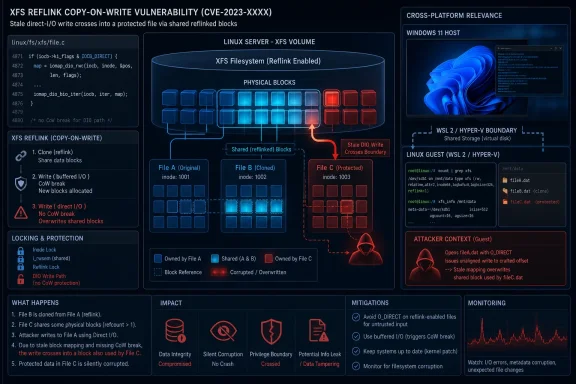
For Windows users, the immediate distinction matters: this is not a vulnerability in NTFS, ReFS, FAT, or the Windows kernel. However, it can be highly relevant to Windows-centered environments that use WSL 2, Linux virtual machines, Hyper-V workloads, dual-boot Linux installations, development servers, container hosts, NAS appliances, or enterprise systems built on Red Hat Enterprise Linux-compatible distributions where XFS is common.
The flaw is especially important because the vulnerable code has existed since Linux kernel 4.11, released in 2017, and because reflink support is broadly enabled on newly created XFS filesystems. A successful attack requires local access and specific filesystem conditions, but those conditions can exist on otherwise conventional multi-user Linux systems.
Background
XFS is a mature, high-performance journaling filesystem used heavily in enterprise Linux deployments. It is widely associated with large files, parallel I/O workloads, virtual-machine storage, database servers, and high-throughput infrastructure. On several enterprise Linux families, XFS has also been a default filesystem choice for root volumes and application data.
A key XFS capability is reflink, a block-sharing feature sometimes described as copy-on-write cloning. Instead of immediately copying every byte when one file is cloned into another, the filesystem can make both files reference the same physical blocks. This makes clones nearly instantaneous and storage-efficient.
When either file is modified later, XFS should preserve isolation through copy-on-write behavior:
- The filesystem determines that the affected block is shared.
- It allocates a new physical block for the writer.
- It copies or prepares the required data.
- It redirects the modified file to the new block.
- It leaves the original file associated with the original block.
That design is sound. The vulnerability is not that XFS supports reflink cloning; it is that a narrow locking and state-refresh failure can lead XFS to make a decision using an outdated mapping.
The resulting issue is severe because filesystem mappings are effectively the bridge between filenames and physical storage. If a direct-I/O write reaches the wrong physical block, the system can violate one of the most important isolation guarantees in a multi-user operating system: a user should not be able to alter a file they do not own or have write permission to modify.
What CVE-2026-64600 Actually Fixes
The upstream fix is titled “xfs: resample the data fork mapping after cycling ILOCK.” That wording is technical, but it precisely describes the problem.
XFS tracks a file’s main block mappings in what is called the data fork. During copy-on-write processing, it also maintains temporary or pending mappings in a separate CoW fork. The filesystem uses these structures, along with reference-count metadata, to determine whether a physical extent is still shared and whether a write must be redirected to new storage.
The vulnerable helpers are:
xfs_reflink_fill_cow_holexfs_reflink_fill_delalloc
Both can temporarily release and later reacquire the inode’s ILOCK while they obtain an XFS transaction. That lock cycle is necessary because allocating a transaction can wait for log space, and waiting while holding particular locks can create deadlock risks.
The mistake was not in releasing the lock. The mistake was in trusting a data-fork mapping that had been collected before the lock was released.
The stale-mapping race
While the ILOCK is dropped, another concurrent operation can complete a copy-on-write cycle on the same file. That operation may change the file’s data-fork mapping from one physical block to another and update the shared-block accounting.
When the first operation reacquires the lock, the XFS code refreshes the CoW-fork state but, before the patch, did not always re-read the data-fork mapping. It could therefore query the reference-count tree using an old physical block address.
That produces a dangerous sequence:
- The first direct-I/O operation records a mapping to physical block X.
- It releases the ILOCK while reserving transaction resources.
- A second concurrent operation completes copy-on-write processing.
- The second operation moves the writable file from block X to a new block Y.
- Block X may now belong only to the original reflink source file.
- The first operation resumes but checks whether block X is shared rather than rechecking the file’s current mapping.
- The code concludes, incorrectly, that it can write in place.
- The direct-I/O layer receives the stale mapping and sends the write to block X.
At that point, the write can reach storage belonging to the original source file rather than the attacker-controlled clone.
The security consequence is not merely a crash, stale read, or denial of service. Under the required conditions, the flaw can become an unauthorized persistent write primitive against data that the local attacker could read but was never authorized to change.
Why Direct I/O Is Central to the Risk
The CVE’s affected path involves direct I/O, commonly requested through the O_DIRECT file-access flag. Direct I/O attempts to bypass portions of the normal page cache, allowing applications to manage I/O buffers and ordering more directly.
It is used by workloads such as:
- Databases
- Virtual-machine storage systems
- Backup utilities
- High-performance data pipelines
- Some storage engines
- Specialized server software
For ordinary desktop users, direct I/O may sound obscure. But the threat model does not require a user to be running a database. An attacker-controlled local process can potentially issue direct I/O operations when the operating system and filesystem permit it.
The critical technical point is that aligned direct writes can follow a locking path that permits overlapping work on the same inode. That overlap creates the opportunity for one operation to change the mapping while another is between its initial lookup and final write submission.
This is why the vulnerability has been compared conceptually with older copy-on-write race flaws: the issue is not a simple permission check failure. It is a timing-sensitive inconsistency between what the kernel believes a file maps to and what that file actually maps to once a concurrent storage operation has completed.
The Practical Exposure Conditions
CVE-2026-64600 does not affect every Linux installation. Exposure generally depends on three major conditions being true at the same time.
A vulnerable Linux kernel must be running
The vulnerable code path was introduced with Linux kernel 4.11-era XFS direct-I/O copy-on-write work. Systems running kernels from that lineage require patch verification.
The CVE record identifies fixed upstream kernel lines that include:
- Linux 6.12.96
- Linux 6.18.39
- Linux 7.1.4
- Linux 7.2-rc4 and later upstream development snapshots
These versions are useful reference points, but administrators should not treat version comparison as the only patch test. Enterprise distributions frequently backport security fixes into kernels that retain older-looking version strings. Conversely, a vendor build may ship a newer nominal kernel while delaying a particular backport.
The definitive test is whether the installed vendor kernel includes the upstream fix or an equivalent backport.
The filesystem must be XFS with reflink enabled
The vulnerable behavior depends on XFS reflink copy-on-write support. A system using ext4, Btrfs, ZFS, NTFS, ReFS, or an XFS filesystem created without reflink support is not exposed through this exact vulnerability path.
On XFS, reflink is a filesystem-format feature recorded in the superblock. It is not simply a runtime toggle that can be safely disabled with a mount option after deployment.
A read-only check for a mounted XFS filesystem can be performed with:
xfs_info /mount/point | grep reflink=
A result containing:
reflink=1
indicates that reflink support is enabled for that XFS filesystem.
Administrators should inspect more than the root filesystem. Application data, container storage, virtual-machine images, build directories, temporary-data volumes, and shared service mounts can all be relevant if they use reflink-enabled XFS.
A local attacker needs a useful path to a protected file
The issue is a local privilege-escalation risk, not a remote network service flaw by itself. An attacker generally needs local code execution, the ability to create or write a file on the relevant XFS filesystem, and read access to a file that would be valuable to alter.
The source and destination must also be on the same XFS filesystem for reflink-style shared extents to be relevant. This makes storage layout important.
A common high-risk layout is a single reflink-enabled XFS root filesystem that contains:
- Readable root-owned files or executables
- World-writable locations such as temporary directories
- Local untrusted user accounts
- A vulnerable kernel
- A path enabling direct-I/O operations
That combination can exist on shared Linux servers, hosted development environments, research clusters, build workers, and some virtual desktop or lab systems.
Why the CVSS Blank Should Not Be Misread
At publication, the NVD record does not yet provide a CVSS 4.0, CVSS 3.x, or CVSS 2.0 assessment. That does not mean the vulnerability is low severity or harmless.
New CVE records often arrive before NVD enrichment, scoring, affected-product analysis, and broader vendor advisories are complete. A blank score should be treated as pending assessment, not as a security clearance.
In this case, the technical impact warrants urgent attention because the flaw has reportedly been demonstrated as a route to local root compromise under appropriate conditions. The core concern is integrity: a successful attacker may alter security-sensitive files on disk while retaining the metadata characteristics of the original target.
That last point raises the stakes. Traditional defenses often assume that a protected executable’s ownership, mode bits, and inode metadata will change if an attacker replaces it. Here, the underlying danger is that the file’s contents can be changed through a block-mapping race without necessarily replacing the target inode itself.
The Upstream Fix: Small Patch, Important Guarantee
The fix is conceptually straightforward: after the ILOCK has been dropped and reacquired, XFS must determine whether the previously observed data-fork mapping is still valid.
The patched code uses a sequence mechanism to detect whether the mapping state changed during the lock cycle. If it did, XFS queries the data-fork mapping again before it performs the shared-block determination and before direct I/O can continue using that mapping.
This restores the required relationship between three pieces of state:
- The file’s current data-fork mapping
- The copy-on-write mapping state
- The physical block reference count
The patch does not remove reflink, disable direct I/O, or turn off concurrent storage operations. It corrects a state-validation gap at exactly the point where concurrency could make an earlier lookup obsolete.
Why this design is the right response
The repair is narrowly scoped and preserves XFS performance architecture. It does not attempt to hold the ILOCK indefinitely across transaction allocation, which could introduce lock-ordering problems or degrade concurrency.
Instead, it recognizes a fundamental rule of concurrent filesystem development: a mapping observed before releasing a lock cannot automatically be trusted after reacquiring that lock.
That is an important lesson beyond CVE-2026-64600. Filesystems are not merely collections of on-disk structures. They are highly concurrent state machines coordinating page cache behavior, direct I/O, metadata transactions, allocation groups, reference counts, journaling, memory pressure, and crash recovery. A seemingly minor stale-state assumption can cross a privilege boundary when file content isolation depends on the correctness of block ownership.
Windows Environments: Where the CVE Matters
Windows PCs are not directly vulnerable simply because they run Windows 11 or Windows Server. The flaw lives in the Linux kernel’s XFS code, not in Windows storage drivers or the Windows filesystem stack.
Still, Windows administrators should map their Linux footprint carefully.
WSL 2
WSL 2 uses a real Linux kernel in a lightweight virtualized environment. Whether CVE-2026-64600 is relevant depends on whether a WSL distribution has access to an XFS filesystem with reflink enabled.
Most default WSL installations use virtual disk storage formatted with ext4, which means the standard configuration is not exposed through the XFS-specific condition. However, custom WSL environments can mount additional disks, use specialized virtual storage, or attach to Linux-managed storage that employs XFS.
The appropriate response is to verify the mounted filesystems inside the Linux distribution rather than assuming WSL is categorically affected or categorically safe.
Hyper-V and third-party Linux virtual machines
Windows workstations often host Linux guests through Hyper-V, VMware Workstation, VirtualBox, or cloud-connected virtual machine platforms. A Linux guest with XFS on its root or data volume can be vulnerable independently of the Windows host.
Updating Windows does not patch the guest kernel. The Linux guest needs its own vendor kernel update and reboot.
Containers and Kubernetes development
Containers share the host Linux kernel. Therefore, a Windows user developing through a Linux VM or remote Kubernetes cluster must distinguish between the container image and the host operating system.
Updating a container image alone is not sufficient if the vulnerable XFS filesystem and kernel belong to the Linux host. In a containerized environment, the most important questions are:
- Which host runs the kernel?
- Which filesystem backs writable storage?
- Is that filesystem reflink-enabled XFS?
- Can untrusted workloads create local files on that same filesystem?
Dual-boot and remote administration
Dual-boot users should patch the Linux operating system separately. Likewise, Windows administrators managing Linux servers through Remote Desktop gateways, Windows Terminal, SSH, or centralized management tools should treat the Linux endpoint as the security boundary that needs remediation.
How Administrators Should Assess Systems Safely
A practical assessment should begin with inventory, not with assumptions.
1. Identify the running kernel
Use:
uname -r
This shows the active kernel release. Record it, but do not stop there. Distribution package naming and backports can make simple version comparisons misleading.
For RPM-based systems, useful package checks include:
rpm -q kernel
rpm -q kernel-core
For Debian-based systems:
dpkg -l | grep linux-image
The goal is to identify the exact installed and currently booted kernel package, then compare it with the vendor’s security advisory and package changelog.
2. Find XFS mounts
Use:
findmnt -t xfs
or:
mount -t xfs
This identifies mounted XFS filesystems. Do not limit the review to /. Secondary data volumes may host application files, build workspaces, user home directories, or storage used by locally accessible services.
3. Check reflink status on each relevant mount
For each mounted XFS filesystem:
xfs_info /mount/point | grep reflink=
If reflink is disabled, that filesystem is not exposed through the RefluXFS path. If reflink is enabled, continue with kernel and access-control evaluation.
4. Review local write locations and trust boundaries
Identify whether untrusted or lower-privileged users can write files on the same XFS filesystem as security-sensitive content.
Pay special attention to:
/tmpand/var/tmp- Shared project directories
- Build and CI workspaces
- Multi-tenant application upload directories
- University or research compute environments
- Managed hosting servers
- Bastion systems with local shell access
- Desktop systems shared by multiple user accounts
5. Confirm the distribution’s fixed build
Do not rely on a generic claim that “the system is updated.” Confirm that the installed kernel package includes the CVE fix, an equivalent backport, or a vendor-provided live patch.
Because the CVE is recent and vendor response timelines differ, the exact fixed package can vary by distribution, support tier, architecture, and kernel stream.
Mitigation While Kernel Updates Roll Out
The preferred remediation is to install a fixed kernel and reboot into it. Until that is complete, mitigations can reduce exposure but should not be mistaken for a full replacement for patching.
Prioritize systems with local untrusted code execution
Patch first where local users, CI jobs, tenants, plugin frameworks, development tools, or workload schedulers can execute code. A single-user machine with no untrusted local execution has a different risk profile from a shared development server, but sensitive systems should still be remediated promptly.
Separate writable scratch space from sensitive files
The vulnerability depends on a meaningful protected target and attacker-writable space existing on the same reflink-enabled XFS filesystem. Separating scratch directories, user homes, build outputs, or tenant data from system binaries and security-sensitive configuration reduces the opportunity for practical exploitation.
This is a valuable containment measure, but it can introduce operational complexity. Moving temporary paths or changing mount layouts may affect software behavior, disk quotas, backup jobs, SELinux labeling, and service startup.
Review reflink usage before making storage changes
Reflink cannot generally be disabled in place for an existing XFS filesystem. Reformatting or migrating to a differently configured filesystem is a major operational action and should not be undertaken casually.
For most organizations, rebuilding storage merely to avoid the CVE is less appropriate than patching the kernel. Storage redesign may be justified for defense-in-depth, but it is not the emergency fix.
Avoid treating access-control layers as complete protection
SELinux, AppArmor, container isolation, filesystem permissions, and endpoint controls remain important. However, this CVE concerns a kernel-level mismatch between logical file permissions and physical block targeting.
Mandatory access control can reduce an attacker’s ability to execute code, access candidate source files, or manipulate storage locations. It does not substitute for correcting the vulnerable kernel behavior.
Detection and Incident-Response Considerations
CVE-2026-64600 is troubling from a forensic perspective because the suspected impact can be persistent modification of file contents without a normal file-replacement event.
Administrators should not assume that a clean ownership record, expected file mode, or unchanged inode timestamp pattern definitively proves that a security-sensitive executable has not been altered. The flaw’s relevance lies precisely in the possibility that a write reaches physical storage associated with another file.
Useful post-patch review measures
After patching, security teams should consider:
- Verifying installed package integrity using the distribution’s package-management tools
- Checking hashes of sensitive executables and configuration files against trusted package metadata
- Reviewing unexpected modifications in authentication configuration
- Revalidating privileged executable inventories
- Examining local account creation, credential changes, and suspicious persistence mechanisms
- Rebuilding or restoring affected systems from known-good sources if compromise is suspected
For RPM-based systems, package verification can help identify changed files:
rpm -Va
On Debian-family systems, package integrity tools and package reinstallation workflows can support similar validation. These checks are not perfect forensic proof, but they are practical starting points for identifying anomalous system-file content.
Treat suspected exploitation as a host-integrity event
If there is credible evidence that an unpatched reflink-enabled XFS system was exposed to untrusted local users, incident response should account for possible root-level compromise.
That typically means preserving evidence, rotating credentials that may have been accessible on the host, reviewing authentication and privileged-access logs, and considering reinstallation rather than relying solely on selective file replacement.
A kernel race capable of altering protected file content is not an event to handle as a routine application bug.
Strengths and Limitations of the Current Fix
The upstream repair has notable strengths.
- It addresses the exact stale-state condition at the heart of the race.
- It preserves the locking behavior needed to avoid transaction-allocation deadlocks.
- It limits extra mapping queries to cases where the relevant sequence state changed.
- It does not require users to abandon XFS reflink or direct I/O.
- It is suitable for stable-kernel backporting because the correction is focused rather than architectural.
There are also operational risks to manage.
Patch availability will not be uniform
Kernel fixes move through multiple channels: upstream stable releases, distribution kernels, cloud-provider images, appliance firmware, embedded products, and long-term support trees. A fix available in mainline Linux does not mean every deployed system has received it.
Reboots remain a practical challenge
A kernel package is not a complete remediation until the machine boots the fixed kernel. Servers with long uptime, clustered workloads, maintenance restrictions, or unattended edge deployments can remain vulnerable after package installation.
Live patching must be verified, not assumed
Some commercial and enterprise platforms provide live kernel patching. Where available, it can reduce reboot urgency. But administrators should validate that the specific live patch covers CVE-2026-64600 and that the running kernel reports it as active.
Risk depends on environment, but the bug is real
The exploitation conditions are narrower than those for a remote unauthenticated vulnerability. That should guide prioritization. It should not create false reassurance.
A system that combines vulnerable XFS reflink storage, local attacker-controlled code, and sensitive files on the same volume presents a meaningful security boundary failure.
The Broader Lesson for Linux Storage Security
CVE-2026-64600 is a reminder that modern filesystem features create complex interactions between performance optimization and security invariants. Reflink cloning, delayed allocation, direct I/O, transactional metadata updates, reverse mapping, and reference-count trees all improve capability or efficiency. Together, however, they create state transitions that must remain consistent under concurrency.
The failure here was not a dramatic memory-corruption bug. It was a stale mapping that survived a lock transition and was later trusted by a critical write path.
That kind of flaw is particularly instructive because it demonstrates why security reviews must include race analysis, lock-boundary validation, and storage-ownership invariants. Permission checks are only meaningful if the kernel ultimately writes to the physical storage owned by the file that passed those checks.
For Windows-focused IT teams, the practical message is clear: keep Windows systems updated, but do not overlook the Linux systems operating beside them. WSL 2 environments, Hyper-V guests, remote Linux servers, container hosts, and enterprise XFS storage all need independent kernel and filesystem assessment.
CVE-2026-64600 should be treated as a priority kernel maintenance issue wherever reflink-enabled XFS and local untrusted execution intersect. The durable fix is a patched Linux kernel running in production, backed by verification that the affected XFS volumes and workload boundaries have been properly reviewed.
References
- CVE-2026-64600 xfs: resample the data fork mapping after cycling ILOCK NVD / Linux Kernel · 2026-07-24T01:02:36-07:00