

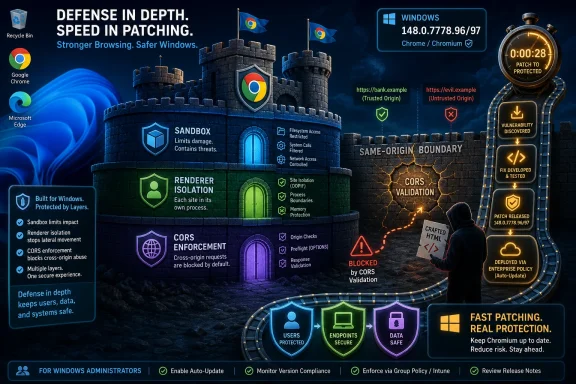
CVE-2026-7968 is a medium-severity Chromium flaw disclosed on May 6, 2026, in which insufficient validation of untrusted input in Chrome’s CORS handling before version 148.0.7778.96 could let an attacker with renderer compromise bypass the same-origin policy using crafted HTML. That dry sentence hides the more interesting security story: this is not a browser bug about a single header, a single website, or a single misconfigured API. It is a reminder that the browser’s security model is now a layered compromise-containment system, and every layer is only as useful as the layer beneath it. For Windows admins, the practical question is not whether CVE-2026-7968 is the scariest bug in Chrome 148; it is whether the browser update pipeline is fast enough to make “medium” vulnerabilities boring again.
Chrome 148 arrived as one of those big, lumpy browser releases that security teams learn to distrust precisely because the headline number is too large to digest. Google’s stable channel update promoted Chrome 148 to Windows, macOS, and Linux, with version 148.0.7778.96 for Linux and 148.0.7778.96 or 148.0.7778.97 for Windows and Mac. Reporting around the release put the total at 127 security fixes, including three critical vulnerabilities, which means CVE-2026-7968 is not the flaw likely to dominate executive dashboards.
That does not make it unimportant. Chromium’s security advisories often read like a taxonomy of modern browser risk: use-after-free bugs, integer overflows, out-of-bounds reads, sandbox escapes, policy bypasses, and validation failures in subsystems most users never think about. CVE-2026-7968 sits in the quieter end of that spectrum, but in a browser, quiet often means architectural.
The description is precise: insufficient validation of untrusted input in CORS allowed a remote attacker who had already compromised the renderer process to bypass the same-origin policy via a crafted HTML page. That precondition matters. This is not described as a one-click remote code execution flaw from a cold start; it assumes the attacker has already achieved renderer compromise.
But that assumption should not lull anyone to sleep. Modern browser attacks are frequently chained. A renderer bug opens the first door, a sandbox escape widens the blast radius, and a policy bypass turns a compromised tab into a data-access problem. CVE-2026-7968 appears to live in that uncomfortable middle ground: not the spark, but potentially an accelerant.
CORS, or Cross-Origin Resource Sharing, is the sanctioned exception mechanism. It lets servers say, in effect, “this other origin may read this response,” under controlled conditions. The entire design depends on the browser correctly interpreting origins, request modes, headers, credentials, preflight checks, and the difference between what a page may send and what it may read.
That is why the phrase insufficient validation of untrusted input in CORS deserves more attention than its low CVSS score might suggest. CORS is supposed to be boring plumbing. When that plumbing misclassifies, trusts, or mishandles attacker-controlled input, the browser’s promise to isolate sites becomes less absolute.
In ordinary web development, CORS misconfigurations are usually server-side mistakes. A backend returns an overbroad access-control header, a CDN reflects an origin it should not, or a developer temporarily allows credentials from everywhere and forgets to remove it. CVE-2026-7968 is different because it concerns the browser’s enforcement path itself. The vulnerable party is not merely a careless website; it is the client deciding whether a cross-origin read should be allowed.
That distinction changes the risk calculus. A single misconfigured server is a local failure. A browser validation bug is a universal parser problem carried into every enterprise session, every consumer banking tab, every identity provider workflow, and every internal web app that assumes the browser is enforcing the rules.
That sounds reassuring until you remember that Chromium’s renderer is where hostile web content is expected to run. The browser’s security model assumes renderers may eventually be tricked, corrupted, or confused, which is why Chrome invests so heavily in site isolation, sandboxing, process separation, and strict policy enforcement. The renderer is not trusted in the same way the browser process is trusted.
A vulnerability that becomes useful after renderer compromise is therefore not irrelevant. It attacks the browser’s second act: containment. If an attacker already has malicious code executing in a renderer, the question becomes what that renderer can touch, read, infer, or influence. Same-origin policy bypasses are dangerous because they potentially turn a renderer foothold from “compromised page” into “compromised web session.”
This is why CVSS can understate operational anxiety. The CISA-ADP vector listed for the issue gives it a low base score, with high attack complexity and required user interaction. That scoring is defensible in isolation. It is also exactly the kind of score that can disappear in a vulnerability management queue behind louder bugs while still mattering in a real exploit chain.
Browser vulnerabilities rarely arrive in the wild as tidy, standalone academic proofs. They arrive as combinations: a memory corruption bug, a logic bug, a bypass, a confused deputy, a race condition, a privilege boundary failure. CVE-2026-7968 may be medium severity, but medium severity in a chainable component of the web security model is not the same thing as medium severity in an optional utility.
That breadth creates a steady stream of vulnerabilities across components with very different threat models. A use-after-free in WebRTC has a different shape from an integer overflow in Blink, which differs again from a CORS validation issue. Yet they all ship inside the same executable that users open dozens of times a day and administrators sometimes treat as just another auto-updating app.
Chrome’s rapid update model is designed for this reality. Google pushes fixes quickly, restricts sensitive bug details while users update, and relies on background updating to close the window. That model is effective when endpoints are online, update services are healthy, users relaunch, and enterprise controls do not introduce too much delay.
But the model is fragile in organizations that freeze browsers for compatibility, block updater traffic, rely on golden images that drift, or treat browser patching as less urgent than operating system patching. In 2026, that hierarchy is backwards. The browser is often the most exposed application on the device, and it is also the application most likely to handle authentication to everything else.
For WindowsForum readers, this is the familiar tension between control and velocity. IT departments want predictable change windows. Browser vendors want near-continuous remediation. Attackers want the gap between the two.
That inheritance is both the strength and weakness of the Chromium monoculture. On the strength side, Google, Microsoft, and the wider Chromium project concentrate security research and patch engineering around a common codebase. A fix for Chromium can propagate across multiple browsers rather than requiring every vendor to rediscover the same bug independently.
On the weakness side, a Chromium flaw is rarely just a Chrome flaw. It can affect Edge, Brave, Opera, Vivaldi, Electron-based applications, embedded web views, and internal software that depends on Chromium components. The web platform’s security boundary has been centralized, and centralization raises the stakes of every validation mistake.
Microsoft’s Edge security notes showed, as of May 6, that Microsoft was aware of recent Chromium security fixes and was actively working on releasing a security fix. That kind of lag is normal in a multi-vendor ecosystem, but it is also the interval admins need to watch. Chrome may have a fixed build available while Edge is still in the process of catching up, or vice versa in other circumstances.
This is where vulnerability management has to be product-aware rather than CVE-aware alone. Seeing CVE-2026-7968 in MSRC does not automatically mean every Edge channel, every platform, and every managed ring has already received the remediation. The actual control is the installed browser version, not the presence of a CVE record in a dashboard.
This matters less because of this particular CPE and more because browser asset identification remains surprisingly messy. Security scanners may key off application version, registry entries, package manager metadata, installed paths, enterprise management reports, or self-reported browser strings. Those data sources do not always agree.
CPE data can lag, change, or represent affected configurations in ways that are awkward for real environments. A Chrome vulnerability may be listed with OS conditions because the affected software is installed on those platforms, but that does not tell an admin whether Chrome is present, whether Edge has incorporated the fix, whether an Electron app is exposed, or whether a user has portable Chromium installed outside standard inventory.
This is one reason browser patching should not be reduced to “the CVE is in the database.” CVE records are essential for coordination, but they are not a complete asset model. They tell you what vulnerability exists; they do not prove where it lives in your environment.
For home users, the answer is simple: update the browser and relaunch it. For enterprises, the better answer is to validate the fleet by browser version across Chrome, Edge, and any other Chromium-based browser allowed on managed endpoints. If the installed Chrome version is earlier than 148.0.7778.96 on desktop platforms, it should be treated as exposed to the patched Chromium issue set.
The problem is that browser CVEs do not map cleanly to patch urgency when they describe chainable primitives. A same-origin policy bypass may not execute code, persist malware, or elevate to system privileges by itself. But it may help an attacker extract information from cross-origin resources once another flaw has put them inside a renderer.
In practical terms, the vulnerability’s impact depends on the attacker’s surrounding toolkit. If they cannot compromise a renderer, this bug may be unreachable. If they can, the bug may help defeat one of the browser’s most important containment assumptions. That difference is why the same CVE can be academically low and operationally uncomfortable.
Security teams should resist the urge to rank browser updates purely by the single highest CVSS score in the release. Chrome 148 includes critical bugs, high bugs, medium bugs, and low bugs, all delivered together. The patch decision should be about the browser build, not a cherry-picked severity line.
This is especially true because the most useful exploit chains often combine vulnerabilities that look unimpressive in isolation. Attackers do not care whether each link in the chain has a satisfying score. They care whether the chain works.
A CORS validation flaw is therefore a trust bug. It raises the possibility that the browser accepted something it should have rejected, interpreted untrusted input too generously, or allowed a crafted condition to pass through an enforcement layer. The CVE does not publicly provide enough technical detail to say exactly which input path failed, and Chromium bug details are often restricted until users have updated.
That restriction is the right call. Public exploit details before patch saturation would turn a medium-severity bug into a race. Still, the lack of detail makes it harder for defenders to reason about precise exposure, so the correct defensive posture is to update rather than to wait for proof-of-concept code.
The phrase “crafted HTML page” also deserves attention. It means the attacker’s delivery vehicle is the web itself. There is no exotic local precondition in the description, no requirement to install a shady driver, no need for a malicious Office macro. A user visiting or being directed to attacker-controlled content is enough for the web-facing part of the chain, assuming the renderer compromise condition is met.
That is the browser’s eternal problem: it is built to process hostile input at scale. Every page is a bundle of markup, script, media, style, headers, policies, and network requests. The security model has to be correct across all of it.
Browser patching is still uneven across enterprises. Some companies have mature rings, telemetry, and forced relaunch policies. Others depend on users to close the browser, tolerate stale sessions for weeks, or discover broken update services only after a scanner reports an obsolete version. The difference between those environments is not theoretical.
Chrome and Edge can both update quickly, but the last mile is often the relaunch. A browser may download an update and sit in a pending state while users keep dozens of tabs alive. In a vulnerability chain scenario, “update available” is not the same as “risk reduced.”
Admins also need to watch the ecosystem around the browser. Virtual desktop images, kiosk systems, remote app servers, developer workstations, and lab machines often sit outside the neatest patch rings. So do third-party Chromium browsers that users install because a vendor portal “works better” in them. The vulnerability management tool that sees Chrome but not the portable browser in a user profile is telling only part of the story.
The fix is not glamorous. It is inventory discipline, version reporting, enforced relaunches, and policy that treats browsers as Tier 1 security assets. The web browser is now closer to an operating system component than a productivity application.
But boring advice should not be mistaken for a boring threat model. A same-origin policy bypass after renderer compromise is precisely the kind of bug users cannot mitigate with “be careful.” The browser exists to visit websites. Users cannot inspect CORS enforcement logic, validate renderer isolation, or determine whether a crafted page is exercising a subtle Chromium flaw.
Extensions complicate the picture further. A heavily extended browser increases attack surface, permissions complexity, and the number of components with access to page content. CVE-2026-7968 is not described as an extension vulnerability, but the broader security lesson still applies: browser hygiene is cumulative. Fewer unnecessary extensions, current builds, and a willingness to restart are meaningful controls.
Enhanced security modes, site isolation, exploit mitigations, and OS-level protections all help. None of them justify postponing the patch. Defense in depth is not a coupon for skipping the primary fix.
Yet the sparse language tells a broader story. Browser vendors are managing vulnerability disclosure as a population-level risk problem. The immediate goal is not to satisfy curiosity; it is to get hundreds of millions of endpoints onto a safer build before attackers can operationalize the details.
That is why “access to bug details may be restricted” has become part of the browser-security ritual. It is not secrecy for secrecy’s sake. It is an acknowledgment that disclosure timing is now part of the defense. Once the patch exists, the vulnerability begins to move from private knowledge to public blueprint.
For admins, this means waiting for full technical analysis is often the wrong instinct. By the time the write-ups arrive, the patch should already be deployed. The article you read two weeks later may be intellectually satisfying, but the security outcome was determined in the first 48 hours.
CVE-2026-7968 is a useful example because it is not the flashiest bug in the release. It forces us to evaluate patch urgency without the drama of an actively exploited zero-day label. That is where mature security programs distinguish themselves: they patch because the exposed attack surface matters, not because the marketing language is alarming.
A modern Windows endpoint without a current browser is an endpoint with an exposed remote content parser running inside the user’s authenticated life. It touches Microsoft 365, Google Workspace, identity providers, SaaS consoles, admin portals, password managers, intranet apps, and consumer services. The browser is where personal, corporate, and administrative contexts collide.
That makes browser patch SLAs essential. Not vague goals, not “users should update,” not “we’ll catch it in the next monthly cycle.” Organizations need explicit timelines for stable browser security releases, exception handling for compatibility blocks, and visibility into machines that fail to update or relaunch.
The SLA should also separate emergency zero-days from routine stable releases without making routine releases optional. A release containing active exploitation may demand same-day action. A release like Chrome 148, with a large bundle of fixes and multiple critical issues, should still move quickly through rings. The right question is not “is CVE-2026-7968 low?” but “how long do we allow known browser vulnerabilities to remain present?”
In that sense, CVE-2026-7968 is less a crisis than a test. It tests whether security teams can process nuanced browser risk without becoming numb to yet another Chromium CVE.
The trade-off is systemic exposure. A vulnerability in Chromium is not confined to one vendor’s browser in the way an old Internet Explorer bug once was. It can matter to Chrome on Windows, Edge in enterprises, Linux desktops, macOS fleets, kiosk systems, and applications that embedded Chromium because shipping a web UI was faster than building a native one.
This is not an argument against Chromium. The alternative universe of many smaller, less-scrutinized engines might not be safer. But monoculture requires operational humility. You cannot assume diversity where none exists, and you cannot assume that patching one branded browser remediates every Chromium-derived surface in the environment.
Electron deserves particular attention in this conversation, even though CVE-2026-7968 is cataloged as a Chrome issue. Many desktop applications ship their own Chromium runtime. Their update cadence may lag the browser’s, and their exposure depends on how they load remote content, handle origins, and enable web platform features. Asset teams that inventory browsers but ignore embedded Chromium are only mapping the obvious roads.
The web platform won because it made software deployment easy. Security teams are now paying the interest on that victory.
Source: NVD / Chromium Security Update Guide - Microsoft Security Response Center
 A Medium Bug Lands in a Very Large Patch Train
Chrome 148 arrived as one of those big, lumpy browser releases that security teams learn to distrust precisely because the headline number is too large to digest. Google’s stable channel update promoted Chrome 148 to Windows, macOS, and Linux, with version 148.0.7778.96 for Linux and 148.0.7778.96 or 148.0.7778.97 for Windows and Mac. Reporting around the release put the total at 127 security fixes, including three critical vulnerabilities, which means CVE-2026-7968 is not the flaw likely to dominate executive dashboards.That does not make it unimportant. Chromium’s security advisories often read like a taxonomy of modern browser risk: use-after-free bugs, integer overflows, out-of-bounds reads, sandbox escapes, policy bypasses, and validation failures in subsystems most users never think about. CVE-2026-7968 sits in the quieter end of that spectrum, but in a browser, quiet often means architectural.
The description is precise: insufficient validation of untrusted input in CORS allowed a remote attacker who had already compromised the renderer process to bypass the same-origin policy via a crafted HTML page. That precondition matters. This is not described as a one-click remote code execution flaw from a cold start; it assumes the attacker has already achieved renderer compromise.
But that assumption should not lull anyone to sleep. Modern browser attacks are frequently chained. A renderer bug opens the first door, a sandbox escape widens the blast radius, and a policy bypass turns a compromised tab into a data-access problem. CVE-2026-7968 appears to live in that uncomfortable middle ground: not the spark, but potentially an accelerant.
Same-Origin Policy Is the Web’s Load-Bearing Wall
The same-origin policy is one of the web’s oldest and most important security boundaries. It is the rule that stops a script running on one site from freely reading data from another site, even though the same browser session may be authenticated to both. Without it, the web’s convenient single-browser workflow would collapse into a cross-site data buffet.CORS, or Cross-Origin Resource Sharing, is the sanctioned exception mechanism. It lets servers say, in effect, “this other origin may read this response,” under controlled conditions. The entire design depends on the browser correctly interpreting origins, request modes, headers, credentials, preflight checks, and the difference between what a page may send and what it may read.
That is why the phrase insufficient validation of untrusted input in CORS deserves more attention than its low CVSS score might suggest. CORS is supposed to be boring plumbing. When that plumbing misclassifies, trusts, or mishandles attacker-controlled input, the browser’s promise to isolate sites becomes less absolute.
In ordinary web development, CORS misconfigurations are usually server-side mistakes. A backend returns an overbroad access-control header, a CDN reflects an origin it should not, or a developer temporarily allows credentials from everywhere and forgets to remove it. CVE-2026-7968 is different because it concerns the browser’s enforcement path itself. The vulnerable party is not merely a careless website; it is the client deciding whether a cross-origin read should be allowed.
That distinction changes the risk calculus. A single misconfigured server is a local failure. A browser validation bug is a universal parser problem carried into every enterprise session, every consumer banking tab, every identity provider workflow, and every internal web app that assumes the browser is enforcing the rules.
The Renderer Precondition Is a Boundary, Not a Comfort Blanket
The most important phrase in the CVE description is “who had compromised the renderer process.” It tells us the attacker is not starting from nothing. They need a separate vulnerability, exploit, or execution foothold inside Chrome’s renderer before CVE-2026-7968 becomes useful.That sounds reassuring until you remember that Chromium’s renderer is where hostile web content is expected to run. The browser’s security model assumes renderers may eventually be tricked, corrupted, or confused, which is why Chrome invests so heavily in site isolation, sandboxing, process separation, and strict policy enforcement. The renderer is not trusted in the same way the browser process is trusted.
A vulnerability that becomes useful after renderer compromise is therefore not irrelevant. It attacks the browser’s second act: containment. If an attacker already has malicious code executing in a renderer, the question becomes what that renderer can touch, read, infer, or influence. Same-origin policy bypasses are dangerous because they potentially turn a renderer foothold from “compromised page” into “compromised web session.”
This is why CVSS can understate operational anxiety. The CISA-ADP vector listed for the issue gives it a low base score, with high attack complexity and required user interaction. That scoring is defensible in isolation. It is also exactly the kind of score that can disappear in a vulnerability management queue behind louder bugs while still mattering in a real exploit chain.
Browser vulnerabilities rarely arrive in the wild as tidy, standalone academic proofs. They arrive as combinations: a memory corruption bug, a logic bug, a bypass, a confused deputy, a race condition, a privilege boundary failure. CVE-2026-7968 may be medium severity, but medium severity in a chainable component of the web security model is not the same thing as medium severity in an optional utility.
Chrome 148 Shows the Patch Burden Has Become Permanent
The sheer size of the Chrome 148 security update is the bigger signal. A browser is no longer a document viewer with a JavaScript engine bolted on. It is a multimedia runtime, identity client, password broker, certificate consumer, GPU workload dispatcher, WebRTC endpoint, enterprise policy target, remote desktop participant, AI feature surface, and application platform.That breadth creates a steady stream of vulnerabilities across components with very different threat models. A use-after-free in WebRTC has a different shape from an integer overflow in Blink, which differs again from a CORS validation issue. Yet they all ship inside the same executable that users open dozens of times a day and administrators sometimes treat as just another auto-updating app.
Chrome’s rapid update model is designed for this reality. Google pushes fixes quickly, restricts sensitive bug details while users update, and relies on background updating to close the window. That model is effective when endpoints are online, update services are healthy, users relaunch, and enterprise controls do not introduce too much delay.
But the model is fragile in organizations that freeze browsers for compatibility, block updater traffic, rely on golden images that drift, or treat browser patching as less urgent than operating system patching. In 2026, that hierarchy is backwards. The browser is often the most exposed application on the device, and it is also the application most likely to handle authentication to everything else.
For WindowsForum readers, this is the familiar tension between control and velocity. IT departments want predictable change windows. Browser vendors want near-continuous remediation. Attackers want the gap between the two.
Edge Inherits the Chromium Clock, Even When Microsoft Owns the Browser
The Microsoft angle is straightforward but operationally important. Microsoft Edge is Chromium-based, and Microsoft tracks Chromium security fixes through the Edge release process and the MSRC Update Guide. When a Chromium CVE appears in the Microsoft ecosystem, it is not because Edge is a separate original source of the bug; it is because Edge inherits the same underlying engine risk unless and until Microsoft ships the incorporated fix.That inheritance is both the strength and weakness of the Chromium monoculture. On the strength side, Google, Microsoft, and the wider Chromium project concentrate security research and patch engineering around a common codebase. A fix for Chromium can propagate across multiple browsers rather than requiring every vendor to rediscover the same bug independently.
On the weakness side, a Chromium flaw is rarely just a Chrome flaw. It can affect Edge, Brave, Opera, Vivaldi, Electron-based applications, embedded web views, and internal software that depends on Chromium components. The web platform’s security boundary has been centralized, and centralization raises the stakes of every validation mistake.
Microsoft’s Edge security notes showed, as of May 6, that Microsoft was aware of recent Chromium security fixes and was actively working on releasing a security fix. That kind of lag is normal in a multi-vendor ecosystem, but it is also the interval admins need to watch. Chrome may have a fixed build available while Edge is still in the process of catching up, or vice versa in other circumstances.
This is where vulnerability management has to be product-aware rather than CVE-aware alone. Seeing CVE-2026-7968 in MSRC does not automatically mean every Edge channel, every platform, and every managed ring has already received the remediation. The actual control is the installed browser version, not the presence of a CVE record in a dashboard.
The CPE Oddity Is a Symptom of a Messier Asset Problem
The NVD change history for CVE-2026-7968 includes a CPE configuration for Google Chrome versions before 148.0.7778.96, with operating-system entries for Windows, Linux, and macOS. The user-facing NVD page also asks whether a CPE is missing, which is a familiar artifact of how vulnerability databases evolve after initial publication.This matters less because of this particular CPE and more because browser asset identification remains surprisingly messy. Security scanners may key off application version, registry entries, package manager metadata, installed paths, enterprise management reports, or self-reported browser strings. Those data sources do not always agree.
CPE data can lag, change, or represent affected configurations in ways that are awkward for real environments. A Chrome vulnerability may be listed with OS conditions because the affected software is installed on those platforms, but that does not tell an admin whether Chrome is present, whether Edge has incorporated the fix, whether an Electron app is exposed, or whether a user has portable Chromium installed outside standard inventory.
This is one reason browser patching should not be reduced to “the CVE is in the database.” CVE records are essential for coordination, but they are not a complete asset model. They tell you what vulnerability exists; they do not prove where it lives in your environment.
For home users, the answer is simple: update the browser and relaunch it. For enterprises, the better answer is to validate the fleet by browser version across Chrome, Edge, and any other Chromium-based browser allowed on managed endpoints. If the installed Chrome version is earlier than 148.0.7778.96 on desktop platforms, it should be treated as exposed to the patched Chromium issue set.
“Low” CVSS Does Not Mean Low Priority in a Browser Chain
The CISA-ADP CVSS 3.1 score of 3.1 places CVE-2026-7968 in low territory, with network attack vector, high attack complexity, no privileges required, user interaction required, unchanged scope, and low confidentiality impact. That sounds modest, and for many enterprise vulnerability queues, modest often means “later.”The problem is that browser CVEs do not map cleanly to patch urgency when they describe chainable primitives. A same-origin policy bypass may not execute code, persist malware, or elevate to system privileges by itself. But it may help an attacker extract information from cross-origin resources once another flaw has put them inside a renderer.
In practical terms, the vulnerability’s impact depends on the attacker’s surrounding toolkit. If they cannot compromise a renderer, this bug may be unreachable. If they can, the bug may help defeat one of the browser’s most important containment assumptions. That difference is why the same CVE can be academically low and operationally uncomfortable.
Security teams should resist the urge to rank browser updates purely by the single highest CVSS score in the release. Chrome 148 includes critical bugs, high bugs, medium bugs, and low bugs, all delivered together. The patch decision should be about the browser build, not a cherry-picked severity line.
This is especially true because the most useful exploit chains often combine vulnerabilities that look unimpressive in isolation. Attackers do not care whether each link in the chain has a satisfying score. They care whether the chain works.
CORS Bugs Are Really Trust Bugs
The old mental model of CORS as a developer nuisance is inadequate. Most developers encounter it as an error in the console, a blocker during API integration, or a configuration entry in a gateway. Security teams see it differently: CORS is one of the places where the browser translates messy web reality into enforceable trust decisions.A CORS validation flaw is therefore a trust bug. It raises the possibility that the browser accepted something it should have rejected, interpreted untrusted input too generously, or allowed a crafted condition to pass through an enforcement layer. The CVE does not publicly provide enough technical detail to say exactly which input path failed, and Chromium bug details are often restricted until users have updated.
That restriction is the right call. Public exploit details before patch saturation would turn a medium-severity bug into a race. Still, the lack of detail makes it harder for defenders to reason about precise exposure, so the correct defensive posture is to update rather than to wait for proof-of-concept code.
The phrase “crafted HTML page” also deserves attention. It means the attacker’s delivery vehicle is the web itself. There is no exotic local precondition in the description, no requirement to install a shady driver, no need for a malicious Office macro. A user visiting or being directed to attacker-controlled content is enough for the web-facing part of the chain, assuming the renderer compromise condition is met.
That is the browser’s eternal problem: it is built to process hostile input at scale. Every page is a bundle of markup, script, media, style, headers, policies, and network requests. The security model has to be correct across all of it.
The Enterprise Risk Is in the Delay, Not the Description
For managed Windows environments, the most interesting part of CVE-2026-7968 is not whether the vulnerability is individually terrifying. It is whether the organization can move Chrome and Edge to fixed builds quickly, verify the change, and handle exceptions without turning them into permanent holes.Browser patching is still uneven across enterprises. Some companies have mature rings, telemetry, and forced relaunch policies. Others depend on users to close the browser, tolerate stale sessions for weeks, or discover broken update services only after a scanner reports an obsolete version. The difference between those environments is not theoretical.
Chrome and Edge can both update quickly, but the last mile is often the relaunch. A browser may download an update and sit in a pending state while users keep dozens of tabs alive. In a vulnerability chain scenario, “update available” is not the same as “risk reduced.”
Admins also need to watch the ecosystem around the browser. Virtual desktop images, kiosk systems, remote app servers, developer workstations, and lab machines often sit outside the neatest patch rings. So do third-party Chromium browsers that users install because a vendor portal “works better” in them. The vulnerability management tool that sees Chrome but not the portable browser in a user profile is telling only part of the story.
The fix is not glamorous. It is inventory discipline, version reporting, enforced relaunches, and policy that treats browsers as Tier 1 security assets. The web browser is now closer to an operating system component than a productivity application.
The Consumer Advice Is Boring Because the Threat Model Is Not
For individual users, the advice is deliberately dull: update Chrome, update Edge when Microsoft ships the corresponding fixed build, and restart the browser. The fact that advice is boring is a triumph of browser engineering. Automatic updates have made most people safer than they would be under a manual patch model.But boring advice should not be mistaken for a boring threat model. A same-origin policy bypass after renderer compromise is precisely the kind of bug users cannot mitigate with “be careful.” The browser exists to visit websites. Users cannot inspect CORS enforcement logic, validate renderer isolation, or determine whether a crafted page is exercising a subtle Chromium flaw.
Extensions complicate the picture further. A heavily extended browser increases attack surface, permissions complexity, and the number of components with access to page content. CVE-2026-7968 is not described as an extension vulnerability, but the broader security lesson still applies: browser hygiene is cumulative. Fewer unnecessary extensions, current builds, and a willingness to restart are meaningful controls.
Enhanced security modes, site isolation, exploit mitigations, and OS-level protections all help. None of them justify postponing the patch. Defense in depth is not a coupon for skipping the primary fix.
The Patch Notes Say Less Than the Release Really Means
Chrome security advisories are intentionally terse. They name the component, assign severity, credit researchers when appropriate, and often withhold bug details. That minimalism frustrates defenders who want to know exactly how scared they should be.Yet the sparse language tells a broader story. Browser vendors are managing vulnerability disclosure as a population-level risk problem. The immediate goal is not to satisfy curiosity; it is to get hundreds of millions of endpoints onto a safer build before attackers can operationalize the details.
That is why “access to bug details may be restricted” has become part of the browser-security ritual. It is not secrecy for secrecy’s sake. It is an acknowledgment that disclosure timing is now part of the defense. Once the patch exists, the vulnerability begins to move from private knowledge to public blueprint.
For admins, this means waiting for full technical analysis is often the wrong instinct. By the time the write-ups arrive, the patch should already be deployed. The article you read two weeks later may be intellectually satisfying, but the security outcome was determined in the first 48 hours.
CVE-2026-7968 is a useful example because it is not the flashiest bug in the release. It forces us to evaluate patch urgency without the drama of an actively exploited zero-day label. That is where mature security programs distinguish themselves: they patch because the exposed attack surface matters, not because the marketing language is alarming.
Windows Shops Need Browser Patch SLAs, Not Browser Patch Wishes
The Windows ecosystem has long been organized around Patch Tuesday, even as the software world around it moved to continuous release. Browsers broke that rhythm years ago, but many organizations still behave as though browser updates are supplemental. They are not.A modern Windows endpoint without a current browser is an endpoint with an exposed remote content parser running inside the user’s authenticated life. It touches Microsoft 365, Google Workspace, identity providers, SaaS consoles, admin portals, password managers, intranet apps, and consumer services. The browser is where personal, corporate, and administrative contexts collide.
That makes browser patch SLAs essential. Not vague goals, not “users should update,” not “we’ll catch it in the next monthly cycle.” Organizations need explicit timelines for stable browser security releases, exception handling for compatibility blocks, and visibility into machines that fail to update or relaunch.
The SLA should also separate emergency zero-days from routine stable releases without making routine releases optional. A release containing active exploitation may demand same-day action. A release like Chrome 148, with a large bundle of fixes and multiple critical issues, should still move quickly through rings. The right question is not “is CVE-2026-7968 low?” but “how long do we allow known browser vulnerabilities to remain present?”
In that sense, CVE-2026-7968 is less a crisis than a test. It tests whether security teams can process nuanced browser risk without becoming numb to yet another Chromium CVE.
The CORS Flaw Is One Thread in a Wider Chromium Monoculture
Chromium’s dominance has made browser security more efficient and more concentrated. When researchers find and report bugs, fixes can protect enormous numbers of users. When Google hardens a subsystem, the benefits often ripple outward. When Microsoft incorporates Chromium fixes into Edge, Windows users benefit from that shared investment.The trade-off is systemic exposure. A vulnerability in Chromium is not confined to one vendor’s browser in the way an old Internet Explorer bug once was. It can matter to Chrome on Windows, Edge in enterprises, Linux desktops, macOS fleets, kiosk systems, and applications that embedded Chromium because shipping a web UI was faster than building a native one.
This is not an argument against Chromium. The alternative universe of many smaller, less-scrutinized engines might not be safer. But monoculture requires operational humility. You cannot assume diversity where none exists, and you cannot assume that patching one branded browser remediates every Chromium-derived surface in the environment.
Electron deserves particular attention in this conversation, even though CVE-2026-7968 is cataloged as a Chrome issue. Many desktop applications ship their own Chromium runtime. Their update cadence may lag the browser’s, and their exposure depends on how they load remote content, handle origins, and enable web platform features. Asset teams that inventory browsers but ignore embedded Chromium are only mapping the obvious roads.
The web platform won because it made software deployment easy. Security teams are now paying the interest on that victory.
The Real Win Is Making This Patch Unremarkable
The right response to CVE-2026-7968 is neither panic nor dismissal. It is to treat the Chrome 148 update as a normal, high-priority browser maintenance event and to verify that the organization’s update machinery actually works. The vulnerability’s details point to a sensitive boundary, while its scoring reminds us that not every important browser bug arrives with a siren.- Chrome desktop builds earlier than 148.0.7778.96 should be moved to a fixed release, with Windows and macOS environments also accounting for the 148.0.7778.97 build where applicable.
- Edge administrators should track Microsoft’s Chromium security incorporation rather than assuming that a Chrome fix instantly means an Edge fix has landed everywhere.
- Vulnerability teams should prioritize the installed browser version over the CVE headline because Chrome 148 remediates a large bundle of issues, not only CVE-2026-7968.
- Security teams should treat renderer-compromise preconditions as chain-risk indicators, not as reasons to ignore the bug.
- Asset inventories should include alternate Chromium browsers, unmanaged installs, kiosk images, virtual desktops, and applications that embed Chromium runtimes.
- Users and help desks should understand that downloading an update is not enough if the browser has not been restarted into the fixed build.
Source: NVD / Chromium Security Update Guide - Microsoft Security Response Center
