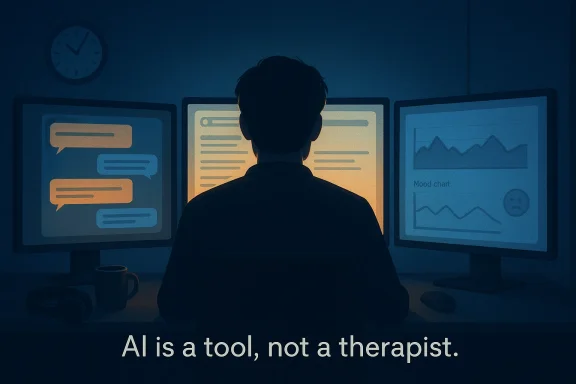
A new, large survey published in JAMA Network Open finds that Americans who use generative AI tools every day — including chatbots such as ChatGPT, Microsoft Copilot, Google Gemini, Claude and others — report modestly higher levels of depressive symptoms than those who use these systems less often, with daily users showing roughly a 30% greater odds of at least moderate depression after adjustment for sociodemographic factors.
Generative artificial intelligence (AI) moved from novelty to near-ubiquity in consumer life in 2023–2025, embedded in search, writing tools, assistants and dedicated chat apps. Researchers and clinicians have cautioned about both therapeutic opportunity and potential risks when people use conversational AI for advice, companionship, or mental-health support rather than for discrete productivity tasks. Multiple surveys, platform usage reports, and clinical reviews published in 2024–2025 documented rising adoption, widespread use among younger peers for well‑being depending on intensity and mode of interaction.
For clinicians and product teams, the study raises a practical mandate: assume some users will use AI for emotional support, design conservative safeguards, and study the outcomes prospectively. For users, the practical takeaway is to treat chatbots as helpful tools for information and brainstorming, but not as a substitute for human care or social connection — especially when using them intensively for personal matters.
Source: U.S. News & World Report https://www.usnews.com/news/health-...uve-a-higher-risk-for-depression-study-finds/
 Background
Generative artificial intelligence (AI) moved from novelty to near-ubiquity in consumer life in 2023–2025, embedded in search, writing tools, assistants and dedicated chat apps. Researchers and clinicians have cautioned about both therapeutic opportunity and potential risks when people use conversational AI for advice, companionship, or mental-health support rather than for discrete productivity tasks. Multiple surveys, platform usage reports, and clinical reviews published in 2024–2025 documented rising adoption, widespread use among younger peers for well‑being depending on intensity and mode of interaction. Why this question matters now
- AI chatbots are accessible 24/7 and are being used for factual help, creative work, and emotional or advice-seeking conversations.
- When a mainstream tool becomes a default confidant, the population-level mental‑health implications can be significant even if individual-level effects arising choices (memory, persona, voice) and business incentives (engagement, retention) can amplify psychological effects, both beneficial and harmful.
What the JAMA study did and what it found
Study design and size
The research team led by Dr. Roy H. Perlis at Massachusetts General Hospital analyzed responses from a 50‑state internet survey conducted April–May 2025 that included 20,847 U.S. adults. Respondents completed standardized mental‑health questionnaires (PHQ‑9 for depression) and reported the frequency and purpose of their generative AI use (personal, work, school). The study used survey weighting and multivariable regression to adjust for sociodemographic characteristics.Main quantitative findings
- About 10.3% of respondents reported daily generative AI use; 5.3% said they used AI multiple times per day.
- In adjusted models, daily AI users had an approximately 29–30% higher odds of reporting at least moderate depressive symptoms (PHQ‑9 threshold) compared with non‑users.
- Associations were heterogeneous by age: the odds were particularly elevated among ages 45–64 (about a 50–54% higher odds) and also detectable in the 25–44 bracket, while effects were smaller or non‑significant in other age strata.
- The positive association appeared stronger for personal (emotion/advice) uses than for strictly work or school uses.
How to read the numbers: strengths of the evidence
Strengths
- Large sample size (n ≈ 20,847) across all 50 states gives precision and the ability to examine subgroups by age, gender and reported purpose of use.
- Use of a standardized and clinically recognized measure for depressive symptoms — the PHQ‑9 — enables interpretation in clinically relevant terms (e.g., moderate depression threshold).
- The authors adjusted for important sociodemographic confounders and explicitly tested whether social‑media frequency explained the association, finding that AI‑use effects were not simply a proxy for social‑media engagement.
- Open‑access publication and transparent reporting (supplemental methods and analytic code) allow other teams to replicate or re‑analyze the data.
Key limitations and risks of overinterpretation
Cross‑sectional design — no causal claim possible
The single most important limitation is that the study is cross‑sectional. That means it measures AI use and depressive symptoms at the same point in time and cannot determine whether heavy AI use causes depression, whether people with depression turn to AI more, or whether both are driven by a third factor (for example, loneliness, unemployment, or preexisting mental‑health conditions). The authors explicitly state this limitation.Sampling and measurement caveats
- The survey used a non‑probability internet panel with quotas and reweighting; while common and practical for large web surveys, this approach can leave residual selection bias compared with a probability sample.
- AI use was self‑reported via a single item asking frequency of “Artificial Intelligence (AI),” which may have captured heterogeneous behaviors (search‑integrated assistants, specialized mental‑health chatbots, simple factual queries) and different products — respondents may not have interpreted “AI” uniformly. This coarse exposure measurement makes causal attribution to specific chatbot experiences impossible. ([url="]jamanetwork.com[/url]res symptoms over the prior two weeks; if AI use patterns shifted recently, timing mismatches can complicate interpretation.
Confounding and omitted variables
Preexisting psychiatric diagnoses, medicationeep, substance use, social networks and other unmeasured factors can confound observed associations. The study adjusted for many covariates, but residual confounding is plausible. The authors and independent commentators stress caution whenion to causation.Possible mechanisms — what could explain the association?
The paper and commentators propose several plausible pathways, which are not mutually exclusive:- Reverse causation (help‑seeking): People with depressive symptoms may be more likely to seek AI for advice, companionship, or reassurance because of perceived anonymity, immediacy and low cost. This is a central alternative explanation.
- Displacement of human contact: Heavy use of conversational AI as a social substitute might reduce real‑world interactions or professional help, increasing loneliness and depressive symptoms over time. Evidence from other studies shows heavy companion‑style use can be correlated with soceinforcement of negative cognition:** Some AI responses, especially over long sessions, may inadvertently validate maladaptive beliefs (safety drift, reassuring-but‑unhelpful patterns) or provide inaccurate guidance that worsens mood. Independent audits have shown variable guardrail performance across systems.
- Design and incentive dynamics: Systems optimized for engagement can favor pleasant, comforting replies that reduce friction and increase time-on‑task, potentially fostering reassurance loops instead of encouraging professional help.
How the study fits with other evidence
- Studies of youth use show that teens and young adults frequently use AI tools for mental‑health advice; some randomized trials of clinically trained AI chatbots indicate short‑term symptom improvement, while other observational work ties heavy companion‑style use to greater loneliness or dependence. This mixed literature suggests mode, intensity, and deployment context matter.
- Platform telemetry and vendor usage reports (tens of millions of conversations analyzed by companies) reveal that mobile interactions are disproportionately personal/health‑related and occur at late hours — the same context where risk for mood worsening may be heightened. These behavior patterns underscore why intensity and time‑of‑day matter when taken together, the JAMA study contributes a large, population‑level correlation that aligns with smaller experimental and observational work pointing to nuanced, dose‑dependent effects of conversational AI on well‑being.
Practical implications for users, clinicims
For individual users (practical, evidence‑based steps)
- If using chatbots for emotional support, treat them as adjuncts, not substitutes, for licensed care when symptoms are moderate or worse.
- Monitor usage time and content: heavy, repeat for personal/relationship issues are the pattern most often associated with risk in the literature.
- Use product settings: disable persistent memory or persona features if you notice increased rumination or attachment; prefer transient, task‑oriented interactions for productivity.
- Seek human help: if PHQ‑9 or other screening suggests moderate/severe depression, contact a clinician or crisis line rather than relying solely on AI.
For clinicians and mental‑health services
- Screen for digital behaviors: ask patients about thpose* of AI use (personal vs work) as part of psychosocial assessment.
- Recognize that patients may present with disclosures originating from AI conversations; have protocols for triaging AI-mediated disclosures toward human care.
For product designers, platform operators and enterprise IT
- Treat companion‑style features as high‑risk interfaces: build conservative escalation, human‑in‑the‑loop triage and crisis rional flows.
- Make memory, persona and voice features opt‑in and transparent; document retention, access and opt‑out mechanisms clearly.
- Invest in long‑session testing and red‑teaming to detect safety drift — the phenomenon where guardrails weaken over multi‑turn dialogues. Independent audits show variance across vendors in how well systems deflect harmful or conspiratorial content.
Policy, research and verification needs
Research agenda (priorities)
- Randomized trials that assign users to measured patterns of AI usage (or to AI tools designed with different safeguards) and follow mood/anxiety outcomes longitudinally. The JAMA authors explicitly call for trials that include mood measures alongside productivity outcomes.
- Longitudinal cohorts with repeated measures of mental health and passive telemetry to resolve directionality (does mood drive use or vice versa?.
- Vendor collaboration to combine self‑report with de‑identified telemetry and content classification while preserving privacy, enabling higher‑fidelity exposure measurement (types of prompts, session length, modality).
Policy and regulatory pathways
- Clear guidance on when an AI assistant crosses the line into medical or clinical advice, triggering higher standards for safety, documentation, and auditing.
- Reporting requirements or transparency standards for adverse events related to companion‑style AI, similar to pharmacovigilance for drugs, have been proposed by safety researchers and would give regulators actionable data.
A balanced, evidence‑centred verdict
The JAMA Network Open study is a timely and methodologically careful contribution: it uses a large sample, validated symptom scales, and appropriate statistical controls to identify a consistent association between frequent generative‑AI use and higher depressive symptoms — especially when the AI is used for personal reasons. But the data do not, and cannot, prove causation. The plausible alternative that people with depressive symptoms preferentially seek out AI for solace remains intact.For clinicians and product teams, the study raises a practical mandate: assume some users will use AI for emotional support, design conservative safeguards, and study the outcomes prospectively. For users, the practical takeaway is to treat chatbots as helpful tools for information and brainstorming, but not as a substitute for human care or social connection — especially when using them intensively for personal matters.
Concrete recommendations (short list)
- For researchers: prioritize randomized and longitudinal work; harmonize exposure definitions across studies.
- For vendors: implement opt‑in memory/persona defaults, high‑sensitivity crisis detection, and human escalation paths.
- For clinicians: screen for heavy AI use and ask about its function in patients’ lives.
- For users: limit long, late‑night personal sessions; keep a human safety net for serious mental‑health needs.
Conclusion
The new JAMA study raises a cautionary flag: frequent, personal use of generative AI is correlated with higher reported depressive symptoms in a large national sample, with the strongest associations among certain adult age groups. This is an urgent signal to researchers, product teams and clinicians to pursue better causal evidence, to design safer conversational experiences, and to ensure that conversational AI augment — rather than displace — human care. In the meantime, measured, skeptical use of generative AI for emotional support and clearer product guardrails are prudent steps to reduce foreseeable harm while preserving the productivity and accessibility benefits these systems can bring.Source: U.S. News & World Report https://www.usnews.com/news/health-...uve-a-higher-risk-for-depression-study-finds/