

The Privacy Pitch Collides With the Public Internet
DarkForums’ Jabber pitch was not subtle. The service framed itself as a communications layer for people who did not want their messages monitored or censored, with encryption, privacy, no logging, and resistance to third-party cooperation presented as selling points rather than optional extras. That positioning matters because criminal forums do not sell trust the way ordinary SaaS companies do; they sell suspicion of everyone else.
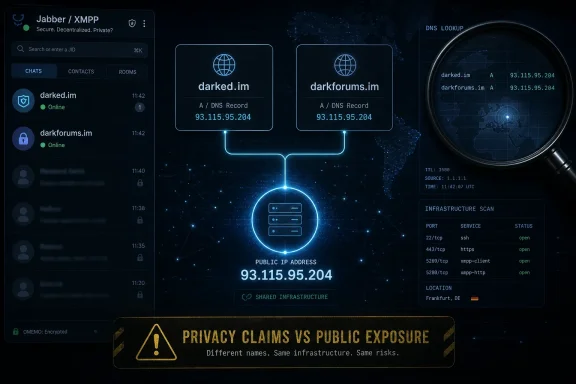
The reported finding is technically simple: the domains darked.im and darkforums.im, offered side by side to users during registration, resolved to the same clearnet address. In plain English, two doors were painted differently, but they appeared to lead to the same building. For a normal small business, that might be boring infrastructure consolidation. For a service promising hardened private communications to a risk-aware underground audience, it is an own goal.
The distinction is important. Shared infrastructure does not automatically mean compromised infrastructure, and a public IP address is not, by itself, evidence that chat contents are readable. But the claim being sold was not merely “we run a server.” It was that the operators had built a communications environment insulated from the surveillance and takedown risks of mainstream platforms.
That is where the story becomes larger than one Jabber endpoint. Security marketing often fails at the exact point where it leaves the slogan and meets deployment reality. DarkForums appears to have presented privacy as a brand attribute, while the exposed architecture invited the same public mapping, correlation, and pressure points defenders use every day.
Two Domains Were Never the Same as Two Systems
The appeal of multiple domains is obvious. They create the appearance of choice, redundancy, and compartmentalization. To a user registering for an account, seeing darked.im and darkforums.im listed as equivalent options suggests a service with some thought behind its namespace and identity design.
But domain names are not security boundaries. They are labels. If both labels resolve into the same publicly reachable infrastructure, then the operational difference between them may be cosmetic unless there is meaningful separation behind the scenes.
That cosmetic layer can still be useful for branding. It can help a community preserve continuity if one name becomes toxic, blocked, or abandoned. It can give users an easy way to remember accounts. None of that creates the privacy properties implied by a hardened messaging service.
The reported Censys discovery matters because Censys and similar Internet-scanning platforms are built to make this kind of correlation routine. They do not need a dramatic exploit to reveal that two services share infrastructure. They enumerate what the public Internet already exposes: hosts, ports, certificates, banners, and the relationships between them.
For defenders, this is standard attack-surface management. For forum operators promising anonymity, it is a reminder that the Internet is not impressed by intent. If a server answers on the public network, it can be cataloged, compared, and revisited.
Clearnet Exposure Is the Oldest Dark-Web Mistake
The phrase “dark web” suggests hidden infrastructure, but much of the cybercrime ecosystem has always been messier than the name implies. Forums, mirrors, chat servers, image hosts, payment panels, paste sites, and support channels frequently spill onto the ordinary Internet. Sometimes that is deliberate, sometimes it is convenience, and sometimes it is incompetence.
That tension has defined underground communities for years. Operators want the reach and usability of conventional web services while also wanting the mystique and insulation of hidden services. The result is often a hybrid stack that inherits the risks of both worlds: discoverability from clearnet infrastructure and fragility from opaque, unaccountable administration.
Jabber, or XMPP, fits naturally into that history. It is old, federated, flexible, and easy to run. It also places enormous trust in the server operator unless users understand exactly which encryption model is being used and where metadata can still leak.
A server can require encrypted client connections while still being in a position to observe account metadata, connection timing, roster information, and other operationally sensitive traces. End-to-end encryption can protect message contents when implemented and used correctly, but it does not magically erase the server’s role. In underground settings, where handles, contacts, and timing can be as revealing as content, metadata is not a footnote.
That is why “no logging” claims deserve skepticism everywhere, not just in criminal communities. Users cannot usually verify them. They can only infer trust from architecture, transparency, incentives, and past behavior. A shared public IP address is not a logging policy, but it weakens the architecture story.
The Community Was Sold an Adversary Model It May Not Have Received
DarkForums’ own messaging reportedly leaned into the idea that mainstream platforms were surveillance infrastructure and that its Jabber service existed to avoid monitoring. That is a powerful claim because it defines an adversary model. It tells users: your enemies are law enforcement, third parties, censors, platform operators, and anyone who might compel cooperation.
If that is the adversary model, then public exposure becomes more than untidy configuration. It becomes a strategic contradiction. A server that can be trivially mapped to a clearnet address is easier to monitor at the network edge, easier to pressure at the hosting layer, and easier to correlate with adjacent services.
The host address reported in the finding belongs to the sort of public cloud or hosting reality that many small operations depend on. That does not mean the hosting provider did anything wrong. It means the operators’ promise of insulation from ordinary infrastructure dependencies was, at minimum, more complicated than advertised.
This is the recurring irony of underground platforms. They often denounce mainstream technology companies while relying on the same basic building blocks: DNS, certificates, hosting providers, commodity server software, and publicly scanned network space. The rhetoric says sovereign enclave. The packet path says rented machine.
For users, the most dangerous misunderstanding is assuming that “not Google,” “not Telegram,” or “not Discord” automatically means safer. A self-hosted service can be better designed than a mainstream platform, but it can also be worse in every measurable way. Trusting a forum admin because the login page says “privacy first” is not operational security; it is brand loyalty with higher legal stakes.
Encryption Was the Marketing Word, Not the Whole Security Model
The most predictable defense of the service is that encryption still matters. That is true. Proper encryption can reduce the blast radius of server compromise, hosting-provider visibility, and network interception.
But “encrypted messaging” is often used as a single phrase to blur several different questions. Are connections encrypted between the client and the server? Are messages encrypted end to end between users? Are keys controlled by users or by the service? Is metadata retained? Can account recovery, moderation, or federation features expose additional information?
Those distinctions are not academic. Transport encryption protects the pipe. End-to-end encryption protects the content from intermediaries. Metadata minimization reduces the value of what remains visible even when content is protected.
A Jabber server can advertise encryption while still leaving users exposed to operator-level trust. It can require TLS and still have administrators who can observe account activity. It can support end-to-end encryption while still depending on users to configure clients correctly. In a community where many users are drawn by convenience rather than cryptographic literacy, that gap is exploitable.
This is where DarkForums’ alleged misstep becomes familiar to enterprise security teams. The word “encrypted” is frequently treated as if it ends the conversation. In practice, it starts one.
The Bigger Risk Is Correlation, Not Just Content
Investigators and threat-intelligence analysts do not always need message contents to build useful pictures. They look for infrastructure reuse, login patterns, account overlap, certificates, DNS history, timestamps, handles, and mistakes repeated across platforms. A shared public endpoint gives them another pivot.
That is why the discovery of a real IP address can matter even if no one reads a single chat message. It can expose hosting relationships. It can reveal service banners. It can show whether other ports are open. It can tie supposedly separate identities together through certificates or server behavior.
For criminal users, the practical danger is not merely that a message saying something incriminating might be intercepted. It is that participation itself can become mappable. Who registered, who connected, when they connected, and which other infrastructure touched the same machine can all become pieces of a larger investigative graph.
This is also why the “coffee break” flavor of the report is so cutting. The finding did not require a zero-day exploit or a secret informant. It reportedly required basic Internet reconnaissance. The underground often imagines exposure as the result of betrayal or elite intrusion; more often, it is the result of something left plainly visible.
DarkForums’ users may not know whether the server logged anything. They may not know whether law enforcement was watching. But they now have reason to question whether the operators’ competence matched their confidence.
Criminal Forums Keep Relearning Enterprise Security Lessons
There is a temptation to treat this story as comedy: hackers getting hacked, privacy absolutists misconfiguring infrastructure, underground operators stepping on their own cape. There is some truth in that. But the same pattern appears constantly in legitimate organizations.
Enterprises also confuse encryption with security. They also create multiple domains that terminate on shared infrastructure without documenting the risk. They also market privacy and resilience while leaving mundane exposure visible to anyone with an Internet scanner. The difference is that enterprises usually have compliance teams and incident-response retainers; criminal forums have reputation, paranoia, and a user base that may disappear overnight.
The shared lesson is that security claims create obligations. If a company says it has zero-trust architecture, customers should expect more than a VPN with a new label. If a dark-web forum says it offers private, unmonitored communications, users should expect more than a public XMPP server with theatrical copywriting.
Attack-surface visibility has changed the baseline. A decade ago, poorly separated infrastructure might have stayed obscure through luck. Today, public scanning, certificate transparency, passive DNS, and automated enrichment make lazy architecture much harder to hide.
The modern Internet has become self-indexing. Services leak their shape. Infrastructure leaves fingerprints. Names that look separate in a registration form often collapse into one host record in a search result.
DarkForums’ Reputation Problem Is an Infrastructure Problem
Underground forums live and die by perceived control. Users know they are dealing with criminals, scammers, informants, and rivals; the entire ecosystem is built on distrust. A forum survives by convincing users that, despite all that, its operators are competent enough to protect the marketplace.
That is why infrastructure mistakes are reputational events. A forum can survive drama, moderation fights, and even scams if users believe the core platform still works. But a privacy service that appears carelessly exposed attacks the platform’s central promise.
DarkForums has already been described by threat-intelligence researchers as a major destination after disruptions elsewhere in the cybercrime forum scene. That migration pressure makes trust more valuable and more fragile. A fast-growing forum inherits not only users but also scrutiny.
The Jabber service was likely meant to deepen the platform’s hold on its community. If users chat through the forum’s own messaging infrastructure, the forum becomes stickier. It controls identity, communication, and social gravity. But that same consolidation raises the stakes of operator competence.
A forum can outsource risk to Telegram, Tox, Session, or other channels and blame someone else when things break. Running your own Jabber server means owning the architecture. DarkForums wanted the credibility of self-reliance; it now gets the accountability too.
The Honeypot Question Will Follow Every Mistake
Whenever underground infrastructure looks sloppy, the same suspicion appears: is it incompetence, or is it a trap? That question is usually impossible to answer from the outside. It is also not the only useful question.
A service does not need to be a deliberate honeypot to be dangerous to its users. A badly run server, an exposed admin panel, weak logging hygiene, reused infrastructure, or a cooperative hosting dependency can create many of the same outcomes. Intent matters morally and legally, but risk often behaves the same either way.
The honeypot suspicion persists because law enforcement has repeatedly disrupted, infiltrated, or exploited criminal communications channels. Underground users understand that their tools can become evidence machines. What they often underestimate is how little conspiracy is required for that to happen.
If a server is easy to identify, easy to monitor, and easy to pressure, then the practical risk exists regardless of whether it began as a sting. The operational-security question is not “Do I trust the admin’s stated motive?” It is “What would an adversary be able to learn if the admin is wrong, careless, compromised, coerced, or already gone?”
That framing is less cinematic, but more useful. It turns the story from gossip into threat modeling.
Windows Defenders Should Care About the Underground’s Bad Plumbing
At first glance, a dark-web Jabber misconfiguration may seem distant from the daily work of Windows admins. It is not. The same infrastructure breadcrumbs that embarrass forum operators are often what help defenders identify malware staging, phishing kits, credential shops, ransomware leak sites, and command-and-control nodes.
Windows-heavy environments remain prime targets for credential theft, lateral movement, and ransomware deployment. The actors who trade access, logs, malware, and stolen data often coordinate through forums and off-platform chat. When those communities expose infrastructure, defenders gain pivots into the ecosystem that targets them.
This does not mean admins should start poking at criminal servers from corporate networks. They should not. But it does mean threat-intelligence teams, managed detection providers, and security researchers can use public infrastructure data to enrich detections and understand actor behavior.
The DarkForums incident reinforces a practical defender’s mindset: adversaries have attack surfaces too. They reuse infrastructure. They misconfigure services. They overclaim security. Their communities are full of incentives to move fast, copy old playbooks, and trust whoever currently controls the forum.
For enterprise security teams, that matters because criminal infrastructure is not magic. It is often just Linux servers, DNS records, certificates, XMPP daemons, web apps, and cloud providers stitched together under pressure. The same visibility that helps defenders find their own exposed assets can help them understand hostile ones.
The Lesson Is Not That Criminals Deserve Better Security
There is an easy moral trap here. Nobody needs to feel sorry for criminal hackers who trusted the wrong Jabber server. If the users were trading stolen data, malware, or access, their privacy problem is not a civil-liberties tragedy.
But dismissing the episode as criminals getting what they deserve misses the broader lesson. Security theater works because people want simple signs of safety: a privacy slogan, an encryption badge, a dark-themed landing page, a promise of no logs. Those signs can fool criminals, consumers, executives, journalists, and occasionally security teams.
The useful response is not sympathy. It is calibration. Claims should be weighed against architecture. Architecture should be weighed against incentives. Incentives should be weighed against the ease with which outsiders can verify or falsify the story.
DarkForums reportedly promised a communications environment beyond monitoring and censorship. The visible infrastructure suggested something more ordinary: a service that could be mapped from the public Internet like countless others. That gap between aura and implementation is the story.
The Registration Form Was the Warning Sign
The most revealing part of the reported setup may not be the IP address itself. It is the user experience around it. Two domains were presented side by side as equally valid choices, with no meaningful indication that users were selecting anything more than a different label.
That matters because security decisions are often hidden inside interface decisions. A user sees options and assumes they represent different risk profiles, different routing, or different infrastructure. If they do not, the interface becomes a confidence trick, even if unintentionally.
In legitimate software, this problem appears when privacy toggles do less than users expect, when “secure” modes preserve telemetry, or when enterprise dashboards obscure shared dependencies. In underground services, the same pattern is more dramatic because the claimed stakes are higher. The registration form becomes a piece of operational-security theater.
If the domains were always meant to resolve to the same host, the operators could have said so. If they were meant to be separated and were not, that is worse. Either way, the presentation did more to project privacy than to explain it.
A mature security culture treats ambiguity as a liability. A hype-driven one treats ambiguity as marketing space.
The Evidence Points to a Trust Failure, Not a Cryptographic Break
The cleanest reading of the available information is also the most damning. This was not a reported break of XMPP itself. It was not a demonstrated decryption of user conversations. It was not proof that DarkForums kept logs after promising not to.
It was evidence that the privacy story rested on infrastructure users could not independently trust. That is enough. In high-risk communications, trust failure is not a soft concern; it is a technical condition.
Users of underground forums often understand this when judging mainstream platforms. They assume companies can be compelled, monitored, breached, or pressured. They are less consistent when applying the same skepticism to their own preferred communities.
A forum-run messaging server concentrates power in precisely the place users should be most cautious. The operator controls account creation, service policy, uptime, and at least some metadata exposure. If the operator is sloppy, compromised, malicious, or under observation, users may not get a warning until the damage is done.
The lesson is brutally simple: replacing a large platform with a smaller one does not eliminate trust. It relocates trust to someone with fewer resources, less scrutiny, and often a louder privacy slogan.
The DarkForums Jabber Flap Leaves Five Hard Facts Behind
The practical conclusions are narrower than the marketing claims and broader than the single IP address. This is not a courtroom verdict on the service; it is a useful case study in how privacy promises collapse when infrastructure tells a different story.
- DarkForums’ Jabber service was marketed as a private, encrypted, unmonitored communications channel for its community.
- The domains darked.im and darkforums.im were reportedly offered together at registration while resolving to the same public Internet address.
- Shared public infrastructure does not prove message interception, but it weakens claims of meaningful separation and hardened operational design.
- Internet-scanning platforms make this kind of exposure easy to discover without exploiting a vulnerability.
- The most serious risk for users may be metadata correlation and infrastructure mapping, not only message-content access.
- The episode is a reminder that “encrypted” and “private” are not interchangeable security properties.
DarkForums may change the plumbing, move hosts, rotate domains, or insist that nothing sensitive was exposed. That would be predictable. But the durable damage is already done: a service that sold paranoia as a feature has given its users a reason to be paranoid about the service itself, and the rest of the security world another reminder that the public Internet keeps receipts.