

Construction backlog in December inched higher — but the gains were starkly uneven, concentrated in data center work that is increasingly the preserve of the largest contractors while smaller firms watch their pipelines shrink. The Associated Builders and Contractors’ Construction Backlog Indicator rose to 8.2 months in December (a 0.1‑month increase from November), yet that headline masks a widening split: contractors with annual revenue above $100 million posted their highest backlogs since 2021, while those under $30 million recorded their lowest levels over the same period.
There is genuine opportunity — for contractors that scale, for equipment makers, and for communities that capture jobs and investment — but equally real risks from concentrated demand, grid constraints, and the environmental tradeoffs of bridging strategies. Policymakers, utilities and industry participants must coordinate faster on transmission upgrades, workforce development and credible low‑carbon firm power solutions if the sector’s growth is to be both sustainable and broadly beneficial.
If the market manages those transitions — by investing in grid capacity, diversifying energy procurement, and expanding training pipelines — the data center boom could usher in a durable construction cycle with broad ripple effects. If it doesn’t, the sector risks sharpening an already widening divide: more backlog for the few, and fewer projects for the many.
Source: Construction Dive Data centers drive lopsided backlog gains
 Background
What the December readings show
The Construction Backlog Indicator (CBI) and the Construction Confidence Index (CCI) are monthly bellwethers ABC produces from member survey responses. In the December survey — fielded Dec. 22 to Jan. 7 — ABC found overall backlog at 8.2 months, up 0.1 months from November and down 0.1 months from December a year earlier. Those raw figures are useful, but the story in the underlying distribution of work is more revealing: 13% of respondents reported active data center contracts, and those firms reported an average backlog of 11.0 months, versus 7.8 months for contractors without data center work. ABC’s chief economist, Anirban Basu, explicitly connected shrinking backlogs among smaller contractors to the fact that nonresidential momentum is largely confined to the data center segment.Why this matters now
Data center construction is not a marginal niche — it has become a major industry driver because hyperscalers and AI firms are committing to large, capital‑intensive campuses that require specialized design, energy infrastructure and skilled labor. Those projects are disproportionately large, long‑duration, and capital‑heavy, favoring established contractors with balance sheets, supply‑chain reach and experience in high‑power, mission‑critical builds. The result is an increasingly bifurcated market where the winners capture outsized backlog and the rest of the industry faces pipeline erosion and constrained hiring prospects.The anatomy of the lopsided gain
Scale and specialization concentrate opportunity
Data center campuses are complex transactions. They require:- Large, contiguous parcels and heavy civil work.
- High‑power substations, transmission upgrades and often behind‑the‑meter generation.
- Specialized mechanical and electrical systems (liquid cooling, redundant UPS, high‑density transformers).
- Tight security, redundant fiber and fast, integrated commissioning schedules.
Vacancy rates, market tightness and the runway for more projects
Commercial real estate and market analysts report extremely low vacancy rates in key data center markets, which signals further demand for new capacity rather than an oversupply. Cushman & Wakefield economists and other market watchers point to constrained vacancy and robust absorption as evidence that hyperscalers will continue to commission new facilities. In practical terms, low vacancy means owners and occupiers face limited options for absorbing demand from AI and cloud workloads without new construction — hence the pipeline remains long for specialized builders.Why the gulf between large and small contractors is widening
1) Project size and contract structure
Large data center projects are often awarded under lump‑sum, guaranteed‑maximum‑price or long‑term CMAR contracts that require scale and financial depth. Smaller contractors typically operate in the subcontract or retail colocation spaces, where contracts are shorter and capital needs are smaller. As the biggest projects dominate new work, the small‑firm share of available nonresidential work shrinks.2) Supply‑chain and capital intensity
Hyperscale owners pre‑purchase equipment, negotiate long PPAs, and secure major electrical and mechanical hardware in advance. Contractors that can front‑load procurement and manage long‑lead items (transformers, chillers, switchgear, accelerator racks) win the tender. Smaller general contractors and specialty trades often lack the capital or procurement leverage to compete on these terms.3) Labor and talent capture
Multibillion‑dollar data center campus builds pull vast numbers of skilled tradespeople — electricians, welders, plumbers and HVAC technicians — who often command premium wages and bonuses on high‑intensity sites. The Wall Street Journal and industry reporting show that the data center boom has become a “gold rush” for skilled construction labor, re‑pricing labor markets and making it harder for smaller firms to staff conventional jobs without paying a premium. This labor competition further amplifies the advantage of large contractors that can attract and retain talent at scale.The implications: winners, losers and the wider market
Winners
- Large general contractors and integrated design‑builders with specialized data center portfolios. They gain longer, steadier revenue streams and predictable utilization.
- System integrators and electrical contractors that specialize in mission‑critical power, cooling and fiber connectivity.
- Suppliers of high‑end accelerators, liquid‑cooling hardware and power equipment — vendors see elevated demand and stronger order books.
Losers or at risk
- Small to mid‑sized contractors focused on traditional commercial or institutional work. Their backlogs have contracted and margin pressure mounts as bid opportunities become scarcer.
- Local subcontractors who can’t compete on price or schedule with self‑performing national firms.
- Communities and utilities that must manage sudden, concentrated load growth with long lead times for grid upgrades.
Systemic risks to watch
- Concentration risk — The data center boom centralizes critical infrastructure among a few large contractors and hyperscalers, increasing market fragility if any single supplier or region faces disruption.
- Grid and permitting bottlenecks — Many regions lack the transmission capacity, substation upgrades or permitting bandwidth to quickly absorb multi‑hundred‑megawatt commitments, which can delay activation and extend backlogs or cause projects to pivot.
- Labor dislocation and wage inflation — High pay on data center projects can squeeze smaller projects’ budgets and drive inflation in construction costs.
- Environmental and community pushback — Large campuses trigger concerns about land use, water consumption (for legacy evaporative cooling), and local tax incentives; regulatory or political obstacles can slow builds.
How hyperscalers and the industry are responding
Energy strategies: speed vs. sustainability
Hyperscalers face a choice: move fast to secure capacity (often via gas peakers, behind‑the‑meter generation or leased aeroderivative turbines) or wait for low‑carbon firm power to scale. The industry has pursued a mix:- Short‑term: aeroderivative turbines, temporary gas plants and modular generation to provide interim firm power while grid and transmission upgrades proceed.
- Medium‑term: long‑term PPAs, battery energy storage systems (BESS) and renewable procurement to backfill daytime loads and reduce operating emissions.
- Long‑term strategic bets: nuclear PPAs and SMR experiments, where hyperscalers underwrite firm, low‑carbon baseload projects — a response to 24/7 AI compute demands that intermittent renewables can’t meet alone.
Design and cooling innovation
To host denser racks and GPUs, hyperscalers are accelerating adoption of chip‑level closed‑loop liquid cooling, immersion techniques and rear‑door heat exchangers. These systems reduce on‑site freshwater usage and enable higher rack power densities, but they can increase mechanical energy tradeoffs (changing PUE dynamics) and complicate maintenance and retrofits on legacy campuses. For developers and contractors, the result is a need for new skill sets and supply chains aligned to liquid cooling and high‑bandwidth fabrics.Modular and partner delivery models
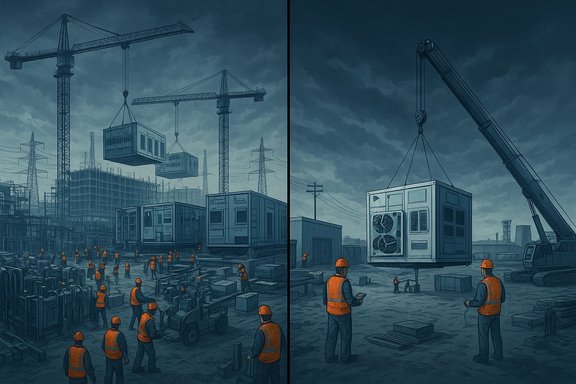
Some owners use prefabricated, modular halls and standard repeatable designs to compress schedule risk. Others rely on wholesale colocation partners to access near‑term capacity without owning facilities outright. These approaches help absorb demand quickly but shift margin and operational exposure between owners and operators.Practical guidance for contractors, owners and policymakers
For small and mid‑sized contractors
- Pivot toward niches that remain in demand (life sciences, healthcare, specialized retrofits) and package capabilities into attractive subcontract offerings for large data center primes.
- Invest in workforce development with apprenticeships and certified training to keep pace with high‑density mechanical, electrical and fiber skills.
- Form strategic alliances or JV arrangements with larger firms to gain entry into data center subcontracts without overextending balance sheets.
For large contractors and owners
- De‑risk by diversifying power strategies — pair renewables with short‑duration bridging generation and storage.
- Standardize designs to reduce per‑project setup time and re‑use proven mechanical/electrical packages.
- Commit to transparent environmental metrics (PUE, WUE, Scope 1/2/3) to manage community and investor expectations.
For utilities and policymakers
- Prioritize transmission and substation upgrades in regions that host significant data center clustering; regulatory timelines and permitting need acceleration to match market cadence.
- Align incentive structures so community benefits (workforce training, tax revenue sharing) are commensurate with infrastructure burdens.
- Require robust procurement transparency for long‑term PPAs and firm power deals to ensure accountability on emissions and grid planning.
Financial and market implications
Order books and investor signals
Large hyperscalers’ multi‑year commitments translate into substantial opportunities for large contractors and the equipment supply chain. For investors, that implies:- Upside for power equipment manufacturers, system integrators and construction firms with established data center practices.
- Near‑term margin pressure for hyperscalers as capex spikes and large procurements depress free cash flow until utilization and monetization catch up.
- A watchlist for capacity conversion — the critical signal is not just backlog but how quickly backlog converts into operating capacity and revenue.
Macro risks
If the industry overbuilds or if energy and labor constraints slow activation, companies could face underutilized assets and slower-than-expected revenue realization. Conversely, if grid upgrades and workforce investments lag permanently, the market could bifurcate into “power‑rich” and “power‑constrained” regions, shifting where hyperscalers place future capacity.Evidence and verification: what’s solid — and what still needs scrutiny
- Solid, verifiable facts:
- ABC’s December CBI reading of 8.2 months and the survey dates of Dec. 22–Jan. 7 are explicitly reported by ABC and summarized in industry outlets.
- The 11.0 vs. 7.8 months backlog split between contractors with and without data center projects is published in ABC’s release and referenced in sector reporting.
- Market commentary describing low vacancy rates and continued data center demand is grounded in Cushman & Wakefield analyses and sector reporting.
- Claims requiring caution or further verification:
- Precise national or regional electricity shortfalls tied to data centers — while analysts have modeled sizable shortfalls in constrained corridors, those projections vary by modeling assumptions and are sensitive to planned grid projects and policy actions. Treat single‑figure GW shortfall claims as scenario estimates rather than fixed facts.
- Company‑level commitments tied to specific energy sources (for example, definitive timelines on nuclear or fusion supply) are often forward‑looking and contingent on regulatory approvals, construction schedules and financing; they should be read as strategic hedges rather than immediate supply fixes.
What Windows‑centric IT teams and corporate procurement should do now
- Map critical workloads to available regions — identify which apps are latency‑sensitive and require colocated inference vs. which can burst to alternate regions with available capacity.
- Negotiate capacity and SLA protections for inference-heavy workloads, including regional substitution clauses and capacity reservation guarantees.
- Design for portability — use containerized models, ONNX (or equivalent portable formats) and CI/CD that allow burst‑to‑cloud or hybrid edge/off‑cloud deployments.
- Monitor vendor energy strategy and transparency — prefer providers that publish firm power sources or credible decarbonization roadmaps, and avoid long‑term reliance on fossil bridging without explicit replacement plans.
Final assessment: opportunity amid imbalance
The December backlog uptick is small in aggregate (+0.1 months), but structurally important: it reveals an industry being reshaped by the scale, energy intensity and capital needs of AI‑grade data center construction. That reshaping concentrates backlog, margins and labor in the hands of large, experienced contractors and exposes smaller firms to pipeline decline.There is genuine opportunity — for contractors that scale, for equipment makers, and for communities that capture jobs and investment — but equally real risks from concentrated demand, grid constraints, and the environmental tradeoffs of bridging strategies. Policymakers, utilities and industry participants must coordinate faster on transmission upgrades, workforce development and credible low‑carbon firm power solutions if the sector’s growth is to be both sustainable and broadly beneficial.
If the market manages those transitions — by investing in grid capacity, diversifying energy procurement, and expanding training pipelines — the data center boom could usher in a durable construction cycle with broad ripple effects. If it doesn’t, the sector risks sharpening an already widening divide: more backlog for the few, and fewer projects for the many.
Quick checklist for industry participants
- For contractors:
- Assess your balance sheet and consider strategic partnerships to access large data center work.
- Invest in liquid‑cooling and high‑density electrical expertise.
- Expand apprenticeship and recruitment programs to retain skilled labor.
- For owners/hyperscalers:
- Lock firm power and transmission pathways early.
- Standardize modular designs to shorten time‑to‑market.
- Disclose clear decarbonization and transition plans.
- For policymakers/utilities:
- Fast‑track grid upgrades in data center corridors.
- Tie incentives to measurable community improvements and environmental safeguards.
- Support workforce training programs aligned with high‑intensity infrastructure builds.
Source: Construction Dive Data centers drive lopsided backlog gains
