

Zenzero and Microsoft used a high‑profile executive forum to deliver a blunt, practical warning to UK IT leaders: as organisations rush to adopt AI, the true limiter — and the greatest source of operational risk — is weak data foundations, and urgent investment in data resilience, governance and secure platform architecture must become a board‑level priority.
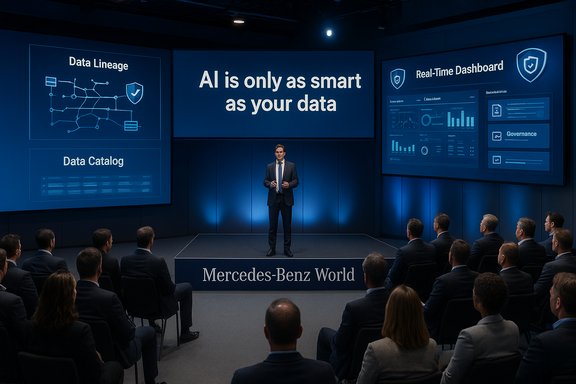
Zenzero, together with its managed‑services arm QuoStar and a delegation from Microsoft, held "Driving data forward" — an executive event staged at Mercedes‑Benz World that brought together more than 70 CIOs, CTOs, IT directors and digital leaders to discuss the concrete steps needed to make AI initiatives reliable and safe. Speakers included Zenzero data leaders, an AI architect from Microsoft’s Innovation Hub, and a high‑profile fireside guest from elite motorsport used to real‑time telemetry decisioning. The organisers framed the discussion around a concise theme repeated throughout the programme: “AI is only as smart as your data.”
That message lands in a context of heightened technical and regulatory scrutiny. Microsoft has pushed Copilot and related analytics features hard across its productivity stack, and those tools deliver value only when underpinned by governed, high‑quality, auditable data — something the event speakers emphasised repeatedly.
However, measured adoption requires hard tradeoffs: upfront engineering effort for data quality and lineage, explicit costs for enterprise capacities and licensing, sustained staffing for governance, and clear human review processes to maintain trust. The most successful mid‑market adopters will balance speed and discipline: move quickly to prove value with small, governed pilots, then reinvest wins into the structural work that enables scale.
Source: AiThority Zenzero and Microsoft urge UK businesses to build data resilience as AI adoption accelerates
 Background
Zenzero, together with its managed‑services arm QuoStar and a delegation from Microsoft, held "Driving data forward" — an executive event staged at Mercedes‑Benz World that brought together more than 70 CIOs, CTOs, IT directors and digital leaders to discuss the concrete steps needed to make AI initiatives reliable and safe. Speakers included Zenzero data leaders, an AI architect from Microsoft’s Innovation Hub, and a high‑profile fireside guest from elite motorsport used to real‑time telemetry decisioning. The organisers framed the discussion around a concise theme repeated throughout the programme: “AI is only as smart as your data.”That message lands in a context of heightened technical and regulatory scrutiny. Microsoft has pushed Copilot and related analytics features hard across its productivity stack, and those tools deliver value only when underpinned by governed, high‑quality, auditable data — something the event speakers emphasised repeatedly.
Why the message matters now
AI adoption has moved from experimentation to enterprise rollout in many organisations, but production‑grade deployment is materially different from proof‑of‑concepts. The event’s central claim — that poor data foundations, not models, are the primary obstacle to realising AI value — maps to three converging facts:- Modern business AI (Copilot experiences, embedded analytics, agent workflows) depends on connected, timely and accurate datasets. Without reliable lineage and governance, AI outputs are unreliable and auditable gaps appear quickly.
- Cyber threats and data incidents remain frequent; weak identity, access and platform controls create attack surfaces that amplify AI risk (for example, unauthorized data access feeding model prompts). The speakers noted the need to harden identity and platform security as part of any AI readiness plan.
- Regulatory and compliance attention on AI and data use is intensifying. Governance and traceability are no longer nice‑to‑have: they underpin legal defensibility and contractual obligations for enterprise AI.
What happened at the event (verified details and notable speakers)
The programme and key moments
The forum included:- A keynote from Alex Karim, an AI architect affiliated with Microsoft’s Innovation Hub, which focused on practical approaches to becoming AI‑ready and stressed data integrity, governance and secure platform design as prerequisites for safe Copilot and analytics deployments.
- A programme led by Zenzero’s Director of Data and Development Services, Wayde Finch, who articulated the event’s central maxim: “AI is only as smart as your data.” Finch tied that statement to the rising economic pressure, cyber threat levels and regulatory expansion that make data resilience a boardroom priority.
- A fireside chat that used elite motorsport telemetry and split‑second decisioning as a metaphor for low‑latency analytics and operational intelligence; the guest used that background to illustrate how telemetry and rapid analytics inform safer, faster business decisions.
Attendance and format
The forum was attended by more than 70 senior IT and digital leaders and concluded with a short, actionable checklist for organisations to take away: improve data quality and governance, integrate previously siloed systems, enable real‑time insight through Power BI and strengthen cyber posture before scaling Copilot or similar AI features.What the organisers recommended — the practical playbook
The event closed with a succinct, pragmatic playbook that maps to immediate, medium and longer‑term activities. These mirror common operational guidance for implementing Microsoft Copilot, Power BI and governed analytics at scale, and are presented here in an implementable format.Immediate steps (0–3 months)
- Run a focused data‑health sprint on the top 2–3 datasets that feed business KPIs (finance, customer, operations). Use automated profiling to identify duplicates, nulls, and schema drift.
- Enforce identity baseline: enable MFA, implement Conditional Access policies, and audit role assignments in Entra ID.
- Establish a temporary human review gate for any Copilot pilot outputs; require DLP policies for any prompts that reference sensitive data.
Platform and governance (3–9 months)
- Deploy a central data catalog and lineage tooling (for example, Microsoft Purview or equivalent).
- Consolidate critical analytic workloads onto governed capacities (Power BI Premium or Microsoft Fabric as required by scale).
- Configure tenant‑level DLP, Purview classification, and Defender controls for the surfaces Copilot and agents will touch.
Scale and assurance (9–18 months)
- Expand Copilot and analytics rollouts only after passing governance and audit checklists.
- Automate data quality checks and run bi‑monthly “red team” exercises to simulate AI‑enabled threats such as prompt injection or exfiltration scenarios.
- Measure and report business KPIs tied to AI initiatives: time‑to‑insight, data quality index, MTTD/MTTR for analytic incidents, and license run‑rate per capability.
Technical validation — what’s realistic with Microsoft tooling
Speakers at the event and follow‑up materials linked the playbook to concrete Microsoft features: Copilot integration inside Power BI and Fabric, tenant protections via Entra ID and Microsoft Purview, and data ingestion/processing through Azure Data Factory, Synapse, and Fabric connectors. These are not aspirational — Microsoft has published operational guidance that makes these exact building blocks the recommended route to production. However, two practical caveats surfaced repeatedly at the forum:- Licensing and capacity matter. Many advanced Copilot and Power BI features require Premium capacities (or Fabric equivalents) for performance, governance and enterprise scale, so technical design must include realistic cost modelling.
- Product capability does not replace process or human oversight. Even when Copilot generates visuals or narratives in Power BI, organisations need data‑steering processes and audit trails to validate outputs and prevent upstream errors from propagating.
Strengths of Zenzero’s approach
- Data‑first sequencing is correct. Prioritising data quality, lineage and governance before scaling AI reduces the odds of "garbage in, garbage out" failures and produces auditable, repeatable outcomes.
- Practical, measurable steps. The playbook’s emphasis on short sprints, a phased platform build, and clear KPIs makes it easier for mid‑market organisations to measure progress and justify incremental investment.
- Partner delivery model. Combining Microsoft product expertise with a managed‑services partner (Zenzero/QuoStar) offers a practical route for organisations that lack deep in‑house data engineering capability but need to move quickly.
Risks, omissions and claims that require caution
While the event’s guidance is practical, several risk areas deserve explicit attention before any organisation commits to large‑scale AI rollouts.1. Licensing, run‑rate and hidden costs
Power BI Premium, Microsoft Fabric capacities, Copilot Studio features and enterprise‑grade tenant controls often carry non‑trivial license and capacity costs. Organisations must model both one‑off migration costs and ongoing run‑rate, including monitoring, stewardship and incident response staffing. These costs were acknowledged but under‑emphasised in the event coverage.2. Vendor lock‑in and multi‑cloud complexity
Heavily investing in a single vendor’s platform can accelerate value capture, but it raises migration risk and bargaining leverage concerns. A clear exit and interoperability plan should accompany any deep Microsoft Fabric / Copilot dependence.3. The human‑in‑the‑loop requirement
Automated analytics and Copilot features can scale outputs quickly; without clear human review processes and role definitions, organisations risk amplifying data errors and making poor operational decisions. The event’s recommendations included human review gates — a necessary control.4. Claims that require verification
Zenzero material referenced contributions to a World Economic Forum New Champions Retreat resilience playbook. Independent checks of public WEF records did not corroborate a named executive contribution at the time of reporting; treat that linkage as a company claim unless independently corroborated. Event organisers and press material are credible sources for the forum itself, but policy‑level affiliations should be verified separately.A mid‑market (UK) implementation checklist — quick, pragmatic, measurable
The following checklist converts the event’s advice into a short, executable programme for mid‑market IT leaders:- Week 0–2: Identify top 3 datasets by business impact and owners. Assign steward and define SLA (freshness, completeness, lineage).
- Week 2–6: Run automated profiling and remediation backlog. Enable MFA and Conditional Access across high‑risk admin and service accounts.
- Month 2–3: Stand up a catalog (Purview or equivalent). Configure DLP policies for Copilot and workspace scopes. Pilot Power BI proof‑of‑value on a single line of business.
- Month 3–6: Migrate critical reports to governed capacity (Premium / Fabric). Implement pipeline monitoring and alerting. Begin red‑team tabletop for AI‑enabled threats.
- Month 6–12: Expand rollouts under governance, automate quality checks, measure KPIs (data quality index, time‑to‑insight, MTTR) and report to executive sponsors.
Cybersecurity considerations specific to AI rollouts
AI changes the threat model. The event highlighted several AI‑specific security vectors that deserve formal mitigation plans:- Prompt injection and data exfiltration risk: log and monitor all Copilot interactions and restrict prompt scopes where sensitive data is involved.
- Credential and entitlement creep: review service principals, automation accounts and app registrations monthly.
- Data poisoning and integrity attacks: track provenance and build tests that validate model outputs against known‑good baselines.
- Incident response for model‑driven error chains: create escalation paths where suspicious AI outputs trigger immediate human review and rollback procedures.
What success looks like — objectives and KPIs
Organisations should translate technical controls into business outcomes. The event suggested these priority KPIs:- Data quality index for high‑value datasets (completeness, freshness, accuracy).
- Time‑to‑insight for priority dashboards (median time from ingestion to actionable report).
- Number and severity of Copilot interactions flagged for manual review (a proxy for model risk).
- MTTD/MTTR for incidents affecting analytic platforms.
- License and run‑rate cost per active user or per analytic capability.
Final analysis — opportunity with responsibilities
The event staged by Zenzero, QuoStar and Microsoft was not a product launch or a cheerleading exercise; it was a practical nudge toward responsible AI adoption. Its central prescription — make data resilience the starting point — is sound and aligns with broader industry guidance on Copilot, Power BI and Fabric implementations.However, measured adoption requires hard tradeoffs: upfront engineering effort for data quality and lineage, explicit costs for enterprise capacities and licensing, sustained staffing for governance, and clear human review processes to maintain trust. The most successful mid‑market adopters will balance speed and discipline: move quickly to prove value with small, governed pilots, then reinvest wins into the structural work that enables scale.
Practical next steps for IT leaders (executive checklist)
- Assign an executive sponsor for data resilience linked to AI outcomes.
- Budget a 3‑phase programme (Discovery → Platform & Governance → Scale & Assurance) with explicit milestones and KPIs.
- Run one short, high‑value Copilot proof‑of‑value under strict DLP and human review.
- Build an exit/interoperability plan to mitigate vendor lock‑in risk.
- Publicly verify partner and policy claims and treat third‑party global policy linkages (e.g., WEF participation) as claims until corroborated.
Conclusion
Zenzero and Microsoft’s message at Mercedes‑Benz World was straightforward and actionable: AI projects will only deliver dependable, auditable business value when they sit on resilient, governed data foundations. The event distilled that message into a practical playbook — immediate sprints, disciplined platform builds, and scaled assurance — while also acknowledging the real cost and governance work required to reach production safely. For UK mid‑market organisations accelerating AI adoption, the path forward is clear: secure identity, establish cataloguing and lineage, fix the highest‑value datasets, and scale Copilot and analytics only within an audited governance framework. Those who treat data resilience as a strategic program rather than an afterthought will stand the best chance of turning AI potential into measurable, long‑term business advantage.Source: AiThority Zenzero and Microsoft urge UK businesses to build data resilience as AI adoption accelerates
