

A deadly crash on U.S. Highway 70 near Old Cornwallis Road in Johnston County on Sunday night left one person dead and another in custody, with troopers saying speed and alcohol were believed to be contributing factors.
U.S. Highway 70 is one of North Carolina’s major east–west corridors, carrying a mix of local, commuter and long-distance traffic through rural and suburban communities. Over the past decade the corridor has seen a string of serious collisions — wrong-way crashes, head-on collisions and multi-vehicle pileups — that have kept traffic-safety concerns center stage for local officials and highway planners. Recent reporting and statewide safety data underscore recurring causal factors in fatal crashes: speeding, impaired driving and inconsistent seat-belt use. The crash that occurred on the evening of December 21–22, 2025 sits in that pattern of high-consequence incidents along U.S. 70, but its immediate facts and law-enforcement updates remain limited to the initial public reporting. The details below are drawn from the reporting that is available while flagging what remains unconfirmed by independent law-enforcement press releases at this time.
Source: WRAL One person killed in crash on US-70 in Johnston County
 Background
U.S. Highway 70 is one of North Carolina’s major east–west corridors, carrying a mix of local, commuter and long-distance traffic through rural and suburban communities. Over the past decade the corridor has seen a string of serious collisions — wrong-way crashes, head-on collisions and multi-vehicle pileups — that have kept traffic-safety concerns center stage for local officials and highway planners. Recent reporting and statewide safety data underscore recurring causal factors in fatal crashes: speeding, impaired driving and inconsistent seat-belt use. The crash that occurred on the evening of December 21–22, 2025 sits in that pattern of high-consequence incidents along U.S. 70, but its immediate facts and law-enforcement updates remain limited to the initial public reporting. The details below are drawn from the reporting that is available while flagging what remains unconfirmed by independent law-enforcement press releases at this time. What happened: the reported facts
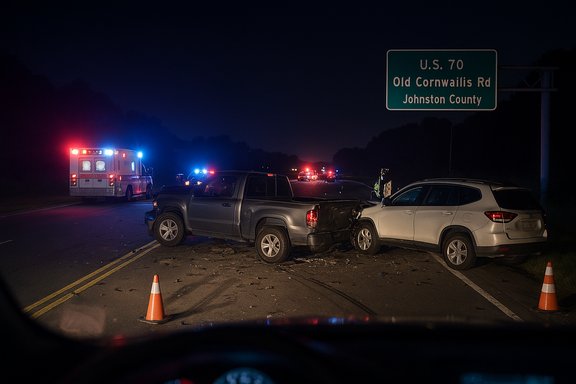
State troopers were called to U.S. 70 near Old Cornwallis Road at about 6:30 p.m., where investigators found the scene of a collision between a pickup truck and an SUV. Troopers reported that the pickup truck struck the rear of the SUV as the smaller vehicle was turning into a driveway off the highway. The driver of the SUV was pronounced dead at the scene. Troopers told reporters that speed and alcohol were believed to be factors in the crash, and that the driver of the pickup truck had been arrested at the scene. As of WRAL’s posting, names, specific charges, and the official identity of the decedent had not been released by law enforcement. Local media noted that state troopers reopened all lanes of U.S. 70 after the scene was cleared. Key points reported so far:- Collision location: U.S. 70 near Old Cornwallis Road (Princeton / Johnston County).
- Time called: roughly 6:30 p.m. local time.
- Crash mechanics (as reported): pickup truck rear-ended an SUV that was turning into a driveway; SUV driver died at the scene.
- Contributing factors (reported): speed and alcohol.
- Arrest: driver of the pickup was arrested; troopers had not released names or formal charge details at the time of reporting.
Immediate response: emergency services and traffic impacts
First responders — including NC State Highway Patrol troopers and local EMS — closed lanes of U.S. 70 while they worked the scene and provided life-saving efforts. The highway was reopened after investigators and wreckers cleared the scene, but the road closure required detours and produced traffic delays typical of a rural highway fatality response. Media crews were on site and WRAL posted a short video summary of the incident within hours of the collision. Traffic on high-speed corridors like U.S. 70 can become chaotic during an emergency response, increasing the risk of secondary crashes. For traffic-management agencies, clearing a fatal scene quickly while preserving investigative evidence creates a difficult trade-off that often shapes when full lane reopenings occur.Investigation and legal status
At the time of initial reporting, troopers cited alcohol and excessive speed as believed factors, and reported an arrest of the pickup driver. Those statements reflect on-scene assessment and the early investigative posture of the North Carolina State Highway Patrol (NCSHP). In most fatal-crash investigations involving suspected impairment, law-enforcement steps typically include breath or blood testing, interviews with witnesses, vehicle inspections and the collection of evidence such as onboard cameras and phone records. A formal charging decision and the filing of specific counts (e.g., impaired driving causing death, felony death by vehicle, etc. are determined after prosecutors review the troopers’ investigative package. Important investigatory notes and what to expect next:- Breath/blood testing: If troopers suspect alcohol impairment, they will seek to obtain chemical testing (breath at the scene or blood at a medical facility). The timing and circumstances of those tests matter for admissibility and influence whether a driver is charged with DWI or similar offenses.
- Crash reconstruction: For rear-end collisions where speed is cited, investigators will document vehicle damage, skid marks, video evidence and roadway geometry to estimate closing speed and sequence.
- Charging and public records: Local prosecutors decide on formal charges from the law-enforcement file; initial on-scene arrest does not equal the final set or gravity of charges. Names and charges may be withheld until next-of-kin notification and booking paperwork are completed.
How this crash fits into broader safety patterns
Speeding and alcohol are among the top recurring contributors to fatal crashes in North Carolina and nationally. Federal and state data consistently show that a substantial share of traffic fatalities involve impairment or excessive speed, and that occupant restraint use also plays a large role in survival outcomes. The National Highway Traffic Safety Administration (NHTSA) estimates tens of thousands of alcohol-impaired driving deaths nationally across recent years, and the agency continues to emphasize that impaired driving, speeding and restraint non-use remain leading, preventable causes of highway fatalities. For local context, WRAL and other regional outlets have repeatedly documented serious incidents on U.S. 70 — from wrong-way collisions to head-on crashes — that share similar causal fingerprints: alcohol, speed, and sometimes failure to yield or misjudgment during turning maneuvers. These incident clusters drive state and county-level traffic-safety programs that target enforcement and road-design interventions on high-risk corridors.- Why rear-end collisions can be lethal on highways: At highway speeds, a rear-end impact is more likely to produce catastrophic intrusion into a passenger compartment, rollovers, or secondary impacts — particularly when vehicles aren’t wearing belts or when vehicles are struck at high closing speeds. Even a relatively modest speed differential can be fatal if the struck vehicle is in the process of slowing, turning or crossing the highway.
Enforcement, public messaging, and what authorities typically do after such crashes
In fatal-crash cases where impairment is suspected, law enforcement often increases enforcement and public messaging on nearby corridors to both detect impaired drivers and to reassure the public that authorities are responding. That can include:- Focused DWI/impairment checkpoints or saturation patrols on weekend evenings.
- Public reminders from state troopers and county law-enforcement about the dangers of speeding and driving under the influence.
- Coordination with prosecutors to expedite charging decisions when evidence of impairment is strong.
Local history: U.S. 70 and Johnston County crash record
Johnston County’s segment of U.S. 70 has a history of high-profile and deadly collisions, which helps explain why residents and local officials pay close attention to traffic patterns and enforcement. WRAL’s news archive contains multiple stories from the region — including wrong-way crashes and other fatal collisions — that highlight how vulnerable this corridor can be when combined with high speeds and impairment. Those past incidents also often prompt questions about whether additional engineering or enforcement measures are needed. These historical incidents matter because they shape community expectations, influence NCDOT and county planning priorities, and can be used as evidence when petitioning for safety upgrades (turn lanes, signal timing changes, speed enforcement cameras where allowed, and other remedial projects). Local leaders frequently cite recurring crash patterns when requesting state funding for targeted improvements.What is verifiable now — and what remains unconfirmed
Verifiable (per available reporting):- A crash occurred on U.S. 70 near Old Cornwallis Road in Johnston County on the evening in question, and one person died at the scene.
- Troopers reported that speed and alcohol were believed to be factors.
- The driver of the pickup that struck the SUV was arrested at the scene.
- The names and demographics of the persons involved, including the identity of the decedent and the arrested individual.
- Specific charges that will be filed against the arrested driver and the formal blood/breath test results, which were not publicly released at the time of initial reporting.
- Any additional contributing factors that may be revealed through a full reconstruction (e.g., mechanical defects, distracted driving, medical emergencies, or roadway conditions).
The policy and technical implications
This crash exemplifies two recurring policy challenges for highway safety:- Enforcement limitations: Enforcement is effective but finite. Troops and local deputies can increase DWI patrols and speed enforcement, but those actions are episodic and require sustained resources to change long-term behavior.
- Engineering and design: Many high-speed rural and semi-rural stretch collisions are aggravated by road geometry, limited sight distances, and the absence of protective turning infrastructure (deceleration lanes, dedicated turn pockets, or signalized intersections). Where repeated collisions occur, engineering interventions can yield durable safety dividends — but they require planning, funding, and political will.
Practical takeaways for drivers (evidence-based)
- Slow down on high-speed corridors. Speed increases the kinetic energy in a crash and reduces reaction margins; even moderate speed differentials (a fast-approaching pickup versus a turning SUV) can become fatal at highway speeds.
- Avoid impaired driving. Alcohol remains one of the largest contributors to fatal crashes nationwide; the combination of impairment and speed is particularly lethal.
- Use seat belts. Restraint use continues to be one of the most effective measures for reducing the risk of death or severe injury in a crash.
- Be mindful when turning from fast-moving lanes. If you must turn from a highway lane into a private driveway, use the appropriate signal, yield to approaching traffic, and wait for an adequate gap; consider pulling fully off the highway where possible before making a turn.
Journalistic and verification notes
This piece relies primarily on local reporting that was published in the immediate aftermath of the crash. Local television and digital news outlets frequently get timely on-scene statements from troopers and first responders; however, those initial statements are not the same as finalized investigative conclusions. When official records (trooper reports, toxicology results, autopsy findings, prosecutors’ charging decisions) are released, they provide the authoritative factual record. Readers and downstream reporters should treat early reports as provisional and look for follow-up releases from the NCSHP, the county coroner, and the district attorney’s office for confirmation. At the time of publication of the initial story, no formal trooper press release with names or charges had been posted publicly; WRAL’s reporting noted that troopers had not released the names of anyone involved. That absence of identity and specific charge information means a number of statements remain pending official confirmation.Conclusion
A single evening on U.S. 70 in Johnston County once again highlighted the lethal consequences when speed and alcohol intersect on high-speed roadways. Early reporting indicates that a pickup truck struck an SUV that was turning into a driveway, killing the SUV’s driver and resulting in the pickup driver’s arrest; troopers said speed and alcohol were believed to be factors. Those are significant assertions that will be tested and clarified as investigators deliver formal test results, crash-reconstruction reports and prosecutorial filings. As is often the case with local traffic tragedies, the immediate human toll is followed by a familiar cycle: investigation, confirmation, and community reflection about enforcement and engineering solutions. For policymakers, transportation planners and the driving public alike, the recurring lessons are predictable but painful: sober driving, appropriate speeds, and consistent seat-belt use remain the simplest, most effective defenses against highway fatalities.Source: WRAL One person killed in crash on US-70 in Johnston County