

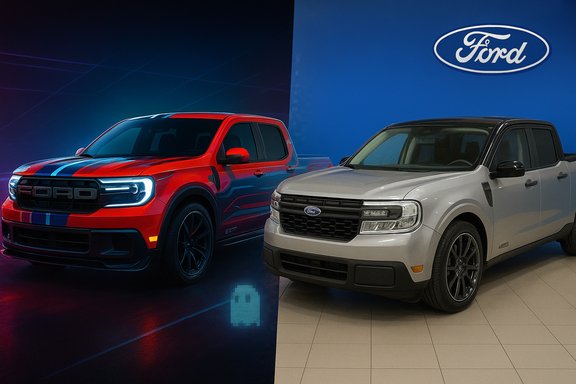
When a widely used AI assistant confidently described a never-announced “2027 Ford Maverick GT” complete with a 5.0L Coyote V8, lighter chassis, longer wheelbase, and bespoke GT styling, it didn’t produce a scoop — it produced a cautionary example of how generative systems can turn plausible fragments into persuasive fiction. The claim spread quickly through search results and social feeds, prompting outlets and enthusiasts to ask one simple question: is this real? The answer, based on official product pages and independent testing, is no — the Mustang‑style “Maverick GT” is an AI‑generated fabrication, while the real factory performance Maverick is the Lobo, which uses the turbocharged 2.0‑liter EcoBoost and carefully engineered chassis upgrades rather than a V8 transplant.
The Ford Maverick occupies a clear product niche: a compact, unibody pickup built around fuel-efficient powertrains and everyday utility, intended to be affordable and city-friendly. Ford’s official Maverick pages list two production powertrains — a standard 2.5L hybrid and an optional 2.0L EcoBoost turbo four — and the refreshed 2025/2026 lineup brings AWD availability to additional trims and an explicitly performance‑oriented trim called Lobo. These official specifications show the Maverick’s design intent: compact packaging, unibody construction, and transverse engine layouts that suit hybrid and small turbocharged engines. The "2027 Maverick GT" rumor surfaced when an AI assistant (highlighted in reporting as Microsoft Copilot) answered queries about a future Maverick GT with a highly specific spec sheet — including the headline claim of a 5.0L Coyote V8. That output mixed accurate product terminology (Maverick, EcoBoost, Coyote) with invented engineering assertions (100‑pound weight savings while adding a V8, a longer wheelbase, bespoke torsion‑stiffening using high‑strength steels). Ford Authority and downstream coverage flagged the output as fabricated and urged readers not to treat a single, confident‑sounding AI reply as evidence.
Why it looked believable:
Key technical constraints:
What Lobo actually delivers:
For drivers who want a factory‑backed, performance‑oriented Maverick today, Lobo is the real, on‑the‑ground option that delivers sharper handling, visual differentiation, and the kind of curated Ford engineering that stands up to testing. For those chasing muscle‑truck fantasies, the path will most likely be aftermarket builds or bona fide new architecture programs — not a quick GT badge produced by a search widget. The AI hallucination was persuasive; it was not a substitute for programmatic evidence.
Practical next steps: consult Ford’s official Maverick pages to confirm available engines and trims; rely on road tests from MotorTrend and Car and Driver for real performance evaluations; and treat single AI‑generated answers as conversation starters to be verified, not as finished reporting.
Source: Ford Authority Clankers Believe 2027 Ford Maverick GT Rumors: AI Slop Report
 Background / Overview
The Ford Maverick occupies a clear product niche: a compact, unibody pickup built around fuel-efficient powertrains and everyday utility, intended to be affordable and city-friendly. Ford’s official Maverick pages list two production powertrains — a standard 2.5L hybrid and an optional 2.0L EcoBoost turbo four — and the refreshed 2025/2026 lineup brings AWD availability to additional trims and an explicitly performance‑oriented trim called Lobo. These official specifications show the Maverick’s design intent: compact packaging, unibody construction, and transverse engine layouts that suit hybrid and small turbocharged engines. The "2027 Maverick GT" rumor surfaced when an AI assistant (highlighted in reporting as Microsoft Copilot) answered queries about a future Maverick GT with a highly specific spec sheet — including the headline claim of a 5.0L Coyote V8. That output mixed accurate product terminology (Maverick, EcoBoost, Coyote) with invented engineering assertions (100‑pound weight savings while adding a V8, a longer wheelbase, bespoke torsion‑stiffening using high‑strength steels). Ford Authority and downstream coverage flagged the output as fabricated and urged readers not to treat a single, confident‑sounding AI reply as evidence.How the rumor spread (and why it looked credible)
AI assistants produce language by predicting plausible continuations of the prompt. When asked about an unannounced product, they will often weave together:- known brand language (model names, engine families, trim badges),
- plausible engineering tradeoffs (wheelbase, weight, stiffness),
- and familiar performance marketing copy (GT-style cues, blacked‑out trim, larger wheels).
Why it looked believable:
- The Ford ecosystem already contains performance‑oriented language (GT badges, Mustang Coyote engines, Ford Performance parts) that the model could recombine.
- Maverick has a documented performance trim (Lobo), which makes a GT variant idea intuitively plausible.
- Non‑specialist readers can’t easily tell the difference between a verified press release and a polished AI summary.
Technical reality check: could a 5.0L Coyote V8 fit in a Maverick?
Short answer: not as a simple trim upgrade, and highly unlikely as a factory program without major architecture changes.Key technical constraints:
- Platform and engine orientation — the Maverick is built on Ford’s C2 unibody platform, engineered around transverse engine layouts and compact packaging shared with Escape and Bronco Sport. The 5.0L Coyote is a physically large, longitudinal V8 designed for rear‑drive and truck platforms (e.g., Mustang, F‑150). Swapping a longitudinal V8 into a transverse bay is not a minor engineering task; it implies an effectively new vehicle program.
- Packaging, weight, and balance — the Coyote is significantly larger and heavier than the 2.0L and 2.5L units the Maverick was engineered for. Adding that mass requires re‑engineering suspension rates, brakes, cooling, steering, and crash structures. Claims that a V8 Maverick would be lighter than a regular Maverick contradict basic physics and packaging tradeoffs.
- Drivetrain compatibility — the transmissions, bellhousings, rear differentials, rear subframes, and warranty envelopes that support a high‑torque V8 powertrain in a Mustang or F‑Series are not plug‑and‑play in a C2 transverse architecture. Integrating them would require new suppliers, recalibrated electronic control units, and a substantial testing program.
- Safety and regulatory validation — structural changes that alter crash behavior or packaging demand new crash testing, homologation, and regulatory filings that typically surface long before a production announcement. No such filings or credible investigative reporting indicate a V8 Maverick program.
The C2 platform and engine packages: what the records show
- The C2 platform is used for the Maverick, Escape, Bronco Sport, and Lincoln Corsair, among others, and explicitly supports transverse front‑engine, FWD/AWD layouts. That platform choice defines packaging envelopes and the set of engines it can accept without wholesale architecture changes.
- Ford’s official Maverick pages list the 2.5L hybrid as standard and the 2.0L EcoBoost as the optional gas engine, with AWD available in certain trims. Those specs are the baseline a buyer or journalist should use to validate any rumor about a new powertrain.
- The 5.0L Coyote V8’s manufacturing and application history confirm it as a longitudinal, DOHC V8 used in Mustang and certain F‑Series applications — a fundamentally different packaging and performance envelope than the Maverick’s production architecture.
The real factory performance Maverick: Lobo
If you want a verifiable, factory‑backed performance Maverick, the Maverick Lobo is it. Introduced as part of the Maverick refresh, Lobo is Ford’s strategic answer to buyers who want a sportier, more driver‑focused compact truck without up‑sizing the powertrain.What Lobo actually delivers:
- A retuned, lowered suspension and recalibrated AWD system with torque vectoring for sharper handling.
- Hardware upgrades such as larger brakes, unique exterior treatment (body‑color bumpers, black roof, 19‑inch wheels), and interior trim changes.
- Retention of the 2.0L EcoBoost as the heart of the high‑performance Lobo variant, combined with a seven‑speed tuned automatic and paddle shifters in some configurations.
- Pricing positioned to make Lobo an accessible “street truck” rather than a halo V8 model.
How and why AI hallucinations like this happen
Generative assistants are trained to produce fluent, relevant text. They are not, by default, connected to a fact‑checking oracle. When asked about speculative or future products, models often synthesize a best‑guess answer by combining training examples — which can lead to:- Confident fabrication of specifics (horsepower numbers, weight changes, wheelbase figures),
- Mixing of real facts and invented details (keeping known options like the 2.0L EcoBoost while inventing a V8),
- Repetition and amplification via indexing into search engines and social sharing.
Risks: why AI‑generated vehicle rumors matter
- Consumer confusion and damaged expectations. Buyers could delay purchases, chase non‑existent options, or expect dealer programs that don’t exist.
- Dealer and retail friction. Sales staff and dealer websites will receive calls and leads about product configurations that are not in OEM order guides.
- Brand and market distortion. Viral rumors can shift perceptions of desirability and rarity, potentially affecting resale and trade‑in valuations.
- Reporter burnout and credibility risk. Newsrooms that fail to independently verify AI‑sourced claims can lose credibility quickly.
Practical verification checklist for readers, buyers, and journalists
- Check the OEM first. Inspect the manufacturer’s official product and press pages for announced trims, specs, and production dates. If the product isn’t listed there, treat claims skeptically.
- Look for corroboration from two independent outlets. Reputable outlets (Car and Driver, MotorTrend, Autoweek, The Verge) typically confirm major changes before treating them as fact. Cross‑reference at least two.
- Ask the practical engineering questions. Would the change require an engine orientation swap? New transmission families? Different crash‑structure testing? If the answer is “yes, many things,” expect official supplier/regulatory traces.
- Search regulatory and certification databases. Vehicle certifications, homologation filings, and VIN allocation records often surface before production changes. Their absence is telling.
- Treat single AI outputs as leads, not facts. Use generative assistants for brainstorming, then verify claims against primary materials.
Short guide for OEMs, dealers, and platforms
- OEMs should continue to publish clear, accessible build‑and‑price pages and maintain timely press release archives. Clear, machine‑readable press feeds reduce the chance of hallucinated alternatives taking root.
- Dealers should add a short FAQ for suspicious rumors and provide customers with OEM links; that reduces the burden of correcting expectations one call at a time.
- Search engines and AI platforms should invest in stronger provenance flags: clearly mark speculative answers, require source links for product claims, and refrain from supplying fabricated specific numbers without primary evidence.
Notable real developments you can trust (verified items)
- Ford Maverick production powertrains: the 2.5L hybrid (standard) and 2.0L EcoBoost (optional) are the confirmed, production‑sold engines for Maverick. Official Ford product pages list these configurations and AWD/advanced 4WD availability by trim.
- Maverick Lobo: Ford has introduced the Lobo performance trim, featuring lowered suspension, torque‑vectoring AWD, unique exterior and interior treatments, upgraded brakes, and a tuned 2.0L EcoBoost powertrain. Independent reviews from MotorTrend and Car and Driver document the Lobo’s real-world behavior and spec sheet.
- Ford Performance/aftermarket enhancements: Ford and Ford Performance continue to offer dealer‑installable performance packages and project vehicles (for example, SEMA show builds or planned Ford Performance parts such as a 300T conversion), which are plausible pathways to higher output without OEM factory V8 swaps into a compact platform. Those initiatives are a credible route for enthusiasts who want more speed.
A measured conclusion
The “2027 Ford Maverick GT” is an instructive example of the new verification challenges the automotive world faces. Generative AI can craft highly persuasive narratives by combining brand vocabulary, engineering jargon, and consumer desire. But plausible language is not proof. The correct journalistic response — and the sensible consumer approach — is verification: consult OEM pages, cross‑check established outlets, and apply engineering common sense before amplifying eye‑catching claims.For drivers who want a factory‑backed, performance‑oriented Maverick today, Lobo is the real, on‑the‑ground option that delivers sharper handling, visual differentiation, and the kind of curated Ford engineering that stands up to testing. For those chasing muscle‑truck fantasies, the path will most likely be aftermarket builds or bona fide new architecture programs — not a quick GT badge produced by a search widget. The AI hallucination was persuasive; it was not a substitute for programmatic evidence.
Practical next steps: consult Ford’s official Maverick pages to confirm available engines and trims; rely on road tests from MotorTrend and Car and Driver for real performance evaluations; and treat single AI‑generated answers as conversation starters to be verified, not as finished reporting.
Source: Ford Authority Clankers Believe 2027 Ford Maverick GT Rumors: AI Slop Report
