

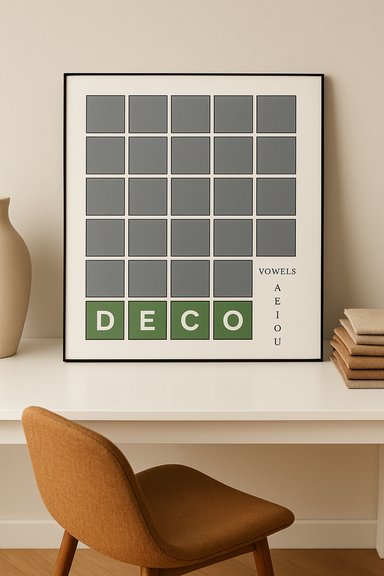
Wordle players woke up to a tidy, design‑themed challenge on December 30, 2025 — puzzle #1655 — and the five‑letter solution that closed the board for many solvers was DECOR.
Background / Overview
Wordle started as a modest, private project and quickly became a daily habit for millions. Created by software engineer Josh Wardle in 2021 as a personal gift for his partner, the simple, six‑guess, five‑letter format exploded into a global phenomenon and was acquired by The New York Times in early 2022. That change of stewardship preserved the core gameplay while folding Wordle into a larger family of daily puzzles managed by NYT Games. The NYT puzzle calendar moves predictably but deliberately: a single canonical answer each day, drawn from a curated list intended to be broad, family‑friendly, and varied in register. For solvers preserving long streaks, understanding the pattern and the editorial constraints behind Wordle can inform smarter guessing and fewer burned attempts.Today's headline: DECOR — what the puzzle looked like
- Puzzle: Wordle #1655
- Date: December 30, 2025
- Answer: DECOR.
Why DECOR is an interesting Wordle pick
DECOR is a strong example of how Wordle leverages common letters to make a word feel simultaneously familiar and unfamiliar. Each constituent letter — D, E, C, O, R — appears frequently across English vocabulary, but the particular arrangement points to a specialized register: interior design, aesthetics, and the vocabulary of presentation.- High familiarity, medium recall: Players know the word but may not default to it under pressure, especially when vowel placements don’t match usual starter words.
- No doubles, no exotic letters: That makes it solvable with good elimination play, but also easy to miss if solvers pigeonhole into vowel patterns like AE or AI early on.
- Semantic domain: Because DECOR lives in the design/visual domain — not everyday verbs or basic nouns like HOUSE or TABLE — it can feel like a niche pick despite being common in newspapers and lifestyle copy.
The Letter Rundown — strategic implications
Quick facts (game mechanics)
- Vowel count: 2 (E, O).
- Consonant count: 3 (D, C, R).
- Position pattern: D C R (vowels in slots 2 and 4).
- Repeated letters: None.
Why positions matter
Vowel placement is a deceptively powerful filter in Wordle. Common starter words like CRANE, SLATE, or AUDIO probe a particular set of vowel positions and combinations; DECOR’s E in position 2 and O in position 4 is not the most frequent pattern players test with those starters. As a result, even if players secure one vowel as correct early, the second vowel can remain masked until late rounds.When DECOR will trap you
- If your opening guesses prioritize vowels in positions 1 and 3 (e.g., AUDIO, ADIEU), you may reveal the presence of vowels but not their correct placements.
- If you focus exclusively on high‑value consonant clusters (CR, TR, PL) without testing alternate vowel slots, you might narrow too slowly.
- The word’s ending with -OR can lure guesses like FLOOR or SCORE; those may help if they confirm R/O, but they also waste guesses when D is required at the start.
Progressive hints: how the published clue ladder guided players
Many daily hint pages provide a progressive hint model that nudges solvers without spoiling the game immediately. For DECOR, the progressive hints might have looked like:- The vibe: interior aesthetics and visual harmony.
- The category: noun, used in conversations about how a space looks.
- Boundaries: starts with D, ends with R.
- Structure: vowels in positions 2 and 4.
- Giveaway: the style and arrangement of furnishings in a room.
Word DNA: roots, meaning, and the editorial call
DECOR — the prose noun meaning the style and arrangement of furnishings and decorations — traces etymologically to French décor and farther back to Latin decor, meaning beauty, grace, or propriety. The semantic kinship with words like decorum places DECOR in a formal cluster of words that speak to taste and appropriateness, making it an editorially tasteful choice for a midwinter puzzle. Why is this relevant to Wordle’s editorial teams? The NYT Games curates answers to avoid obscure slang, profanity, or overly specialized jargon. DECOR fits that editorial bar: recognizable, non‑offensive, and broad enough to be in the vocabulary of many players.Tactical playbook: how to solve similar puzzles faster
Wordle is a game of information theory: each guess should maximize information gain while preserving the chance to pin down solution letters. Here’s a compact playbook tailored for DECOR‑style puzzles.1. Opening moves that reduce vowel uncertainty
- Recommended openers: CRANE, SLATE, SOARE (if you use it), ROATE (advanced). These mix high‑value consonants and vowels across slots and will often identify at least one vowel in the word.
- If you prefer vowel-first approaches, use ADIEU or AUDIO to quickly confirm or rule out vowel combinations, but be prepared to pivot if the pattern doesn’t match.
2. Second move: mix consonant testing and alternative vowel slots
- If your first guess returns one vowel yellow, intentionally test the other vowel slot in guess two. For DECOR, once E or O appears as yellow, try a second guess that places the alternate vowel in a different slot (e.g., try a word with E in pos2 and O in pos4 or vice versa).
3. Use pattern logic when first/last letters are revealed
- When the first letter is D and the last is R, the space of five‑letter words matching D _ R becomes manageable. Prioritize common consonant fillings like D A I L Y‑style permutations and test probable middle consonants (C, L, N, V) and vowels.
4. Hard mode discipline (optional)
- If you play in Hard Mode, every revealed green or yellow must be used in subsequent guesses. That enforced discipline often reduces wasted permutations and can expose uncommon vowel placements earlier.
5. Streak‑save microflow (for late attempts)
- If on your fifth or sixth guess and you have two letters confirmed but not placed, choose a word that uses those letters in new slots while covering as many high‑frequency remaining letters as possible.
- Avoid obscure words unless every other common option is eliminated. DECOR is common enough to appear in everyday language, so favor dictionary strength.
Opening words ranked for DECOR‑style puzzles
- CRANE — strong consonant coverage and an E in pos2.
- SLATE — similar to CRANE, swaps in L/S for different consonant tests.
- ROATE — favored by some high‑level solvers for vowel spread (R, O, A, T, E).
- ADIEU/AUDIO — targeted vowel probes that quickly resolve which vowels are present.
- SCORE/FLOOR — good second‑guesses when you suspect an -OR ending.
Editorial and cultural take: why outlets ran the same answer
In the modern news environment, many lifestyle and puzzle outlets publish daily Wordle hints and the eventual answer. On December 30, several mainstream properties published identical solutions and parallel hint sets — a natural consequence of the single canonical NYT puzzle and the public’s appetite for streak‑saving guidance. When reputable sites publish matching answers and explanatory hints, it’s reasonable to treat the consensus as verification that DECOR was indeed the official solution for #1655. Note: where outlets provide numerical metrics like “average solve: 3.8 guesses,” those are editorial estimates unless a publisher explicitly reveals their sample size and data methodology. Treat such metrics as directional rather than precise unless accompanied by transparent data.What DECOR teaches about Wordle vocabulary selection
DECOR demonstrates a few editorial tendencies in the Wordle archive:- Preference for common words that are nonetheless not the most obvious everyday nouns, preserving challenge without resorting to obscurity.
- Mix of semantic domains across weeks (e.g., kitchen, nature, design), avoiding clustering that would allow players to guess by theme.
- Etymological variety: Wordle selections often pull roots from Latin, French, or Old English, giving editors a wide vocabulary pool.
Risks, traps, and how publishers handle spoilers
Daily Wordle spoilers are a reality: outlets publish the solution minutes to hours after the puzzle resets, and social platforms overflow with grid screenshots. For players seeking to preserve the surprise:- Use browser or app settings that block search results for “Wordle answer” or “Wordle #1655.”
- Disable social media previews or mute keywords on Twitter/X, Facebook, and Reddit.
- If you want to avoid all external sources, play early in the day or before checking news feeds.
Advanced reflection: statistical perspective and solvability
From an information‑theory standpoint, DECOR is a medium‑entropy target. Because letters are frequent and there are no repeats, the solution space collapses steadily once a few correct letters are located. The main challenge stems from the less‑common vowel slots rather than letter rarity.Two practical consequences:
- Early vowel probes are high‑value moves; they reduce entropy faster than random consonant testing.
- Once a consonant is placed in the first or last slot, the number of reasonable candidates drops sharply, which is why many published hint ladders emphasize revealing boundary letters.
Lessons for Wordle habit building
Wordle is as much a mental habit as a puzzle. Puzzles such as DECOR reinforce several long‑term skills:- Experiment deliberately: rotate opening words across sessions to avoid pattern blindness.
- Log outcomes: note which starters yield useful information most often for your playstyle.
- Adjust risk: if you’re protecting a streak, favor information‑dense moves over creative but low‑yield choices.
Final verdict and takeaways
DECOR is a textbook mid‑difficulty Wordle: familiar letters arranged in a pattern that tests vowel placement. The answer is verifiable across multiple reputable puzzle and news outlets that covered the December 30, 2025 puzzle, and the word’s etymology and meaning make it an editorially appropriate choice for the NYT editorial ledger. Key takeaways:- When you encounter a puzzle with two vowels and an unusual vowel distribution, prioritize vowel position testing early.
- If you’re down to a last guess and have first/last letters confirmed, pick a candidate that reuses confirmed letters while covering high‑frequency unknowns.
- Treat published solve‑time averages as estimates unless the publisher provides underlying data.
DECOR — the word, its origins, the tactical implications, and the community reaction — illustrate why Wordle remains an elegant daily ritual: a simple engine of discovery that rewards pattern recognition, linguistic knowledge, and the occasional bold guess.
Source: Technobezz Today's Wordle Hints, Clues and Answer for Puzzle #1655 on December 30, 2025
