

Deep Care’s CES recognition and US push make a clear point: transatlantic tech flows run both ways, and Europe’s healthtech innovators are now exporting privacy-first workplace wellness at scale.
The last decade has been defined by an asymmetric rhythm: US cloud, chip, and foundational AI providers supplied much of the tooling for Europe’s digital economy, while European startups and research institutions contributed domain expertise, regulatory best practice, and user-sensitive product design. That relationship has always been reciprocal in practice, but recent success stories are making the reciprocity visible: European teams are shipping finished consumer and enterprise products into the US market and bringing privacy and prevention-first approaches with them.
Deep Care, a German healthtech startup founded in Ludwigsburg in 2020, recently crystallized that dynamic with two developments that matter for the market: the company’s Isa Resilience Coach was named a Digital Health honoree in the CES Innovation Awards 2026, and the startup has publicly signalled an imminent US market entry—an important strategic pivot for a product originally designed for occupational health customers in Europe. This article explains what Deep Care is shipping, why the timing matters, and what the success and associated risks mean for the broader EU–US tech collaboration narrative. It verifies headline claims against primary and secondary sources, highlights strategic strengths, and flags areas that require scrutiny before wide deployment in the United States.
Key technical advantages:
Advantages of this approach:
Action for buyers: insist on access to study protocols, anonymised metrics, and the right to run controlled pilots that measure absenteeism, productivity, and wellbeing outcomes before large-scale rollouts.
Action for buyers: demand demographic performance reports, bias audits, and retraining commitments to ensure equitable accuracy.
Action for buyers: require a security whitepaper, details on the device’s supply chain, and the vendor’s incident response plan.
Action for buyers: obtain legal assurance on claims, and confirm whether the product will seek any regulatory clearances for higher‑risk use cases.
Action for buyers: implement transparent pilot governance, worker opt-in, and independent oversight.
The product’s technical design—sensor fusion with local AI and an explicit no‑camera stance—directly addresses the cultural and regulatory sensitivities that often stall workplace health deployments. The company’s commercial route, combining enterprise pilots, insurer conversations, and accelerator support, is the pragmatic path that many European healthtech firms now follow when entering the US.
However, visibility and awards are only the beginning. The decisive factors for long‑term success will be independent clinical validation, demonstrable ROI in US pilots, rigorous security practices, and transparent governance that puts employee consent and fairness at the centre. Purchasers should insist on these guarantees before replacing established wellbeing programmes with hardware‑centric interventions.
For EU–US tech collaboration, Deep Care’s moment is a useful case study: the relationship is now truly bidirectional. The US provides cloud, scale and large enterprise markets; Europe supplies privacy-first design, compliance familiarity, and research-grounded product development. When those strengths combine—backed by rigorous validation and pragmatic deployment governance—the result can be healthier workplaces and a more balanced transatlantic tech ecosystem.
Source: 150sec German healthtech startup Deep Care shows that US-EU tech collaboration is a two-way street - 150sec
 Background
The last decade has been defined by an asymmetric rhythm: US cloud, chip, and foundational AI providers supplied much of the tooling for Europe’s digital economy, while European startups and research institutions contributed domain expertise, regulatory best practice, and user-sensitive product design. That relationship has always been reciprocal in practice, but recent success stories are making the reciprocity visible: European teams are shipping finished consumer and enterprise products into the US market and bringing privacy and prevention-first approaches with them.Deep Care, a German healthtech startup founded in Ludwigsburg in 2020, recently crystallized that dynamic with two developments that matter for the market: the company’s Isa Resilience Coach was named a Digital Health honoree in the CES Innovation Awards 2026, and the startup has publicly signalled an imminent US market entry—an important strategic pivot for a product originally designed for occupational health customers in Europe. This article explains what Deep Care is shipping, why the timing matters, and what the success and associated risks mean for the broader EU–US tech collaboration narrative. It verifies headline claims against primary and secondary sources, highlights strategic strengths, and flags areas that require scrutiny before wide deployment in the United States.
Overview of the product and claims
What Isa Resilience Coach does
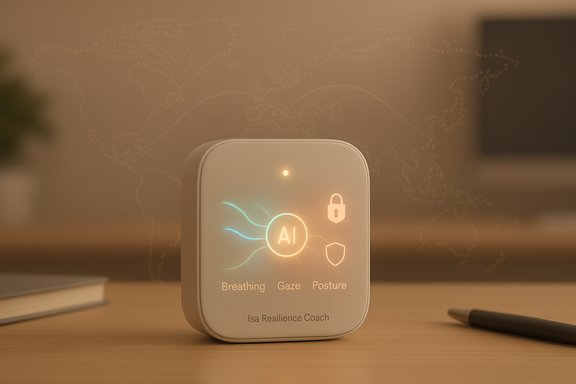
The Isa Resilience Coach is a compact, sensor-based desk device that detects subtle physiological and behavioural signals—breathing rate, gaze behaviour, micro-movements and posture—and uses locally operated artificial intelligence to infer stress state and cognitive load. When it detects prolonged concentration, physiological signs of stress, or sedentary risk patterns, Isa offers gentle nudges: breathing cues, advice to stand or move, or prompts to take restorative breaks. The system is positioned as a privacy-first alternative to camera-based surveillance and cloud-dependent analytics: all processing is performed locally on the device and the company emphasises that Isa operates without a camera or continuous cloud connection.Verified milestones and company statements
- CES Innovation Awards 2026: Honoree in Digital Health — Isa is listed on the official CES Innovation Awards page and Deep Care’s press blog confirms the award. The recognition amplifies the product’s visibility ahead of a US launch.
- German Accelerator programme: Deep Care has announced acceptance into the German Accelerator, which many European startups use as a bridge to US market entry. The company’s communications and third‑party coverage report the acceptance and mention the establishment of a US subsidiary, Deep Care Inc., as part of its US-readiness plan.
- Commercial launch timing: Deep Care states that the Isa Resilience Coach is scheduled to go on sale in early 2026; this schedule is reiterated in the company announcement and multiple news outlets covering the CES honorees.
- Market traction in Europe: the company reports deployment of earlier Isa iterations across more than 250 organisations and insurers in Europe; this scale is cited in the firm’s brief and corroborated by multiple news write-ups.
Why this matters: strategic context for EU–US tech collaboration
European strengths now exported
Europe offers three advantages that are becoming exportable to the US market:- Privacy-led product design — European regulatory pressure and market expectations (GDPR and privacy-aware consumers) have forced many startups to bake privacy into the product. The Isa device’s local inference/no-camera stance is a product-level reflection of that design philosophy.
- Domain expertise in workplace health — decades of workplace health programmes, social insurance models, and occupational health providers give European healthtechs a depth of institutional customers and use cases that translate to value propositions beyond simple wellness tracking. Deep Care’s early deployments in European corporate and insurer channels underpin product-market fit claims.
- Strong research links — Deep Care cites research collaborations and methods informed by Fraunhofer Institute contributions; partnerships between startups and public research labs are a reliable vector for turning evidence into deployable products.
The US market opportunity
The US is the world’s largest corporate and consumer software market: for healthtech companies, a credible US foothold can be decisive for growth, valuations, and partnerships with major insurers and enterprise clients. Index Ventures’ research shows that a growing share of European startups expand to the US very early—64% of companies now expand to the US at pre-seed or seed, up sharply from prior years—underscoring founders’ calculation that early US presence can be critical to scaling. For Deep Care, CES recognition and a German Accelerator pathway are tactical steps to reach enterprise buyers, insurers and consumer channels in the US.Technical design and privacy: a closer look
Sensor fusion and local AI
Isa’s selling point is sensor fusion combined with local AI inference. The device reportedly ingests multiple low-bandwidth signals—breathing patterns, micro-movements, gaze metrics and posture—and runs models on-device to detect extended focus, cognitive fatigue, or physiological stress markers. This reduces the need to stream raw biometric data to the cloud for processing, minimizing network cost and attack surface.Key technical advantages:
- Lower latency for real-time nudges.
- Reduced data exfiltration risk because sensitive inputs are not continuously transmitted.
- Potential to meet stricter privacy laws and enterprise compliance requirements by design.
What “local AI” implies and what it does not
“Local AI” as a phrase covers many architectures: from small deterministic signal-processing pipelines to quantized neural networks running on embedded NPUs. The publicly available materials do not disclose model family, update cadence, or whether models are periodically retrained via opt‑in aggregated telemetry. Those details matter for:- Model drift and safety — physiological signals can vary with demographic factors, setting, and device placement; model retraining and validation are essential to avoid false positives/negatives.
- Security updates — embedded devices require secure update mechanisms to patch vulnerabilities; the update channel is an important attack vector.
- Explainability and user control — users and employers will rightly demand transparency on when and why the device issues a nudge.
Commercial strategy and go-to-market analysis
B2B > B2C blend: a pragmatic route
Deep Care’s roadmap indicates a blended B2B (occupational health, insurers, corporate wellbeing vendors) and B2C strategy. Historically, workplace health hardware has found buyers through corporate benefit programmes and insurers rather than pure consumer channels, because employers can subsidize devices as part of health benefits and insurers can offer devices as risk-reduction tools.Advantages of this approach:
- Faster procurement cycles at enterprise scale once clinical/ROI evidence is available.
- Potential integration with corporate wellbeing platforms, EAPs (Employee Assistance Programs), and insurer prevention initiatives.
- A path to consumer unit economics by using employer-subsidized pilots as springboards to broader retail distribution.
Pricing, scale and competitor landscape
The company has not publicly disclosed final US retail pricing or enterprise subscription terms. That will be a decisive factor: successful workplace health hardware typically pairs a modest hardware price with subscription-based analytics or platform services. Competitors will include:- Wearable-first firms pivoting to workplace analytics (existing players with established consumer bases).
- Desktop-focused wellbeing startups (both hardware and software nudging solutions).
- Enterprise employee-wellness platforms that could bundle sensor-free behavioral nudges.
Strengths: where Deep Care’s approach wins
- Privacy-first positioning — By designing without a camera and relying on local inference, Isa addresses the most potent source of employee pushback: workplace surveillance. This is a strong differentiator in the US where employee privacy and perception are as important as technical compliance.
- Evidence-oriented narrative — Deep Care points to research inputs and prior deployments in Europe. A product tied to research institutions and real-world trials is more credible when selling to cautious buyers like insurers and corporate HR.
- Early US strategy and institutional support — Joining German Accelerator and setting up a US entity reduces common friction points: local contracting, logistics, and market intelligence. These steps suggest the company understands that US enterprise sales require local presence.
- Timing and PR leverage — CES honoree status is a highly visible stamp that helps with partner introductions and pilot conversations in Q1 2026. The timing ahead of a planned early‑2026 sale increases the probability of pilots converting to paid deployments.
Risks and open questions
No product is without tradeoffs. Buyers and regulators should examine the following areas closely.1. Clinical validation and effectiveness
Published marketing mentions and corporate case counts are positive signals, but independent, peer-reviewed clinical validation is the gold standard for health interventions that claim to reduce absenteeism or prevent burnout. The company references research contributions but does not, in public materials, provide standardised trial outcomes, methodologies or peer-reviewed papers for the Isa Resilience Coach specifically.Action for buyers: insist on access to study protocols, anonymised metrics, and the right to run controlled pilots that measure absenteeism, productivity, and wellbeing outcomes before large-scale rollouts.
2. False positives, bias and demographic generalisability
Physiological signals and gaze/motion patterns can vary significantly across populations. Models trained primarily on European cohorts may not generalise to diverse US workforces without targeted retraining. Misclassification risks include unnecessary interruptions for some users and missed signals for others.Action for buyers: demand demographic performance reports, bias audits, and retraining commitments to ensure equitable accuracy.
3. Security and software update management
Embedded devices that run local AI still require secure update paths. A secure boot chain, signed firmware updates, and tamper-resistant hardware are essential to prevent device compromise that could spoof signals or exfiltrate data.Action for buyers: require a security whitepaper, details on the device’s supply chain, and the vendor’s incident response plan.
4. Regulatory classification and liability
Products that make health-related recommendations can sit in a fuzzy regulatory zone. If a device is marketed as a wellness nudge it is less likely to be regulated as a medical device; if it makes diagnostic claims or directs clinical action, it may fall under medical device regulation (FDA in the US). Deep Care’s marketing emphasises prevention and support rather than diagnosis, but purchasers should clarify legal labeling and liability.Action for buyers: obtain legal assurance on claims, and confirm whether the product will seek any regulatory clearances for higher‑risk use cases.
5. Employee acceptance and workplace culture
Even privacy-first devices can be perceived as intrusive if employer deployment is mandatory or if usage affects performance metrics. The psychology of acceptance is as important as the technology: opt-in programmes, clear privacy guarantees, and worker representation in deployment decisions reduce pushback.Action for buyers: implement transparent pilot governance, worker opt-in, and independent oversight.
Procurement checklist for IT and HR teams
- Request the vendor’s technical specification: data types captured, sampling rates, on-device model architecture (if possible), and firmware update process.
- Obtain a privacy and data protection statement: confirm what data (if any) leaves the device, retention policies, and contract language for data control.
- Ask for independent validation: studies, anonymised pilot data, and access to trial methodologies.
- Conduct a security assessment: penetration test reports, secure boot, signed updates, and incident response commitments.
- Define governance for deployment: opt-in rules, allowable uses, and integration boundaries with HR systems.
The bigger picture: what Deep Care’s move means for transatlantic tech flows
Deep Care’s trajectory illustrates a broader trend: the US–EU tech relationship is maturing beyond a one-way import model. European startups are:- Taking US market timelines seriously and expanding earlier in their lifecycle, consistent with Index Ventures’ observation that 64% of European companies now move into the US at pre‑seed or seed stages.
- Exporting privacy-first hardware/software design patterns that many US enterprises will find attractive—particularly where employee acceptance and regulatory scrutiny are acute.
- Leveraging visibility platforms like CES to accelerate partnerships and pilot conversations with insurers and enterprise buyers in the US.
Caveats and unverifiable claims
Several claims circulating in secondary press coverage require cautious handling:- Some outlets have reported that Deep Care is already working with named US academic institutions or insurers. These partnership claims appear in third‑party coverage but are not corroborated by primary documentation on the partner side or in independent registries at the time of writing. Those specific partnership statements should be considered unverified until confirmed by the named institutions or formal announcements. Purchasers and partners should request documentary evidence of any claimed collaborations.
- Public marketing describes prior deployments in “over 250 companies and insurers across Europe.” This number appears in company materials and was repeated in news coverage; procurement teams should verify deployment counts, scope, and contract terms (pilot vs enterprise rollouts) during vendor due diligence.
Practical recommendations for enterprise buyers, insurers and policymakers
- Enterprises and insurers should run short, controlled pilot programmes that focus explicitly on measurable outcomes: reduction in sick days, changes in self-reported wellbeing, and impact on productivity metrics. Link payments to outcome milestones where feasible.
- IT and security teams must treat the device like an endpoint: require device attestation, encrypted configuration channels, and an agreed vulnerability disclosure process.
- HR and legal teams should codify transparent governance: voluntary use, explained privacy guarantees, and clear separation of wellbeing support from performance evaluation.
- Policymakers and standards bodies should consider minimum transparency standards for workplace wellness devices: required reporting on dataset composition, performance by demographic group, and test protocols for sensors and inference fairness.
Conclusion
Deep Care’s Isa Resilience Coach and its CES Innovation Awards recognition are more than PR milestones: they signal a maturing transatlantic exchange in which European startups are not only consumers of US infrastructure but exporters of privacy-aware product architecture and prevention-first healthtech.The product’s technical design—sensor fusion with local AI and an explicit no‑camera stance—directly addresses the cultural and regulatory sensitivities that often stall workplace health deployments. The company’s commercial route, combining enterprise pilots, insurer conversations, and accelerator support, is the pragmatic path that many European healthtech firms now follow when entering the US.
However, visibility and awards are only the beginning. The decisive factors for long‑term success will be independent clinical validation, demonstrable ROI in US pilots, rigorous security practices, and transparent governance that puts employee consent and fairness at the centre. Purchasers should insist on these guarantees before replacing established wellbeing programmes with hardware‑centric interventions.
For EU–US tech collaboration, Deep Care’s moment is a useful case study: the relationship is now truly bidirectional. The US provides cloud, scale and large enterprise markets; Europe supplies privacy-first design, compliance familiarity, and research-grounded product development. When those strengths combine—backed by rigorous validation and pragmatic deployment governance—the result can be healthier workplaces and a more balanced transatlantic tech ecosystem.
Source: 150sec German healthtech startup Deep Care shows that US-EU tech collaboration is a two-way street - 150sec
