

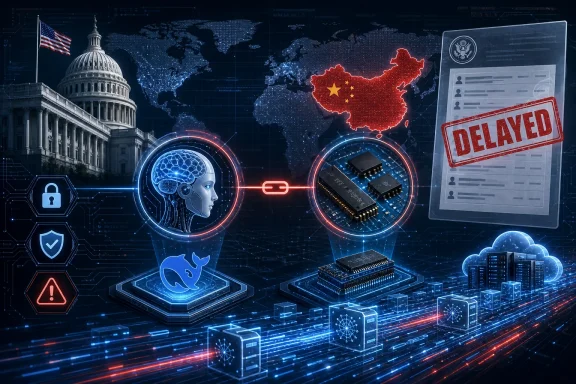
Washington Discovers That the Blacklist Is a Foreign-Policy Instrument
The Entity List is often described as a blacklist, which is useful shorthand but not quite the whole story. It does not automatically make every transaction illegal, nor does it mean a company vanishes from the global economy. What it does is force U.S. exporters, and many foreign firms using controlled U.S. technology, to ask Washington for permission before selling covered goods, software, or technology to a listed party.
That permission is often difficult to obtain. In practice, the Entity List can turn a supplier relationship into a compliance hazard overnight. For semiconductors, cloud infrastructure, development tools, and advanced manufacturing equipment, that is enough to matter.
The reported delay around DeepSeek and CXMT therefore cuts two ways. On one hand, U.S. officials appear to have concluded that the companies deserve the kind of scrutiny reserved for national-security risks. On the other, the administration has apparently chosen not to pull the public trigger, at least for now.
That gap between internal approval and public action is the story. It suggests that the United States has not changed its mind about the strategic risk of Chinese AI. It has changed its appetite for escalation.
DeepSeek Became Too Big to Treat Like Just Another Lab
DeepSeek’s rise in January 2025 was disruptive because it challenged two assumptions at once. The first was technical: that frontier-style reasoning models required almost impossibly expensive training runs and access to the best accelerators. The second was geopolitical: that U.S. export controls had already created a meaningful moat around advanced AI capability.
The company’s R1 model did not prove that chips no longer matter. That was always the lazy version of the argument. What it did prove was more uncomfortable: clever engineering, efficient training methods, open model releases, and aggressive pricing could narrow perceived gaps faster than Washington expected.
For the American AI industry, DeepSeek was a cost shock. For policymakers, it was a control shock. If a Chinese startup could produce a model that developers around the world wanted to use despite export restrictions, then the problem was no longer simply access to Nvidia’s most powerful chips. The problem was the entire AI stack.
That is why DeepSeek has become such a sensitive target. It sits at the intersection of model capability, chip supply, cloud access, data governance, and national-security suspicion. Any one of those issues would be enough to attract scrutiny. Together, they make the company a symbol of the next phase of U.S.-China technology competition.
The Allegations Around Distillation Made a Technical Dispute Political
The accusation that DeepSeek benefited from distillation sharpened the politics around the company. Distillation, in AI terms, usually means using the outputs or behavior of a stronger model to train or improve another model. It can be a legitimate technique in some contexts, but it becomes contentious when the stronger model is accessed through commercial services under terms that forbid that kind of use.
OpenAI has alleged that DeepSeek and other Chinese actors used outputs from Western models to improve their own systems. Reuters has also reported that U.S. officials instructed diplomats to raise concerns about distillation with allies. DeepSeek has denied intentional misuse of synthetic data, according to reporting on the dispute.
This matters because it changes the frame from “China built a cheaper model” to “China may have used access to U.S. systems to compress the frontier.” That is a much more politically combustible claim. It gives hawks a clean narrative: American companies spend billions on model development, Chinese firms learn from them at lower cost, and U.S. infrastructure ends up helping a strategic competitor.
The difficulty is that AI development is messy. Modern models are trained on huge mixtures of public text, licensed data, synthetic outputs, scraped material, benchmark traces, and developer-generated examples. Drawing a bright legal and technical line between inspiration, imitation, distillation, and theft is not always easy.
But politics does not wait for perfect attribution. Once DeepSeek became associated with model-copying allegations, military-use concerns, and restricted technology workarounds, it became nearly impossible for Washington to treat the company as a mere commercial rival.
CXMT Is the Reminder That AI Is Still a Hardware War
The inclusion of ChangXin Memory Technologies in the same reported queue is crucial. CXMT is not an AI chatbot brand. It is a memory-chip company. Its relevance makes clear that Washington’s anxiety is not confined to the visible layer of AI applications.
AI systems need processors, but they also need high-bandwidth memory, networking gear, storage, servers, fabrication tools, packaging capacity, and cloud-scale deployment. The model that users see is only the last layer of a much larger industrial machine. Export controls increasingly target that machine rather than any single product.
Memory is especially important because frontier AI workloads are bottlenecked not only by raw compute but by how quickly data can move through a system. High-performance AI training and inference depend on dense, fast, power-efficient memory systems. A Chinese push into advanced memory therefore has obvious relevance to China’s broader AI ambitions.
That is why CXMT’s reported treatment alongside DeepSeek makes strategic sense. One company represents the application-layer shock; the other represents the hardware-layer anxiety. Together, they show that Washington is no longer thinking about AI as a software sector. It is thinking about AI as an industrial base.
Export Controls Are Expanding Because Workarounds Keep Expanding
The United States has spent years tightening technology controls aimed at China, especially around advanced semiconductors and chipmaking equipment. Each tightening creates a new compliance frontier. Restricted firms look for subsidiaries, distributors, cloud access, offshore entities, or foreign-made products containing U.S. technology. Regulators then respond by broadening definitions, adding affiliates, and closing loopholes.
This is the logic behind the reported focus on shell companies and third-party routes. If a restricted technology cannot be sold directly to a sensitive end user, the obvious enforcement question becomes whether it can reach that end user indirectly. In the AI era, indirect routes are plentiful.
A model developer does not necessarily need to own every chip it uses. It can rent compute, rely on partners, use cloud credits, access open-source weights, fine-tune smaller systems, or train around constraints. Hardware scarcity still matters, but it is not a simple on-off switch.
That makes the Entity List both powerful and imperfect. It can disrupt supply chains, raise costs, scare off partners, and create legal risk. It cannot, by itself, erase technical knowledge or prevent every route to capability.
Washington knows this. Beijing knows this. So do the companies trying to sell into both markets.
The Delay Shows the Limits of Maximum Pressure
If DeepSeek and CXMT were approved for addition last year, as Reuters reports, the obvious question is why the names have not appeared. The likely answer is not that the risks disappeared. It is that the consequences became larger.
A major Entity List update targeting prominent Chinese AI and semiconductor firms would be read in Beijing as an escalation. It would arrive in a climate where technology restrictions are already deeply entangled with tariffs, investment reviews, rare-earth leverage, military signaling, and diplomatic choreography. Even when the legal mechanism is technical, the political message is unmistakable.
The Trump administration may be trying to preserve negotiating room. It may be trying to avoid triggering retaliation before a broader diplomatic engagement. Or it may simply be discovering that the Entity List has become so consequential that using it now requires White House-level strategic calculation.
That is the irony. The blacklist became powerful because it was administratively precise. Now it is so politically loaded that publishing names can become a geopolitical event.
For critics of the delay, this will look like weakness. If officials have already deemed companies a security risk, why allow additional time for transactions, restructuring, or stockpiling? For defenders, the pause may look like prudence. If the United States is trying to manage a fragile relationship with China, why fire off a major technology sanction without a broader plan?
Both arguments have force. That is why the delay matters.
Silicon Valley Wanted a Market Race and Got a Security Race
DeepSeek’s emergence was initially processed by much of the tech industry as a market event. Investors asked whether AI training costs were about to collapse. Developers asked whether open models could replace expensive proprietary APIs. Cloud providers asked whether cheaper inference would expand demand rather than destroy margins.
Washington processed the same event differently. To national-security officials, cheaper capable models are not just a margin problem. They are a proliferation problem.
A model that can help write code, analyze documents, automate research, support cyber operations, or reason across technical domains is economically useful and strategically sensitive. If such models become cheaper and easier to run, more actors can use them. That is the entire promise of AI diffusion — and the entire nightmare of AI control.
This tension is not unique to DeepSeek. It applies to open-weight models, small reasoning models, coding agents, local inference tools, and enterprise AI platforms everywhere. But DeepSeek made the issue politically unavoidable because it attached that diffusion story to China.
The result is a market that increasingly behaves like a security domain. Procurement teams, compliance officers, and CISOs now have to ask questions that would have sounded excessive in the early chatbot boom. Where was the model trained? Who controls the service? What data is retained? Which jurisdictions can compel access? Could export controls interrupt availability?
Those are not abstract questions anymore. They are operational ones.
Windows Shops Will Feel This Through the Stack, Not the Headlines
For WindowsForum readers, the DeepSeek blacklist delay may sound remote. Most administrators are not negotiating semiconductor shipments or lobbying Commerce officials. But the practical effects of AI geopolitics tend to arrive through ordinary tools: developer extensions, cloud services, endpoint software, procurement policies, and vendor contracts.
A Windows-heavy organization might encounter DeepSeek indirectly through an AI coding assistant, a local model package, a third-party SaaS integration, or a cloud marketplace listing. It might never sign a contract with a Chinese AI vendor and still depend on a supplier that has exposure to restricted entities. That is how modern technology supply chains work.
The compliance problem is especially awkward for smaller firms. Large enterprises can ask vendors for export-control representations, model cards, data-flow diagrams, and legal attestations. A regional business, school district, or midsize managed service provider may not have that leverage. It may simply see a cheaper AI tool and adopt it.
That is risky. Not necessarily because every Chinese model is unsafe, and not because every U.S. model is safe. The risk is that AI services can become politically unstable infrastructure. A tool that works today may be restricted tomorrow, removed from a marketplace, blocked by a vendor policy, or flagged by a customer’s security questionnaire.
Windows administrators have lived through versions of this before with drivers, certificates, remote management tools, and supply-chain compromises. AI adds a new twist: the service itself may be useful precisely because it is connected to large-scale data and compute systems that are hard for customers to inspect.
The Enterprise AI Checklist Is Becoming a Sanctions Checklist
The next phase of enterprise AI governance will not be limited to hallucination testing and data-loss prevention. Those still matter, but they are no longer enough. Organizations will have to treat AI vendors as supply-chain entities, not just software providers.
That means asking whether a model provider, hosting partner, parent company, affiliate, or key hardware supplier could become subject to U.S., EU, UK, or allied restrictions. It means understanding whether a service depends on export-controlled technology. It means documenting where data is processed and whether logs, prompts, embeddings, or fine-tuning data cross borders.
This is where the DeepSeek case becomes more than a China story. It is a preview of AI vendor risk management in a world where national-security policy can redraw the map. If an AI product is cheap because it is optimized brilliantly, that is good. If it is cheap because legal, security, or geopolitical costs are being ignored, that is a different calculation.
Procurement departments have historically lagged behind technical adoption. Developers find a useful API, teams build workflows around it, and only later does legal ask whether the vendor passes review. With AI, that sequence is increasingly dangerous.
The cost of switching models can be lower than switching databases, but it is not zero. Prompts, evaluations, integrations, fine-tunes, retrieval pipelines, monitoring tools, and user habits all create lock-in. If a vendor becomes restricted after adoption, the scramble can be ugly.
Microsoft and the Cloud Giants Are Stuck in the Middle
The major U.S. cloud and software companies occupy a particularly uncomfortable position. They want the broadest possible AI ecosystem because model variety drives cloud usage, developer engagement, and enterprise adoption. But they also operate under U.S. law and cannot ignore national-security pressure.
When Chinese models appear in Western developer ecosystems, the reaction is often split. Engineers may value the competition and the efficiency. Security teams may worry about provenance, telemetry, and legal exposure. Policy officials may see the same integration as a strategic own goal.
This split is not going away. Open models and portable inference make AI harder to contain than traditional enterprise software. A model can be mirrored, quantized, fine-tuned, wrapped, embedded into applications, and run locally. The cloud giants can control what they host, but not everything developers do.
That creates a future in which policy compliance becomes part of AI platform design. Marketplaces may need clearer provenance labels. Enterprise consoles may need region and vendor controls. Audit logs may need to show which models processed which data. Model catalogs may start looking more like software supply-chain inventories.
For Windows environments, especially those tied into Microsoft 365, Azure, GitHub, Intune, Defender, and endpoint management, this is not a side issue. AI features are being woven into administrative workflows and productivity tools. The more invisible AI becomes, the more important vendor trust becomes.
Beijing Will Read Silence as Strategy, Not Neutrality
The U.S. delay should not be mistaken for de-escalation in any durable sense. From Beijing’s perspective, a pending blacklist can be nearly as significant as a published one. It signals suspicion, creates uncertainty, and warns suppliers that the named companies may become toxic counterparties.
China has repeatedly accused the United States of politicizing trade and technology. That complaint is not new, but AI gives it sharper force. Beijing wants Chinese firms to climb the value chain, reduce dependence on U.S. technology, and compete globally in strategic sectors. Washington wants to prevent U.S. technology from strengthening Chinese military and intelligence capabilities.
Those goals are not easily reconciled. The best-case scenario is managed rivalry. The worst-case scenario is accelerating technological decoupling, where each side builds parallel ecosystems and forces third countries to navigate between them.
DeepSeek complicates that picture because its appeal is global. Cheap and capable models are attractive to developers in countries that do not want to be conscripted into a U.S.-China technology binary. That includes companies in Africa, Latin America, Southeast Asia, and Europe that care more about cost and performance than Washington’s strategic doctrine.
But geopolitics has a way of arriving through procurement forms. Even organizations far from Washington and Beijing may find themselves answering questions about sanctioned entities, data residency, model provenance, and exposure to controlled technology.
The South African Angle Is Really a Global Middle-Market Problem
The Memeburn framing rightly points out that South African businesses should care. The same is true for any market outside the two superpower blocs. The firms most exposed to AI disruption are often the least equipped to track export-control risk.
A company in Johannesburg, Cape Town, Nairobi, São Paulo, Jakarta, or Warsaw may adopt a low-cost AI service because it solves a real business problem. It may not have a sanctions lawyer, a dedicated AI governance team, or a procurement process sophisticated enough to map upstream dependencies. Yet it can still be affected if a vendor loses access to U.S. technology or becomes unacceptable to multinational customers.
This is one of the underappreciated consequences of the AI race. Technology that promises democratization can still carry geopolitical dependencies. A cheap API is not just a price. It is a chain of compute, software, jurisdiction, capital, and policy risk.
For IT professionals, the practical lesson is not to ban every unfamiliar model. That would be simplistic and probably unworkable. The lesson is to classify AI tools according to sensitivity.
A public summarization tool used on non-confidential content is one risk category. A coding assistant with repository access is another. A customer-support chatbot processing personal data is another. A local model used entirely offline is different again. The vendor’s country of origin matters, but so do hosting, logging, licensing, update channels, and integration depth.
The Real Contest Is Over Dependency
The DeepSeek episode is often framed as a contest over who has the best model. That is the wrong lens. Model quality matters, but the deeper contest is over dependency.
The United States wants the world’s AI supply chain to remain dependent on technologies it can regulate: chips, EDA tools, cloud platforms, model APIs, operating systems, and enterprise software. China wants to reduce those dependencies and create alternatives that other countries will adopt. Developers and businesses want cheaper, faster, more flexible tools.
These incentives collide. Export controls are Washington’s attempt to preserve leverage. DeepSeek-style efficiency is Beijing’s answer to leverage. Enterprise adoption is the battlefield where both strategies become real.
This is why the reported delay is so revealing. If the United States blacklists DeepSeek, it admits the company matters enough to target. If it does not, it risks allowing a strategic rival more room to grow. Either way, DeepSeek has already forced a policy response.
The same applies to CXMT. If Chinese memory capability advances, it reduces one more dependency on foreign suppliers. If Washington restricts it, China has more reason to accelerate domestic substitution. Each move tightens the spiral.
The Blacklist Delay Is a Warning Label for AI Buyers
The most concrete lesson from the DeepSeek-CXMT pause is that AI governance can no longer be separated from geopolitical risk. The companies have not been added to the Entity List as of the reported delay, but the fact that they were reportedly approved for addition is itself material information for cautious buyers.
Organizations do not need to become foreign-policy experts. They do need to stop pretending that AI tools are interchangeable web apps. The risk profile of a model now includes legal exposure, strategic dependency, and the possibility of sudden access changes.
- Businesses should inventory which AI models, APIs, browser extensions, coding assistants, and SaaS features are being used across the organization.
- Procurement teams should require vendors to disclose model providers, hosting regions, data-retention practices, and material exposure to restricted entities.
- IT administrators should treat AI integrations with code, email, file storage, identity systems, or customer records as high-risk until proven otherwise.
- Security teams should distinguish between local model use, cloud-hosted inference, and third-party services that may retain prompts or training data.
- Executives should assume that AI vendor risk can change quickly when export controls, sanctions, or diplomatic negotiations shift.
The point is not panic. It is preparedness. The organizations that handle this well will not be the ones that chase every new model or block every foreign tool. They will be the ones that know what they are using, where it runs, what data it touches, and how quickly they can move if the policy ground shifts.
The DeepSeek blacklist delay shows that the AI race in 2026 is no longer a clean contest between better models and bigger chips. It is a contest between capability and control, between cheap access and strategic trust, between the speed of software and the slower machinery of states. Washington may still publish the names, or it may keep waiting for a more convenient diplomatic moment. Either way, the message for IT is already clear: the next AI disruption may arrive not as a product launch, but as a regulatory notice that changes which parts of the stack can be trusted.